

How Absolutely Fucked Young Kiwis Are

Everyone knows that the housing situation is bad, but few realise exactly how bad it is. Politicians only propose tinkering around the edges; no-one is willing to propose fundamental change. However, as this article will show, the situation is bad enough that only fundamental change can fix it.

Statistics nerds were overjoyed by the release of the updated Parliamentary profiles last month. These profiles contained information from the 2018 Census, allowing us to update our knowledge of each electorate.

One important thing the Parliamentary profiles tell us is how wealthy each electorate is. We know that 648,537 people out of 3,776,355 aged over 15 in the General Electorates and 66,126 people out of 597,498 aged over 15 in the Maori Electorates make over $70,000 a year. This equals 714,663 people out of 4,373,853, or slightly more than 16%.

Being in the top 16% means that anyone making $70,000 a year is creaming it in comparison to the average Kiwi worker. They’re getting paid much better, and will likely have a commensurately harder job. Either they’re working much longer hours than average, or they have a job with a greater than average level of responsibility, or they are applying much greater than average human or industrial levels of capital.

However, even on this top 16% income, it’s all but impossible to own a house.

If you earn $70,000 a year in New Zealand, you will pay about $15,000 in taxes. That will leave you with $55,000 a year – assuming you opt out of KiwiSaver, otherwise you’d be down to $52,000 a year. That isn’t a lot of money once the high cost of living is factored in.

The cost of living in New Zealand can be estimated by the New Zealand Government’s own cost of living calculator. New Zealand isn’t a cheap country to live in. It can be seen from using the calculator that the average Auckland family of two adults and two dependent children has living expenses of around $2,000 a week.

This means that one working adult in the top 16% of Kiwi wage-earners only makes half of what they need to keep the average family running. If that sounds paradoxical, that’s an indicator of how fucked young people in New Zealand are now.

If we change the calculations to two working adults, each earning a wage in the top 16%, things become a bit easier. But even with two working adults both earning such a wage, it’s extremely difficult for a family with two children to save any money. According to the cost of living calculator, a family of two parents and two children can expect that their living expenses will be in the neighbourhood of $2,000 a week.

This means that a family with two parents and two children, where both parents are in the top 16% of wage-earners, saves no money on a weekly basis. All that work is just to stand still. The family will never own its own home, not even with two adults working and only two children. And that is even if both adults are earning in the top 16% of wages.

Now let’s consider a family with a special talent for living frugally. Let’s say both adults have unusually high levels of determination, willpower and resourcefulness, and they are capable of making do with considerably less than the average family of two children.

In this case, we can take the cost of living calculator and reduce the expenses to the lowest 25% or so of all families of four. This involves taking the sliders and setting them halfway between the average expenditure and the absolute minimum required to survive.

This gives us expenses of $200 per week for food and alcohol, $30 for clothing and footwear, $360 for housing and household utilities, $38 for household contents and services, $13 for health, $121 on transport, $22 on communication, $62 for recreation and culture, $25 for education, $81 for miscellaneous spending and $124 for other expenditure.

This gives us a total of $1,080 per week in expenses for a family of four. So our husband and wife duo of professional workers, both in the top 16% of Kiwi wage earners, if they cut their family expenses down to the bottom 25%, can expect to save around $950 a week, or close to $50,000 a year.

The average house price in New Zealand as of July this year was $739,000. So if a family can manage to have two breadwinners both earning in the top 16% of all wages, and if they can manage to cut their expenses down to the lowest 25% of all families of four, they can expect to own the average house after 14.8 years.

Let’s say, more realistically, that the partner of the main breadwinner works part-time in order to look after the two children, and so makes $30,000 a year. This would leave them $400 a week after expenses, or around $20,000 a year. At such a rate of saving they could expect to own their own home after 37 years.

Let’s say, even more realistically, that their expenses are at the average level for a family of four in Auckland. In such an instance, they will be unable to save money even if both parents are working and earning in the top 16% of wage earners. According to the cost of living calculator, a family of four in such circumstances will have to borrow $50 a week to be able to live. Saving will be impossible.

And that’s for people in the top 16% of earners.

Even if a person and their partner are in the top 16% of earners, they will have to cut their expenses down to less than average merely to save any money at all. They will have to cut those expenses to far less than average to save enough to own a home. Anyone earning less than this, or anyone whose expenses are higher than this, will never own a home, not even if they worked to age 100.

Simply put, you have to earn far, far more than average if you want to own your own home in New Zealand. The dream of home ownership is now only a reality for a fraction of the population. The rest of us are effectively serfs, doomed to labour our whole lives without ever owning land.

To compare this with how the previous generations had it, in 1992 the average New Zealand house price was $105,000. Also in 1992, the average wage was $15. So in 1992, the average house could be purchased for the equivalent of 7,000 hours of labour. Today, with an average house price of $739,000 and an average wage of $34, buying the average house requires the equivalent of over 21,000 hours of labour.

There simply aren’t enough years in one lifetime for the average Kiwi to save enough money to own their own house. Either you inherit, or, failing that, become a professional worker with an income of $150,000+ per year.

Another way of looking at it is that if house prices had only increased in proportion to the increase in the average wage between 1992 and 2020, i.e. 2.25 times instead of 7 times, the average house price today would be around $236,000.

The grim reality is that we are some two-thirds poorer than our parents were. This conclusion is inescapable unless one denies the maths.

In summary, the Millennials and the younger generations have been effectively enslaved by the Boomer generation. The Boomers own everything, and they pay such pitiful wages that we have no chance of bettering our positions. Only two outcomes can give the young of New Zealand basic dignity: wait 30 years for the Boomers to die, or revolution.

*

If you enjoyed reading this essay, you can get a compilation of the Best VJMP Essays and Articles of 2019 from Amazon for Kindle or Amazon for CreateSpace (for international readers), or TradeMe (for Kiwis). A compilation of the Best VJMP Essays and Articles of 2018 and the Best VJMP Essays and Articles of 2017 are also available.

*

If you would like to support our work in other ways, please consider subscribing to our SubscribeStar fund. Even better, buy any one of our books!

Demography Is Destiny

The West is in a dismal state today. Despite unprecedented material wealth, our collective social capital has never been lower. Sometimes it feels like the West is in a state of civil war, with chaos and destruction reigning in many major cities. Most of this was predicted at least half a century ago, by those who studied the demographic trends.

The American fertility rate was over three children per woman from 1950 to 1964. This period of high fertility became known as the “Baby Boom”. The rate fell sharply after 1964, and by 1978 it had fallen to 1.8 children per woman. This demographic pattern had serious economic consequences.

As the Boomers entered the workforce en masse, an incredible economic phenomenon began. Because there were a great number of workers, and very few elderly or young dependents, the economy was unusually profitable. This is measured by something called the dependency ratio, which is the ratio of people in the workforce to people not in the workforce.

The dependency ratio was high during the Baby Boom, on account of all the children, but it began to plummet from around 1980, after those children entered the workforce. This led to a time of great profitability, which lasted as long as the Boomers were in employable age groups.

By today this process has begun to reverse. The first of the Baby Boomers hit the pension age of 65 in 2010. Ever since then, the dependency ratio has risen. In 2000, there were five workers per pensioner in America; by 2050, there are expected to be 2.9 workers per pensioner. We are about to go through a time of great unprofitability.

The saying “demography is destiny” refers to the fact that the macrotrends of Western economies since World War II have followed demographic trends.

When the Boomers die off en masse, a process which is beginning now, the dependency ratio will improve. This will also lead to a sharp decrease in housing demand. The combined effect of these two major changes will create an economic boom lasting several decades. Unfortunately for most of the people reading this article, the post-Baby Boomer boom won’t fully start happening until after 2050.

The situation might seem bad for the West, but it’s even worse in the industrialised countries of the Far East. Their fertility rate collapse is a more extreme version of the Western one.

China had a similar economic boom to the West from 1985 to 2010, with a large demographic bulge of working-age people keeping the dependency ratio low. But China today, despite being infamous for its population, only has a fertility rate of 1.7.

In 2010, the old-age dependency ratio in China was 11%, meaning nine workers for every pensioner. By 2060, it is expected to be over 50%, meaning two workers for every pensioner. Considering that they are only a middle-income nation today, and that future economic growth is uncertain, a dependency ratio of 50% threatens to cause extreme poverty.

It’s worse still elsewhere in Far East Asia.

In 2020, the South Korean fertility rate is less than 1.1 children per woman. At a fertility rate this low, the South Korean population will halve every generation. The fertility rates of people in Singapore, Taiwan, Hong Kong and Japan are only slightly higher, around 1.4. Their populations should decrease by a third every generation. China’s should decrease by a quarter.

Some might argue that Europe and Far East Asia are overpopulated anyway, and the environment would benefit from a sharp population decrease. The trouble is that the rulers of both places are accustomed to a certain standard of living, and, if given the choice, will act to maintain that standard of living even if succeeding generations have to suffer for it.

In Western countries, falling populations have been preempted by mass immigration. This has prevented Western economies from shrinking, keeping stock prices and house prices high, and the ruling class happy. However, the result of this process has been the collapse of social cohesion, reflected everywhere in less trust.

A nation that opens itself to mass immigration also opens itself to division and, eventually, chaos. The historical record is clear on this subject, as is the science. Changes in kinship intensity have direct and far-reaching political consequences. If demographics lead to a decrease in a nation’s kinship intensity, then that nation’s destiny is discord and war. The civil unrest in today’s America is merely a foretaste.

That demographic trends are capable of tearing nations apart from the inside can be understood mathematically. Taking the example of France, it can be seen that the destiny of any population with a low fertility rate, once it comes to host a foreign population with a high fertility rate, is to be conquered.

If the white population of France is 50,000,000, and their women reproduce at the rate of 1.5 children per woman, the white French population will fall to 28,125,000 after two generations. If the Muslim population is 5,000,000, and their women reproduce at the rate of three children per woman, the Muslim French population will rise to 11,500,000 after two generations.

After three generations, the French population will be some 21 million, and the Muslim population some 17 million. By that time, the majority of fighting-age males will belong to the Muslim population, and France will be a de facto conquered land. Muslims will have achieved with their wombs what they could not achieve with their swords 1,300 years earlier, at the Battle of Tours.

Much the same logic was followed by French financier Charles Gave, who outlined it in a paper he wrote for the Institute of Liberty. He was immediately attacked for promulgating the great replacement conspiracy theory, only it is no conspiracy. It’s a simple extrapolation from currently known values, and its logic is inescapable.

The fertility rate in France has been famously low for over a century now. The fertility rate in neighbouring Algeria, by contrast, was over seven children per woman as recently as 1980. The consequence is that, by today, there are two to three times as many Algerians in France as there were French people in Algeria in 1940, when Algeria was a French colony. France is now itself a colony in all but name.

France’s destiny is to become an Islamic state. This follows inexorably from their current demographics, and is no harder to predict than was the German victory over France in World War II. This victory had been forecast over half a century beforehand, by people who knew that Germany had a much higher fertility rate than France, and who had calculated that this would eventually lead to an overwhelming German numerical advantage.

The single most important demographic trend of this century is the one that predicts that the population of Africa will quadruple by the end of the century. Currently around one billion, it is expected to be four billion by 2100, which will mean that almost half of the world’s population will be African.

Countries like Niger and Somalia are still reproducing at the rate of over six children per woman. The total African fertility rate is 4.4 children per woman. The sad reality of this population explosion is that, by the end of this century, the majority of Africa’s megafauna will be extinct in the wild. Most megafauna are already threatened thanks to human population pressure, and they will not survive an African population of four billion.

The societies of Europe are unlikely to survive it either. Europe today is barely capable of defending their borders against migrant inflows from the South. In the medium-term future, with an even smaller European population and a surging African one, they won’t be capable of defending them at all. The destiny of Europe appears to be getting overwhelmed by the surplus African population.

The next century looks like it will bring a drastic decrease in the high IQ populations of the world, and an equally drastic increase in the low IQ populations of the world. The inevitable result will be low IQ people surging into high IQ territories, and a profound increase in the average amount of human suffering. Demography really is destiny, and it suggests that the world’s destiny is a grim one.

*

If you enjoyed reading this essay, you can get a compilation of the Best VJMP Essays and Articles of 2019 from Amazon for Kindle or Amazon for CreateSpace (for international readers), or TradeMe (for Kiwis). A compilation of the Best VJMP Essays and Articles of 2018 and the Best VJMP Essays and Articles of 2017 are also available.

*

If you would like to support our work in other ways, please consider subscribing to our SubscribeStar fund. Even better, buy any one of our books!
Debunking The “Structural Racism” Conspiracy Theory

The most prevalent conspiracy theory of our time is so prevalent that it’s accepted as truth by most media entities. This theory has it that black and brown academic and economic underachievement can best be explained by structural racism and white supremacy. The truth is that, like most conspiracy theories, this theory goes directly against the relevant science, and can be disproven by it.

When 9/11 happened, a popular conspiracy theory said it was an inside job. One particular version claimed that, as the melting point of steel is higher than the burning point of jet fuel, the twin towers could not have collapsed on account of being struck by aeroplanes (the official explanation). They had to have been taken down by explosives placed within the structure of the buildings.

The way to refute this theory was to ask people qualified in the relevant science. You could say to a civil engineer or a physicist “Jet fuel can’t melt steel beams,” and they would tell you that it doesn’t have to melt the beams, it just has to heat them up enough so that they become too soft to support the weight of the building, at which point it will collapse. This is what happened in the case of the twin towers. Conspiracy theory debunked.

Anyone wanting to test other conspiracy theories can do likewise. If you want to know whether the Earth is flat you could ask an astronomer. If you wanted to know whether the Earth was 6,000 years old you could ask a geologist. If you wanted to know whether humans landed on the Moon you could ask an aeronautical engineer. And if you wanted to test whether the structural racism conspiracy theory was bullshit, you could ask a psychologist.

This is what a psychologist would tell you.

The science of IQ is the most robust and heavily supported of any social science. There is more evidence backing the validity of it than there is backing anything else. Most importantly, IQ also has more predictive power than any single other variable known to Psychology.

If you disagree about its predictive power, consider the following analogy.

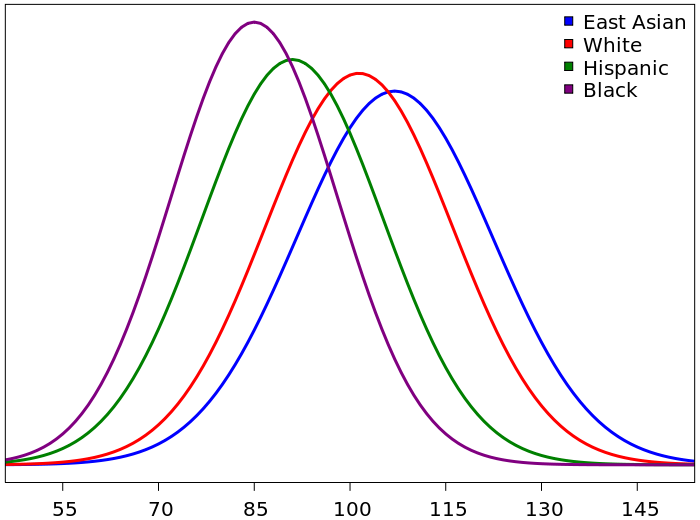
You have two 13-year old boys. One is tested to have an IQ of 115, i.e. one standard deviation above average. The other is tested to have an IQ of 85, one standard deviation below average. The two boys are followed up ten years after the test. Without knowing which boy is which, you’re told that one has recently completed an accounting degree, whereas the other dropped out of school and drifted into petty crime.

Can you guess which is which?

Almost everyone would guess that the boy with an IQ of 115 became the accountant. And, in the vast majority of such cases, they’d be right. Accountancy is intellectually challenging: far more accountants have IQs closer to 115 than to 85. Likewise, far more petty criminals have IQs closer to 85 than to 115. Almost everyone knows this, and almost no-one questions it.

The fact is that IQ is so powerfully predictive that we can already get a rough idea of how a person’s life will turn out just from accurately measuring their IQ. The average person with an IQ of 85 will have much greater trouble learning and recalling information than the average person with an IQ of 100. Their impulse control, measured by ability to delay gratification, will be significantly inferior.

Because their intellectual ability and their discipline are poorer than than of the average person, they will be less able to meet the demands of the modern workplace. As such, they will be marginalised into unemployment and underemployment more often. Any population of people with an average IQ of 85 will be much poorer and much more criminal than any population with an IQ of 100 or higher.

85 is also the average IQ of black Americans and Pacific Islanders, with Maoris being slightly higher (around 90). This we know from the research compiled by researchers like Richard Lynn in books like Race Differences in Intelligence.

Psychological science, therefore, can predict on the basis of IQ alone that black Americans and brown Kiwis will be poorer and will be more involved in the criminal justice system than white Americans and white Kiwis. This can be confidently predicted even in the total absence of structural racism or white supremacy.

At this point, a believer in the structural racism conspiracy theory will argue that structural racism not only makes blacks and browns poorer and more likely to be involved with the criminal justice system, but it also makes their IQs lower on account of things like teachers ignoring them more often during class or discouraging them from study. Therefore, even if they do have lower IQs, it’s still white people’s fault.

For one thing, we know that this contention can’t be true because intelligence is mostly genetic and not environmental. Although the environment can have a powerful effect on the intelligence of young people, the effect of environment on IQ is no more than 0.2 by adulthood – a phenomenon known as the Wilson Effect. Therefore, low adult IQ is primarily a genetic phenomenon.

For another thing, we can observe the experience and outcomes of other racial groups who have similar IQs to white people.

105 is the average IQ of Far East Asians. The structural racism conspiracy theory would predict that Far East Asians do worse than white people, on account of that white people deny them opportunities for advancement and discriminate against them in business and politics. After all, white supremacists don’t like Asians any more than they like blacks.

The psychological science theory would predict that Far East Asians do as well or better than white people, on account of that their high IQs lead to successful careers and less criminality. Being high IQ and having good impulse control, they should study hard and get decent jobs.

As it turns out, Asian Americans earn 7% more than whites at the median. They are also significantly less criminal, despite that more of them are from poor families and many are even refugees. This directly refutes the structural racism conspiracy theory and directly supports the psychological science theory.

Ultimately, the main reason why blacks do worse than whites in America, and the main reason why browns do worse than whites in New Zealand, is because of low IQ. This low IQ leads them to make more impulsive decisions, which leads to poverty. This isn’t at all controversial among those who have studied the relevant science.

The conspiracy theory that says blacks and browns do worse because of white racism is bullshit. This means that the poorer outcomes of blacks and browns cannot be explained by white racism, but by factors inherent to the blacks and browns themselves.

*

If you enjoyed reading this essay, you can get a compilation of the Best VJMP Essays and Articles of 2019 from Amazon for Kindle or Amazon for CreateSpace (for international readers), or TradeMe (for Kiwis). A compilation of the Best VJMP Essays and Articles of 2018 and the Best VJMP Essays and Articles of 2017 are also available.

*

If you would like to support our work in other ways, please consider subscribing to our SubscribeStar fund. Even better, buy any one of our books!

How A Kanye West Run Could Win Trump Re-Election

The 2020 American Presidential Election just got even wackier with news that Kanye West has thrown his hat into the ring. West has no realistic chance of winning the American Presidency, but if he runs as an independent he could still impact the outcome. This article explains how.

In the 1992 American Presidential Election, third party candidate Ross Perot, running as an independent, won almost 19% of the popular vote. Although he didn’t win any Electoral College seats, he won over half as many votes as Republican candidate George W Bush, who lost to Democratic candidate Bill Clinton.

In retrospect, it seems that Clinton’s win was a total fluke, because the right-wing parties won about 59 million votes to his 45 million. Clinton only won thanks to Perot’s run, which split the right-wing vote, as many natural Bush supporters voted for Perot. Their mutually assured destruction saw Clinton coast home.

The same thing happened in the 2000 election, only for the other side. Al Gore won about half a million more popular votes than George W Bush, but Dubya won the election by five Electoral College votes. Gore probably would have won had it not been for Ralph Nader, who won almost three million votes for himself on a Green Party ticket. The vast majority of these votes would have gone to Gore had Nader not contested.

The Nader influence was felt most acutely in Florida. George W Bush won Florida, and its 25 Electoral College votes, after an infamous recount process that dragged on for weeks. In the final tally, Bush carried the state by 537 votes, but Nader won 97,488 votes there. Had Nader not stood in Florida, it’s all but certain that Gore would have carried the state – and with it America.

It can be seen from these examples that arguably the single most important factor for success in an American presidential election is not having a third party candidate running on the same half of the electoral spectrum to you. Because each state in the Electoral College is won on a winner-takes-all and first past the post basis, third party runs do little but split the vote.

So back to Kanye West.

One of the biggest obstacles to Trump’s re-election bid is his low support among blacks. Blacks have always been disinclined to vote Republican, on account of the Republican Party’s support for the War on Drugs and their opposition to welfare. 89% of them voted for Hillary Clinton against Trump, and an even higher percentage supported Barack Obama against his opponents.

Polls suggest that blacks intend to vote heavily for Joe Biden this year. This is for two reasons. The first is that Biden is a Democrat. The second is that blacks remember how Biden was a dutiful and competent Vice President to Obama for eight years. Biden never went against his man or undermined him, and this is remembered by those who were Obama’s strongest supporters.

Kanye West appears to intend to run as an independent. He is 43 years old, black, and works in a creative role. His biggest supporters are from similar demographics. Being one of the world’s most popular musicians, West’s name recognition among Millennial and Zoomer voters is immense. A great number of them will vote for him on this basis alone.

In appealing to these demographics, a West run will split the left-wing vote. The young, the black, the creative voters who will support West are all groups that would have otherwise supported Joe Biden. In other words, a West presidential bid would cost Biden a lot more potential votes than it would cost Donald Trump.

Biden is well ahead of Trump in the polls right now, but the reality is that an incumbent American president hasn’t lost a presidential election since Clinton beat Bush in 1992. Trump was rubbished by the mainstream media leading up to the 2016 election and still won. At worst for Trump, 2020 might be a close loss.

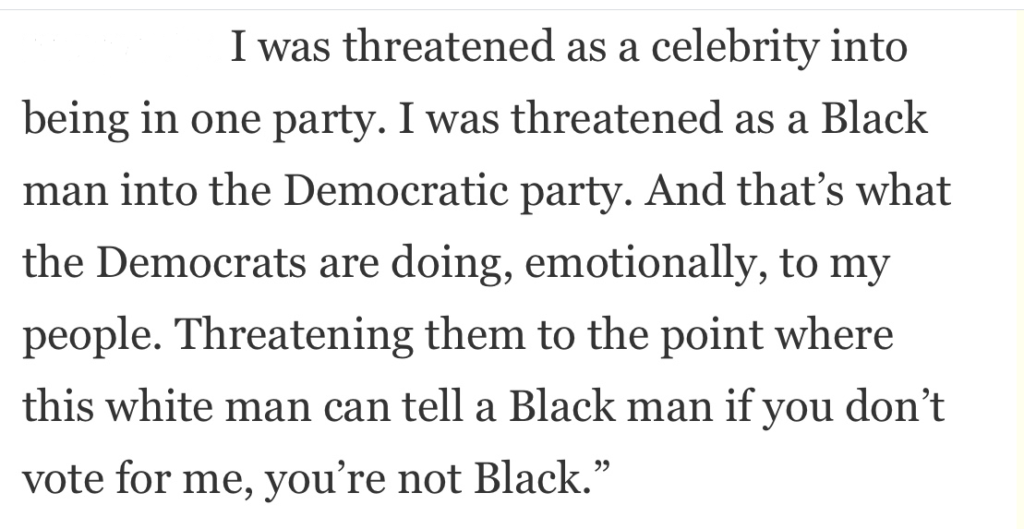
All this means that a Kanye West presidential bid has a very real chance of tipping the balance of this November’s election from a Joe Biden win to a Donald Trump win. West would only need a small percentage of blacks to support him for Biden to risk losing some states – and after Biden’s “if you don’t vote for me, you ain’t black” gaffe, such an outcome is fully plausible.

*

If you enjoyed reading this essay, you can get a compilation of the Best VJMP Essays and Articles of 2019 from Amazon for Kindle or Amazon for CreateSpace (for international readers), or TradeMe (for Kiwis). A compilation of the Best VJMP Essays and Articles of 2018 and the Best VJMP Essays and Articles of 2017 are also available.

*

If you would like to support our work in other ways, please consider subscribing to our SubscribeStar fund. Even better, buy any one of our books!