
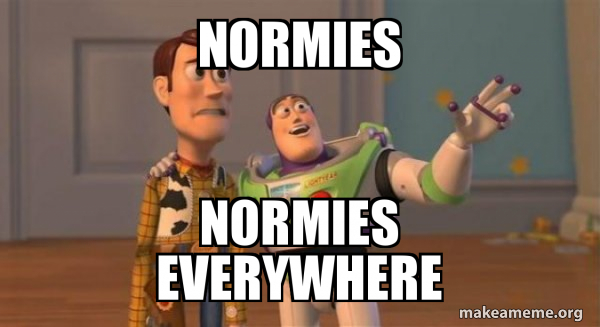
Normies, Tards and Hams

1. Normies, Tards and Hams are the principal opponents of the Elementalist.

2. A Normie doesn’t get it.

3. A Tard can’t get it.

4. A Ham won’t get it.

5. Most non-Elementalists are Normies.

6. The Normie is the common man who has not been introduced to Elementalism. He may not have heard of it, or he may have heard of it and not considered it important.

7. The Normie is not an enemy of the Elementalist, but rather someone who doesn’t understand the Four Tenets and their applications.

8. The Normie is the most likely of the three to convert to Elementalism.

9. Many people who are currently Normies are Elementalists to be. They are waiting to be exposed to the right information at the right time with the right energy, frequency and vibration.

10. Normies are found in almost every walk of life and in almost every position.

11. Tards are relatively few in number.

12. The Tard is someone who is not intelligent enough to get it.

13. The Tard is sometimes, but not always, an enemy of the Elementalist, and like the Normie they don’t understand the value of the Four Tenets and their applications.

14. The Tard is the least likely to convert to Elementalism, because they can’t understand it.

15. The difference between the Tard and the Normie is that the Tard is not intelligent enough to understand Elementalism no matter how it is presented.

16. Like the Normies, Hams are also very common.

17. The Ham is someone who refuses to get it.

18. The Ham refuses to get it because they are liars, wedded to lies. Lying is in their souls, and it finds expression in their every action.

19. The worst lies of the Ham are Judaism, Christianity, Islam and Baha’i.

20. All Hams are followers of the Principle of Evil.

21. The Ham is the primary enemy of the Elementalist.

22. All throughout human history, Hams have sought to destroy anyone who speaks spiritual truths. They will seek to destroy Elementalists.

23. The Ham is more likely to convert to Elementalism than the Tard, but less likely than the Normie.

24. Of the religions, only the Hams are wrong. All others are right.

25. Give a Ham an inch, he will take a mile. Give a Ham a mile, he will kill you and everyone you know.

*

This chapter is an excerpt from Elemental Elementalism, the foundational scripture of the new religion of the Age of Aquarius.

*

If you enjoyed reading this essay/article, you can get a compilation of the Best VJMP Essays and Articles of 2020 from Amazon for Kindle or Amazon for CreateSpace (for international readers), or TradeMe (for Kiwis). A compilation of the Best VJMP Essays and Articles of 2019, the Best VJMP Essays and Articles of 2018 and the Best VJMP Essays and Articles of 2017 are also available.

*

If you would like to support our work in other ways, subscribe to our SubscribeStar fund. Even better, buy any one of our books!
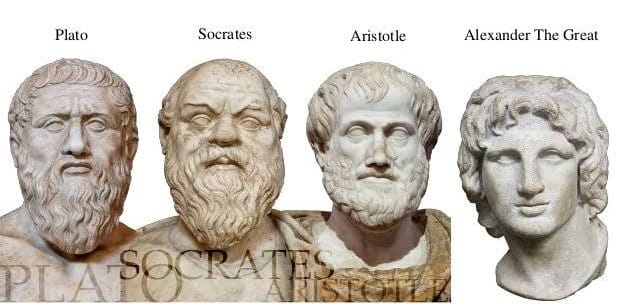
Towards A Theology Of The Age Of Aquarius

1. The Principle of Good has four High Gods underneath it, each of who rule over a 45-degree span of the Quadrijitu.

2. These 45-degree spans can be considered as representing three-hour stretches of a great Spiritual Daytime.

3. The rule of the Principle of Good, which we are now entering as the Age of Aquarius is beginning, is analogous to a Spiritual Daytime.

4. The four High Gods are the earthly avatars of the Principle of Good.

5. The First High God is Socrates, representing the gold. He spans from 1 to 45 of the Quadrijitu.

6. Socrates tells the truth at any price, even that of his own death. He is utterly unafraid of death, being aware that it is merely a transition of forms.

7. Whenever someone tells the truth in the face of an enormous pressure to lie, there is the energy of Socrates.

8. Socrates brings rectitude to other living beings. Knowing the truth, they can achieve their Aspirations.

9. The Second High God is Plato, representing the mercury. He spans from 46 to 90 of the Quadrijitu.

10. Plato is the messenger of the divine. He brings to humanity knowledge of the workings of the divine.

11. Whenever someone accurately understands the Four Tenets, there is the energy of Plato.

12. Plato brings enlightenment to other living beings by reminding them of the spiritual realities of existence.

13. The Third High God is Aristotle, representing the silver. He spans from 91 to 135 of the Quadrijitu.

14. Aristotle represents intelligence, and the human ability to overcome our surroundings through the application of intelligence.

15. Whenever somebody expounds the application of the Four Tenets to everyday life, you have the energy of Aristotle.

16. Aristotle brings understanding to humanity by educating them as to the nature of reality.

17. The Fourth High God is Alexander, representing the copper. He spans from 136 to 180 of the Quadrijitu.

18. Alexander represents how the material world is inevitably subjugated by the higher elements working in unison.

19. Whenever someone takes action based on an exposition of the Four Tenets, you have the energy of Alexander.

20. Alexander brings glory to people by bringing them into the Empire of Truth.

21. Each of these four High Gods rules over nine Greater Gods, who themselves rule over a five-degree segment of the Quadrijitu.

22. Each of these Greater Gods rules over five Lesser Gods, so that every degree in the upper half of the Quadrijitu is represented by a particular angelic energy loyal to the Principle of Good.

*

This chapter is an excerpt from Elemental Elementalism, the foundational scripture of the new religion of the Age of Aquarius.

*

If you enjoyed reading this essay/article, you can get a compilation of the Best VJMP Essays and Articles of 2020 from Amazon for Kindle or Amazon for CreateSpace (for international readers), or TradeMe (for Kiwis). A compilation of the Best VJMP Essays and Articles of 2019, the Best VJMP Essays and Articles of 2018 and the Best VJMP Essays and Articles of 2017 are also available.

*

If you would like to support our work in other ways, subscribe to our SubscribeStar fund. Even better, buy any one of our books!

Balancing The Higher And Lower Selves

1. Understanding everyday life is a matter of understanding whose story we’re telling.

2. There are two fundamental narratives to what this life is about.

3. The first life narrative is that we are rising beasts who have evolved up out of the Earth.

4. The second life narrative is that we are fallen angels who have descended down out of the heavens.

5. The truth is that we are both rising beasts and fallen angels simultaneously. Both of these narratives are true, but sometimes one more than the other, depending on whose story we’re telling at the time.

6. To put too much value on the rising beast narrative is to occlude the divinity of humanity, leading to egotheism.

7. Egotheism bores the gods because it reminds them of the behaviour of children.

8. To put too much value on the fallen angel narrative is to occlude the lived reality inside the Great Fractal, leading to withdrawal.

9. Withdrawal bores the gods because it reminds them of the behaviour of suicides.

10. The imperative to entertain the gods demands that we balance the higher and lower selves, which both contribute to our experience of reality.

11. The higher and lower selves are balanced on the Great Masculine Axis.

12. The will to indulge the lower self is the same as the Undergoing Will.

13. The will to indulge the higher self is the same as the Overcoming Will.

14. Depending on which part of the Great Fractal one is in, the local environment will be conducive either to indulging the lower self or indulging the higher self.

15. If the local environment is conducive to indulging the lower self, but a person acts from the higher self, they will soon find themselves in an environment conducive to indulging the higher self, as per the Law of Attraction.

16. If the local environment is conducive to indulging the higher self, but a person acts from the lower self, they will soon find themselves in an environment conducive to indulging the lower self, as per the Law of Attraction.

17. Operating too much from the lower self causes the lived experience to become animal-like. The gods are bored by the predictability.

18. The animal experiences significance but he must suffer for it.

19. Operating too much from the higher self causes the lived experience to become ghost-like. The gods are bored by the unreality.

20. The ghost does not suffer but neither does he experience significance.

21. The gods created us to aspire to rise up the Great Masculine Axis, but to struggle to do so on account of our imperfect wills. They derive great amusement from the ensuing struggle.

22. The correct balance is struck by saying Yes to life as much as is possible while always keeping this Yeasaying subordinate to the First Tenet.

23. The Tenets are therefore a home base from which the Great Fractal can be explored in the service of entertaining the gods.

*

This chapter is an excerpt from Elemental Elementalism, the foundational scripture of the new religion of the Age of Aquarius.

*

If you enjoyed reading this essay/article, you can get a compilation of the Best VJMP Essays and Articles of 2020 from Amazon for Kindle or Amazon for CreateSpace (for international readers), or TradeMe (for Kiwis). A compilation of the Best VJMP Essays and Articles of 2019, the Best VJMP Essays and Articles of 2018 and the Best VJMP Essays and Articles of 2017 are also available.

*

If you would like to support our work in other ways, subscribe to our SubscribeStar fund. Even better, buy any one of our books!

The Minor Aspiration

1. The Major Aspiration of every person is to entertain the gods.

2. The principal way to entertain the gods is through struggling in an attempt to achieve the meaning of one’s life.

3. The Minor Aspiration of every person is whatever they decide the meaning of their life is.

4. In principle, there are no restrictions to what a person might decide their Minor Aspiration is.

5. No matter how fervently they aspire to their Minor Aspiration, their struggles are always subordinate to the Major Aspiration. This is true whether or not they believe in Elementalism, and whether or not they have even heard of Elementalism.

6. Some decide that the meaning of their life is survival.

7. Those whose Minor Aspiration is survival operate on a similar level to prey animals. Their main concern is getting through to the next day.

8. Some decide that the meaning of their life is recreational.

9. Those whose Minor Aspiration is recreational operate on a similar level to children. Their main concern is lulz.

10. Some decide that the meaning of their life is physical.

11. Those whose Minor Aspiration is physical operate on a similar level to predatory animals. Their main concern is control.

12. Some decide that the meaning of their life is sexual.

13. Those whose Minor Aspiration is sexual operate on a similar level to bonobos. Their main concern is the next oxytocin hit.

14. Some decide that the meaning of their life is social.

15. Those whose Minor Aspiration is social operate on a similar level to wealthy people. Their main concern is the next dopamine hit.

16. Some decide that the meaning of their life is intellectual.

17. Those whose Minor Aspiration is intellectual operate on a similar level to the Seven Initiates. Their main concern is dispelling ignorance.

18. Some decide that the meaning of their life is spiritual.

19. Those whose Minor Aspiration is spiritual can operate on the same level as any other being, depending on the orientation of that spirituality and the degree to which a person successfully attains it.

20. It is important that a person knows what their Minor Aspiration is and where it might lie on the Great Masculine Axis.

21. Whatever a person decides the meaning of their life is, that meaning is subordinate to the Major Aspiration.

*

This chapter is an excerpt from Elemental Elementalism, the foundational scripture of the new religion of the Age of Aquarius.

*

If you enjoyed reading this essay/article, you can get a compilation of the Best VJMP Essays and Articles of 2020 from Amazon for Kindle or Amazon for CreateSpace (for international readers), or TradeMe (for Kiwis). A compilation of the Best VJMP Essays and Articles of 2019, the Best VJMP Essays and Articles of 2018 and the Best VJMP Essays and Articles of 2017 are also available.

*

If you would like to support our work in other ways, subscribe to our SubscribeStar fund. Even better, buy any one of our books!