
Clown World Chronicles: What Is A ‘Midwit’?

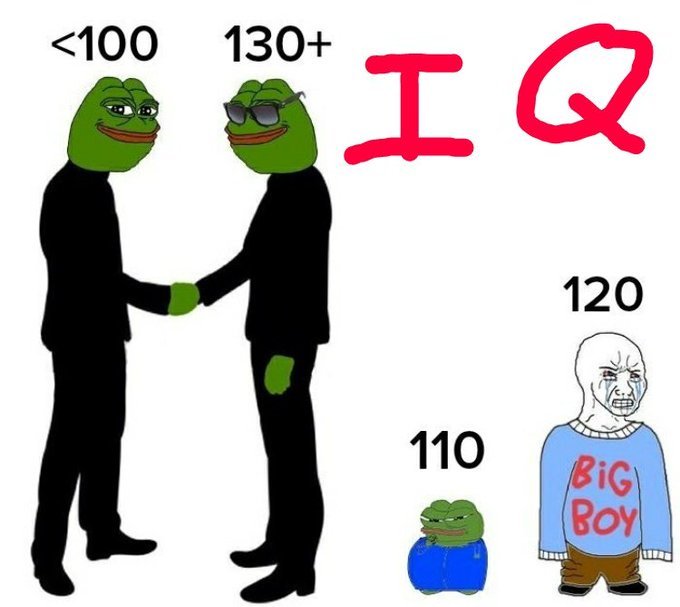
Films and history books warn us of the dangers of evil geniuses coming to power. Skillful orators like Hitler, we are told, are able to trick masses of people into following them, with dire consequences. But the lone evil genius is not as big a danger as a horde of mediocre people. Understanding the midwit phenomenon is crucial to understanding Clown World.

A ‘midwit’ is someone of middling intelligence. They are higher than lackwits, halfwits and fuckwits, but are lower than any genuine wit. They’re not dull, just not bright. Although this sounds very ordinary, the sheer mass of humanity at the very centre of the bell curve creates its own phenomena that we have to be wary of.

Psychologists have observed a curious phenomenon that is known as the Dunning-Kruger Effect. This is when a person with a low level of ability or knowledge heavily overrates themselves. It’s a specific example of an area of Psychology known as illusory superiority.

A person is most liable to fall victim to the Dunning-Kruger Effect when they know a little bit about a subject. This is because a person who doesn’t know the boundaries of a field of knowledge will not know the limitations of their own knowledge either. The tendency in such cases is to discount the volume of the knowledge not known.

When someone uses the term ‘midwit’ they are referring to this kind of person. They don’t mean a person of merely average intelligence, but rather a person who is utterly incapable of recognising their own intellectual shortcomings. The midwit secretly thinks he might be the smartest person who ever lived. This is because his understanding of his limitations is minimal.

Central to midwit psychology is their tendency to go along with the herd. Midwits can’t actually see ahead, much less beyond, but they like to give the impression they can. They only way they can continue to give this impression is by expending great energy determining what actually smart people think.

The problem here is that midwits can’t generally tell the difference between people smarter than them and crazy people. This leads to three characteristic midwit errors.

The first is dismissing people smarter than them as crazy.

Midwits don’t have the academic acumen to read scientific journals, much less conduct scientific literature reviews. As such, they are dependent on the word of experts in order to understand anything. Of course, if a person doesn’t have any expertise themselves then they have to rate those who do on trust, and that is a crapshoot at the best of times.

Any genuine scientific or cultural advance will, at first, only be understood or appreciated by the genuine experts and geniuses in the field. From them, it filters out to the merely brilliant, then to the bright and then finally to everyone else. So any really interesting scientific advance will only be appreciated by a minority – until it stops being interesting.

Because the midwit follows the herd, the midwit will always dismiss the genius as crazy on account of his low number of followers. When the genius becomes recognised by the masses, the midwit will follow along, up until the point where the genius becomes unfashionable. Then the midwit will drift into the next intellectual trend.

The second characteristic midwit error is following a crazy person out of the belief that that person is smart.

The archetypal example of this is the Manson Family. Charlie Manson was certainly capable of sounding smart, but his was more of a carnival storyteller’s glibness than the wisdom of a sage. He could take people for an enjoyable ride and show them some incredible places, but at the end of it they were left with regret.

Manson was certainly capable of expressing advanced spiritual insights. After all, if you hang around the psychedelic drug scene long enough you will come to hear some profound insights into the nature of reality from genuine shamanic adventurers. All he had to do was parrot them accurately enough and a couple of dozen Southern California midwits decided that he was a guru.

Because midwits are mediocre, they’re especially prone to mistake convoluted insanity for profundity. Consequently, there are all kinds of lunatics who have followings on account of that their babblings have become fashionable. Most of these lunatics are mainstream media figures – television celebrities are to the midwit what the gods were to the ancient Greeks and Romans.

These errors are magnified by the sheer number of midwits out there. Because there are so many of them, most midwits are used to the experience of encountering others who agree with them. This leads to the third, and most characteristic error of the midwit: groupthink.

Because the midwit knows that they are not distinguished in any fashion, being entirely mediocre, they come to prize the bare average above the exceptional. From this they develop a tendency to ignore anything vaguely controversial. If the herd thinks it, that’s good enough for the midwit. As the midwit is right on the centre of the bell curve, their opinions are the most common. Therefore, they conclude, they must be correct.

Related to this, midwits are especially fond of labelling any explanation they cannot understand a ‘conspiracy theory’. Perhaps unsurprisingly, they fall for all sorts of conspiracy theories themselves, especially ones that get popular in the midwit’s circle, or which may have been pushed in the mainstream media.

The traditional solution to the midwit problem was beating them into submission with a Bible. In recent years, control has shifted to a combination of psychological abuse (at school) and pacification (through the mainstream media). The contentment of the midwit is the dam protecting Clown World from the waters of change. If it goes, we fall into chaos.

*

This article is an excerpt from Clown World Chronicles, a book about the insanity of life in the post-Industrial West. This is being compiled by Vince McLeod for an expected release in the middle of 2020.

*

If you enjoyed reading this essay, you can get a compilation of the Best VJMP Essays and Articles of 2019 from Amazon for Kindle or Amazon for CreateSpace (for international readers), or TradeMe (for Kiwis). A compilation of the Best VJMP Essays and Articles of 2018 and the Best VJMP Essays and Articles of 2017 are also available.

*

If you would like to support our work in other ways, please consider subscribing to our SubscribeStar fund. Even better, buy any one of our books!

Opposing Islam Is Left-Wing, Not Right-Wing

With the rapid changes that have occurred in the West over recent decades, many people have been forced to make quick strategic decisions. In some cases, grievous errors have been made. In other cases, great amounts of complete and utter bullshit have been spoken. This article looks at one egregious example.

On 11 January this year, Radio New Zealand ran a smear attack against Right Minds columnist Dieuwe de Boer, calling him a “far-right activist”. This was part of a report detailing how de Boer had been raided by Police in connection with a recently-prohibited firearm part (none was found). This hit piece led to a couple of complaints to the New Zealand Media Council.

Beholden to the same globalist corporate interests as the rest of the New Zealand media, the New Zealand Media Council ruled in favour of Radio New Zealand. In a decision that the Marxists at the Human Rights Commission must have applauded, they declared that it was not unreasonable to use the term ‘far-right’ to describe de Boer on account of that he was “openly critical of Islam”.

As usual when it comes to Governmental proclamations, the truth is closer to the opposite of what they say it is. In this instance, the truth is that open criticism of Islam is left-wing, not right-wing.

Islam is practically no different, in either ideology or action, to the far-right-wing Christian conservatives that the left has always opposed. Just like Christian conservatives, the vast majority of Muslims oppose homosexuality, oppose women’s liberation, hate non-believers and oppose the use of spiritual sacraments.

There are 12 countries in the world that currently punish homosexuality with death: Afghanistan, Brunei, Iran, Mauritania, Nigeria, Pakistan, Qatar, Saudi Arabia, Somalia, Sudan, the United Arab Emirates and Yemen. All of them are Muslim-majority countries.

The vast majority of Muslims support punitive measures against homosexuals. Koranic passages such as 26:165 and 29:28 describe homosexuals as evil, and declare that they should be destroyed. Hadiths such as Sunan Abu Dawud 38:4447 are no less horrifying. This one cites Muhammad himself as saying: “If you find anyone doing as Lot’s people did, kill the one who does it, and the one to whom it is done.”

These attitudes and beliefs are firmly right-wing conservative. The religious sentiments that inspire Muslims to persecute homosexuals are almost identical to the religious sentiments that inspired Christians to persecute homosexuals in decades gone by.

Hatred for homosexuals is not the only thing shared by Muslims and conservative Christians. Both have taken measures to oppress and enslave women. Both have taken measures to persecute non-believers. Both have extremely relaxed attitudes to child abuse. Both have imprisoned users of spiritual sacraments.

In all of these instances, Muslims and Christians have been opposed by the left. It was primarily the left that fought to change the laws that were persecuting homosexuals. It was primarily the left that fought to criminalise child abuse. It’s primarily the left fighting now to end the persecution of cannabis and psilocybin users.

Therefore, opposing the attitudes and beliefs held by Muslims is left-wing.

It’s left-wing to oppose Islam because Islam itself is far-right. In fact, Islam is so compatible with the far-right that there was even a Muslim division of the Waffen-SS. The 13th “Handschar” Division was made up of German officers and volunteer troops, mostly Muslim, mostly recruited in Bosnia with assistance from the Grand Mufti of Jerusalem.

Nazism and Islam are highly compatible on account of that they are both hate-fueled supremacist ideologies that share a common enemy in the Jew. If Nazis are the kind of far-right extremists who we should all be scared of, and if Muslims fight side-by-side with Nazis out of shared ideological sentiments, then Islam itself is far-right. This is basic logic.

De Boer opposes Islam, not because Islam is left-wing, but because the Christian vs. Islam conflict is part of the interminable internecine warfare that Abrahamism has inflicted upon the world. Everywhere there is Abrahamism, there is war, whether war against non-believers or war against heretics. Christianity and Islam have been at war for almost 1,400 years, and de Boer is merely playing his part in that.

One point needs to be emphasised, however: just because there is an internal conflict within Abrahamism, one that sees Christians and Muslims fighting with each other, doesn’t mean that anyone criticising one particular faction of Abrahamism becomes “right-wing”. Christianity is itself divided into Catholic and Protestant factions, but no serious person would claim that a Protestant who opposes Catholicism on account of Catholicism’s barbaric attitudes towards spiritual sacraments is ‘far-right’.

The left would like to claim Muslim voters for their own on account of that Muslims tend to be non-white and outside the Establishment power structure. But neither of those things is close to sufficient. Homosexuals, women and users of spiritual sacraments are already outside the power structure – therefore anyone who hates these people is in service of the right wing.

It is left wing to stand against doctrines that call for the subjugation and oppression of homosexuals, women, outsiders and users of spiritual sacraments. This is especially true when the subjugators claim to be acting in the name of the God, and it goes double when they specifically claim that it is their destiny to rule over the rest of the planet.

Therefore it is left wing to stand against Islam.

*

If you enjoyed reading this essay, you can get a compilation of the Best VJMP Essays and Articles of 2019 from Amazon for Kindle or Amazon for CreateSpace (for international readers), or TradeMe (for Kiwis). A compilation of the Best VJMP Essays and Articles of 2018 and the Best VJMP Essays and Articles of 2017 are also available.

*

If you would like to support our work in other ways, please consider subscribing to our SubscribeStar fund. Even better, buy any one of our books!
Uncovering Occultic Insights While Gaming

by DIE SIENER

I grew up in the 80s and spent my free time playing games on some comparatively inglorious rigs. My first rig, which I had to share with my dad, was an Intel 80286 PC with a monochrome tube screen running some archaic version of DOS. Big bulky sort of thing, it made noises like an old truck engine when it cranked up. It booted the operating system from an 8-inch floppy disk and most programs ran from a secondary floppy drive – no hard drive on this puppy at all.

To my preteen self, this was the most glorious piece of technology ever invented by man and I spent countless hours having a crack at text-based RPGs, carefully manoeuvring my ASCII character through dungeons fighting text-based orcs and warlocks. At the time, I would never have thought that one day I would be able to play a game such as The Elder Scrolls: Skyrim on a gaming laptop tens of thousands of times faster and oh so exceptional at displaying all those monsters and dragons on a full 24-inch HD screen.

Apart from gaming, I have also nurtured a habit of delving into the occidental occult. From the arcane wisdom, I have learned a lot about myself and the nature of the Great Fractal.

I habitually continue to learn through daily observation, even in times I’d rather just chill out and forget about work and family commitments. It was a bit of a surprise though that, while I was playing an Elder Scrolls game, I was elevated into a meditative trance. It just goes to show that if you are receptive to God, he is always willing to reveal the mysteries, no matter your current disposition.

Before I delve too deeply into the nature of this trance, let me first clarify some mechanics relating to the Elder Scrolls franchises’ game mechanics.

In the Elder Scrolls franchise, your avatar is ultimately represented by three forces. The first of these forces is called “Health” and is habitually coloured red. The second force, which is the mirror of the first, is called “Magicka” and is coloured blue. The third force is often called “Fatigue” and is coloured green.

Now from here on it becomes a bit more complex and varies from franchise to franchise, but, in general, we can say that these three forces are derived from some additional factors: the star sign under which a character is born and also the class of character the gamer chooses. These two choices influence the three forces in such a way as to govern how the character will develop in-game.

A gamer would usually complete this creation process at the start of a new game and your avatar is then born into the game-world and the “you/avatar” team can then start exploring and taking on quests etc. So, this is the basics of how the avatar is created.

The gamer will now manipulate the avatar around the game world and, based on its primary forces, will favour any number of different playing styles while solving various challenges.

A physical character would have high health and fatigue reserves and so would favour going into combat directly with heavy weapons and armour, trying to cause a lot of damage and ultimately outlasting his adversaries. His weakness would be his lack of mana which will leave the avatar incapable of casting beneficial spells, say casting a healing spell or a protection spell.

A character that is focused on predominantly casting spells and using magic to overcome challenges would benefit from a high reserve of mana and fatigue as it will have to manoeuvre around heavily armoured foes rapidly, and cast different forms of magic to overcome its foes’ greater physical prowess.

As the player continues along his path, completing quests, clearing dungeons and fighting random monsters in the game-world, the character slowly builds up experience in the skills that it favours. This then reinforces the nature of the character since each time it levels up, the characteristics which enable that type of character to become better at what it does will naturally be chosen.

At first, tasks seem hard and you fail often, but the better defined the character becomes, the easier it finds its way through quests and challenges.

Now coming back to the other night when I entered an altered state of consciousness. You see, I realised once again that we humans are not much different from this make-believe digital avatar. The catch is that in real life it takes tremendous effort to separate the actor from the flesh and blood avatar.

It doesn’t only take effort once – like RPG games, it takes the repetition of challenges, each tougher than those before, to define our primary attributes and train our avatar to follow the instructions of the actor and not the other way around. How we as individuals choose to address these temporal challenges also determines the type of character our souls ultimately develop into. It affects our fate – something which receives far too little consideration in modernity.

This tripartite nature of our reality is, unfortunately, a mystery deeply hidden to the masses who, for the most part, remain asleep and forgetful about their true nature beyond the flesh. It is this forgetfulness which inhibits our higher selves from taking control of our encounters and overcoming the challenges and uncertainties which we are all fated to experience. We remain trapped in the forces which govern our lower aspects and never seem to overcome them. The lesson that all occultists can take home is this warning.

In RPG gameplay, you can easily become lost in the fantasy, just as you can in real life. It takes real effort by the actor to distance himself from the avatar, to see things for what they truly are and to overcome them through the effort of body, mind and soul.

*

If you enjoyed reading this essay, you can get a compilation of the Best VJMP Essays and Articles of 2019 from Amazon for Kindle or Amazon for CreateSpace (for international readers), or TradeMe (for Kiwis). A compilation of the Best VJMP Essays and Articles of 2018 and the Best VJMP Essays and Articles of 2017 are also available.

*

If you would like to support our work in other ways, please consider subscribing to our SubscribeStar fund. Even better, buy any one of our books!

Spirituality Is Bad For The Economy

Many people feel that spirituality is a taboo topic. Part of the reason for this is because it reminds people of death – questions of God and life’s meaning go hand-in-hand with questions about the afterlife. Therefore, talking about spirituality is bad because it reminds people that they will die one day. As this essay will show, this is only part of the reason.

The purpose of spirituality is to reduce suffering.

The objective of the Buddhist path is to achieve nirvana, the objective of the Hindu path is to achieve moksha and the purpose of the Western esoteric traditions is to achieve ataraxia. In all cases, this state of ultimate enlightenment offers a liberated existence independent of material acquisition, status anxiety, social anxiety or attachment to food, sex or power – a state in which one no longer suffers.

Buddha was motivated to end the suffering of all sentient beings, and his conception of the Eightfold Path was an attempt to teach how an individual could achieve this for themselves. He taught that happiness could not be found in the material, which was an illusion. Every person had to look within themselves.

Buddha is famous for advocating meditation as an avenue to enlightenment, but all true spiritual traditions teach that happiness (or at least an end to suffering) is found within. Analects 15:20 quotes Confucius as saying “The Superior Man seeks within himself. The inferior man seeks within others.” The Tao Te Ching, likewise, is replete with admonitions to find satisfaction in everyday life and not to strive for it.

Looking within is the secret to ending suffering. From society’s perspective, however, a dilemma lies therein.

In our society, the most important thing of all is money, and getting money requires jobs. In order for a job to exist, there has to be demand for goods and services. This demand comes from only one place: human dissatisfaction. Without human suffering, there could not be money. Therefore there must be human suffering.

Many people have never comprehended the fact that other people exist, and that they are conscious, and that this consciousness suffers just like one’s own does. These people act as if the world was a virtual reality game that only they were playing, and everyone else was just an NPC. In life they are as hungry ghosts, their insatiable appetites causing them to lurch from one instinct-fueled lust to the next.

In our culture, the dissatisfaction of these unfortunates has been channelled towards buying stuff. New clothes, new cars, new toys, new foods – and all of it greases the wheels of commerce. Consumerism is therefore powered by this dissatisfaction, by suffering. It follows that anything that stops people consuming is bad.

Spirituality, though, tends to have a profound effect on people’s consumption habits. Once a person starts to look within, they start asking questions like: did that most recent purchase really increase my happiness? Or did I get more happiness from the chance social encounter I had in town last week? Once a person starts thinking like this, their lives start to change profoundly.

When a person becomes skilled at meditation, it’s easy for them to feel a more powerful sense of satisfaction from meditating than from buying new stuff. Meditating is the ultimate activity in many ways, and one of the main ways is that it is anti-consumerist. The dissatisfaction that people feel in everyday life is assuaged by meditation. So people who are into meditating are seldom the same people who line up overnight for the next iPhone release.

It follows from all of this that the engine of consumerism runs on godlessness. The further a person is from God, they more they suffer, and the more they suffer the greater the volume of goods and services they consume. The ruthless logic of the markets has led to a horrific outcome: genuine spirituality has deliberately been attacked in order to power the capitalist machine.

People with genuine spiritual insight have been persecuted for thousands of years, but this has intensified in recent centuries according to the demands of capitalism. Witches have been burned at the stake and hippies – their cultural descendants – have also been attacked. True spiritual sacraments such as cannabis and psilocybin have been criminalised, those who grow or gather them locked in cages.

Worse, false spiritual traditions have been promoted to distract people from the true ones that would help them. There are hundreds of different Christian churches who teach that wealth is evidence of God’s grace, and hundreds of millions of other Abrahamists who mutilate the genitals of their children, persecute homosexuals and who consider women and non-believers to be subhumans.

This combination has obliterated the spiritual wealth of the masses. In doing so, however, it has caused the material wealth of the elites to overflow. Thus, it is perpetuated. Spirituality is bad for the economy, and that’s why it’s been suppressed.

We can hope that, in the coming years, the economy will be considered less important, and human suffering more important. At the least, we can hope that it will be remembered that the economy is a means for ending human suffering, and that human suffering is not a fuel that should power the economy.

*

If you enjoyed reading this essay, you can get a compilation of the Best VJMP Essays and Articles of 2019 from Amazon for Kindle or Amazon for CreateSpace (for international readers), or TradeMe (for Kiwis). A compilation of the Best VJMP Essays and Articles of 2018 and the Best VJMP Essays and Articles of 2017 are also available.

*

If you would like to support our work in other ways, please consider subscribing to our SubscribeStar fund. Even better, buy any one of our books!