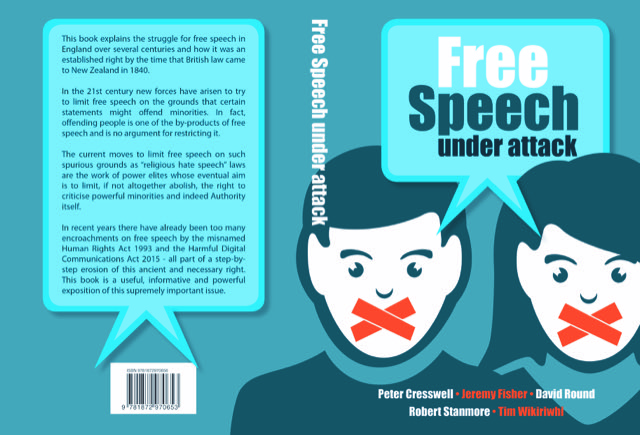
The next edition of the VJMP Reads column is Free Speech Under Attack. This book is a compilation of essays written by New Zealand authors with an interest in liberty.
The book is published by Tross Publishing, who appear to have an interest in anti-Establishment material (much like VJM Publishing).
The first chapter is ‘The Struggle For Free Speech’ by Jeremy Fisher. Here, Fisher outlines the history of speech suppression efforts since the 13the century. The Church has played a major role, requiring that people apply for a licence to print books. 16th century England restricted the printing of books to a guild, lest the wrong person print some.
Fisher recounts that many American colonies were founded by people who had been persecuted for their opinions in Europe. Suppression of speech was sophisticated, using a system of licences and stamp duties to pre-empt dissent. Political parties used the law to suppress the free expression of their opponents.
The second chapter is ‘Preparing the Ground to destroy Free Speech’, also by Jeremy Fisher. Here Fisher describes the authoritarian mindset of the opponents to free speech. The authorities push political correctness to make people easier to control. Thinking follows speech, so if they ban the speech they ban the thoughts.
Fisher labels political correctness as a form of totalitarianism that must be destroyed. He describes the role that organisations such as the Anti-Defamation League, the Southern Poverty Law Centre and Antifa play in suppressing free speech.
The third chapter is also by Fisher, and is called ‘The Deception of Hate Speech’. The chapter recounts the efforts of organisations like the United Nations and the Organisation of Islamic Co-operation to fight free speech under the guise of fighting xenophobia and hatred. Most of the examples of free speech suppression listed here come from Britain, which, as VJMP has previously argued, is fucked anyway.
Many religious ideologies, in particular Islam, have seized upon the hate speech laws to stifle criticism. Islamists have managed to reinstate blasphemy laws under the guise of hate speech laws. Fisher ends the chapter with the conclusion that the purpose of hate speech laws is to stifle dissent.
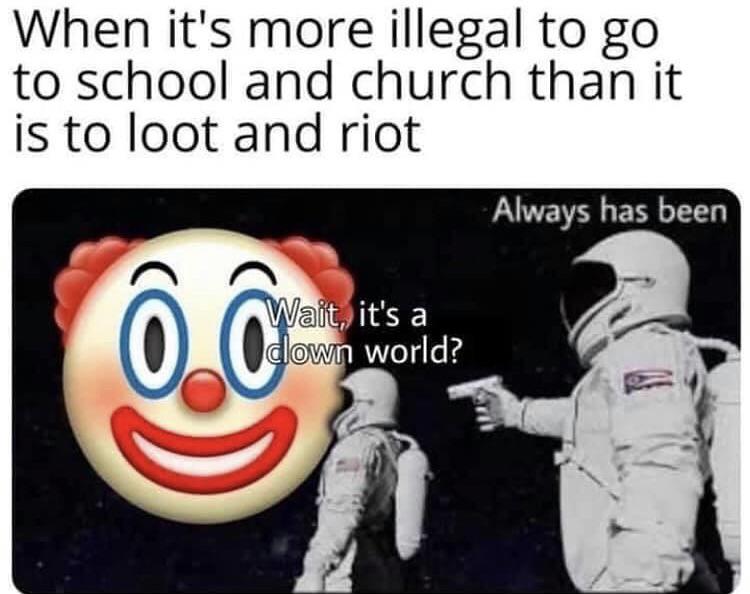
Clown World is paradoxical in many ways. On the one hand, there is the disintegration into total chaos, but on the other, there is the imposition of a suffocating degree of order. This paradox can be resolved once it is understood as anarcho-tyranny.
There are many different kinds of anarchism. As anyone who has spent any time with anarchists knows, none of them can agree on anything. This has led to anarchists breaking up into a kaleidoscope of different subgroups: anarcho-communists, anarcho-capitalists, anarcho-syndicalists, anarcho-nihilists, anarcho-homicidalists and more.
Like ‘anarcho-nihilism’, people don’t usually identify with the term ‘anarcho-tyranny’. It’s normally applied from the outside. Anarcho-tyranny was first discussed by philosopher Sam Francis, who attributed the apparent decay of society to mass immigration.
Francis’s logic was that multiculturalism inevitably leads to disputes over moral values, and the discord that follows is exploited by tyrants. Political freedom depends on people having enough in common to agree on what freedom means. Absent those commonalities, law and order can only be kept by force. This echoes the words of Aristotle some 2,300 years earlier, who noted that multicultural societies ended up as tyrannies.
Mass immigration is one of the major causes of Clown World, as it is has led directly to a decrease in kin intensity, and thereby to a major decrease in solidarity between any two randomly-chosen people. This decrease in solidarity has led to an increase in self-interested behaviours. This selfishness has been exploited for votes by a venal ruling class, and they have used the resulting power to enforce anarcho-tyranny.
Whatever its root causes, anarcho-tyranny can be defined as a political and judicial system wherein everything is illegal, but the ruling class only enforces the law if they want to send a message to someone they don’t like.
The ‘anarcho’ comes from that there is no proper law enforcement. Practically any law can be ignored as long as you’re on the right team. The ‘tyranny’ comes from that law enforcement is applied in an arbitrary and biased fashion, and usually to destroy the enemies of the tyrants.
The characteristic feature of anarcho-tyranny is that actual criminals don’t get punished in proportion to the suffering they have caused, but political enemies get punished extravagantly for the smallest misstep.
Perhaps the best recent example comes from New Zealand.
A man named Philip Arps was sentenced to 21 months imprisonment last year for sharing a video of the Christchurch mosque shooting. Even though the act of sharing the video didn’t harm anyone, Arps is a white nationalist and therefore on the wrongthinkers list. As such, he was given an extremely heavy sentence.
In September 2020, by contrast, a man named Marcus Barker was sentenced to home detention for the crime of sex trafficking a child. The sex trafficking of children is an act that causes unfathomable suffering; almost everyone has the wit to tell you that sex trafficking of children is a worse crime than sharing a video.
Under anarcho-tyranny, however, the severity of a crime depends not on the degree of suffering caused, but whether the crime served the interests of the ruling class. The elites don’t share mosque shooting videos, but they are into raping children.
Near New Zealand is the Australian state of Victoria, which also offers an example of anarcho-tyranny.
Victorian Police arrested and handcuffed a pregnant woman in front of her own children for promoting an anti-lockdown protest in Melbourne. This was part of a series of pre-emptive arrests of protest organisers. Police in that state have vowed to stop any and all anti-lockdown protesting, with Assistant Commissioner Luke Cornelius even calling the organisers “the tinfoil hat-wearing brigade”.
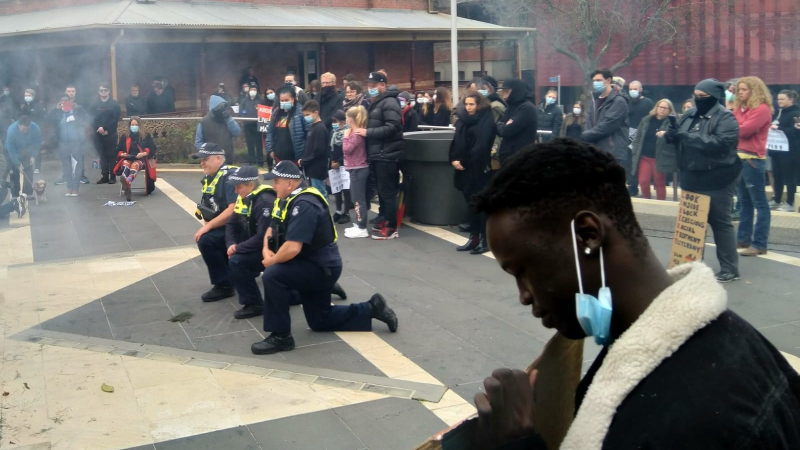
But Black Lives Matter ran a massive Melbourne protest that June, and the Victorian Police didn’t lift a finger. In fact, they took a knee to the protesters. This is despite that the coronavirus pandemic was already in full swing, and therefore that the BLM protests were no less dangerous than the anti-lockdown protests.
Similar situations prevail in Britain and in America. In Britain, people get arrested for offensive FaceBook posts while child grooming gangs escape investigation, and in America BLM mobs are running wild in areas that local law enforcement have abandoned.
This is anarcho-tyranny in practice: anyone pro-Establishment is allowed to assemble and to break the law without sanction, but anyone anti-Establishment is not even entitled to the rights that they are supposedly guaranteed by human rights legislation.
As Clown World intensifies, anarcho-tyranny will get to the point where mobs run rampant in major Western cities with no opposition from law enforcement. At the same time, people will start to get imprisoned for criticism of their government. Both bad chaos and bad order will reign over their good opposites. This could be said to be peak Clown World, and what happens then is anyone’s guess.
*
This article is an excerpt from Clown World Chronicles, a book about the insanity of life in the post-Industrial West. This is being compiled by Vince McLeod for an expected release in the middle of 2020.
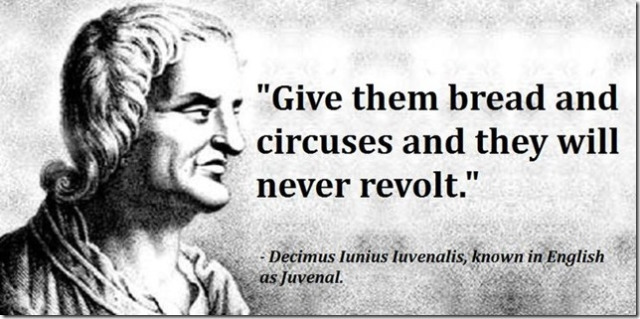
Panem et circenses is an ancient Roman phrase, attributed to the poet Juvenal, that means “bread and circuses.” The idea is that a degenerate society, once it has abandoned all higher values, has nothing left but bread and circuses. Take that away, and the society will fall apart. Our bread and circuses are in the process of being taken away.
The Roman Empire discovered that paying for public circuses was a great way of preventing civil unrest. If the people had an upcoming gladiatorial games to look forward to, they were much more likely to be content. When they didn’t have anything to look forward to, they tended to entertain thoughts of rebellion.
Eventually, the Romans found themselves unable to pay for more games, and that was the tipping point. The cessation of the circuses meant that the citizens got their entertainment from wrecking society instead, and that was the end of the Roman Empire.
The Western World appears to be going through a similar process.
Professional sports have replaced the circuses in the West, and most professional sports leagues have been severely impacted by the coronavirus pandemic. The English Premier League season lost three months, the Major League Baseball season lost 100 games, and Dr. Anthony Fauci, member of the White House’s coronavirus task force, predicted that running the NFL later this year would be impossible.
In New Zealand, there hasn’t been a single All Blacks match so far in 2020, and it looks like there won’t be. There hasn’t been a Black Caps match since March, and there is no news of upcoming fixtures (although a tour to Bangladesh has supposedly been planned).
Even worse, the increasing politicisation of professional sport has seen many turn their televisions off. NBA viewership is down some 20% compared to this time last year. Although the linked article suggests injuries to star players may be the cause of the decline, the truth is that many viewers are sick of having political issues shoved in their faces.
People watch sport to be entertained. They don’t care about the political opinions of professional sportsmen, any more than they care to watch Donald Trump play basketball. They know the sportsmen are not educated intellectuals who study history and human nature. As such, their political opinions don’t need to be taken seriously.
Compounding the problem are blatant double standards when it comes to the political issues being pushed.
In an NBA match earlier this month, Los Angeles Clippers player Montrezl Harrell called Dallas Mavericks player Luka Doncic a “bitch ass white boy“. Although a white player calling a black player a “bitch ass black boy” would be a worldwide scandal, it appears that Harrell is going to avoid sanction entirely.
There might be an inherent demand for entertainment once a person’s basic survival needs are met, but it’s hard to be a white person and keep watching a sports league when you know that league explicitly endorses anti-white racial abuse. It’s a direct humiliation, and many sports fans have found themselves switching off instead.
As in ancient Rome, the lack of easily-available entertainment has led to people seeking it elsewhere, in more destructive ways. There is a direct link between the winding up of the American circuses and the widespread civil unrest there. Instead of finding entertainment in sport, people are finding it in other people getting shot and beaten to death.
More worryingly, the bread is also winding up.
When Juvenal spoke of “bread” he was referring to the grain dole, another Roman invention for defraying rebellious sentiments. Because of the psychological effect of starvation, hungry populations soon become violent. The Roman masses were pacified with free grain, then free bread, wine and pork.
When this food dole wound up, people started going hungry, and this led to even more trouble than the boredom. A bored person can get entertained quickly by setting something on fire; a hungry person won’t be satisfied until they kill someone. For the Roman ruling classes, to not dole out bread meant the collapse of their society.
The West doesn’t have a grain dole, but we do have a system of social welfare which has much the same effect. It’s also being scaled back.
In America, negotiations for a second stimulus check are in doubt, because Republicans and Democrats cannot agree on terms. The first stimulus check was granted because the coronavirus pandemic had destroyed many American jobs, but those jobs are yet to return, and therefore the economic stress has not gone away.
In New Zealand, the COVID-19 Resurgence Wage Subsidy – designed to have a similar effect to the American stimulus checks – is expiring later this week. The likely outcome is a high volume of job losses. Already the New Zealand economy has been hit hard by the near-total annihilation of our international tourism sector; further major job losses would cause widespread despair.
It’s possible that Donald Trump and Jacinda Ardern will extend welfare benefits, at least for now. But the largesse cannot be continued indefinitely. The New Zealand national debt was $US 59.6 billion in March this year, but has already blown out to $US 81.1 billion by September. They can’t keep borrowing money to keep the party going forever.
When these special coronavirus payments are stopped, the inevitable result will be an increase in the number of people taking to the streets in protest. Given how ugly sentiments already are, with multiple protesters having been shot dead in America over the past week, a wider collapse of order is a very realistic prospect.
In summary, society is held together by bread and circuses, and both of those are winding up thanks to the coronavirus pandemic. This phenomenon is occurring across the Western World, which suggests that we’re all in for some difficult times over the next 12 months or so.
A previous essay on this page recounted the life cycle of Internet forums. The Second Hermetic Principle teaches us that as below, so above. As this essay will describe, the Internet itself is running on a life cycle – and we’re moving into the less enjoyable part of it.
The Golden Age of the Internet began in August 1995, with the release of Microsoft’s Windows 95. This operating system took the Internet out of the hands of the technological elite, and put it in the hands of the masses. This was the beginning of the personal computing revolution.
At first, the Internet appealed mostly to nerds, who had been starved of information thanks to the relative inefficiency of the book-and-library system. These nerds did what came naturally, which was to use the Internet to share information. They created all kinds of websites, most of them on subjects appealing to young men, like science, technology and engineering.
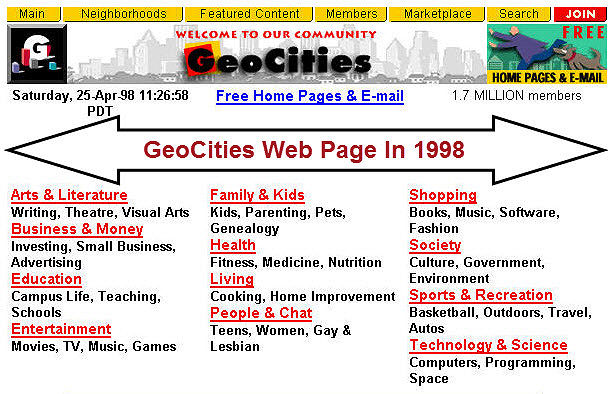
In the Golden Age of the Internet, websites consisted of little other than pure information and hyperlinks to more. Being restricted by bandwidth, websites focussed almost entirely on sharing the greatest quality of this info. Search engines such as Metacrawler indexed it all for ease of access. It was like having a library in every house.
The peak of the peak may have been around 2002, when an enormous number of small websites were available on GeoCities (later known as “GeoShitties”). This was also the peak of websites such as SlashDot, which appealed specifically to the programmers who were building the infrastructure of the Internet.
By 2003, the seeds of the decline had become apparent. Google AdSense was launched that year, which changed the web publishing game permanently. AdSense offered something truly revolutionary: cold, hard cash. But as is usually the case when cash is on the table, there were conditions.
The Google AdSense program was funded by advertisers, and those advertisers expected a certain degree of influence. In the same way that advertisers in newspapers 100 years ago exerted influence over what those newspapers published, AdSense advertisers pressured Google to not show ads on sites that carried certain content.
That meant content relating to illicit drugs, erotic literature, serial killers, violent anarchy and political extremism (i.e. all the interesting stuff) was produced less. This was the start of the great decline. Once Google AdSense money got involved, website owners started self-censoring to keep the shekels flowing in. The Golden Age of the Internet ended, and the Silver Age began.
The Silver Age of the Internet began on the 26th of September 2006, when FaceBook became open to everyone, and not just university students. This was the point at which social media really began to take off, a big deal because it meant that users could generate their own content. This steady stream of content could then be exploited by inserting advertising slots in it.
With the arrival of FaceBook, the Internet became a true commercial venture. Now there were billions of dollars involved. This was a Silver Age because of advertising, which corrupted the purity of the information. Although there was a greater quantity of information than ever, it had advertisements all through it.
The advertisers demanded more and more influence over the content. Eventually, FaceBook and YouTube became televisionised, with an extensive list of content restrictions. People started to get banned for calling each other ‘faggot’ or ‘nigger’. But still the Internet grew, to the point where the government decided that they had to get involved.
Once Big Government started to take an interest in what was being said on social media, and making up laws over who was allowed to say what, the Silver Age ended. The Bronze Age of the Internet began in April 2016, when Count Dankula was arrested for a YouTube video of a dog giving a Nazi salute. The freewheeling, freespeaking Internet of free expression was gone.
By the time of the Bronze Age of the Internet, there were so many retards online that much of cyberspace became detrimental to mental health. As the IQ of the average Internet user continued to decline, the quality of the average Internet experience became lower and lower. During the Golden Age of the Internet, the world’s retards bullied people for using computers – in the Bronze Age, they bully people by using computers.
If the Golden Age of the Internet saw its realisation, and the Silver Age saw its commercialisation, the Bronze Age saw its weaponisation. It was realised that, in the 21st Century, wars would be fought with information rather than bullets. The politicisation of the Internet saw people act to restrict the platform access of their ideological enemies.
By the time of writing this article, wrongthinkers are getting purged left, right and centre. Even websites like Reddit, founded in the twilight of the Golden Age specifically as a free-speech platform, are banning entire subforums on a weekly basis. It’s forbidden to discuss any subject that displeases the advertisers.
This has seen the rise and rise of imageboard culture, especially the chans such as 4chan. The ‘anything goes’ nature of these sites appeals to those who appreciated the Golden Age. In the Bronze Age of the Internet, those parts of cyberspace that still uphold the values of the Golden Age are dismissed as “cesspits”. This merely causes the appeal of the chans to grow further.
The Iron Age of the Internet is yet to begin. We can predict what it will look like: a totalitarian surveillance network in which the activities and social interactions of every citizen are tracked to the finest detail. 5G networks offer the bandwidth to transmit high-definition video footage faster than it can be viewed, and the advent of facial recognition technology means that they will know exactly where you are in real time.
Free speech restrictions might be bad now, but they can get worse. Improving AI tech will make it possible for any social media comment to be analysed and, if necessary, shadowbanned before anyone can see it. Even more ominously, the governments of all Western nations appear willing to increase Police harassment of online wrongthinkers.
When the Iron Age of the Internet is fully upon us, the Internet will be unrecognisably different from its Golden Age, much like today’s religions are radically different to those practiced during the Western spiritual tradition’s Golden Age in ancient Greece. We will then, as per Plato’s Republic, have to wait for a movement of philosopher-kings to overthrow the old Internet and institute a new one.
*
This article is an excerpt from Clown World Chronicles, a book about the insanity of life in the post-Industrial West. This is being compiled by Vince McLeod for an expected release in the middle of 2020.