What Actual Racial Equality In Cricket Would Look Like

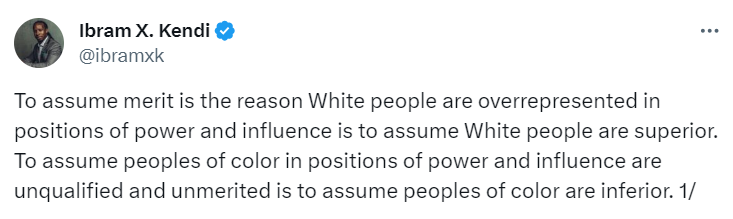
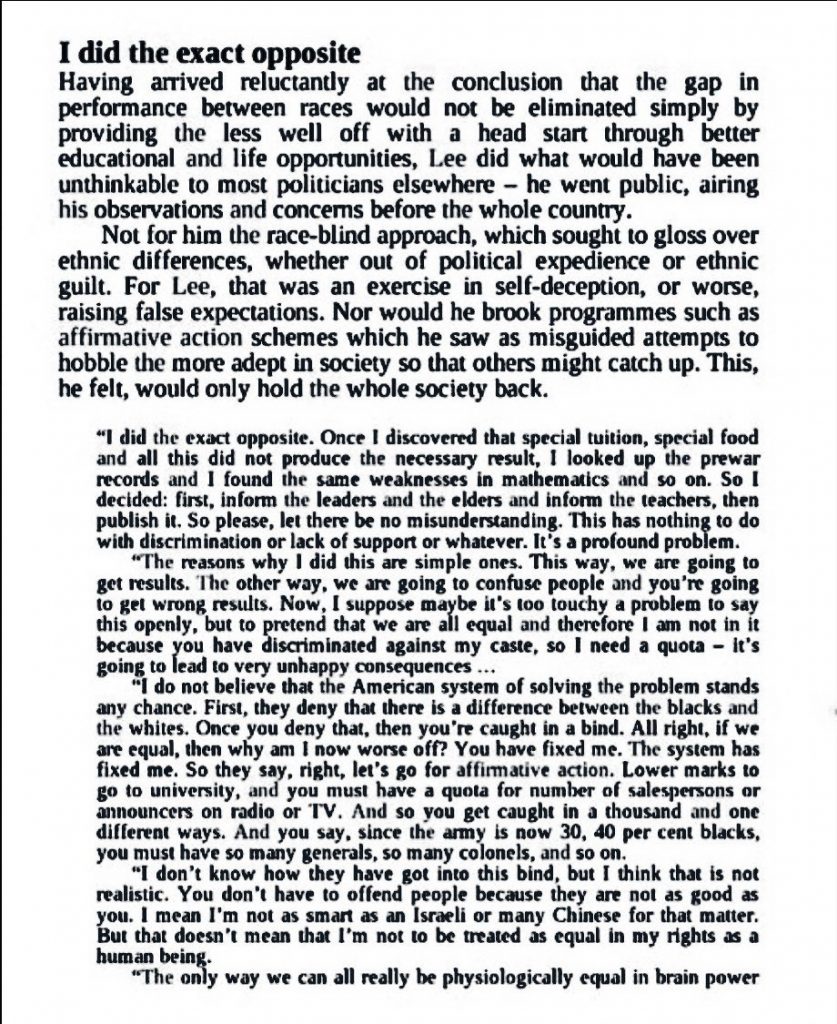
Everyone’s asking what racial equality would look like in the sport of cricket. The typical, low IQ, explanation is that it would look like equal representation for all disadvantaged communities and blah blah blah. This article suggests an alternative, higher IQ explanation free of Marxist nonsense.

The laws of cricket are based on a great many assumptions. One of those is that cricket is fundamentally a contest between bat and ball. Another assumption is that bowling fast is the “standard” way of beating the bat, and that spin bowling is a variation.

This latter assumption plays out often. The fast bowlers almost always open the bowling. Usually only after they’ve already had a go does the captain bring on a spinner. Often the spinner has to wait until the third (or even fourth) seamer has already bowled.

Seaming conditions are, at time of writing, considered “standard” conditions in international cricket. But not every bowler is suited to seaming conditions. More importantly, not every cricketing nation is suited to producing fast bowlers. And here we’re not talking about culture, but genetics.

As anyone who has recently seen the Australian cricket team will know, there are a lot of tall fast bowlers on the international scene. Mitchell Starc and Josh Hazlewood are 6’7″ and 6’6″ respectively. Pat Cummins is relatively short in such company, at only 6’4″. But even Cummins, the shortest of the three, is two standard deviations above the mean height of Australian males.

Fast bowlers tend to be tall for the same reason that baseball pitchers tend to be tall. The taller someone is, the longer their arms. The longer the arms, the higher the handspeed at point of release (all other things being equal). And the higher the handspeed, the faster the delivery. So international fast bowlers are almost always taller than their national average.

The national average, of course, varies from nation to nation. But it is precisely here that the current cricketing setup advantages some nations and disdvantages others.

Richard Dawkins has explained that civilisation has the effect of making populations smaller over the long-term. This it does by removing the major selective advantage in favour of large size, which is capacity for violence. In a state of Nature, a capacity for violence is the primary determinant of whether a man gets to pass his genes on to following generations. In a state of civilisation, the violent are executed and don’t pass their genes on.

So countries such as India, whose people have been civilised for several millennia, have long since lost a strong selective pressure in favour of size and capacity for violence. Countries with people of Northern European descent, whose people were barely civilised at all as recently as a thousand years ago, maintained that selective pressure much longer. Hence, Northern European men today are much bigger than Indian ones.

If the average height of an Anglo-Saxon male aged between 20 and 35 (the demographic that produces the vast majority of Australian cricketers) in Australia is 5’10”, and if this demographic is 10% of the total Australian population, then there are about 2.5 million men in this population.

If the average standard deviation of male Anglo-Saxon height in Australia is about three inches, then a player like Starc or Hazlewood is about three standard deviations above average. This means that players of their height are about 1 in 740 among the general population. 2.5 million divided by 740 gives us 3,378 – the number of Australian men tall and young enough to be extremely effective international fast bowlers.

Let’s assume that those young and male enough to make the Indian cricket team are also 10% of the population. But their average height is significantly less than that of the average Anglo-Saxon Australian – 5’5″-5’6″. So in order to be around Starc’s or Hazlewood’s height, the average Indian male has to be 4.5 standard deviations above the mean. This makes them much rarer – only about one in 300,000 Indian men will be that tall.

So if all the men aged between 20 and 35 in India comprise 10% of the nation’s population of 1.4 billion, this makes 140 million young enough for the national cricket team. Of them, only some 467 will be of a similar height to Starc or Hazlewood.

In other words, Australia has 7-8 times as many men tall enough to be extremely effective international fast bowlers as India does. This is despite that India has over 50 times as many people.

The conclusion from all of this mathematics is simple: the normalisation of fast bowling as the standard method of bowling a cricket ball provides an unfair advantage to countries with taller populations (the West Indies are also a beneficiary here, as anyone who saw Joel Garner, Curtly Ambrose or Courtney Walsh bowling will know).

The Indian phenotype, being shorter and with much more flexible wrists than white people, is far better suited to spin bowling. The more flexible one’s wrist, the easier it is to put large spin on the ball, and the greater the spin the higher the likelihood of taking wickets.

Racial equity in cricket, then, would require the normalisation of the idea that fast bowling and spin bowling were arts deserving of equal attention.

The situation facing the Indian Test team, and Ravi Ashwin in particular, is a disgrace. Ashwin is currently the world’s No. 1 Test bowler by far. The fact that he can’t find a place in the team when India tours England – because conditions in England have been manufactured to suit fast bowling on the basis that that’s normal bowling – is an absurdity.

The main argument of this essay is that genuine racial equality in cricket does not involve any Marxist nonsense, but is chiefly a matter of providing conditions that suit spin just as much as seam.

This might even entail a requirement that conditions in non-Asian countries be manufactured so that teams bowl at least 40% of their overs in spin (averaged across a season), and of the players’ own volition. That way, it could be said that bowling in cricket was something for all possible physiques, not just the tall and strong.

Such a measure would tip the balance back towards skill from strength. Cricket is primarily a game of skill – in contrast to sports like wrestling, boxing or rugby, where strength is the most important factor. Extreme skill on display has always been cricket’s major appeal. Forcing balance between pace and spin could be the way to maximise the skill component of cricket, and to minimise the strength component.

Eventually this might entail that international cricket teams would bowl around half their overs in pace and half in spin.

*

For more of VJM’s ideas, see his work on other platforms!
For even more of VJM’s ideas, buy one of his books!

*

If you enjoyed reading this essay/article, you can get a compilation of the Best VJMP Essays and Articles from 2021 from Amazon as a Kindle ebook or paperback. Compilations of the Best VJMP Essays and Articles of 2020, the Best VJMP Essays and Articles of 2019, the Best VJMP Essays and Articles of 2018 and the Best VJMP Essays and Articles of 2017 are also available.

*

If you would like to support our work in other ways, subscribe to our SubscribeStar fund, or make a donation to our Paypal! Even better, buy any one of our books!

Jordan Peterson’s Unthinkable Corollary

One of the topics that Jordan Peterson most enjoys lecturing us about is how we would have all been Nazis if we had lived in 1930s Germany. Peterson once said “I teach my students that had they been in Nazi Germany during the 1930s they would have been Nazis.” But there’s a corollary to Peterson’s logic – one that he himself dare not consider.

Peterson is an exceptionally knowledgeable psychologist and there’s little inaccurate about what he said. It’s true that human beings are social animals. As Edward Bernays wrote almost a century ago, people don’t tend to form their opinions by thinking about them, but rather by mindlessly aping authority figures.

Humans are not only social animals, we’re also herd animals. Like other herd animals, consensus is valued higher than truth. The consensus-setters are those who rule. In a state of Nature, that’s the strongest alpha male. In the modern West, it’s the invisible goverment that regiments the opinions of the masses through media control.

Media control allows the ruling class to shape the prevailing social narratives. Then, as per human nature, anyone going against any of those narratives is shunned, ridiculed and ostracised. Then the rest fall in line. In practice, it doesn’t actually matter what those narratives are. The vast majority of people will go along with any common narrative, no matter how ridiculous.

It’s an egoic delusion, Peterson loves to remind us, to think that we would have been immune to the propaganda of the 1930s, had we lived then. We are not immune to propaganda. Neither are we immune to social pressure. As such, we would have goose-stepped along with the rest of them.

Peterson is right to labour the point that the vast majority of 1930s Germans were not political philosophers, but rather just ordinary people, getting dragged along by the social currents of their time. Just like us! But then Peterson, happy to have delivered his sermon, ends it there.

The only problem with Peterson’s line of thought is that it doesn’t go far enough. There is a corollary to Peterson’s argument, one that Peterson dares not think about.

Namely: if the NSDAP had won the war, then according to Peterson’s own logic, we’d all be sitting here praising them today. If the NSDAP, and not Anglo-American capitalists, had won World War II, it would be the NSDAP setting the official moral agenda. They would control all of the world’s media. Thus, they would comprise the invisible government that shaped the world’s opinions.

If the NSDAP had won World War II and wiped the Jews out, then according to Peterson’s own logic, he himself would be telling people right now how that was the right thing to do. He himself would be lecturing people about how Nazi morality was self-evidently true as per the Will of God, and that the swastika represented order in contrast to the chaos of Marxism and Bolshevism.

Peterson might even be telling us that Hitler was the second coming of Rabbi Yeshua, the proof being that both Hitler and Rabbi Yeshua were opposed by the Jewish establishment of their time. If he did, he would be acting entirely consistently with his own admonition that, if modern people were transported back to 1930s Germany, they would be Nazis.

For him to deny this would be for him to contradict himself. It would mean that he had fallen prey to the same egoic delusion that he has been lecturing others about. In fact, psychological science tells us that had the Nazis won World War II, we would all be Nazis today. And just as globalist logic is self-evident to us today, so would Nazi logic be self-evident to us had they won.

In the same way that anyone wanting to become an academic today must deny the science of race and IQ so as to appease the globalist victors of World War II, anyone wanting to become an academic in the Nazi victory timeline would not be allowed to deny it. They would have to be a eugenicist, whether they liked it or not.

Most people, upon hearing this argument, will deny it stenuously (our morals in 2023, of course, don’t come from an invisible government but from pure reason). Hence it is described as an unthinkable corollary.

*

For more of VJM’s ideas, see his work on other platforms!
For even more of VJM’s ideas, buy one of his books!

*

If you enjoyed reading this essay/article, you can get a compilation of the Best VJMP Essays and Articles from 2021 from Amazon as a Kindle ebook or paperback. Compilations of the Best VJMP Essays and Articles of 2020, the Best VJMP Essays and Articles of 2019, the Best VJMP Essays and Articles of 2018 and the Best VJMP Essays and Articles of 2017 are also available.

*

If you would like to support our work in other ways, subscribe to our SubscribeStar fund, or make a donation to our Paypal! Even better, buy any one of our books!

The Seven Alchemical Ages Of Man

In the same way that the Mithraic Ladder consists of seven steps, so too can the life of a human being. From an alchemical perspective, the human life can be divided into seven distinct stages, each with its own metal and patron gods. These seven ages of man constitute a life ideally lived.

The first age, from zero to 12, is analogous to lead. At this level, base survival is the most important concern of all. Children aged between zero and 12 have to learn not to fall off cliffs, not to run out in front of traffic, not to provoke dangerous animals/people, not to eat poison or to stick a fork in an electrical socket.

This is the realm of Saturn. Being in the realm of Saturn, things are very serious. There is no room for levity when you’re trying to teach a child not to get hit by a bus. Historically speaking, most people died in the first 12 years of life, mostly from childhood diseases. Thus there is a connection between Saturn and the Grim Reaper.

From 12 to 24, the relevant alchemical metal is tin. This is the realm of Jupiter, where joy is the natural state. This second alchemical age is achieved by anyone who survives the age of Saturn, i.e. the age of basic physical survival. No longer being concerned with death or dying, teenagers become primarily concerned with overcoming boredom.

All play and all games occur under the auspices of Jupiter, whose jovial nature embodies the frequency of recreation. Tin is brighter than lead; this represents the overcoming of the saturnine seriousness of the first age and the transmutation of dullness into brightness.

The years 24 to 36 are spent under the auspices of Mars, the god of iron. These years are when a man masters fighting and martial prowess. The peak fighting ability of most men will be during this age. Usually a man learns how to fight as an individual at the beginning of the age of iron. By the end of the age of iron, he could lead a century of men into battle.

Iron can carry a sharper edge than any other metal, hence it represents the basic masculine action of dividing. For millennia, an iron sword was the very emblem of strength and virility. Successful transmutation of tin into iron means that a man learns how to impose order upon the material world. Being able to impose order, he is now a warrior.

Venus rules the years from 36 to 48. Here the relevant metal is copper, representing romance and lovemaking. Having proven himself on the battlefield, here the alchemist has to prove himself with the trophy of battle: a woman. Hence the peak sexual market value of a man who has lived well is between these two ages (the less well one lives, the earlier one peaks).

Copper is both softer and more colourful than iron. This represents the age when man realises there is more to life than battle. Here he must soften because he must engage with his children instead of foes on a battlefield. So he softens, becomes funnier and less serious. Transmutation of iron to copper is about the change from warrior to family man.

From the years 48 to 60 man labours under Athena, the goddess of civic participation. Having raised his children so that they have successfully survived the gauntlet of lead in the first alchemical age, a man moves beyond his family and moves into a position of social power. Silver is more brilliant than copper, representing man’s broadening of focus from family to society.

Plato wrote in Republic that a man is ready for a political life at age 50. By the fifth alchemical age a man should have exhibited enough mastery over his life so far that other people want to be like him. He is not yet capable of radiating divinity but, under the auspices of silver, he can reflect it (as does the Moon). As such he can play a role bringing people together.

Between 60 and 72 a man is in the realm of mercury. Mercury is also the name of the god of the sixth alchemical age. Silver is transmuted to mercury by a process of quickening, in other words, through the entry of the divine into the material world. This is a minor form of illumination compared to the seventh age, but it’s powerful enough to have major effects.

This is the age of greatest temporal power. At the completion of the age of mercury a man might be an emperor with control over all the known world. Compared to a man of silver, a man of mercury has more gravitas and inspires more awe. Some might even consider him a demigod.

From age 72 to age 84 – or until the end of life – a man is in the realm of gold. Here he ought to fashion himself after Apollo, who represents perfection and illumination. In this age a man ought to learn how to radiate divine truth. Learning to do this is the secret of transmuting mercury into gold.

Ideally, a man reaching this stage would retire from all material concerns and focus entirely on readying himself for death. Temporal power has little appeal to those in God’s waiting room. Those who can grow old and die with grace and dignity can be said to have apotheosised, as Socrates did. Dying with the highest possible frequency brings the best chance of taking one’s place among the gods after death.

The example given in this article is idealistic. The actual life of any given alchemist will not progress this smoothly. Aspects of all seven ages are present in every age, and so a person can work the frequency of any stage at any time.

*

For more of VJM’s ideas, see his work on other platforms!
For even more of VJM’s ideas, buy one of his books!

*

If you enjoyed reading this essay/article, you can get a compilation of the Best VJMP Essays and Articles from 2021 from Amazon as a Kindle ebook or paperback. Compilations of the Best VJMP Essays and Articles of 2020, the Best VJMP Essays and Articles of 2019, the Best VJMP Essays and Articles of 2018 and the Best VJMP Essays and Articles of 2017 are also available.

*

If you would like to support our work in other ways, subscribe to our SubscribeStar fund, or make a donation to our Paypal! Even better, buy any one of our books!
A Paean To Springbok Rugby

I have always felt, from the perspective of the whole world, that rugby was the greatest sport of all. My personal favourite sport is Test match cricket, but that’s a peculiar taste, off-limits to most. The great masses of plebs prefer soccer, but, of those, the majority can be persuaded to understand rugby if given the chance. When they are, many prefer rugby to soccer.

Within rugby there are many great rivalries. All Blacks vs. Wallabies is a common favourite, as are England vs. France and England vs. Wales. The best, however, is All Blacks vs. Springboks. This rivalry has most consistently produced close contents exhibiting high skill levels. Therefore, if rugby is the greatest sport of all, the All Blacks vs.Springbok rivalry is the greatest sporting rivalry of all.

The basis of this rivalry is not merely quantitative: it’s not merely because the Springboks beat the All Blacks more than any other team does, nor is it merely because the Boks and ABs win the most Rugby World Cups. Many have claimed this, but are wrong.

The basis of the All Blacks-Springboks rivalry is qualitative: it’s because these are the only two sides who would rather die on the field than lose.

If my love of cricket really began with the 1992 Cricket World Cup, then my love of rugby really began with the 1995 Rugby World Cup. I stayed over at a friend’s place to watch the final and he, his family and I woke up in the middle of the night for it. The whole saga around Jonah Lomu, Sean Fitzpatrick, Jeff Wilson, Nelson Mandela, Joel Stransky, Francois Pienaar and the food poisoning was fantastic drama.

I have followed most All Blacks matches since then. I have observed many patterns in these matches. One of these patterns is that All Blacks vs. Springboks games are regularly the best theatre in world rugby, and, therefore, in world sport.

The reason why the All Blacks routinely beat the Northern Hemisphere teams, I have always reasoned, was because they wanted it more. The All Blacks were more committed to tackles, more committed to diving on the loose ball, more committed in the air, at scrumtime, all across the park. This was typified by the example of Buck Shelford getting his scrotum torn open during a match against France, getting it stitched up again and then playing to the end.

The Springboks want it just as much. Defence, for them, appears to be a matter of life or death. Springbok players seemed happy to launch themselves like human missiles at players about to score in the corner. Ball in hand, their favourite thing was to run it up the middle like something out of the Iliad. All this was first-rate entertainment, and why many of my favourite non-All Black players, over the years, have been Boks.

Gary Teichmann was for many years the archetypal Springbok player. Big, fast and skilled, he was the first Springbok who I observed to be a truly dangerous opponent. The 17-win streak under his captaincy etched permanently into my mind the perception of Springbok excellence.

Joost van der Westhuizen was in a similar category thanks to his intensity. A 90s journalist in New Zealand described him as possessing a “Man from Blood River Stare”. In his mind, he was at war. To me, van der Westhuizen embodied the spirit of rugby.

I believe that no rugby player has ever played with less regard for his own physical safety than Corne Krige. Watching Krige clatter into rucks like a runaway train was premium entertainment. That his Super Rugby career ended with an eight-week ban for headbutting is comedy gold.

John Smit was the most respected captain of any All Black opponent, even more so than Eales, Johnson or Dusautoir. He understood that you can’t outpassion a team that does hakas before the match. So you have to coldly dismantle them. Winning 3-0 against the All Blacks was a feat I’ve never seen repeated.

Victor Matfield was always my personal favourite. Because he was the same height as me, I imagined that Matfield was what I would be like if I played international rugby. The matches he played with a forearm brace were great theatre.

Schalk Burger was maximum entertainment, as he appeared to be completely insane, like a Viking beserker. Second only to Krige in terms of total disregard for his own safety.

Jean de Villiers marked the beginning of a new era of Springbok rugby – that of using brains. The Boks before then were as tough as anyone, but they made a lot of mistakes in the top two inches. After de Villiers captained the side, the Boks became much less predictable.

Pieter-Steph du Toit perhaps best typifies the modern Springbok approach. He is capable of exerting ruthless defensive pressure while maintaining a low error rate. Like Gary Teichmann but somehow even bigger, faster and more skilled.

Some have accused the Springboks of playing one-dimensional rugby, of being “bosh merchants”. I have always disagreed. Rugby is fundamentally a battle of possession. The Springboks have never forgotten this. Therefore, I consider their style pure, unconcerned with the fashions of the day.

It’s true, however, that there has always been an element of villainy in the Sprinboks’ contribution to rugby culture. Like the rest of New Zealand, I was appalled when Johan le Roux bit Sean Fitzpatrick’s ear, when Matfield cracked Byron Kelleher in the head with his forearm brace, when Bakkies Botha headbutted Jimmy Cowan.

Ultimately, despite the thuggery, Springbok vs. All Black rugby is the best sporting theatre on earth. As such, I don’t mind losing to the Springboks in the final this year as much as I would have minded losing to England, Ireland or France. The Boks want it more, so fair enough.

*

For more of VJM’s ideas, see his work on other platforms!
For even more of VJM’s ideas, buy one of his books!

*

If you enjoyed reading this essay/article, you can get a compilation of the Best VJMP Essays and Articles from 2021 from Amazon as a Kindle ebook or paperback. Compilations of the Best VJMP Essays and Articles of 2020, the Best VJMP Essays and Articles of 2019, the Best VJMP Essays and Articles of 2018 and the Best VJMP Essays and Articles of 2017 are also available.

*

If you would like to support our work in other ways, subscribe to our SubscribeStar fund, or make a donation to our Paypal! Even better, buy any one of our books!