
The Four Elements of Health

Alchemism holds that the metaphysical world is comprised of four masculine elements of clay, iron, silver and gold. Because we can apply the maxim as above, so below, we can reason that there are patterns within the physical world that reflect this. This essay look at personal health through the prism of the four masculine elements.

The first element of clay relates to eating well. There are two aspects to this.

Fundamental to physical health is simply getting enough food. This fact has long been forgotten in the West on account of our centuries of abundance, but it’s still a biological reality for all creatures. The primary survival challenge for creatures similar to us in a state of Nature is to gather enough food resources to meet their metabolic needs. If this is not possible it will lead to hunger, then weakness, then death.

Another important aspect is that one gets the right food. It’s not simply a matter of filling one’s stomach: one must eat food that is actually healthy. Acting correctly at the level of clay will see a person avoid sugar and fatty cheeseburgers in favour of fruits, vegetables and home-cooked meals. Someone who has mastered life at this level will act as if food is medicine.

Iron relates to physical discipline in the pursuit of health. There are also two aspects to this.

Most obvious is exercise. The body has to be used, otherwise it will fall into decay. Humans were very active during the biological past, and this is reflected in the biological present. Properly applying the element of iron to one’s health means that one will get up and stay fit, whether through walking, running, swimming or biking. thereby one becomes physically hard, like iron.

Iron is the masculine element, and as a consequence it is the element that imposes boundaries. Therefore, part of the realm of iron is preventing unwanted substances from entering one’s body. This is obviously true in the case of poisons, but become trickier when applied to drugs and medicines. Acting correctly in the element of iron will see a person keep harmful things out of their body.

Silver relates to intellectual exercise. This shares elements of both clay and iron, and like clay and iron there are two distinct aspects to silver.

The former relates to what you put into your head. This relates to quality of information. A person acting at the level of silver will take care to not read low-information sources. They will tend to avoid gossip mags and FaceBook. Someone succeeding at this level will read full books from start to finish, and will cross-reference claims made in the media with other sources before believing them.

The latter relates to the discipline necessary to keep using the mind. The brain is like a muscle: you will lose it if you don’t use it. It’s important to keep reading everyday, and thinking about what one has read, as well as challenging what one thinks is known. Part of the realm of silver is intellectual debate, and a healthy individual at the level of silver will be able to do with words what the man of iron does with a sword.

The element of gold relates to spiritual exercise. Again like the previous elements, this is achieved in two ways.

The first is to keep incorrect thoughts out of one’s head. Gold is different to silver here because the realm of gold deals with frequencies, and not information like silver. So this does not relate to keeping bad information out of the head, but rather bad frequencies. Correct application of gold to health involves avoiding people and situations that cause bad energies, as well as patterns of thought that lead to same.

The most important spiritual exercise, of course, is meditation. Only through meditation does an individual arrive at the peace of mind and self-knowledge necessary to make correct decisions. Meditation is the final transmutation of the previous three elements into the gold of enlightenment. This brings what is usually referred to as “mental health”, involving a calm acceptance of things.

These four elements combine to create a complete picture of health. An individual who succeeds in applying these four elements to their health will be physically, mentally and spiritually healthy.

*

If you enjoyed reading this essay, you can get a compilation of the Best VJMP Essays and Articles of 2017 from Amazon for Kindle or Amazon for CreateSpace (for international readers), or TradeMe (for Kiwis).
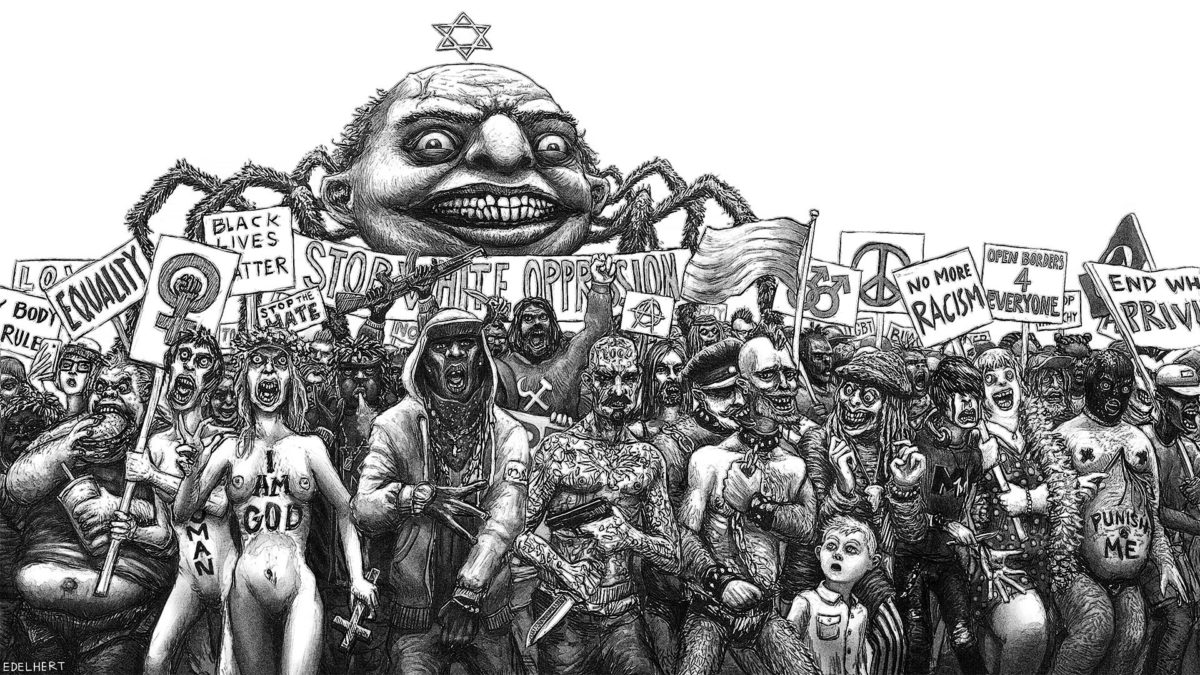

The Bogan-Faggot Spectrum

This essay introduces a new concept in psychology: the B-F spectrum. This is short for Bogan-Faggot spectrum, which is a way of measuring maladapative personalities on a scale from 1 to -1, with a score of 0 a good healthy medium that will allow for well-adjusted behaviour in most instances.

At one far end of the B-F spectrum is the Bogan Pole, represented by the extreme value of 1. This is essentially the pole of maladapted masculinity, or an excess of masculinity. This is so named after the hyper-aggressive, low-intelligence bogans that make life really hard for working-class people, by causing society to think of them when they think of the working class.

Here we find a masculinity so stubborn and unyielding that parents regularly hit and verbally abuse their children, reasoning that the children need to grow up “hard” in order to cope with the challenges of life. At the Bogan Pole, all emotional expression is for faggots. Expressing an emotion is a sign of weakness because it is evidence that one has lost one’s self-composure.

At the Bogan Pole, there is to be no similarity between men and women. Men are hard, women are soft, end of story. There are a set of actions and displays that are only permissible for men, and there are others that are only permissible for women. Any man or woman who performs an action or display characteristic of the other gender is subhuman.

At the other end of the B-F spectrum is the Faggot Pole, represented by the extreme value of -1. This is the pole of maladapted femininity, or excessive femininity. It is named after the hyper-passive-aggressive, overly sensitive faggots that make life really hard for homosexual people, by causing society to think of them when they think of homosexuals.

This is a kind of toxic femininity that demands that everyone and everything be forced to be equal. It is a kind of slave morality, in that it demands that everyone be meek and self-effacing, lest they be shamed into it by the collective. At the Faggot Pole, all assertive expression (such as the setting of boundaries) is for bogans. Anyone who has a high self-esteem has to be ripped down the level of the collective.

At the Faggot Pole, there is to be no difference between men and women. An individual can possess any characteristic whatsoever, or fail to possess any characteristic whatsoever, and still assert that they are either man or woman (or anything else). Anyone who claims otherwise is a filthy bogan, because they are setting boundaries and that is masculine.

Also at the Faggot Pole is a relaxed attitude to sexual abuse of children. In much the same way that people at the Bogan Pole, being hyper-masculine, don’t consider violence against children to be a bad thing, neither do people at the Faggot Pole, being hyper-feminine, consider sexuality towards children to be a bad thing. People at this pole are far more likely to believe that they are doing children a favour by molesting them.

The B-F spectrum is an alchemical triangle in the sense that the healthiest behaviour lies in the middle. Both the Bogan Pole and the Faggot Pole represent extremes of behaviour that are not well adapted to the challenges that our society offers. The central position, represented by 0, refers to behaviour that is neither hypermasculine nor hyperfeminine – just balanced, intelligent, appropriate behaviour.

It could be that some situations genuinely demand the taking of a particular position on the B-F spectrum, or at least one close to one of the poles. If an individual goes to war, it makes sense to take a B-F position closer to 1 on account of the violence and deprivation that they will encounter. If an individual makes love, it makes sense to take a B-F position closer to -1 on account of that one is in a situation where boundaries are dissolved.

It’s worth noting that the poorer a person is, the more likely they are to approach the Bogan Pole, and the wealthier a person is, the more likely they are to approach the Faggot Pole. This is a long-observed phenomenon. The most common downfall for any man mighty enough to make himself into a king was having a son who becomes effeminate as a result of the wealth and comfort in which he lives, and who thereby becomes too weak to maintain his position.

There is, as of yet, no questionnaire that will estimate where an individual is on the Bogan-Faggot spectrum. Future research will have to identify variables that correlate with excessive masculinity or excessive femininity, and from there it will be possible to develop a set of questions. In any case, intuitive estimations might still have some use.

*

If you enjoyed reading this essay, you can get a compilation of the Best VJMP Essays and Articles of 2017 from Amazon for Kindle or Amazon for CreateSpace (for international readers), or TradeMe (for Kiwis).

Why You Can Never Know if Another Person is an NPC, And What This Means

Much recent interest has been devoted to the idea that a significant proportion of other human beings might be “NPCs” (non-player characters). What is meant by this is that “the lights are on but nobody’s home” – that the person is not conscious, despite appearing to be. As this essay will discuss, this philosophical problem has a number of chilling interpretations.

When people decry others as NPCs, what they are really saying is that these people are not conscious. There might be bodies moving around and saying and doing things, but there is no conscious observer that pays attention to the lived experience of such bodies. Individual NPCs might just as well be androids of some kind, machines that replicate the functions and actions of conscious beings without actually being such.

The reason why recent interest has attached to this idea is that some people seem to be utterly incapable of thinking for themselves.

Certain political issues have made it apparent that a large proportion of voters do not think about reality at all. They are happy enough to adopt wholesale a Weltanschauung from the television and from their peers. This is especially true if a person adheres to one or the other side of the mainstream political spectrum, but a political allegiance isn’t necessary. Many people’s heads seem to be more or less empty: they simply repeat whatever has been pumped into them from the outside.

This has led others to wonder if there’s anyone really in those heads at all. These apparently unthinking people might be NPCs: essentially meat-puppets that look and sound like humans but which have no conscious will, and who therefore are incapable of creative direction. They can only follow orders like drones, whether those orders come from other humans (PCs or NPCs), the Government or the television. They are therefore categorically different to those of us who are conscious.

But this line of reasoning opens up some extremely thorny philosophical questions.

Primary among these is that you can’t measure or detect consciousness empirically. Consciousness is a state of being aware, and this is impossible to measure because awareness cannot be detected by any instrument. A materialist will object that it is possible to measure responsiveness, and this can be done with (for e.g.) EEG machines that can tell whether a person is awake – but these measures are always of purported correlates of consciousness, not consciousness itself.

We seem to intuitively believe that being “awake” is somehow linked to being conscious, but the simple fact is that we are also conscious of experiencing dreams, and are therefore also conscious even when asleep. Therefore, our intuitive perceptions about who is conscious are not necessarily accurate. It may be that the common perception that all humans are conscious is erroneous.

One can be aware of one’s consciousness, of course. This is logically trivial: if one is conscious of anything at all, then one is conscious. Therefore, if you’re even aware of yourself asking the question of whether or not you’re conscious, you must be. Although, because one’s own consciousness cannot be measured any more than that of other beings can, its presence cannot be proven to anyone other than oneself.

It really seems that the only way consciousness can be sensed in others is by means of some intuition. It certainly seems as if consciousness can be detected in others; at least, this seems intuitively true to most people. This is the basis of the NPC phenomenon: by whatever means this intuitive decision is made, a person decides that another person is either conscious or not.

The difficulty then arises: is it true that all other humans are conscious, or only some? Because not everyone necessarily agrees. Some argue that only their race is conscious, and that others are some kind of ‘bugmen’. Others argue that only members of their religion are conscious, because only these have been “infused with the light of God” or similar. Yet others argue that only members of their class are conscious, and that the poorer someone is, the more like an animal.

The obvious problem with this way of thinking is that it leads to asking questions like: if other races/religions/classes are not conscious, why not just wipe them out for the sake of securing a better position for our own? It’s clear to anyone who has studied World War II that the dehumanisation of other people, by way of declaring them less conscious, can easily lead to bloodshed and genocide. This is why the vast majority of people have adopted the unspoken assumption that all other humans are conscious.

Even if all humans are declared conscious, one must then ask if all other beings are conscious, or only some?

Another thorny philosophical question is moral: if another individual is an NPC, and therefore not conscious, is it immoral or not to exploit that individual? One the one level, it seems like nothing should be different, but on another, it could be argued that if nothing is aware of any injury caused to the physical body then it isn’t really suffering. Therefore, harm done to beings that are not conscious is not immoral (unless those beings are the property of someone else).

Because you can never really know if another person is an NPC, the default response seems to be to assume that no-one is, i.e. that all other people are conscious and that their suffering is meaningful. This is certainly the approach that a courtroom will take if you beat up someone because you think they are an NPC. But you can’t ever really be sure.

*

If you enjoyed reading this essay, you can get a compilation of the Best VJMP Essays and Articles of 2017 from Amazon for Kindle or Amazon for CreateSpace (for international readers), or TradeMe (for Kiwis).

Folksjälvmord

On my first visit to Sweden, from 2001 to 2003, I found occasion to coin a word in the Swedish language. They already had a word for genocide (‘folkmord’) and they already had a word for suicide (‘självmord’), but they didn’t have a word for the sociological phenomenon, widespread at the time, that combined both. This essay discusses ‘folksjälvmord’ and the reasons for it.

If you have 1,000 crowns in one bank account at 6% interest, and 100,000 crowns in another bank account at 2% interest, inevitably the first account will become larger than the second (assuming no withdrawals or changes to the rate). This is a matter of mathematical certainty, and can be proven true in every case where a smaller balance has a higher interest rate than a larger balance. No-one disputes this.

By similar reasoning, we can see that if the population of a minority group is increasing faster than their host population, then the minorities will eventually outnumber their hosts. Assuming no withdrawals (i.e. deportations or genocides), then a population that has a fertility rate of 3.0 plus 50,000 immigrants per year will eventually grow to overwhelm a population that starts out a hundreds times larger, but which only has a fertility rate of 2.0 or less (and no immigrants).

This process is known straightforwardly as “conquest” in any other context, but when the host population has an overwhelming military advantage compared to their invaders it isn’t so simple. If the hosts are willingly paying tax money to import these minorities, and then paying again to have those minorities breed while on welfare, then they’re effectively paying for their own ethnic cleansing.

This process can only be likened to a collective suicide, or suicide at the level of the population – folksjälvmord. After all, politics is little more than the expression of power, and the expression of power is mostly a numbers game, particularly in a democracy. If the host population stops being the majority then they give up power, and giving up power within your own country to a foreign entity that you imported can only be analogised as stabbing oneself in the leg or stomach, perhaps harakiri style.

Swedes didn’t think much of my witty neologism. The thought that it might happen to them seemed to be so unpleasant that it simply couldn’t be countenanced. It didn’t seem to matter to them that the same process of inevitable mathematical conquest was precisely what happened in the New World, where I came from. Better to simply blindly believe that all would be well than to ask how the Africans and Muslims would behave when they comprised 20%, 30%, 40%, 50%+ of the population.

This wilful, oblivious ignorance about the state of their situation might be likened to a delusion-based psychiatric illness, in the same way that someone who is obviously dying but who refuses to admit it.

A man addicted to heroin doesn’t want to hear that the drug will soon kill him; a nation addicted to virtue-signalling and self-righteousness doesn’t want to hear that the mass importation of foreigners with incompatible values will soon destroy them. In either case, a well-meaning observer might be well aware that the behaviour in question was effectively suicidal.

Sixteen years after this first visit of mine, it’s possible to observe the results of the practice of folksjälvmord. Although the decay of the country is yet to reach the elites – and therefore, yet to be officially acknowledged – the Swedish people are certainly aware of it. They responded by giving 18% of their votes to the far-right extremist Sweden Democrats in a General Election last month.

In Germany, which has also recently imported a large number of low-IQ immigrants, a similar phenomenon can be observed. Opinion polls for the next German Federal Election show that the far-right extremist Alternativ fuer Deutschland is now polling higher than the Establishment social democrats. This phenomenon is likely to spread to other nations that let in large numbers of “refugees” against the better judgment of the more sober of their citizens.

Folksjälvmord, then, doesn’t simply refer to a declining population, because populations (historically speaking) tend to resist conquest with as much violence as they can muster. It can also refer to the coming to power, within a nation, of groups of people who are patently unfit to rule, and who wreck the place. Folksjälvmord could, in that context, be considered a symptom of a dark age, or Kali Yuga. The destruction is as much internal, and spiritual, as external and physical.

The state of the world has notably changed since first coining the term ‘folksjälvmord’. The national suicides of the European nations are continuing apace – but now the Far East Asian ones have joined them. Indeed, the fertility rate in Far East Asia is now lower than Northern Europe (China 1.6, Japan 1.4, South Korea 1.2, c.f. Sweden 1.9, Netherlands, Denmark and Norway 1.7), and is continuing to fall there.

Perhaps the most frightening realisation is that folksjälvmord is far from a uniquely Swedish, European or even Western problem. It seems to be a natural part of the ebb and flow of empires and the golden ages of various peoples: as before, so after.

*

If you enjoyed reading this essay, you can get a compilation of the Best VJMP Essays and Articles of 2017 from Amazon for Kindle or Amazon for CreateSpace (for international readers), or TradeMe (for Kiwis).