
The Basics of VPN Use, And Why Every Kiwi Needs to Know Them

The aftermath of the Christchurch mosque shooting showed that the New Zealand Government is willing to give away all of our freedoms in its blind panic to clamp down on everything. We Kiwis are going to have to learn how to fight Internet censorship and how to share information despite a Government committed to banning free discussion. This article discusses the basics of VPN use.

‘VPN’ stands for Virtual Private Network. It serves to extend a private network across a public one, so that you virtually access a private network somewhere else in the world. Essentially, a computer somewhere else surfs the Internet on your behalf, and then sends the data directly to your computer. The point of this is primarily to circumvent government censorship and corporate geo-restrictions.

It’s like the diplomatic black bag of internet traffic – the Government can’t snoop in on it while its in transit and choose to block it.

VPNs are very popular in totalitarian countries such as China, because they allow their users to access websites that the government doesn’t wish them to access. As any reader of 1984 could tell you, the prime objective of any government is to stay in power, by whatever means necessary. One of the primary ways this can be achieved is by controlling information and discourse, so that rebellious ideas cannot flourish in the minds of the populace.

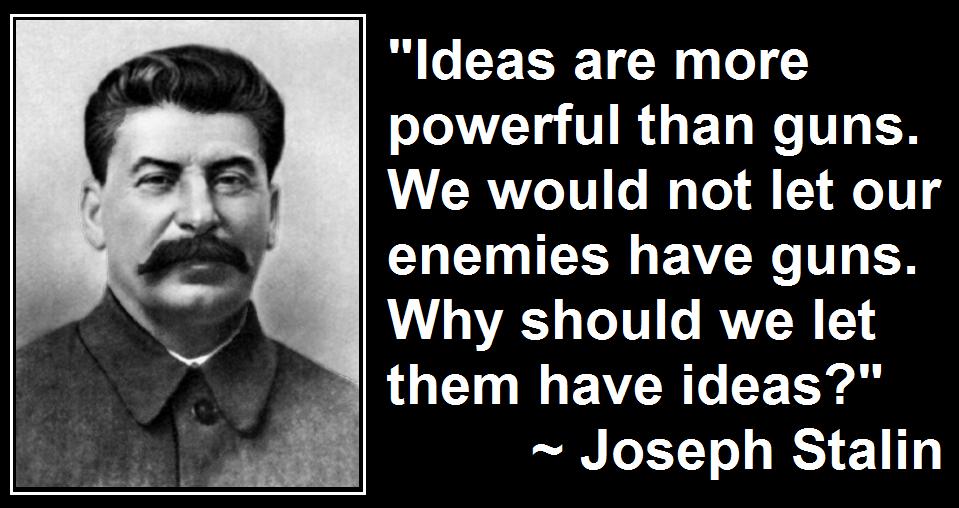
As Joseph Stalin put it: “Ideas are more dangerous than guns. We would not let our enemies have guns, why should we let them have ideas?”

In the wake of the Christchurch mosque shootings, the New Zealand Government has taken a sharply totalitarian turn. They seem to have decided, without securing the consent of the people or even making an announcement, that it’s okay for them to censor whatever website they see fit, for any reason (or even none). Although they will not admit it, this is a totalitarian action that breaches fundamental human rights. For this reason, we citizens are forced to take counter measures.

When a country such as New Zealand tries to block the free flow of information to its citizens, those citizens have to turn to grey- or black-market solutions such as VPNs. Using a VPN will allow a person to access almost any website that the New Zealand Government may have decreed verboten, for the reason that the Great Firewall of New Zealand will consider the web traffic to be something else.

The Opera browser comes with a built-in VPN, which is probably the easiest way to get started for anyone new to the idea. The simplest way to get started is to just download and install the Opera browser (the download page can be found with a simple web search). If you then open that browser, you can see the Opera symbol up in the top left corner. Clicking on this will open a drop-down menu, on which you can select ‘Settings’ near the bottom.
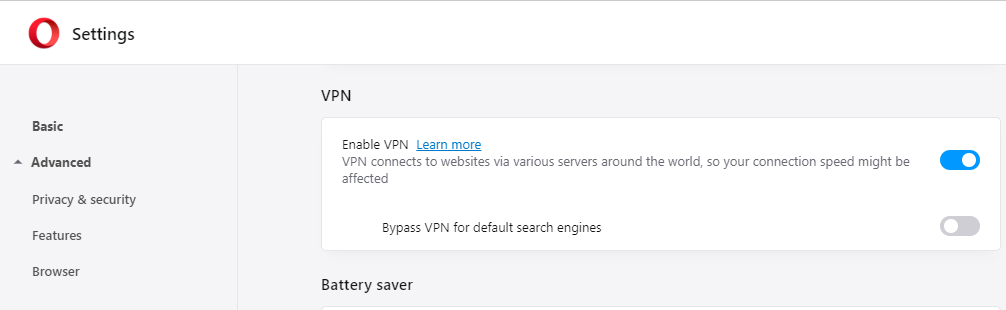
This will take you to a separate Settings page, where you have a number of options. By default, you will come to the Basic panel. Towards the top-left corner of the screen, underneath the word ‘Settings’ you should be able to see the words ‘Basic’ and ‘Advanced’. ‘Advanced’ is a drop-down menu, itself consisting of three options: ‘Privacy & security’, ‘Features’ and ‘Browser’.

If you click on ‘Features’, a number of options will appear in the centre panel. At the top of these is one called ‘VPN’. Underneath this is the option to ‘Enable VPN’. From here, enabling the browser VPN is a simple matter of hitting the radio switch to the right.

Note that this may make your browsing a bit slower, because the VPN is an extra step between you and your data. However, this is a minor inconvenience, and may be your only easy option if you want to access forbidden websites.

Some people might say at this point “But the Government, in its omnibeneficence, only banned the really evil sites where hate speech flourished and I didn’t want to go there anyway.” Fair enough – but the Government could ban anything else in the future, and so you might as well learn how to circumvent that now while you still can.

Ask yourself, do you really believe that the Government is going to stop with 8chan and Zero Hedge? The Government probably regrets that the Internet ever came to exist. They would gladly switch to having a North Korea-style government news service with all alternatives banned if they thought they could get away with it.

So what we can expect is more of what David Icke calls the “Totalitarian Tiptoe”, in which the Government bans an ever-increasing number of websites, taking advantage of moral panics to do so. Because the Government’s appetite for power and control is unlimited, Kiwis ought to get to know the basics of VPN use immediately.

*

If you enjoyed reading this essay, you can get a compilation of the Best VJMP Essays and Articles of 2018 from Amazon for Kindle or Amazon for CreateSpace (for international readers), or TradeMe (for Kiwis). A compilation of the Best VJMP Essays and Articles of 2017 is also available.

VJMP Reads: Edward Bernays’s Propaganda VII

This reading carries on from here.

The seventh chapter of Edward Bernays’s Propaganda is called ‘Women’s Activities And Propaganda’.

Bernays is comfortable stating, in 1928, that women “have achieved a legal equality with men”. This doesn’t mean that their activities are the same – it simply means that their vote is of equal worth. This makes them particularly important to understand from a propaganda perspective.

He points out that women don’t have to occupy high positions of political power in order to have a strong political influence. It doesn’t matter that women are not taken as seriously as men in positions of high leadership, because they lead women’s organisations with great numbers of members, and the women leading them have a heavy influence on how their members vote.

Bernays considers the women’s suffrage campaign (which had won victory in America shortly before he wrote this book) to be a good example of the power of propaganda to bring societal changes. He credits the use of propaganda by women’s organisations for increased social welfare and alcohol prohibition. Many female propagandists were trained either by the suffragette movement itself or by the Government during World War One.

These clubs can hold events that draw large numbers of people, so if a popular enough event can be held, it will result in great numbers of people being influenced. Bernays is especially taken with the idea of such clubs sponsoring art or literary competitions. Such events can generate enormous amounts of goodwill.

Bernays is optimistic that an increased voice for women can help mould the world into a better place for all of us. He believes that the entrance of women into politics will allow them to focus on areas that men had previously neglected or were not interested in. This is primarily achieved by the introduction of new ideas or methods.

*

If you enjoyed reading this essay, you can get a compilation of the Best VJMP Essays and Articles of 2018 from Amazon for Kindle or Amazon for CreateSpace (for international readers), or TradeMe (for Kiwis). A compilation of the Best VJMP Essays and Articles of 2017 is also available.

VJMP Reads: Edward Bernays’s Propaganda VI

This reading carries on from here.

The sixth chapter of Edward Bernays’s Propaganda is called ‘Propaganda and Political Leadership’. Having elaborated upon the basics, Bernays now turns to what this book is best known for.

The chapter opens with an almost Machiavellian statement of anti-democracy. “No serious sociologist any longer believes that the voice of the people expresses any divine or specially wise and lofty idea.” The leader, then, has an obligation to use propaganda to induce the people to go in the right direction.

Curiously for 1928, Bernays is in a position to lament the apathy that already existed in the American voting population of the time. He presages the coming of Adolf Hitler when he states that this apathy only exists because of the failure of any political leader to capture the imagination of the public (this might be because propaganda has been used to destroy political communication).

Voter apathy is here blamed on the inability of politicians to dramatise themselves and their platforms in terms that have real meaning to the public. This cannot be achieved by a politician who merely follows the public whim. Given the strictures of democracy, “The only means by which the born leader can lead is the expert use of propaganda”.

Political campaigns ought to be planned and conducted as professionally and as meticulously as any advertising campaign of a large company. To this end, they would do well to be honestly funded. Bernays decries the “little black bag” method of funding, on account of that it lowers the prestige of politics.

A clever political campaign will outline, from the beginning, specifically which emotions it intends to appeal to. It will figure out exactly who it intends to appeal to, how to reach those people, and the areas in which multiple target groups have aligned interests.

Politicians, as leaders, ought to be creators of circumstances, not victims of them. In this, they have to be clever. The old-fashioned approach is to assault voting resistance head-on, through argumentation. The new approach is to arrange things so that such a conclusion seems dramatic and self-evident.

The best thing is to agitate the public into a sense of anxiety beforehand, so that when the politician speaks it is as if they are providing the answer to a desperate question. Bernays expresses a strong conviction that untrue propaganda will never drive out the honest, because the untrue propaganda will become weakened by growing public awareness of it.

Viewed from ninety years later, it seems that Bernays was altogether too naive and trusting. He wasn’t wrong when he says that the question of whether the newspaper shapes public opinion or public opinion shapes the newspaper is a bit of both. However, he didn’t appear to have anticipated that those who control the apparatus of propaganda would choose to pump it out ever more shamelessly, nor that mass media would see us soaked in propaganda 24/7.

A real leader ought to be able to use propaganda to get the people to follow them, rather than them follow the whims of the people. Again, Bernays emphasises that understanding the target audience is crucial: “The whole basis of successful propaganda is to have an objective and then to endeavor to arrive at it through an exact knowledge of the public and modifying circumstances to manipulate and sway that public.”

Government can be considered the “continuous administrative organ of the people”. To this end, an understanding of propaganda among its workers is vital for the sake of clear and accurate communication. Bernays prefers to describe this as education rather than propagandising. Perhaps the difference was more distinct in the 1920s.

*

If you enjoyed reading this essay, you can get a compilation of the Best VJMP Essays and Articles of 2018 from Amazon for Kindle or Amazon for CreateSpace (for international readers), or TradeMe (for Kiwis). A compilation of the Best VJMP Essays and Articles of 2017 is also available.

VJMP Reads: Edward Bernays’s Propaganda V

This reading carries on from here.

The fifth chapter of Edward Bernays’s Propaganda is called ‘Business and the Public’.

Businesses have realised that their interactions with the public are not limited to selling their product. They also have to keep on side with that public, otherwise the latter will pass laws restricting the operational freedom of that business. This need to stay onside with the moral fashions of the public has created the public relations industry.

Incredibly for 1928, Bernays is already talking about the fact that it is no longer demand that causes goods to be supplied to the market. He is aware even then that demand is something that is created, and that this is economically necessary in an age of mass production owing to the size of the capital investment necessary to get started. This is entirely different to even a century beforehand.

It has meant that psychology is now necessary in order to conduct business. The minds of the market, both as individuals and as collectives, must be understood. The vast reach of mass media only makes this more important. “Business must express itself and its entire corporate existence so that the public will understand and accept it.”

A company must think hard about the impression that it creates on other people. This means that businesses have to think about things like the dress of their staff. Much of this sounds routine for 2019, so it must be remembered this book was written in 1928.

The propagandist’s work can be divided into two major groups: “continuous interpretation” and “dramatisation by highspotting”. The former is a kind of micromanagement of the public mind in all minor matters, whereas the latter attempts to create a striking and lasting impression. The appropriate method to use can only be determined after a thorough study of the needs of the client.

Bernays writes of his conviction that “as big business becomes bigger the need for expert manipulation of its innumerable contacts with the public will become greater.” Critical to this is finding common interests between the good or service to be sold and the public interest. This search can have an almost infinite number of dimensions. He emphasises against that the goodwill of the public is necessary for any success, in particular stock floats.

Competition is now so intense that almost every decision made by the consumer is someone’s interest. Even the choice of what to eat for breakfast impacts a large number of corporate interests, all of who want to sell their product. Bernays jokes that this might lead to people becoming fat out of a fear that manufacturers will go bankrupt if people don’t eat enough – bizarrely ironic considering our obesity struggles 90 years later.

Bernays finishes this chapter writing about the amusement industry, which has its roots in carnivals and “medicine shows”. They were the ones who taught business and industry about propaganda. Ultimately, propaganda is a dynamic industry that responds to changing trends, and therefore “Modern business must have its finger continuously on the public pulse”.

*

If you enjoyed reading this essay, you can get a compilation of the Best VJMP Essays and Articles of 2018 from Amazon for Kindle or Amazon for CreateSpace (for international readers), or TradeMe (for Kiwis). A compilation of the Best VJMP Essays and Articles of 2017 is also available.