
The Case For Cannabis: Law Reform Is Not A “Slippery Slope”

The case for cannabis prohibition is essentially based on fear, in particular fear of the unknown. Prohibitionists and other doommongers like to give the impression that cannabis law reform is a “slippery slope” to widespread social decay. As this article will show, cannabis law reform will not be a slippery slope to selling heroin to schoolchildren, or anything like it.

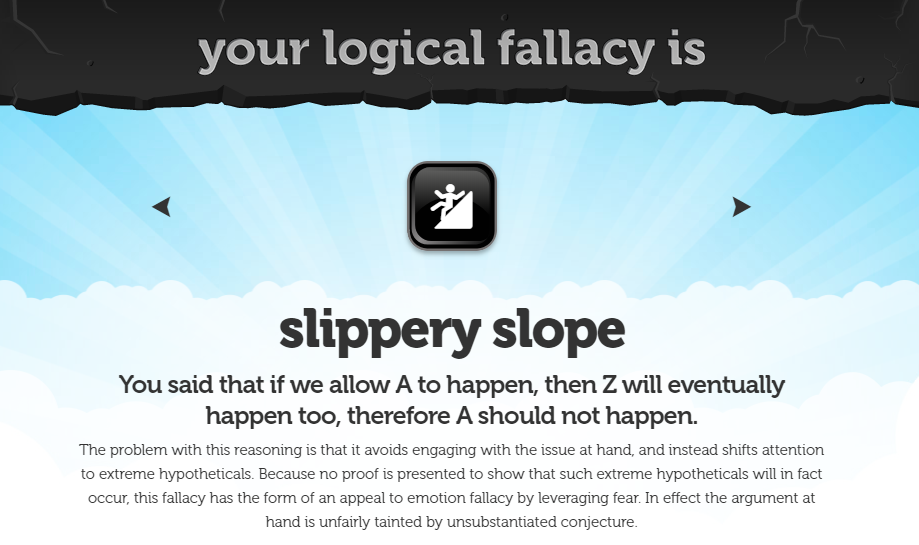
The slippery slope argument is used so often that it has become a formal logical fallacy. In short, this logical fallacy is when a person argues that a certain action must not be allowed, because if it is allowed, it will lead to worse actions also becoming allowed. To prevent those worse actions from coming to pass, we should keep the status quo, because to make even a small change is to step onto a slippery slope that will inevitably lead to disaster.

When we wanted to make it illegal to hit your children, we were told it was a slippery slope to those children beating up their parents. When we wanted to legalise prostitution, we were told it was a slippery slope to Weimar Republic-style child prostitution on the main streets. When we wanted to introduce a capital gains tax, we were told it was a slippery slope to the Government confiscating properties from those it deemed too wealthy.

None of these feared outcomes occurred, which is why the slippery slope fallacy is a recognised fallacy.

The slippery slope argument, then, is wheeled out almost every time someone tries to change any law. So it’s not a surprise that it also gets wheeled out in response to proposals for cannabis law reform. The problem is that we’ve had cannabis prohibition for so long now that almost no-one can remember life from before it was brought in, so we’ve forgotten that prohibition has done more damage than legal cannabis ever could.

The old form of this argument was that cannabis use is a slippery slope to heroin use, and therefore we have to keep cannabis illegal to protect people from getting sucked into heroin, because they’re all some form of “dope”. Nowadays, almost everyone knows that the sort of people who use cannabis have very little in common with those who use heroin, and don’t generally move in the same circles.

Cannabis prohibitionists warn us breathlessly that liberalising the cannabis laws will lead to “THC-laced confectionery” being sold to schoolchildren. The New Zealand media has shown images of gummy bears that are purported to contain 30% or more THC, and the implication is that a small child might gulp down a couple of dozen of them thinking they’re sweets. Ignoring the fact that eating two dozen cannabis-infused gummy bears would still be safer than eating two dozen paracetamol, the argument fails for at least two major reasons.

For one thing, most of the arguments about harm don’t apply to other drugs. It’s fair and reasonable to argue that cannabis causes less harm than alcohol; it’s neither fair nor reasonable to make the same argument of crystal methamphetamine. Neither has anyone ever argued that heroin or methamphetamine was a spiritual sacrament.

Where those arguments do apply, then it’s fair enough to consider them on their own merits. The War on Cannabis is, indeed, one front in the wider War on Drugs, and just because the case for drug law reform is the most obvious in the case of cannabis doesn’t mean it doesn’t exist in the case of other drugs. It happens to also be true that the law against psychedelics is as ridiculous as the cannabis one, if not more so.

The other major reason is that we are entirely free to recriminalise cannabis, should we reform the current laws and then decide the change isn’t working. The people who have looked at the evidence and the previous experience of places that have relaxed their cannabis laws almost all believe that this won’t happen, but it might. If we do decide that cannabis law reform doesn’t work, we will be free to change it back.

The argument that legalising cannabis would be a slippery slope to various kinds of social decay is not valid. Cannabis prohibition is, and never was, a wise move – prohibition is itself the experimental condition. In any case, relaxing the law is not a move into permissiveness but finally having the courage to correct an error that was made generations ago.

*

This article is an excerpt from The Case For Cannabis Law Reform, compiled by Vince McLeod and due for release by VJM Publishing in the summer of 2018/19.

The Case For Cannabis: Prohibition Destroys Families

Cannabis prohibition is a destructive approach in many ways. Because of the need to use law enforcement officers to attack people who use cannabis, massive emotional trauma and psychological damage is the inevitable result of prohibition. As this article will examine, some of the worst damage is that inflicted upon families of cannabis users.

The most severe way that cannabis prohibition affects families is through law enforcement. To fully appreciate the destructive effect that prohibition has had on families, it helps to imagine the situation from the perspective of a child who has had a parent taken way on account of a cannabis offence.

The psychological literature is replete with information about the devastating effect that losing a parent, even temporarily, has on the child’s mental health. It’s common for children in such a situation to feel a powerful sense of neglect and loss. They don’t understand why their parent has been taken away and put in a cage – after all, most adults don’t understand cannabis prohibition either, so how can a child?

Cannabis prohibition means that children are deprived of bonding time with their parents, sometimes even for years, because of the need to put people in prison for violating the cannabis laws. This regularly has a devastating effect on the child’s mental health – for no real benefit to anyone.

Another way that prohibition destroys families is by driving a wedge between generations. As mentioned elsewhere in this book, the young are almost universally in favour of cannabis law reform. They know it’s much safer than alcohol, and they’ve seen the carnage alcohol has caused to their parents’ and grandparents’ generations.

So when their parents start lecturing them about how they should avoid cannabis because it causes psychosis, and how they should drink alcohol instead because it’s not a drug, the predictable response is that the children come to lose faith in their parents, and to trust them less.

The most extreme example of this is when one family member is using medicinal cannabis and living in the same house as another one. This often causes conflict when the owner of the house is afraid that the presence of cannabis will attract the Police. In cases like this, it’s possible for the tension to lead to a family being pulled apart, and this can all be attributed to the law against cannabis.

It should be pointed out here that the damage done to families is worse than it seems at first glance. The sort of people who grow cannabis are frequently in a precarious social situations. After all, one of the main reasons why people smoke it is to deal with the anxiety and depression that comes with being on society’s fringes.

For these people, the safety net of the family is sometimes the difference between life or death. Vulnerable people generally don’t have much else to rely on. Putting an adult in prison can have the effect of removing an important node from their family’s social net, meaning that families have to go without income and children have to go without parents. Even more distant relatives like cousins, nephews and nieces can be affected.

It’s common for the imprisonment of one parent to lead to the rest of the family having to move home or school. Breaking up these social networks, merely because a person grew a medicinal plant, is unconscionable. This suffering caused to family members of cannabis users is not justifiable.

Cannabis ought to be made legal so that Kiwi families are no longer made to suffer as collateral damage. A repeal of cannabis prohibition would mean that the integrity of the family could no longer be damaged by the actions of law enforcement. This would avoid causing severe emotional damage to the children and wider family members of anyone imprisoned, a much more humane and compassionate approach to the one currently used.

*

This article is an excerpt from The Case For Cannabis Law Reform, compiled by Vince McLeod and due for release by VJM Publishing in the summer of 2018/19.

Almost All Cases of Growing Cannabis Are Altruistic

New Zealand cannabis law reform supporters were overjoyed on Monday by the news that Rose Renton was discharged without conviction in her case at the Nelson District Court. Charged with the cultivation of 58 plants, she could have been facing seven years’ imprisonment. As this essay will examine, the logic used to exonerate her could be used to exonerate almost any other cannabis grower, and should lead to a change in the cannabis law.

Renton was discharged without conviction on the grounds that her offending was “altrustic” in nature, according to Judge David Ruth, who was quoted as saying: “This was effectively an altruistic endeavour on your behalf to help those for whom that help wasn’t otherwise possible.” This is an entirely fair point, and it’s about time a judge said so, but it goes further than this.

She had been growing cannabis to supply medicine to a variety of people, a job that has been given the title “green fairy”. The ‘green’ refers to cannabis medicine and the ‘fairy’ refers to the fact that this medicine doesn’t come regularly but simply shows up whenever the fairy can make it happen. Renton was supplying clones of a CBD-rich strain to people who then grew the medicine themselves.

A Police officer who came to Renton’s home noticed a cannabis plant there. Instead of ignoring it, the officer made the decision to enforce Parliament’s law against cannabis by arresting her. This decision led to 18 months of suffering on Renton’s part, until discharged without conviction on Monday, for the reasons mentioned above.

Cannabis is a medicine. The main reason why people use it is to escape the suffering caused by either physical or psychological pain. There are several effective substitutes for the effect that cannabis has on physical pain, but there is little that can stop psychological suffering as quickly and efficiently. Countless people have found that a bout of rage, depression or despair can be stopped cold by a dose of cannabis.

It’s rarely admitted to, but there is a lot of suffering in our society. Not just the tedium of the drudge-work that we endure, and the anxiety over our uncertain futures, but the stress of encountering new strangers all the time and the alienation of having no community or political representation all combine to create an existence that is wretched for many. This can be measured by our increasing suicide rate, which hit a record level last year.

Almost all the cannabis that is grown, by anyone, ever, is grown with the intent of reducing some of this suffering. There’s no point to it otherwise. No-one grows cannabis with the intent to cause suffering. Anyone who believes this is simply not in touch with the reality of cannabis use. Everyone who grows it does so with the intent that using the end product will alleviate suffering in some way.

So the concept of non-altruistic cannabis growing makes as much sense as the idea of non-altruistic insulin production.

People who aren’t interested in the medicinal effects of cannabis might still be using it for that reason, even if they smoke it in joints. Even casual joint smokers are often motivated by the decrease in anxiety, stress, nausea or insomnia that comes with using it. This means that the vast majority of cannabis that anyone is growing, anywhere, is for altruistic reasons, much the same as with Rose Renton.

Many people are unwilling to accept this, for the reason that this makes the current law seem extremely cruel. The hard facts are, however, that the current law is extremely cruel. It’s possible that the law prevented Alex from getting hold of a medicine that would have saved his life. We’ll never know.

It’s possible that Rose Renton had to watch her son die for no other reason than that New Zealand politicians were too stupid and cowardly to address the need to repeal cannabis prohibition in time. That might seem unreasonably cruel, perhaps even so cruel that it’s hard to admit to, but that’s what we did. We’ve been doing it for decades, to Kiwi families up and down the country.

We have to face up to the fact that cannabis is a medicine, and that the law withholding it from people is killing those who need its medicinal qualities. It’s time for us to accept that the vast majority of people who are growing cannabis are doing so with the ultimate intent of alleviating human suffering, so we should repeal cannabis prohibition and make it legal.

*

If you enjoyed reading this essay, you can get a compilation of the Best VJMP Essays and Articles of 2018 from Amazon for Kindle or Amazon for CreateSpace (for international readers), or TradeMe (for Kiwis). A compilation of the Best VJMP Essays and Articles of 2017 is also available.

The Case For Cannabis: Prohibition Funds Crime

Other articles here have mentioned that cannabis prohibition doesn’t mean the cannabis market goes away: it just means that it goes onto the black market. There are several deleterious aspects to this, each worthy of separate discussion. This article will look at the role cannabis prohibition plays in funding crime.

The logic is that, by prohibiting cannabis and by attacking cannabis users through the justice system, it becomes possible to prevent cannabis profits from steadily flowing into the hands of criminals, which would prevent them from being able to fund further enterprises. So criminal activity, and thereby the suffering of the citizenry, can be pre-empted by attacking cannabis users and growers.

As we saw with alcohol, the attempt to prohibit a substance just makes everything about it worse. Alcohol prohibition infamously led to the rise of an entire class of gangsters and bootleggers, the most well-known being Al Capone. Because the substance couldn’t be sold lawfully, it was sold on the black market, and the criminal enterprises who made the profits were happy to use that money to find other ventures.

In Capone’s time, much of that black market money was used to buy firearms, which were then used in the commission of robberies and contract killings. Alcohol prohibition ensured a constant flow of money into the coffers of criminal gangs, and this financed further ventures. Consequently, those criminal enterprises flourished.

We don’t have alcohol prohibition any more, but cannabis prohibition has done a fine job of filling that gap.

The New Zealand Drug Harm Index 2016 stated that “Over $70 million in funding for other criminal activities is provided each year from drug trafficking. The majority of this (nearly 90%) is generated from the sale of cannabinoids.” Another way to write this is to say: Cannabis prohibition puts $60 million into the pockets of criminal gangs in every single year, in New Zealand alone.

This money then finances all the murders, robberies and methamphetamine production that the rest of us have to suffer from. The Police are not wrong when they say that illegal cannabis sales fund further crime – they’re just wrong when they say that the solution is to crack down on it. It’s the cracking down on cannabis that makes it valuable, and this attracts the desperate, greedy and short-sighted.

If a criminal wants to fund the purchase of a large amount of precursors to methamphetamine, they might find themselves in need of a few thousand dollars. This is a similar amount of money to what they could make in one cannabis grow under a 600 watt light, after about three months of growing. Because anyone with a real criminal network knows someone with cannabis clones (or at least seeds), just about anyone inclined to set up a meth operation can also get a cannabis grow started.

Moreover, cannabis prohibition makes it possible to cut up a pound of cannabis into $50 bags and sell them piecemeal. They can do it themselves, or they can get gang underlings to do it – after all, $50 is within the reach of even high schoolers. This makes it possible for criminal enterprises to draw more and more people in.

Under a regime of legal cannabis, such things would not be possible, or would at least be strongly disincentivised. For one thing, cannabis prices are much lower in places where it is legal, and this removes most of the incentive to get involved in selling it. A second factor is that the vast majority of people prefer not to deal with criminals if they can get the same goods from a white market vendor.

So cannabis prohibition makes it possible for a variety of criminal enterprises to get funding, whereas they may not have been able to get off the ground without their backers’ ability to sell cannabis on the black market. A lot of this criminal activity only exists because the law makes it possible. Wherever you have an economic niche, white market or black, someone will step into it.

The common counter-argument that, if cannabis was made legal, gangs would just sell hard drugs, turns out to be the opposite of the truth. The scenario we’re given is that criminals will sell drugs anyway, so it’s better for them to sell cannabis to our children than methamphetamine. The assumption seems to be that criminals choose to sell cannabis in preference to methamphetamine etc. out of kindness.

Leaving aside all the other ways in which this argument is wrong, it takes a certain amount of start-up capital to be able to get in on the market for hard drugs, because it’s necessary to deal with major players. Cooking up a batch of meth takes start-up capital, and even buying precursors usually requires a five-figure sum of cash on account of that people dealing in such are disinclined to make petty deals. Cannabis law reform would make those five figures harder for criminals to come by.

Cannabis prohibition should be repealed so as to take a major source of funding away from criminal gangs. Without black market cannabis, a number of criminal enterprises and schemes would not be able to get off the ground, which would keep our communities safer than cannabis prohibition can.

*

This article is an excerpt from The Case For Cannabis Law Reform, compiled by Vince McLeod and due for release by VJM Publishing in the summer of 2018/19.