
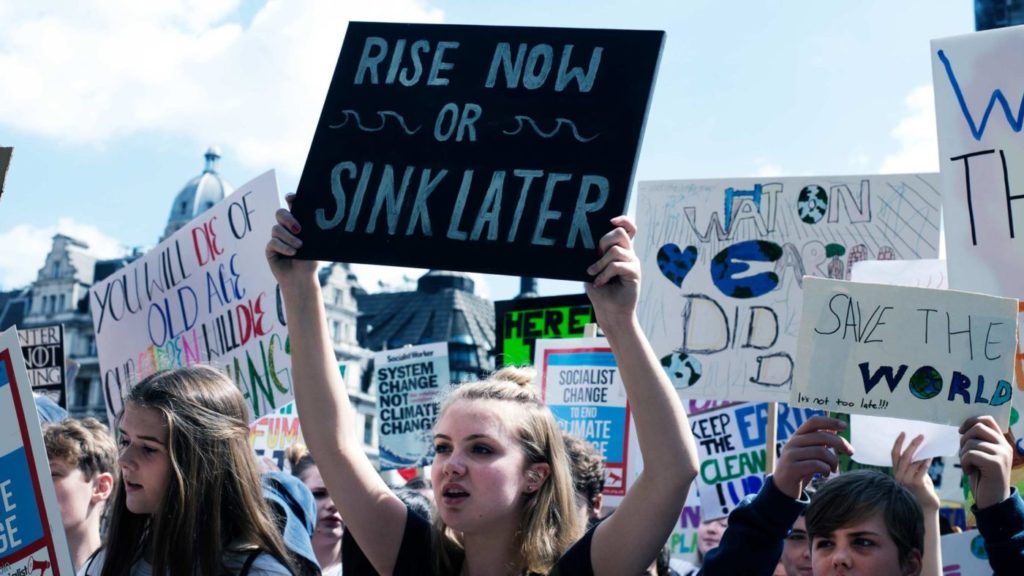
Why I Don’t Believe In Climate Change Alarmism

I don’t have a qualification in Climatology, and am therefore not an expert on the subject. I do, however, have a couple of Psychology degrees, and so have a claim to expertise there. When it comes to understanding issues like climate change, I can’t use Climatology knowledge; I have to use Psychology knowledge. This is how I do it.

Like anyone else who understands general science, I can try to understand the basics of climate change. I can go to Google Scholar, type in “climate change predictions” and then limit the search to papers from 2019 onwards, as I did here. This would give me a general overview of the current state of the science. There’s one minor problem – such a search query returns over 20,000 hits.

Realistically, becoming an expert on climate change would require reading at least a hundred of these papers, as well as at least a hundred published before 2019. This would total several years of study – a time investment that I’m neither able nor willing to make. Therefore, like any other layman, I’m reduced to making a judgment based on whether I believe the people taking about climate change are credible.

If the people talking about it seem trustworthy, then I will be inclined to believe what they say. If they seem untrustworthy, then I will be disinclined to believe what they say. This is how it works with every other political issue, from cannabis law reform to immigration to abortion to euthanasia to taxes. Once the subject of discussion moves out of Psychology, I’m operating on trust and not my own expertise.

As it turns out, the people pushing climate change strike me as grossly untrustworthy, for three major reasons: they seem insincere, irrational and dishonest.

If the politicians pushing climate change alarmism were sincere, they would not also be buying beachfront properties. Yet Barack Obama, one of the world’s foremost harbingers of climate doom, recently bought 29 acres of it. Why would Obama, privy to the world’s most advanced scientific research when American President, buy beachfront property, unless he expects the sea level to remain the same?

The market shows that seaside property is still highly valued. Waterfront property in Sydney, extremely vulnerable to rising oceans, still sells for eight-figure sums. How could a property doomed to be wiped out by rising sea levels sell for over ten million dollars? The only answer is that no-one cares about rising sea levels. The claims of those like Obama cannot be sincere.

On top of this, the people pushing climate alarmism seem irrational. On the one hand, they claim that CO2 emissions are making a major contribution to global warming, such that every one of us has the moral imperative to minimise our CO2 emissions insofar as we are able. But then these same people turn around and argue for an increase in the refugee quota, in some cases tripling it or even more.

New Zealanders consume resources at many times the rate of the average Third World resident. Where is the sense in taking 5,000 people every year (as the Greens propose) from low-emissions parts of the world, and flying them at great expense to a high-emissions part of the world, where they and their numerous descendants will consume future resources at many times the rate they would have done otherwise?

The only logical explanation for the Greens’ refugee policy is that the entire concept of CO2 emissions being bad is horseshit. Either the Greens are lying about the imperative to minimise CO2 emissions, or they don’t understand the relevant science (a closer look shows that not a single one of New Zealand’s current Green MPs has a tertiary science qualification – the closest is James Shaw with an M.Sc from a business school).

If the Greens would say that CO2 emissions were bad and, therefore, we will close the borders to immigration from low-emission areas, then the threat of climate change would appear to make rational sense. But they do the exact opposite of that. Therefore, I can conclude that those promoting climate change are irrational, and so the truth value of their pronouncements can be discounted.

The real showstopper for me though, as a psychologist, is that one of the people fronting the climate charge alarmist movement in New Zealand is a convicted fraudster. This is no less a dignitary than the Maori Climate Commissioner herself, Donna Awatere Huata.

In 2005, Huata was found guilty of fraud and of attempting to pervert the course of justice. The money that she defrauded from a foundation set up to help underprivileged kids learn to read was used on a stomach stapling operation. What sort of malignant narcissist would steal money from children to fund cosmetic surgery for herself? A Climate Commissioner, that’s who.

In the same way that I wouldn’t buy a used car off convicted ponzi schemer David Ross, I wouldn’t buy one off Donna Awatere Huata either. So why on Earth would I listen to her pronouncements about climate change? The smart thing to do would be to believe the exact opposite of whatever Huata says.

In summary, I don’t believe in climate change alarmism because the people pushing it are crooked, insane and unqualified to make scientific pronouncements. These people seem every bit the shameless grifters that have pushed every other kind of alarmism to make a quick buck out of the ensuing hysteria.

I’m willing to be corrected, but do note that you will have to have a qualification in a relevant science from a proper university, and you will have to cite peer-reviewed journal articles in relevant disciplines, for me to take you seriously on this matter.

*

If you enjoyed reading this essay, you can get a compilation of the Best VJMP Essays and Articles of 2019 from Amazon for Kindle or Amazon for CreateSpace (for international readers), or TradeMe (for Kiwis). A compilation of the Best VJMP Essays and Articles of 2018 and the Best VJMP Essays and Articles of 2017 are also available.

*

If you would like to support our work in other ways, please consider subscribing to our SubscribeStar fund. Even better, buy any one of our books!
Low Unemployment Is Meaningless If The Jobs Don’t Pay

Politicians like to brag about the low levels of unemployment they claim to have achieved. A low level of unemployment is presented as evidence that the economy is being managed well, and therefore that the stewards don’t need to be changed. But as this essay will demonstrate, low unemployment is meaningless if the jobs don’t lift people out of poverty.

Western politicians have been terrified of unemployment ever since World War II. Adolf Hitler frequently made reference in his rally speeches to the climbing German unemployment rate, citing it as evidence of the failure of the then-existing political Establishment. It’s taken as true by all that an unemployed man is far more likely to cause trouble.

The postwar paradigm has been characterised by a concerted effort to keep unemployment low. This worked out very well in the decades after the war, because back then a job guaranteed a certain standard of living. A full-time worker could expect to own a house and support a wife and three children. This great wealth, fairly distributed, kept revolutionary sentiments to a minimum.

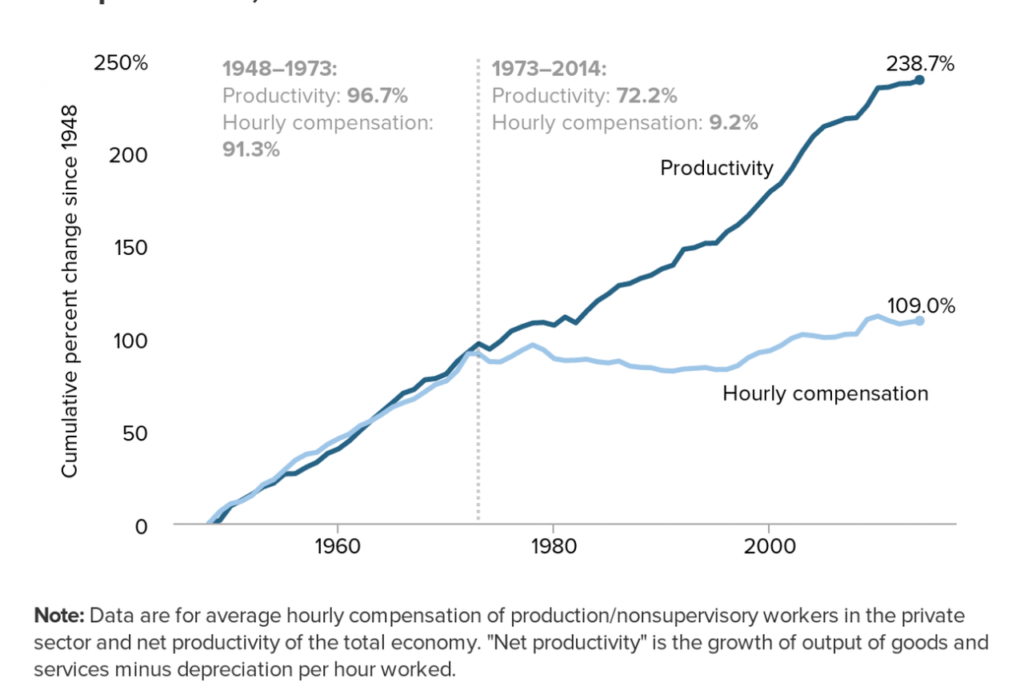
Since the advent of neoliberalism in the early 1980s, the Western worker has solidly lost ground. Wages are no longer coupled with productivity (see graph at top of page), and so the buying power of the average wage has steadily declined. The average wage in New Zealand now has less than 40% of the house-buying power that it had a generation ago.

The problem is that Western politicians have continued with the assumption that so long as they keep unemployment low, all will be swell. This is a fine assumption when the average worker can afford a house and to raise three children in it. When they can’t, this assumption just leads to the face of the average worker getting pushed further and further into the shit.

If a person works full-time, but can’t meet a dignified standard of living with the proceeds from their wage, then that person is effectively a slave. Whether you’re a slave or free is not a question of how big your television is, it’s a question of how much coercion you live under. If your wage is so poor that you can’t live on it, then you’re effectively dependent on other people’s largesse. Less dependent than a beggar, but dependent all the same.

The lesson that Western politicians need to learn is that unemployment itself is not a good thing. Unemployment only has value insofar as it is conducive to ending the people’s suffering. If a working person can’t alleviate any of their suffering because their wage is so poor, then they are just as liable to become discontented as an unemployed person.

After all, the unemployment rate on slave plantations is extremely low. No-one on a slave plantation is sitting idle, or on the dole. So if unemployment alone is a factor important enough to gloat about, then it could be argued that the slave plantation model is a highly effective way to organise an economy. The absurdity of this is obvious.

It’s meaningless, then, for a politician to gloat about the low unemployment levels of their economy, as if that alone were evidence that they were running the country well. What matters is that the people are not suffering – if a large proportion of employed workers are not able to live decent lives, then the country is not run well.

The starkest problem for the Western worker is that they no longer have any negotiating power. This is the result of a combination of factors, the foremost being union-busting laws, ever-increasing technological sophistication (requiring ever-higher educations to understand) and the mass immigration of cheap labour. The capital holders have all the power, and they have used this to drive wages to the floor.

There probably isn’t any way to solve this problem within the current economic paradigm. The decoupling of wages from productivity has granted to capital holders a degree of coercion over their workers that they have not enjoyed since slavery: stories like this are now common. The only solution that seems likely is to institute a universal basic income, because this would allow workers to turn down abusive or exploitative employers.

*

If you enjoyed reading this essay, you can get a compilation of the Best VJMP Essays and Articles of 2019 from Amazon for Kindle or Amazon for CreateSpace (for international readers), or TradeMe (for Kiwis). A compilation of the Best VJMP Essays and Articles of 2018 and the Best VJMP Essays and Articles of 2017 are also available.

*

If you would like to support our work in other ways, please consider subscribing to our SubscribeStar fund. Even better, buy any one of our books!
Clown World Chronicles: What is ‘Neoliberalism’?

In the financial sections of the world’s news websites, the reader often finds reference to “neoliberalism” or even “the prevailing neoliberal paradigm.” This is something so all-pervading that its necessity is taken for granted. It’s very important to understand neoliberalism, because the neoliberal mindset is the one in which things get done. This chapter explains.

In short, neoliberalism is the prevailing economic paradigm of Clown World.

The ‘neo-‘ prefix denotes that this is not the first time we have lived under this economic paradigm, and the ‘liberal’ root means that this economic paradigm is characterised by a lack of regulation of business activities. The liberty in question isn’t your liberty from coercion by capital; it’s the liberty of capital to coerce you.

As anyone who has played a game of Monopoly will be aware, the problem with economic liberalism is that it ends up with massive inequality. Absent a system of wealth redistribution, the ability of landowners to charge rent means that they eventually end up with all the money. Their ever-increasing ownership of capital leads to ever-increasing rents until the masses are as impoverished as any medieval peasant.

In the real world, economic liberalism led to the Great Crash of 1929, and from there to the Great Depression. This always happens under liberalism, because once all the money ends up in a few hands then no-one but them have any spending power. One no-one has any spending power, the economy slows down, workers get laid off, and recession begins.

The original liberalism was ended by American President Franklin D. Roosevelt, who brought in the “New Deal“. This was a drastic reorganisation of the economic system, intended to reverse all the advantages accrued by what Theodore Roosevelt had earlier called “the representatives of predatory wealth.” Decried as both Fascism and Communism by FDR’s opponents, the New Deal ended the Great Depression in America.

The Great Depression ended much more violently in Europe. The anger and paranoia brought about by the terrible economic conditions saw many people cast about for a scapegoat. This desire to find someone to blame for the desperate problems made it possible for an opportunist like Adolf Hitler to come to power, and the consequences of that are known to all.

After World War II, Western politicians became extremely cautious about allowing a return of the economic conditions that they believed were the ultimate cause for the bloodshed. Absent extreme and desperate poverty, they reasoned, the people would have no cause to give their power to a supremacist who wanted to conquer their neighbour.

As a result, those politicians allowed the workers to get a fair deal. Instead of all the economic power being held by a few people who ruled the others like kings, it was widely distributed across the population. This egalitarian economic arrangement continued for almost 40 years. This time period encompassed some great decades – the 50s, 60s and 70s allowed for freedom and creative expression to flourish all over the West.

It was too good to last.

Neoliberalism arose in the early 1980s, after the ruling class realised that it had been 40 years since the end of World War II, and the hard-won lessons about solidarity had been forgotten. Ronald Reagan and Margaret Thatcher, no less opportunistically than Hitler himself, came to power promising a shake-up of the existing economic paradigm. Their recipe for greatness was low taxes, low welfare and free markets.

The influence of America and Britain is such that practically the entire Western World is now neoliberal. Arse-licking dogs like David Lange forced neoliberalism on an unsuspecting New Zealand public after 1984, laying the economic foundations for the Clown World era. The demented Ruth Richardson piled on the pain by slashing the Family Support allowance. Helen Clark opened the immigration floodgates and John Key kept them open.

This obsession with money, at the expense of society itself, led us to here. Neoliberalism is to consume, mindlessly and without end. All higher culture and all spiritual traditions are to be destroyed because they prevent people from consuming. The borders must be thrown open because every new immigrant – regardless of what crimes they commit – is a new consumer.

By 2020, neoliberalism has, much like the original liberalism, led to the concentration of wealth in extremely few hands. Although society has become shittier in a great many ways, this increasing shitness has brought with it vast profit potential, and those profiting greatly are putting enormous energy into perpetuating the system. This combination of increasing diversity and increasing inequality is one of the major causes of Clown World phenomena.

All over the West, economic desperation is now standard for the youth. A study showed that the average wage in New Zealand has less than 40% of the house-buying power that it had 26 years ago. The youth suicide rate is skyrocketing, and the individual despair felt by these unfortunates is starting to become a generational malaise.

Much like the original liberalism, neoliberalism has set the scene for totalitarian extremists to come to power in the West. Although Donald Trump isn’t the one, a new Hitler could easily take advantage of the worsening economic conditions to channel the people’s desperation into another paroxysm of violence. The Weimar Republic was the original Clown World, and our current iteration of it could end in a similar fashion.

*

This article is an excerpt from Clown World Chronicles, a book about the insanity of life in the post-Industrial West. This is being compiled by Vince McLeod for an expected release in the middle of 2020.

*

If you would like to support our work in other ways, please consider subscribing to our SubscribeStar fund. Even better, buy any one of our books!

If The Media Wrote About Jacinda Ardern The Same Way It Wrote About Wrongthinkers

The politician accused of masterminding multiple violations of the New Zealand Bill of Rights Act is running for re-election this year.

The 38-year old Jacinda Ardern’s Sixth Labour Government has been accused of violating New Zealanders’ rights to free expression, free assembly and free commerce. She has been recorded on film paying homage to the ideology of Marxism, which subscribes to the same totalitarian far-left ideology as the Soviet Union that starved 100 million people to death in the gulag archipelago.

A constitutional lawyer says the accusations facing Ardern are among the most serious, and he believes that criminal charges laid by Police could follow.

VJM Publishing understands that the politician has refused to answer questions about her loyalty to the New Zealand nation. Last April, VJM Publishing revealed that Ardern was working closely with French President Emmanuel Macron to force globalist policies on the New Zealand people without their knowledge or consent.

It is not known whether the human rights violations that Ardern has allegedly committed were committed to further Marxist ideology.

Neither the Police nor the Labour Government would comment on the accusations.

Since the accusations of human rights violations were levelled against Ardern, she continues to make short films in which she tries to justify her actions, publishing these on FaceBook.

Ardern’s actions were first observed by activists who track members of the far left, Marxists and Communists online. Ardern’s FaceBook account has been used since the accusations of human rights violations were laid.

For several years, Ardern has posted racist, anti-nationalist and anti-white comments on social media, including references to a “white supremacism” conspiracy theory. This racist conspiracy theory claims that the low academic performance of browns and blacks can be explained by white prejudice.

“The response I’ve received has been positive. No tech company, just like no government, would like to see violent extremism and terrorism online,” Ardern is quoted as saying.

The account also showcases Ardern’s hate for the New Zealand people, frequently insinuating that they are racists, bigots and criminals.

A Police spokeswoman declined to answer specific questions about whether they plan to arrest the politician.

“The accused has not been formally charged, which means that she is at liberty to travel as she pleases,” the spokeswoman said.

Wellington barrister Schlomo Goldberg, who has 20 years’ experience working in constitutional law, said Ardern was the first politician he knew of to be accused of violating New Zealanders’ rights to free expression, free assembly and free commerce.

“For a member of the New Zealand Government to use the position she’s been given to prejudice the human rights of New Zealanders, that’s a big deal,” he said.

Goldberg, who has no involvement in the case, said the politician could possibly have access to Marxist publications that could include tactics, techniques, procedures and plans for subverting national cultures.

“But also, if you have someone like the Chinese Communist Party, they might think it’s kind of handy to have, to get their hands on information that shows them how the New Zealand Government conducts operations because they might want to use those sorts of things themselves.

“There’s a whole load of information which an organisation that is intent on violating New Zealanders’ human rights to achieve its ends might find useful, both from a point of view of how it might conduct its own operations and also how you know what it might anticipate the security services are going to do against it.”

He said the Police were likely wanting to keep any investigation into Ardern’s human rights violations out of the public eye, despite the potential for criminal charges in civilian courts.

This would be done so that classified information involved in the case could be presented without revealing it to the public, he said. 

*

This article is a parody of this piece of digital excrement: https://www.stuff.co.nz/national/119231183/arrested-soldier-continues-to-share-white-nationalist-material

*

If you enjoyed reading this essay, you can get a compilation of the Best VJMP Essays and Articles of 2019 from Amazon for Kindle or Amazon for CreateSpace (for international readers), or TradeMe (for Kiwis). A compilation of the Best VJMP Essays and Articles of 2018 and the Best VJMP Essays and Articles of 2017 are also available.

*

If you would like to support our work in other ways, please consider subscribing to our SubscribeStar fund.