

Category: cannabis
Is David Seymour the Biggest Coward in the New Zealand Parliament?

On the face of it, it seems self-evident that a New Zealand libertarian party would be a staunch supporter of cannabis law reform. There’s nothing less libertarian than the government putting people in cages for using a medicine they don’t approve of, and there’s nowhere in the world with a greater appetite for a repeal of cannabis prohibition.
The New Zealand ACT Party claims to be a libertarian party. They have wrapped themselves in the libertarian yellow and their website boldly states “We believe the current role of government is far too large and should be limited on a principled basis.”
Sounds good, as probably 75% of New Zealand agrees that the New Zealand Government’s decades-long war on medicinal cannabis users has been a governmental overreach and should be limited.
The ACT Party Crime and Justice page even goes as far as to state, at the top: “We’re striving for a progressive, vibrant New Zealand that encourages individual choice, responsibility and excellence.”
From all this rhetoric you’d think a repeal of cannabis prohibition would be front and centre, but it’s not even mentioned. Instead the entire Crime and Justice section is just a lengthy diatribe about how burglary is the greatest evil facing our nation and ought to be punished severely.
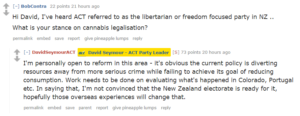
The inability of the ACT Party to make good on their rhetoric about compassion and freedom by supporting a repeal of New Zealand’s cannabis laws – despite their unprecedented degree of leverage on the current Government – marks that party, and David Seymour, as a pack of weaklings.
What takes the ACT Party’s behaviour from disappointing to pathetic is the fact that it has already been well established that a repeal of our cannabis laws would save the taxpayer $400,000,000 per year.
So changing our cannabis laws, and making good on all the lofty rhetoric about compassion and freedom and fulfilling New Zealand’s destiny as a forward-thinking nation, would be a simple matter of negotiating with the current National Government $400,000,000 worth of tax cuts that would be paid for with the savings from cannabis prohibition.
It isn’t clear why Seymour has yet to kick the ball into this wide open goal.
Probably because he is a coward, but it’s unlikely that a man could possibly be so craven. Imagine being so gutless, so lily-livered, so chickenshit, that a 76-year old former leader of your party was saying what needed to be said six years ago, and you still can’t find the stomach to walk the same trail blazed by this geriatric.
A more charitable explanation though, going by his wittering about the need to do work on evaluating what’s happening overseas, is that Seymour is just in the same twenty-year time warp as most of the rest of the country.
It was pointed out in a previous Dan McGlashan column that supporting the ACT Party has a very strong negative correlation with being born in New Zealand (-0.74). Has the ACT Party sold its soul to corporate globalist interests so that Seymour could be a National party puppet?
Considering that there are significant correlations between voting ACT and both having a professional occupation, or with working in financial and insurance services, it’s unlikely that ACT voters or supporters have much in common with cannabis users at all, much less using cannabis themselves.
If those are the circles Seymour moves in, perhaps this is why Seymour has failed to observe the immense appetite for a change to our ridiculous laws.
So maybe he needs to climb down out of the ivory tower and get a clue.
Coming out in support of cannabis law reform would lend credence to the idea that ACT might really be a libertarian party, instead of what most Kiwis suspect them to be – paid whores of big corporate interests.
The question is whether Seymour has the courage to stand up to a Catholic prohibitionist National Party leader, or whether he’d rather scurry away and prepare himself for the aftermath of the likely National loss later this year.
The most sure thing of all is that if ACT does not make an appeal to libertarian New Zealanders by updating their cannabis policy, they have little hope of winning more than one seat in this year’s election.
The Solution to Nelson Drunkenness is Cannabis Cafes on Bridge Street

Nelson does exceptionally well as a tourist town over the summer. We get thousands for the Abel Tasman alone and the Black Caps played here twice this season. It means big money for Sun City – but it won’t continue if we continue to get a reputation for mindless violence.
Retail group Uniquely Nelson is especially concerned by what they see as a spike in antisocial activity, in particular “drunkenness, violence, abuse, theft, rubbish and broken glass.” But as anyone who has lived in Nelson for any length of time knows, violence, abuse, theft rubbish and even broken glass are natural consequences of the first problem named – drunkenness.
Neither can we glibly blame everything on ‘North Islanders’ as if Nelsonians are not subject to the same loss of inhibition as everyone else on the planet who drinks booze. Drunk people in Nelson do the same things in Nelson that drunk people in any low-wage area get up to.
The problem with the drinking culture of Nelson is this – most of the intelligent people who have lived here for long enough have secured cannabis hookups and use that instead. Cannabis has driven out alcohol among the sort of consumer that is most sensitive to being turned away by dickheads, and this has left the drinking to the lowest common denominator.
Anyone new to Nelson looking for a good time will quickly encounter this lowest common denominator, and the results are usually as described in the examples given in the opening paragraph.
The sad thing is, there is plenty of opportunity for people to come here and have a good time. Being the oldest of Kiwis, we Nelsonians naturally represent what is the best of us, in particular a sunny nature, a social attitude and a genuine joy of life.
But we’d rather smoke weed at home than come into town to get our heads kicked in.
So the solution is obvious.
We ought to demolish the dive bars of Bridge Street and replace them with a handful of cannabis cafes, so that Nelsonians and our many visitors can relax in public without fear of being attacked by some drunken animal.
As it is, if I’m driving East on Bridge Street late on a weekend night and I see some young backpackers heading the other way for a night on the town, I feel sorry for them, knowing that they will not get to see the best of my city or of its people.
Cannabis cafes on Bridge Street would provide the revitalisation that Sun City needs. It would bring the young people back out of their homes and life back into the streets of the CBD. It would also create a festive atmosphere in the city centre to replace the fighting, vomiting and vandalism.
Not least, the local retailers of Nelson stand to make a packet from the idea. The wider Nelson region is already, along with Coromandel, the most popular destination in New Zealand for underground cannabis tourism owing to our widespread local embrace of the plant medicine. International visitors know that they can come to this region for some of the world’s best natural cannabis.
If Nelson could get it together to take advantage of the impending repeal of cannabis prohibition we could position ourselves first in the queue for the hordes of young tourists that would flock here to escape from the drunken shitheadery that plagues most other Kiwi towns and cities.
If we did it right, many of those tourists would be other Kiwis. These people should leave Nelson with a sense of being impressed by our forward-thinking, gregarious and positive attitude, not with relief at getting out before they were glassed by some pisshead.
Ranking The New Zealand Political Parties In Order of Kiwiness

This essay is based on a premise that will aggravate some and endear us to others: that Kiwis born in New Zealand are significantly more representative of what constitutes Kiwi culture than Kiwis born outside of New Zealand, and so much so that this factor alone can tell us things about ourselves.
To put it more precisely, the premise is that the higher the correlation between voting for a particular party in the 2014 General Election and being born in New Zealand, and the lower the correlation between that and being born overseas, the better that political party represents New Zealand and Kiwis.
With that defined, here are the political parties of New Zealand, ranked in order of how unlikely it is that a Kiwi born in New Zealand would vote for them. This unlikelihood is expressed as a correlation.
-0.74, ACT: It isn’t really surprising that the Get Rich Quick party has the lowest correlation with being born in New Zealand. The entire point of the ACT Party is essentially to rape the country and then sell it off, not to the highest bidder, but whoever comes up with some cash first.
The ACT Party has a relationship to New Zealand roughly analogous to the relationship a medieval Arab slave trader had to his Nubian slaves. Perhaps the best example of how the ACT Party fails to be Kiwi is that, even in a political environment where the centre-right National Party has completely crushed all opposition, they can’t manage more than one single seat.
-0.36, National: This correlation is fairly similar to that between net personal income and being foreign-born, which suggests that most of the immigrants that we let in on the grounds of being rich vote National.
As for those of us born here, we tend to not like National much because they’re not really the party of the Fair Go. They’re more like the party that charges First World prices while paying Third World wages. They don’t have quite the lowest correlation though because there’s something Kiwi about capitalist exploitation, as we are, after all, children of the Empire.
-0.22, Conservative: There is something mildly Kiwi about a party that just won’t give up in the face of insurmountable odds. Especially when that party is led by a weirdly creepy fundamentalist Christian fellow who sets off all kinds of sexual predator alarm bells in the heads of those watching him talk.
There is a well-established conspiracy theory that the British dumped their sexual deviants in New Zealand in the same way they dumped their criminals in Aussie. If there is any basis at all to this sort of thing then the Conservative Party are perhaps a natural long-term manifestation of this policy.
-0.01, Green: The Greens are a mixed bag. In some ways they represent the very best of us, and in others the very worst. In so far they represent the best of us, the professional, scientific and technical class – those with the best understanding of the systems we rely on to support ourselves and the challenges facing their sustainability – tend to vote Green.
In so far they represent the worst, there is no party more puffed-up and self-righteous, and supporters of no other party are as likely to hate you for disagreeing with them. In that manner the Greens represent the kind of of arrogant elitism that has used New Zealand as a social psychology laboratory for over a century.
It’s easy to imagine that the Greens might want to bring in ten million refugees in one hit and make it a criminal offence to raise public opposition to the idea. Which is exceptionally unkiwi.
0.01, Labour: Labour are basically the same as the Greens, and for similar reasons. This is why the strength of the correlation between voting Labour and being born in New Zealand is essentially nil.
The Maoris, who have the highest positive correlation with being born in New Zealand, are likely to vote Labour, as are the Pacific Islanders, who have a negative correlation with being born here. European Kiwis, who tend to vote National, counterbalance the immigrant Europeans who tend to vote Green.
All in all, the Labour Party is a big mess of confusion about which little can be accurately said.
0.54, Internet MANA: Perhaps fittingly, the next three parties on the list are all led by Maoris. Hone Harawira, whose family name is deeply entwined with the entire New Zealand power structure, was the public face of this abomination.
However, a party funded by a big fat criminal from Germany has an upper limit on how Kiwi it can ever be, and despite Hone’s best efforts Internet MANA tops out at 0.54.
0.62, Maori Party: Blundering mindlessly forward into your own destruction despite both obvious signs that the path forward is suicide and many chances to turn back is quintessentially Kiwi (this is essentially the spirit of Anzac).
So when the Maori Party stakes the entirely of its political capital on a hamfisted attempt to “help” Maori people by taxing them into the local Mental Health Unit on account of them using tobacco, it’s perfectly representative of them to double down and to keep increasing the taxes despite repeated warnings from academic researchers that it is counterproductive.
0.69, New Zealand First: Maybe no-one should be surprised that New Zealand First has come in second place in this study. After all, they are called New Zealand First, as opposed to Global Banking Interests First (as National should be called) or The United Nations First (as Labour and the Greens could combine as).
Being led by a Maori who doesn’t know if he’s left wing or right wing and who is a little bit shy about even identifying as Maori in the first place is like a Kiwi caricature.
And that leaves us with the most Kiwi party of them all, which is…
0.77, Aotearoa Legalise Cannabis Party: The Legalise Cannabis Party represents the best of New Zealand – full of young people, free thinkers and Maoris, these are the kind of people who will not believe any kind of rubbish simply because it is handed down from an authority figure.
Apart from the All Blacks, Vegemite, and being shy about getting naked, cannabis use is the strongest identifier of actual Kiwi culture out of the lot of them. There’s nothing else that brings Kiwis of all classes, races, cultures and occupations together like smoking weed.
If any of this reasoning has failed to convince the reader, just ask yourself: who would Billy T James have voted for?
*
This article is an excerpt from Understanding New Zealand, by Dan McGlashan, the complete guide to the voting and demographic patterns of New Zealanders. First ediction published by VJM Publishing Winter 2017.