New Zealand Still Runs on A Spoils System

There are many different kinds of corruption in the world’s various political systems. One of the most blatant is the type known as a spoils system. Although this is commonly believed to be a corrupt form of government that we have now moved past, New Zealand still runs on a spoils system, as this essay will examine.

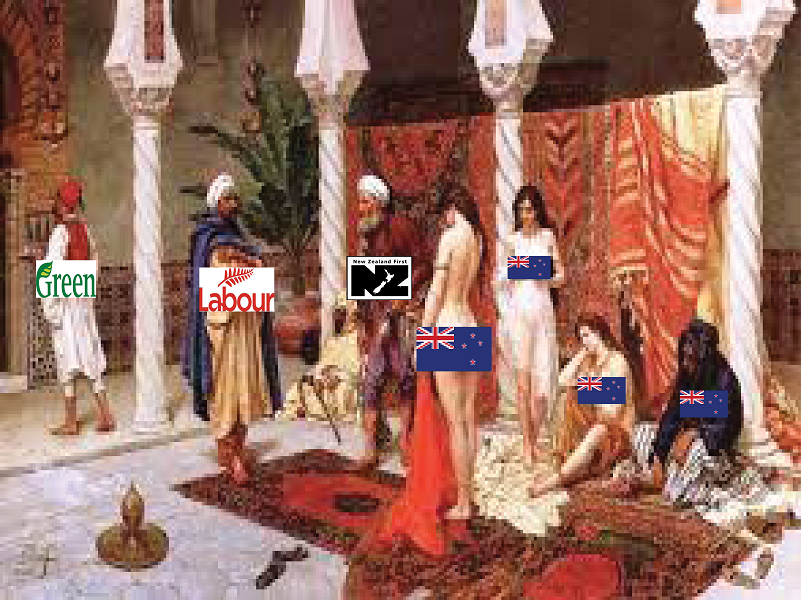
A spoils system is when the victorious party gets to dish out government posts and gifts from the treasury as if they were the spoils of war. Like a conquering Roman legion, all the treasure and booty are piled in a big heap, and then apportioned out by the leaders to their lackeys.

When the spoils system was blatantly in play, an incoming Government would remove many of the previous Government’s supporters from any influential positions so as to install their own. Back then, there wasn’t a public taxation fund to pillage, so the spoils of victory mostly involved jobs in central Government. The position of regional postmaster was a particular favourite.

Although the New Zealand Government would like to give the impression that it fills its positions based on merit and that this merit has been determined after great thought and dutiful application of philosophy, it also runs on a spoils system.

Transport Minister Julie Anne Genter is married to a man named Peter Nunns, who is a principal economist of a transport consultancy firm named MR Cagney. Since taking power in 2017, Government spending on hiring this particular firm has leapt from around $50,000 a year to $246,000 a year, with this money coming from 18 different contracts.

Incredibly, none of these contracts were even put up for tender. The linked article lists a range of excuses for this supposed coincidence, but all of them are just red herrings. The simple fact is that MR Cagney had money being piped into it from the central government, and that the victorious Green Party increased the flow of money fivefold as soon as they were able.

Shane Jones’s $3,000,000,000 Regional Development Fund is another example of the spoils system at play. Jones found himself in charge of the treasury, helped himself to a few billions, and now he’s doling it out in exchange for future favours. Like a jolly brown Santa, he descends from the skies to bring gifts to those who have behaved correctly.

The reason why it’s purely a regional development fund is because that will best reward New Zealand First voters. According to Dan McGlashan’s Understanding New Zealand, there is a correlation of 0.60 between voting New Zealand First in 2017 and living in a rural electorate.

The only other party to come close to this is the Aotearoa Legalise Cannabis Party, at 0.40. New Zealand First is, therefore, very much the party of the countryside, and this $3 billion fund is little more than payback for the support of the countryside at the last election.

Treating New Zealand as the spoils of war is far from something the Sixth Labour Government invented to keep coalition allies onside. It didn’t matter to John Key and Bill English that over two-thirds of the country explicitly said ‘no’ to asset sales, because the majority of National voters fell into the one third who said ‘yes’. The Labour, New Zealand First and Greens voters that made up the two thirds didn’t support National, therefore didn’t get any of the spoils of the National victory.

In a sense, democracy can’t avoid being a spoils system because if the winning party doesn’t reward its voters, it may not get voted in again. The Labour Party rewards Maoris, not because they are communists, but because Maoris vote for them in great numbers: Dan McGlashan found a correlation of 0.58 between being Maori and voting for the Labour Party in 2017.

If voting for the Labour Party didn’t have some kind of payoff, perhaps people wouldn’t do so again. This is more important the more marginalised your voters are, because these are the most likely to abstain from voting. Therefore, whichever party wins the election is all but obliged to dish out the spoils to those who voted for them, because if they don’t then the other side will, and then the other side will stay in power for longer.

There are several problems with this, however. One of the most obvious is that, once it’s apparent that it’s a spoils system contested by Team Rich and Team Poor, there arises a great incentive to disenfranchise Team Poor.

There will always be more poor people than wealthy ones, and so the obvious move for the wealthy, from a game theory perspective, is to demoralise the poor so that they don’t bother to vote. Widespread use of this strategy can have a devastating effect on social cohesion, as America has demonstrated. It could be argued that it was this phenomenon that led to the rise of Hitler during the Weimar Republic.

The only way to get around this is to increase the solidarity of the nation, and the strength of the bonds between each person. This cannot be achieved until the rotten, half-collapsed structures of the previous age are finally razed to the ground. From the ashes, a true spirituality can arise, and this will inspire us to make the right moves elsewhere.

*

If you enjoyed reading this essay, you can get a compilation of the Best VJMP Essays and Articles of 2018 from Amazon for Kindle or Amazon for CreateSpace (for international readers), or TradeMe (for Kiwis). A compilation of the Best VJMP Essays and Articles of 2017 is also available.

How FaceBook Censorship Radicalises Young Men Into Violence

My first ban from FaceBook was for writing the phrase “But Hitler didn’t do anything wrong”, which in context was obviously a joke response to a troll. It lasted 24 hours. I then got a three-day ban for quoting someone else who said the word “faggot” and then a 7-day ban for posting an image of an SS soldier with the caption “Begone Degenerate” in response to someone advocating pedophilia. During this 7-day ban I discovered a place called /pol/.

Having grown up in a generation where everyone called each other “faggot”, and where it was taken in good humour, getting banned from FaceBook for it generated some resentment. Although it was only a small amount, it emphasised the open welcome I got from /pol/. Whereas FaceBook made me feel like a morally defective subhuman that needed to go into a gulag, /pol/ made me feel normal and among friends.

The same sentiments that got me excommunicated from Mark Zuckerberg’s platform were expressed by many on /pol/. I naturally, therefore, decided that it was a great place full of honest, brave and intelligent people. Others will no doubt disagree – most will say that /pol/, like 4chan, is a cesspit. Anyone who does think this, however, might want to think about how FaceBook censorship drives people to places like it.

What happened to me is far from unique. Many people who like to discuss politics, but who got banned from FaceBook, came to feel the same way about /pol/ as I did. If free speech is censored on the grounds that certain political opinions make other people feel bad, this will lead inevitably to those banned people finding company in places where they feel welcome.

Let’s not forget that censorship isn’t just the banning of ideas. It’s also the banning of the people who express those ideas. Censorship doesn’t merely say that a particular idea is unwelcome; it also says that people who express those ideas are unwelcome. If you have those ideas, no logical argument is entered into. You are simply banned.

For paranoid individuals like an Anders Breivik or a Brenton Tarrant, it’s not easy to handle getting banned from FaceBook for making a joke, when openly genocidal comments go unpunished if made by the right people. This is precisely the kind of thing that convinces people that an overarching leftist conspiracy to destroy white people exists.

There appears to be a great and terrible delusion on the part of many leftists.

The delusion is that they are entrusted with some kind of teacher role and the rest of the world are moral reprobates in need of correction. They seem to imagine that getting banned from FaceBook for 30 days means you have to sit in the naughty corner and think about what you have done. In reality, it’s closer to getting kicked out of the classroom and smoking cigarettes with the truants behind the bike sheds.

Banning people from FaceBook has a similar effect to banning people from civil society and sending them to prison. In much the same way that prisons often serve as “universities of crime”, so can the darker regions of the Internet serve as centres of radicalisation. Censoring social media, far from inspiring people to investigate themselves for moral weaknesses, simply pushes them into the company of people who make no effort at all to hide their hatred.

The worst thing, however, isn’t that naughty people might be forced into the company of other naughty people and have their naughtiness normalised. It’s the resentment that such heavy-handed tactics create among those rejected. This resentment is truly dangerous.

There’s an African saying that has it “If a child is not embraced by the village, he will burn it down to feel its warmth.” For all the damage that might be done by exposing young shitposters to radical Nazis, it’s much worse for those young men to get jettisoned from the arena of public debate, because this makes them hateful.

In such an atmosphere, a person banned from FaceBook could come to see genuine Nazis as fellow victims. Worst of all, they might come to relate to the kind of resentment that inspired the Christchurch mosque shooting. If honest people get banned and end up on /pol/, and then end up shooting people, then maybe shooting people is the path that honest people get forced down?

FaceBook censorship plays a direct role in the radicalisation of young men like Tarrant and Poway Synagogue shooter John Earnest. This censorship plays a direct role in feeding the sentiments that make these young men feel that they have the whole world against them. The sense that free-thinking people are being persecuted by an inhumane and tyrannical neo-Communist shadow regime becomes entirely believable when FaceBook bans people for making slightly off-colour jokes.

The answer is not to ban places like /pol/. For one thing, that could never work in the age of VPNs and Tor browsers. The answer is to normalise the idea of free, intelligent and respectful political discussion in all places. This way, men like Tarrant, who have legitimate grievances and fears about the way his nation is going, can express those grievances instead of feeling forced to pick up a rifle.

If it’s possible to lay out the welcome mat to Islam, an ideology of hate that has killed hundreds of millions of people, then it must also be possible to allow discussion about controversial political topics such as ending Third World immigration. It must surely be possible to lay out the welcome mat to our own working class, and listen to their misgivings about the way the world is going. This would work much better than more bans.

*

If you enjoyed reading this essay, you can get a compilation of the Best VJMP Essays and Articles of 2018 from Amazon for Kindle or Amazon for CreateSpace (for international readers), or TradeMe (for Kiwis). A compilation of the Best VJMP Essays and Articles of 2017 is also available.

The Case For Cannabis: It’s Easier To Stop Using Cannabis If It’s Legal

Many people take an overly simplistic approach to cannabis law reform and assume that cannabis prohibition leads to less use and less desire to use. In truth, much like the fact that people don’t use more cannabis in places where it is legal, cannabis prohibition doesn’t even help addicts. As this article will show, it would be easier for people to stop using cannabis if it was legal.

The logic appears to be that making cannabis illegal will make people decide to stop using it. If it’s not possible to openly grow and sell cannabis, some people reason, then it won’t be as easy for a person to maintain a cannabis habit, and therefore people will be incentivised to quit.

Many people who support this theory seem to assume that cannabis users, many of who are using the substance for medicinal reasons, will just sit and mope for a while and then go and do something more productive. Not only does this ignore the obvious fact that it’s easy to get hold of cannabis pretty much anywhere in New Zealand, it also ignores human psychology.

The reality is, thanks to the wonders of something called variable interval reinforcement, prohibiting cannabis actually makes addicted cannabis users more addicted. Under prohibition, because a person can never be sure if they can maintain a supply, they come to cherish cannabis a lot more when they do get it. So when they do use it, the reinforcing effect is much more powerful.

There are two major reasons why legal cannabis would make it easier for those who are cannabis addicts to quit.

It might not be easy for the average educated, middle-class person to appreciate, but not everyone trusts their doctor or mental health worker. Just because the average Normie considers their doctor to be an intimate confidante doesn’t mean that the average cannabis user feels the same way.

Attitudes have changed sharply compared to some decades ago, but there’s still a lot of distrust on the part of many cannabis users towards health professionals. So if they are honestly advised to quit cannabis for good reasons, they are less likely to pay heed, because they can’t be sure if the advice is coming from a place of honesty or is a formality due to the law.

It’s not easy for a doctor to say that cannabis would be beneficial if it is not legal. For one thing, they don’t want to get a reputation for being the local cannabis doctor. For another thing, there are potential professional consequences. None of them want to explain to a professional board why they recommended an illegal drug to a patient.

If cannabis were legal, it would be possible to trust your doctor if they would say that you wouldn’t benefit from using medicinal cannabis. As it is, if your doctor does not recommend medicinal cannabis, it’s impossible to know if they say this because they believe cannabis would be harmful, or if they believe cannabis would be beneficial but are afraid of potential professional or legal consequences for saying so.

The second major reason is that legal cannabis would make it easier for a user, who accepted that they were addicted, to taper down their use with the intent of stopping.

This relates to the reinforcement schedules referenced above. In the same way that it’s better to use variable interval reinforcement to strengthen a response, it’s better to use fixed interval reinforcement to weaken one. This is because it leads to a gradual weakening of the craving, rather than taking it full force and risking a relapse.

Anyone who has tried to suddenly stop using tobacco or alcohol knows how difficult it is to just make a clean break with it. In most cases, if there is not an immediate threat of death, a person will be advised by their doctor not to quit cold turkey but rather to taper down over a few weeks or a month. As mentioned above, this is partly to avoid relapse, but it’s partly because this is less painful.

People who were interested in stopping their cannabis use could, if we had a sane system, get a prescription for a fixed amount of cannabis with a view to tapering off. They could be given a number of joints and told to smoke x for the first week, x-1 for the second week, x-2 for the third week – or whatever worked.

This would prevent the disaster scenario familiar to people who have tried to stop smoking tobacco or drinking alcohol, in which one sits there while the craving for the drug rises and rises, until one finally caves, at which point using it feels like a divine gift. As mentioned above, this variable interval reinforcement only makes it much harder to quit.

Legal cannabis would be much better for those addicted than prohibition is. It would encourage addicts to trust their doctors when they suggested that cannabis had no medicinal value for them, and it would enable those doctors (or psychologists) to provide a schedule of decreasing fixed reinforcement that would allow for a relatively painless transition to sobriety.

*

This article is an excerpt from The Case For Cannabis Law Reform, compiled by Vince McLeod and due for release by VJM Publishing in the summer of 2018/19.
How Mass Immigration Causes Us To Lose Freedoms, And Why It’s Being Pushed

The cultural tensions brought about by mass immigration have claimed several casualties over the past six weeks. From the 50 deaths in the Christchurch mosque shootings to the numerous losses of civil liberty at the hands of the Sixth Labour Government, much has been destroyed. This article explains how the people who advocated for mass immigration of incompatible cultures have provoked this, and by design.

There is now ample scientific research that increasing ethnic diversity has a negative effect on the society. Increased ethnic diversity reduces trust. Social trust is negatively effected by ethnic diversity. Increased diversity causes people to disengage from public life. Ethnic diversity causes people to trust their neighbours less. Even among children, ethnic diversity erodes trust.

The science is reasonably straightforward. Human beings naturally have in-group favouritism and out-group prejudice, and naturally see in-group members as more trustworthy than out-group members. The greater the number of encounters with out-group members, the greater the sense of distrust and suspicion. Increasing diversity then, leads directly to decreasing trust.

The big problem, though, is that decreasing trust leads to a measurably worse society. It leads to people disengaging from the political system, leading to a lower grade of politician, and to politicians with less oversight. It also leads to them disengaging from public life, and from the voluntary associations that society depends upon. These withdrawals mean that society becomes a much lonelier and more depressing and stressful place.

In other words, increasing diversity causes more suffering. However, just because increasing diversity causes suffering among the populations that are forced to become more diverse, doesn’t mean those those populations can avoid it. The diversity is usually forced on them by factors outside their control, such as people who benefit from exploiting those populations.

There are two major forces that benefit from the tensions caused by mass immigration. One is the Government, and the other is religion.

The Government knows that jamming incompatible cultures together will cause conflict. Any idiot knows this, because it’s a simple matter of looking around the world, either physically or through a history book, and one will see that wherever you have different cultures meeting you have violence. Unfortunately, the members of our current Government are autocrats.

Being autocrats, and being control freaks, they want to take as much freedom away from the population as possible. The more freedom we have, the less power they have. So events like the Christchurch mosque shootings are like lottery wins for the people in the Government. They make it possible for the Government to strip away any freedom they want, and anyone who disagrees is made to feel moral culpability for the 50 deaths.

The blueprint for this can be seen with the introduction of the Patriot Act in America after 9/11, which was widely criticised for its multiple civil liberty violations. No intelligent person can doubt that the Sixth Labour Government will use the excuse of white nationalist terrorism and possible Muslim reprisal terrorism to further chip away at our rights to privacy and freedom of association.

Theocrats are the other major group who benefit from “hate speech” laws. Muslims, for their part, know that hate speech legislation is an open door through which they can bring blasphemy charges on infidels. This they have already successfully done in Austria, where a woman was convicted and fined in a criminal court for saying that Muhammad was a pedophile.

Muslims in New Zealand are among the strongest supporters of destroying our tradition of free speech. Federation of Islamic Associations of New Zealand President Hazim Arafeh was instrumental in having Lauren Southern and Stefan Molyneux banned from speaking in New Zealand, and Manawatu Muslim Association President Riyaz Rahman is on record as saying “I think the freedom of expression that we have does not allow for hate to be curbed”.

Muslims would love nothing more than for criticism of their hate ideology to become illegal, and the possibility of sneaking in anti-blasphemy laws under the guise of anti-hate speech laws is also why Christians are broadly supportive of such laws. Every religious fundamentalist will be rubbing his hands at the thought of hate speech laws, because this would give them all a weapon to strike down any criticism.

A conviction for saying that Muhammad was a pedophile is only a tiny step away from a conviction for saying that the Pope protects pedophiles.

This means that New Zealand risks slipping into a double dark age. We have both theocratic authoritarians and secular authoritarians joining forces to destroy liberty among our people. Any real Kiwi ought to be extremely concerned by this alliance, because both parts are possessed of self-righteousness enough to justify any amount of cruelty.

The reality is that “hate speech” laws and blasphemy laws are essentially the same thing. The ruling classes get offended by anyone disrespecting their sacred cows, and so they make such disrespect illegal – it doesn’t matter if those ruling classes are theocratic, secular, or an alliance of both. The plebs shall not be allowed to criticise their betters.

As was the case in Austria, further mass immigration will provide excuses to strip more freedoms away. Even if there are no more mass killings in New Zealand, the control freaks will go after free speech, and greater ethnic diversity creates the distrust that makes it possible for them to do so. “Preserving the religious peace” will be one of the excuses used to crack down on criticism of religions and religious groups.

Fundamentally, it’s important to never forget that these freedoms were only lost because of mass immigration. Had we never opened the borders to cultures that did not respect our values of free speech, we would never have lost our right to practice it. There would never have been the tension that created opportunities for free speech crackdowns. We would never have lost the basic trust on which our society is built.

The worst part is that we were warned about this by intelligent people, and did not listen.

The only way to prevent further loss of freedom is to close the borders to incompatible cultures until such a time as all the people currently in New Zealand have learned to accept and appreciate freedom and liberty. This will mean a complete and total stop to the further immigration to New Zealand of men like Riyaz Rahman and those who share values with him. We’ve already lost too much.

*

If you enjoyed reading this essay, you can get a compilation of the Best VJMP Essays and Articles of 2018 from Amazon for Kindle or Amazon for CreateSpace (for international readers), or TradeMe (for Kiwis). A compilation of the Best VJMP Essays and Articles of 2017 is also available.