Te Reo With Mnemonics: Spirituality Words

God – Atua

At a beach bar somewhere in Greece, two gods are chatting (imagine Achilles and Apollo). One of them says “Yeah, I’m really into art.” The other god says “Oh I’m into art, too.”

Supreme God – Io-matua-kore

The Supreme God shows off an invention. It is a clockwork android named Corey (if you know someone named Corey, like the cricketer Corey Anderson, imagine that the android looks like them). The Supreme God says “This is Automatic Corey.”

Spirit/Soul – Wairua

A man dies, and it’s possible to see his soul leaving the body as a bright golden wire.

sacred – tapu

A tarpaulin is staked to the centre of a large lawn. People approach it with reverence and bow down to it. It is the sacred tarpaulin.

Life force/Vital essence – Mauri

Late at night, a lawnmower sits on a grassy verge. Suddenly, it is struck by a lightningbolt. The lightningbolt seems to impart some kind of life force or essence into the mower, and it starts up and starts mowing.

Prayer – Karakia

A family sitting at a kitchen table give a lengthy prayer before starting on a meal of a single cracker.

Curse – Kanga

A priest is just about to get into his car when a kangaroo jumps on the bonnet, damaging it. The priest shakes his fist at the kangaroo and yells “Curse you!”.

to bless – whakamānawa

After a battle, a man-of-war enters a temple and is greeted by some temple whores. The temple whores bless him for his service, and then take him into the back room. Their post-blessing intention is to fuck a man of war.

to sanctify/consecrate – whakatapu

A man and his son are both dressed in holy garb. The man is teaching his son how to consecrate a new temple with a holy water sprinkler. “Righto son, let’s get consecrating,” he says. “Don’t fuck it up.”

Wise man/Sage – ruānuku

A wizened old man with a beard and a staff calls into a ruined temple and an echo comes back. The sage caused the ruin echo.

Material/Physical world, Earth – ao mārama

From a spaceship, some aliens look out at Earth. They zoom in on a small part of it, and see and old man hammering plates for a suit of armour. On Earth is an old armourer.

Priest – tohunga ahurewa

Three men stand in line at a McDonalds. One is dressed as a Maori priest, the other two are elderly and dressed in neon clothing like ravers. The priest is in line with two hungry old ravers.

*

This wordlist is an except from Learn Te Reo With Mnemonics, a book being compiled by Jeff Ngatai for an expected release at the beginning of 2020.

The Young Perish, and the Old Linger

In the Lord of the Rings trilogy, King Theoden uses the phrase “The young perish, and the old linger,” to describe the accursed state of his kingdom of Rohan. The phrase strikes a chord, because most people can intuitively understand that society ought to exist to further the young, and that the old ought to gracefully let go of power when their time is up. As this essay will examine, New Zealand has become a place every bit as rotten as Tolkien’s fictional kingdom.

Provisional suicide statistics released this week by the New Zealand Chief Coroner are frightening in many ways. Not only do they reveal the highest suicide numbers on record (685 deaths in one year), but they also reveal a number of patterns once you drill down a level or two. The data is broken down by demographic factors, and these can be compared to previous years’ statistics.

Perhaps the most disturbing of these patterns is that the young are committing suicide at greater rates, while the old are committing it less.

The suicide rate for Kiwis aged between 20-24 was 26.87 deaths per 100,000 people last year. By way of comparison, the murder rate in Mexico was 24.80 deaths per 100,000 people in 2017. Some might be shocked to hear that, even with all the cartel violence and gang warfare in Mexico, our young adults are killing themselves at an even greater rate than Mexicans.

The suicide rate for Kiwis aged between 65-69 was 8.72 per 100,000 people – less than a third of the rate for people aged between 20-24. Old people in New Zealand don’t start to kill themselves in significantly higher numbers than this until they get to 90. The quarter century between the ages of 65 and 90 is now the prime of life for a New Zealander.

Compared to 2010, young people are killing themselves more often – the suicide rate among 20-24 year olds in 2010 was only 21.23 per 100,000. For all Kiwis aged between 15 and 29, the suicide rate was 18.88 in 2010 and 23.62 in 2018. All this means that young people are now killing themselves about 25% more often than they were in 2010.

However, old people are killing themselves less often. The suicide rate in 2010 for people in their golden years (between 65 and 84) was 9.20 per 100,000. By 2018, this had fallen to 8.36 per 100,000 – a decline of some 10%. The young perish, while the old linger.

These suicide statistics reveal a fact about our society that is rarely spoken of: New Zealand is an awesome place to be old, and is increasingly getting more awesome for old people as the economic balance tilts ever-further in their favour. However, it is a truly shit place to be young, and is increasingly getting more shit for young people.

New Zealand is an awesome place to be over 65 because there is a universal basic income for such people, of $370 a week. As Dan McGlashan showed in Understanding New Zealand, there is a correlation of 0.82 between being on the pension and living in a freehold house in New Zealand. This means that the vast majority of pensioners don’t have to worry about paying rent out of that $370 – most of it is disposable income.

If you already own a house, getting paid $370 a week just to hang out in it for a quarter century when you are aged between 65 and 90 is a sweet deal. Anyone owning their own house also has a permanent community, and therefore gets a strong sense of social inclusion. To get $370 a week, no questions asked, to enjoy that lifestyle is an incredible privilege.

There’s little wonder that the suicide rate is so low among people who have got it so good.

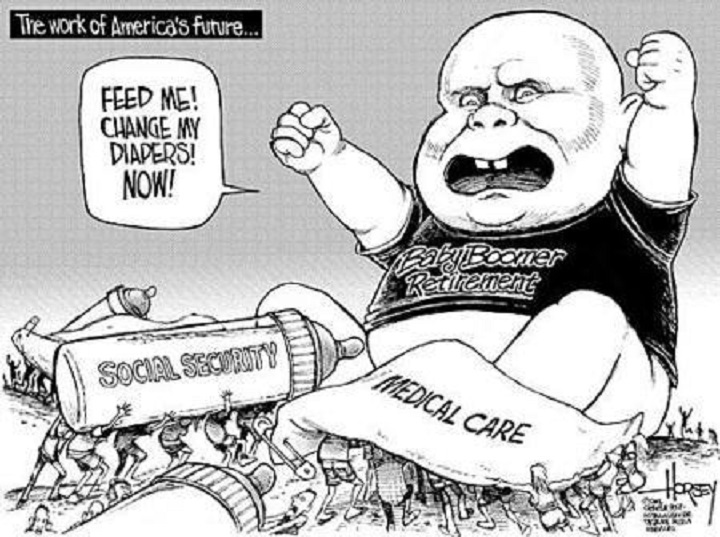
New Zealand is a shit place to be young, on the other hand, because they are the ones who have to work and pay for the luxurious retirements of the old. In order for our elderly to get $370 a week of free money for a quarter century, the young have to be taxed brutally. This makes it much harder for them to pay back their student loans, to own their own house or to raise a family.

Most pensioners in New Zealand are homeowners because it used to be possible to buy a house on the average wage in this country. Analysis shows, however, that the average wage would now have to be almost $80 an hour for young people to have the same chance of owning a house that their parents’ generation had. Young people nowadays face a level of financial desperation that their parents never came close to experiencing.

Studies have shown that financial pressures are the second most common contributing reason to suicide attempts, behind only depression. Stressful life events are powerful predictors of future suicide attempts. These stressful life events are much more common for the young, who face unprecedented levels of uncertainty over housing and employment. Unfortunately for them, high stress is all but inevitable as the Boomers demand to be catered for to the level at which they are accustomed.

In a normal, properly-functioning nation, the elderly will happily sacrifice themselves so that the younger generations can prosper. Knowing that the young are the next generation of themselves, the elderly are happy to lay the foundations for the prosperity of the young, even at their own discomfort. This has always been the case in healthy nations.

In New Zealand, the elderly throw the young to the wolves so that they can have more for themselves. Many of the suicides of young people could be prevented if we had a properly-funded mental health system. The old people who control the national purse strings, however, have directed almost every penny towards ensuring their own comfort, and have left the young to go without.

New Zealand spends $15,000,000,000 a year on pensions, much of that going out to people who don’t need it. Many people in their sixties and seventies run a business and get $370 of pension money a week on top of that. This colossal expenditure is evidence that our society is run to the benefit of the old, at the expense of the others.

Precise figures for mental health funding are impossible to find for New Zealand because of our district health board system. In Australia, though, some 5% of total health spending goes on mental health care specifically. We can assume a similar figure for New Zealand. Because we spend about $17,000,000,000 a year on healthcare, 5% of our total health budget works out to be about $850,000,000.

It’s not clear exactly what percentage of funding goes to those aged between 15 and 29, but assuming a figure roughly equal to that age bracket’s proportion of the population, we arrive at roughly $200,000,000 per year. Considering that New Zealand spends $400,000,000 per year on enforcing cannabis prohibition, $200,000,000 for the mental health care needs of an entire generation seems absurdly little.

And it is – it’s an absolute disgrace.

The solution to this state of injustice, and a partial solution to our increasing suicide rates among young people, is to lower the age of universal basic income from 65 to 18. This would allow relief from the insane financial stresses that are now levied on those young people.

Lowering the universal basic income age from 65 to 18 necessitates that today’s wealthy Boomers will have to share their pie with others, so we can expect that they will fight this suggestion tooth-and-nail to the bitter end. The overall outcome, however, would be a reduction in suffering, as the Boomers’ loss of luxury would be compensated for by the younger generations’ emancipation from poverty.

*

If you enjoyed reading this essay, you can get a compilation of the Best VJMP Essays and Articles of 2018 from Amazon for Kindle or Amazon for CreateSpace (for international readers), or TradeMe (for Kiwis). A compilation of the Best VJMP Essays and Articles of 2017 is also available.

The War Criminal’s Apprentice

The great disconnect between the rhetoric and the reality of the Sixth Labour Government has confused many people. Many people have been taken in by the mainstream media’s propaganda about kindness, and are therefore at a loss to explain what’s currently going on in our society. This article seeks to explain the psychology of Jacinda Ardern – the War Criminal’s Apprentice.

It was reported yesterday that New Zealand now has the highest suicide rate in its history, with 685 people taking their own lives last year. This is a figure greater than one Christchurch mosque massacre’s worth of deaths every month, and is almost double the road toll (especially if one considers that many road deaths in single-car accidents are disguised suicides).

This will surprise some, in particular those who expected the rate to go down after the 2017 General Election. After all, the mainstream media has made it very clear to us that the Sixth Labour Government is motivated by kindness, and that fixing New Zealand’s failed mental health system is a priority for them. But not only has Ardern’s Government not taken the correct measures to reduce suicide rates, they have purposefully taken measures that will raise them.

It might seem outlandish to the reader, even horrifying, to hear the claim that our politicians are literally willing to sell their own people out for personal gain. It is, however, true. Although the ideal is that politicians will represent the interests of their nation much as if they were the head of some great family, the reality is that politicians represent their own interests and consider the people and their votes much like a dairy herd and its milk output.

Some are even willing to cosy up to ideologies of hate if those individuals calculate that doing so will advance their career.

Jacinda Ardern has been willing to do this in multiple ways. Right from the beginning of her career, she demonstrated that not even a nine-figure body count was enough to make her willing to repudiate an ideology, whether that ideology be Communism or Islam. This she showed most infamously with her “Comrades” speech to the International Union of Socialist Youth in 2008, the year she was elected President.

Graduating from university in 2001 with a Communications degree, Ardern took a role as a staffer to Helen Clark. She must have been dutiful in this role, because she quickly ended up in London as a Senior Policy Adviser to Tony Blair’s Labour Government. This is presumably a role in some demand, and therefore not given lightly to people in their 20s unless they show special promise.

British Prime Minister Tony Blair committed the British Armed Forces to the invasion of Iraq in 2003. This was done despite the fact that his plan to do so caused the largest protests in the history of the world – one million gathered in London to voice their disapproval, and three million gathered in Rome.

One million was also roughly the number of people killed by the invasion of Iraq, which means that Blair (alongside fellow warmongers George W Bush and John Howard) takes a position in the second tier of history’s greatest murderers. Ardern knew all this when she offered to work in his office, but it didn’t stop her. This fact is crucial to understanding her mentality.

It might seem incredible that a person supposedly committed to kindness would volunteer to work for a mass murdering war criminal – but Ardern did so in order to study his methods. She is every bit a willing apprentice to a war criminal. Anyone who considers the globalist wrecker of nations Tony Blair a model to base themselves on can only reasonably be treated with the deepest suspicion.

The reason why Ardern is opening the gates to mass Muslim immigration, as Blair did in Britain (Britain’s Muslim population increased 70% during Blair’s ten years in power), is twofold.

The first reason is that it strengthens the electoral position of the Labour Party. As Dan McGlashan showed in Understanding New Zealand, there was a significant correlation between being Muslim and voting for the Labour Party in 2017. Moreover, the average Muslim in New Zealand currently has qualified through normal immigration channels and is therefore more likely than usual to be educated and wealthy, and therefore less likely than usual to be a Labour voter.

Opening the borders to poorer and less educated Muslims than what New Zealand currently has is to all but guarantee that the majority of the newcomers will vote Labour. As has been seen in Britain, most Muslims already vote Labour, and can be relied upon to do so. Opening the borders to them, therefore, is to import a loyal voting bloc.

They also know that the more problems they can create, the more they can justify Government intervention. It’s no secret that mass Muslim immigration will bring with it widespread poverty, violence, property crime and sex crimes like child grooming gangs. This is only a drawback for the victims of those crimes. For politicians, it’s an opportunity to convince the public those politicians are needed to solve the public’s problems.

The second reason is that it promotes Ardern’s personal ambitions for future United Nations honours. Ardern is fully aware that one quarter of the world’s population is Muslim, and therefore that her desire to one day get a powerful role in the United Nations is heavily dependent on Muslim goodwill.

If Ardern’s psychology is to be understood, it has to be understood that she considers herself to be acting on the world stage, not on the New Zealand stage. This is the reason why she is dismissed, in some quarters, as the “Part-time Prime Minister.” Her audience is global, and far more important than mere Kiwis. Trivialities like running New Zealand can be delegated to Andrew Little.

Part of the reason for the brutal free speech crackdowns on New Zealand citizens (crackdowns that are in violation of existing New Zealand human rights law) is to maintain her appeal to the Muslim section of the globe. It’s also why the Sixth Labour Government doubled the refugee quota despite New Zealand’s worst ever housing crisis.

Putting followers of a foreign hate ideology above her own people is all but guaranteed to provoke immense resentment among New Zealanders. The bitter irony – that it’s precisely this kind of favouritism that leads to things like the Brenton Tarrant shooting – is lost in the hubris. So there’s every sign that New Zealand could be in for a tumultuous decade.

The desire to impress globalist interests is also why she doesn’t care about cannabis law reform, despite that there is an extremely strong desire for it among New Zealanders. There are simply no pro-cannabis blocs of voters at the United Nations, therefore no favour to be won by supporting the issue. It doesn’t matter that it would alleviate the suffering of large numbers of Kiwis.

It has to be emphasised at this point that Ardern simply doesn’t care about the human suffering that she causes through her ambition to become World Princess. It’s not an exaggeration to say that Ardern is the closest that New Zealand has ever had to a Hitler or a Stalin. The will to sacrifice any number of their own people to achieve personal goals is the common factor.

Who she most compares to is Blair himself, who was perhaps one order of monster lower than Hitler or Stalin. Nevertheless, like his fellow war criminal George W Bush, Blair is many times worse than even the most destructive serial killer. That Ardern willingly apprenticed herself to such a man, to learn his methods and strategies, speaks to an obscene degree of megalomania, perhaps exceeding anything New Zealand has ever previously produced.

*

If you enjoyed reading this essay, you can get a compilation of the Best VJMP Essays and Articles of 2018 from Amazon for Kindle or Amazon for CreateSpace (for international readers), or TradeMe (for Kiwis). A compilation of the Best VJMP Essays and Articles of 2017 is also available.
The First Shall Be Last And The Last Shall Be First

The phrase “The first shall be last and the last shall be first” is mentioned in many different spiritual or religious contexts, perhaps most famously in the Bible. It refers to a Nietzschean revaluation of all values, where the existing social order is completely inverted. This essay takes a detailed look at the various ways that such an inversion can happen.

There are four realms of elemental alchemical energy: the realm of clay, the realm of iron, the realm of silver and the realm of gold.

When one transitions from one realm to another, it inevitably means that the previous social order is upset, often to the point of being completely reversed. Sometimes it means that the very actions that led to success (or failure) in the one realm lead to the exact opposite result in the new realm.

For instance, large men with big muscles dominate in the realm of iron, because they are better at fighting. But if their group should transition into the realm of clay, the base survival level, being big is a disadvantage. In a state of resource scarcity, the largest individuals have the greatest stress trying to obtain enough resources to meet their metabolic needs. The best fighters tend to be the worst scavengers.

When Jesus used this phrase, he was referring to the transition from the realm of silver to the realm of gold. The time that Jesus lived in was one when the advances of civilisation had led to a grossly materialistic culture. He was warning those who benefitted from that materialism that their positions at the top of the hierarchy weren’t as secure as they wanted to think.

There are other transitions: from iron to silver reflects the imposition of an age of peace, from silver to iron represents the collapse of a peaceful age into a one of war etc.

In all of these transitions, there is an element of the first shall be last and the last shall be first. The man of silver, whose gregarious and social nature makes him the dominant party during peacetime, usually becomes a weakling when society transitions into the realm of iron. Likewise, the man of iron, whose physical courage and unyielding nature makes him a war hero, becomes a criminal delinquent when society transitions into the realm of silver.

On Earth, it’s possible to accumulate vast wealth and power. Doing so for the sake of rising in social status is something that is common to all social animals, and in the realm of silver it will increase your position on the hierarchy. Upon the death of the physical body, however, the connection to all of that wealth is lost, and one’s soul stands before God once again.

Should it be God’s judgment that your wealth was accumulated at the cost of other people’s suffering, then your likely fate is to be reincarnated into a world where people behave like you did. Your next life, then, will be fraught with the suffering caused by greed. You will, of course, not complain, because before God you will understand that it’s perfectly fair for you to reincarnate in a world full of beings on the same frequency as yourself.

By this means, a man who could have been the very highest of all in one material world might become the very lowest of all in the next one.

This is not at all to imply that it’s immoral to be wealthy. It’s entirely possible that a person’s great wealth is the result of being showered in gratitude by the multitudes who that person has helped. There’s no reason to automatically assume that any given fortune was acquired by crime. It’s simply a fact that advantage in one realm does not correlate with advantage in the next one.

On the other side of the divide, there are many people today who possess vast spiritual knowledge but who sit at the bottom of the social hierarchy on account of that such knowledge is not valued. We may live in a degenerate age, perhaps even a Kali Yuga. This means that the sort of person who once concerned themselves with spiritual knowledge is now inevitably an outcast.

The knowledge that is valued today is that which causes one to grow in material power or wealth. Spiritual knowledge, and the desire for spiritual knowledge, are more or less considered mental illness. Those who currently rule the West are so utterly Godless that they have pathologised the very belief in God. We have fallen very far from the realm of gold.

Once upon a time the spiritual man would have been a shaman or a sage, and warrior-kings would come to speak to them about things that no-one else understood, and their advice would thereby lighten the suffering of many myriads. Great witches, likewise, would have been consulted on decisions that set the course of kingdoms and empires.

Today we look at the shaman or witch and, instead of seeing a person whose mind is set on the spiritual at the expense of the material (and therefore holy), we see one whose mind is set on delusions at the expense of the real (and therefore diseased). We see a psychotic to be treated with disdain rather than a visionary to be treated with regard.

However, the time may come when a revolutionary spirit is stoked and when the shackles of materialism are thrown off. It’s already apparent to many that the obsessive focus on GDP growth at the expense of all else is causing more misery that it’s alleviating. A transition to another realm could involve the introduction of a new Golden Age onto the Earth.

The world is rapidly approaching a revolutionary transition between realms in any case. The elite governments of our world are hopelessly corrupt, and awareness of this is spreading faster than ever (a process that some are describing as The Great Awakening). The pre-existing fractures in our society will not be able to survive the stresses that are coming.

Perhaps the first shall become last in the sense that the elites of one corrupt system are cast down when it is overthrown, and the last shall become first in the sense that the good people who were kept down by corruption will rise to their natural place in the hierarchy. The best thing is to work on raising one’s own frequency so that one can take the right measures when the time comes.

*

If you enjoyed reading this essay, you can get a compilation of the Best VJMP Essays and Articles of 2018 from Amazon for Kindle or Amazon for CreateSpace (for international readers), or TradeMe (for Kiwis). A compilation of the Best VJMP Essays and Articles of 2017 is also available.