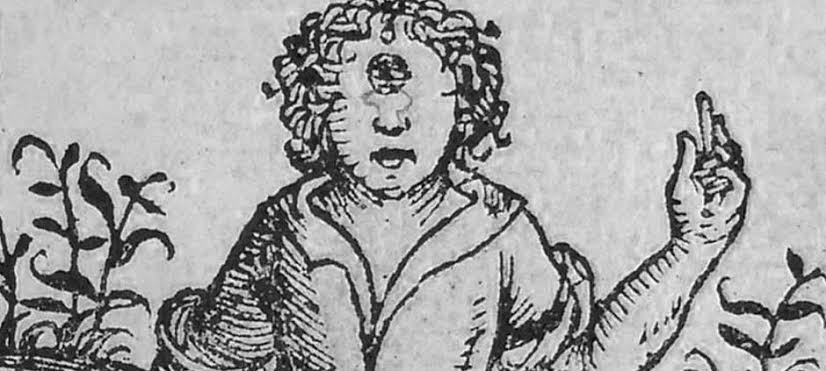
A popular piece of wisdom holds that “In the land of the blind, the one-eyed man is king.” This is supposed to imply that any individual with superior perception will inevitably rise to the top of any dominance hierarchy. The reality in a Slave Culture such as our own is different. In a culture as blind as ours, anyone who can see clearly will be blinded.
The blind, like all humans, will never simply accept the dominance of someone who claims to see things that they don’t. It’s not in human nature to do this.
If a one-eyed man entered the land of the blind and started talking about how he could see things that the others could not, the blind would rather deem him insane. They would adamantly refuse to acknowledge that any higher insight to their own was possible. The land of the blind would have its own dominance hierarchy, and its own incumbent alphas, and they would defend their positions.
If the one-eyed man insisted that he could see things that the others could not, he’d be declared acutely psychotic. The things seen would be dismissed as hallucinations, and it would be declared that these hallucinations were brought on by excessive stimulation, and they’d forcibly sedate him. They might put him in a cell so that his disturbed mental state didn’t upset others.
Eventually, they’d just rip the eye clean out of his head. They’d come to the conclusion that there was something wrong with the function of the eye itself, and that was why he couldn’t break the delusion of being able to see things that others could not. Better to just remove the offending organ with surgery.
Anyone who doubts the plausibility of this conjecture need only observe the way that our society today, operating under a materialist paradigm, treats those of a sensitive enough psychic disposition to detect a world beyond the physical.
In today’s society, anyone who claims to possess any spiritual knowledge whatsoever is considered psychotic. If a person makes a claim to some minor knowledge, they might be politely humoured, but anyone making a claim to major spiritual truth is despised as someone too weak to maintain a grip on reality.
Anyone claiming firm gnosis is simply dismissed as schizophrenic. Especially forbidden is any talk that we may be God ourselves. The mental health system might begrudgingly allow someone a belief in Rabbi Yeshua ben Yosef, but any idea that all conscious beings are co-creating reality in the eternal moment is absolutely right out.
This is the land of the blind – the spiritually blind. The vast majority of the population either superstitiously follows a dead tradition or follows none at all. But we cannot expect that a spiritual man, should one arise, would be welcomed and his insight greeted. Far more likely he would be shunned as a heretic.
One of the great philosophical debates is between materialists and idealists. The materialists consider their opponents to be mentally ill dreamers, while the idealists consider theirs to be literal-minded children. This essay expounds a thought experiment that shows that materialism is not tenable.
Materialists believe that the consciousness is generated by the brain. The most popular materialist theory is that consciousness is an “emergent property” of the combination of the various senses. Consciousness has evolved as a kind of supervisor of this sensory input, presumably for the purpose of making decisions or similar.
Therefore, materialists believe that the individual’s awareness of the outside world resides in the physical brain. It is the brain itself that is aware of the outside world through the impressions it receives from the various sensory organs. It follows from this that when the brain dies, consciousness also ends.
A simple thought experiment shows that this position is not tenable.
When a person goes to bed and dreams at night, they habitually find themselves exploring alien worlds. They do this while occupying a body that seems very similar to the bodies we occupy here on Earth. This body can see, seemingly through eyes about five or six feet off the ground, and it can also hear, seemingly through ears. In the dream world, these eyes and ears observe other bodies much like the bodies on Earth.
In this dream world, one’s surroundings seem very real. It’s rare for a dreamer to become aware that they’re dreaming – if they do, they usually wake up. While dreaming, it’s no more common for the consciousness to question the reality of the sensory impressions it receives than it is for a consciousness awake on Earth to do so. It seems very much like a real world.
The question that exposes the weakness of materialism is this. When you are dreaming, which brain generates consciousness? Is it the brain of your body here on Earth that generates the consciousness that observes the dream world, or is it the brain of your body in the dream world?
From a materialist perspective, one of those two things must be true – but both put the lie to materialism itself.
If the brain in your body here on Earth generates the consciousness that observes the dream world, then a brain on Earth is not necessary to observe Earth. This is because, if the dream world is being observed by a consciousness that is generated by a brain in a different reality, then the consciousness that observes Earth may be also generated by a brain in a different reality. Or perhaps not even generated by a brain.
This means that it’s possible that the consciousness that observes Earth is generated by a brain somewhere else, perhaps in a reality outside of, or more fundamental than, the one in which Earth resides. In such a case, we have no more reason to think that the death of our body on Earth should be the end of consciousness than we do to think that the death of our body in the dream world should be the end of consciousness.
On the other hand, if it is the brain in the dream world that generates consciousness – perhaps on account of that it is connected to the eyes and ears of the dream world and therefore receives sensory input from the dream world – then a material brain is not necessary in order to observe a world. The brain in the dream world cannot be definitely said to exist, because there is no evidence of the true existence of the dream world (at least none that can be produced on Earth).
But if it is the brain in your body in the dream world that generates consciousness, then there’s no reason to assume that the death of one’s body here on Earth ought to result in the end of that consciousness. If the brain in your body in the dream world generates consciousness, then consciousness cannot be “tied” or “fixed” to a brain. If a brain in a dream world can generate it, then so could many other things, such as other brains in other dream worlds.
The simple fact that it’s possible to be conscious in a dream world while dreaming makes it impossible to state that the brain on Earth generates consciousness. The fact that one is conscious in the dream world must mean that either a brain is unnecessary to generate consciousness, or that there are multiple brains in multiple levels of reality that consciousness can move between.
In either case, materialism is untenable.
This apparent paradox can be resolved in an instant, simply by realising that it is consciousness that is the prima material and fundamental basis of reality. You are not your body, you are consciousness – and, as consciousness, you can travel between worlds. In fact, all worlds are merely dreams, just patterns of perception – as the Buddhists have long known.
Because of all this, there’s no reason to think that the death of the physical body on Earth ought to affect one’s individual consciousness. It’s possible for consciousness to travel between worlds without being bound to a body – dreams are proof of this. Therefore, materialism is untenable, and the fundamental materialist fear – that the death of one’s Earthly body means the extinguishing of one’s consciousness – is unfounded.
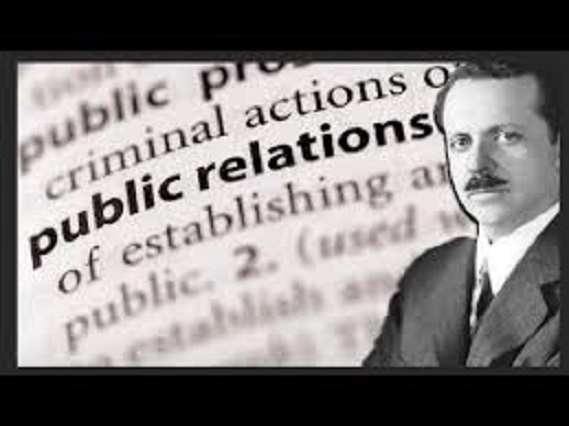
Chapter Eleven in Edward Bernays’s Propaganda is called ‘The Mechanics of Propaganda.’ Here Bernays talks about how propaganda gets transmitted to the public.
Bernays defined propaganda here as “the establishing of reciprocal understanding between a person and a group.” Therefore, there is no practical limit to the number and type of media that may be employed to transmit propaganda (one wonders what Bernays would have made of the Internet).
He writes about how the public meeting was the best means of propaganda 50 years ago (i.e. in the 1870s), but people have become “sick of the ballyhoo of the rally,” and prefer to get information from the radio and newspapers. The propagandist must keep up with the shifting patterns of the popularity of various media, as well as anticipate future changes.
Bernays notes here that there is almost no item of news that, if published, would not benefit the interests of some people and harm the interests of others. He notes also that the newspaper does not care about the propaganda value of a piece of information, but only about its news value. Thus, propaganda that is also news is more likely to get propagated.
It’s important to tailor the message to the audience. The propagandist must create propaganda items with specific audiences in mind. To this end, magazines are different to newspapers because they’re not obliged to print news. This also means that magazines are kind of naturally like propaganda organs.
The propagandist might like to consider supplying a propaganda organ with a series of articles that puts the case to a particular audience. This is especially likely to succeed if that organ feels like they can derive prestige from the association with the company the propagandist works for.
Hilariously (with hindsight), Bernays is able to speak about the radio when it was a new invention and its development uncertain. He notes that many newspaper enterprises have moved into radio, correctly in his estimation. Anticipating the Internet, he predicts that various groups will have an ev ever-increasing interest in buying media space for the sake of propagandising.
Incredibly, Bernays was able to write 90 years ago that Hollywood films were major propaganda devices. He also predicts the rise of the cult of personality by noting that “the public instinctively demands a personality to typify a conspicuous corporation or enterprise.” This is acutely true in New Zealand, where our Prime Ministers have little to go on apart from the personality cults.
Bernays notes that the public has already become cynical to attempts at manipulating them through the media, but some interests are universal. People will always have a need for food, for amusement, for beauty and for leadership. For this reason, they will always seek out sources of propaganda.
He leaves us with the statement: “Intelligent men must realise that propaganda is the modern instrument by which they can fight for productive ends and help bring order out of chaos.” This statement must be read in the light of World War I, which was itself the result of the old methods of fighting. In this sense, Bernays and this book herald a shift from an Age of Iron to an Age of Silver.
Many historical theories view the world as an eternal struggle between two forces. The Christians call it good and evil, the Communists call it the proletariat and the bourgeoisie, and the Nazis call it the Aryan and the Jew. A previous essay here suggested it was between the K and r-selected. This essay takes a new approach: that Friedrich Nietzsche was more accurate than anyone else, and the true eternal struggle is between those with a master mentality and those with a slave mentality.
In The Genealogy of Morals, Nietzsche described two basic forms of morality.
Master morality judges actions on the basis of good or bad. Nietzsche defines master morality as the morality of the strong-willed: it is championed by the noble and the powerful. This doesn’t mean that master morality is mere domination – it also prizes honesty and an accurate appraisal of one’s own weaknesses. People with this mentality are not concerned with what the herd thinks. They prefer to pursue their own self-defined form of excellence.
Slave morality, by contrast, judges actions on the basis of good or evil. In slave morality, strong people are equated with evil. In slave morality, goodness is equated with passivity, timidity, agreeableness and an insipid kindness. Slave moralists aren’t concerned with accurate viewpoints – they simply believe whatever makes them feel good. Questioning the herd is a great sin, because it requires strength and therefore only someone evil would do it.
The masters are always fewer in number, and the slaves more numerous. In this regard, master and slave morality maps fairly closely to the mentality of the K-selected vs. the mentality of the r-selected. The major differences are that K-selected people are liable to suffer from pathological altruism, whereas the master morality (not feeling pity) does not, and that r-selected people do not lack vitality and are not prudish, whereas the slave morality is neurotic.
The true course of history has been the ebb and flow of these two different forms of morality.
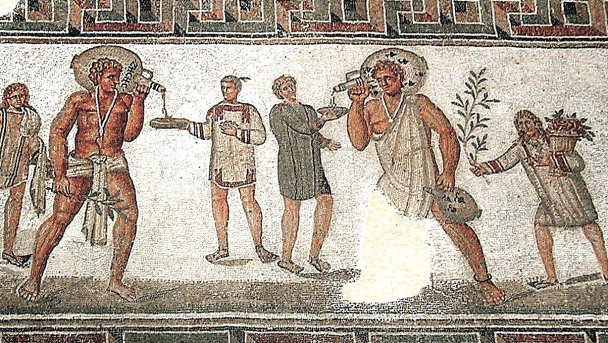
Nietzsche himself wrote that the ancient Greco-Roman culture encapsulated master morality, but was subverted from the inside by Christianity, one of the original forms of slave morality. When Christianity became the official religion of the Roman Empire in 323 A.D., Westerners became slaves, our natural spiritual traditions having been thoroughly destroyed and replaced with superstition.
This victory of slave morality endured until the Renaissance (an event which a previous essay here called the Minor Renaissance). At this time, some of the old master morality returned in the form of the quest for scientific knowledge, previously hidden or taboo philosophy and exploring the world. Unfortunately, this didn’t last.
The 19th Century was a relative high point for master morality (of course, Nietzsche didn’t know this). During this decade, the European Empires reached their greatest extent. The British Empire had achieved such a state of dominance that it was able to settle Australia and New Zealand – lands on the other side of the planet – at the same time as providing most of the settlers to North America, and all this while keep the world’s shipping lanes open.
Unfortunately, there was no Major Renaissance, as the wider Western consciousness kept falling at the first three hurdles of dumb Abrahamism, blind Materialism or deaf Satanism. The West never managed to revive the master spirituality it had before being poisoned by Christianity some 1,700 years ago.
It has long been observed that empires tend to fall from the inside, rather than get smashed by any outside force. The reason for this is the internal rise of slave morality. The reason why the West has fallen into the decrepitude that it has is because slave morality has risen to the point where it is normal. Accordingly, we are weak.
It has also long been observed that good times lead to weak men, who then create hard times, which leads to strong men, who then create good times. This has been discussed here as the Red Pill-White Pill-Blue Pill-Black Pill sequence. New Zealand philosopher Rick Giles describes it as the Dignity Culture-Honour Culture-Victimhood Culture-Slave Culture quadrichotomy.
Hard times lead to strong men by process of selection. When times are hard, there’s not enough surplus to waste any of it. Therefore, the people in charge of resources have to be discriminating. Even more pressing is the fact that, when times are hard, people will fight over what little resources exist. This fighting, being in the realm of iron, rewards the hard and those who can do without.
This Spartan sense of miserliness leads to efficiency and a masterly mindset. When things operate efficiently, life is good. Everyone has their needs met and, as is usually the case when people’s needs are met, they become wealthy. When everyone is wealthy, everyone tends to be happy, and it is as if a Golden Age had descended upon the land.
When everyone has their needs met, they stop being hard. No-one with a full belly wants to fight – better to just wait until the problem goes away. If there’s no food in the cupboards, that’s when it’s time to worry. People in the “fat and happy” mindset tend to ignore challenges rather than respond to them.
This doesn’t only lead to physical softness but, more crucially, it leads to mental softness. This mental softness prevents people from being able to make sharp and accurate distinctions between the phenomena they encounter. Consequently, they become apathetic and indifferent, a malaise that they mistake for the virtue of tolerance.
This apathy and indifference leads to a failure to adequately deal with corruption. Either corruption is ignored, or the corrupt are not punished – a slave’s mindset. Because no-one is strong enough to challenge the corrupt, they come to positions of dominance. When corrupt people are in power, hard times are just around the corner. And so, the cycle repeats.
In today’s Clown World, slave morality has the total ascendancy. We are so apathetic that our politicians can kick us in the guts on a daily basis and we just roll over and take it. The total victory of slave morality is, perhaps, the fundamental explanation as to why Clown World is the way it is. This is a world without masters. The slaves have completely inverted natural morality.
What’s needed is the Major Renaissance. This would constitute a spiritual renaissance that would reconnect the people of the Western World to God. Being reconnected to God, we would then possess the necessary illumination to see the path forward in the darkness. We need a new set of masters for a new age.