

Clown World Chronicles: What Is ‘Race Neurosis’?

People in Clown World exhibit all kinds of neuroses, most of them caused by our highly unnatural way of life. Adapting to modern industrial society has proven to be challenging for even the most resourceful of people. As this essay will examine, the forced diversity that we all live under has created a form of mental illness particular to itself.

A neurosis refers to a class of mental disorders that are characterised by anxiety, obsessional thoughts and avoidance behaviour. Karen Horney considered the defining characteristic of neurosis to be a worldview that is distorted by compulsive needs. Neurotics exhibit their unusual behaviours, according to Horney, to meet their exaggerated needs for power, prestige and affection.

It’s common for people to be neurotic about cleanliness – some are excessively anxious about getting infected by germs and will obsessively wash their hands or clean their teeth. These behaviours feed the neurosis by causing the neurotic to feel themselves superior to others on account of their greater hygiene, and that other people will be more affectionate towards them because they are so clean.

People with race neurosis are similar. Their need for power is met by silencing others for making ‘racist’ comments, and their need for prestige is met by looking down their noses at those moral inferiors and shaming them. As with other ingratiating behaviours motivated by neurosis, those with race neurosis believe that this virtue signalling will cause others to like them more.

‘Race neurosis’ refers to a very specific kind of neurosis that is most accurately considered a type of obsessive-compulsive disorder. The compulsive need in the case of race neurosis is the need to deny human biodiversity. This compels them to believe that all human subgroups are precisely the same and, when different, only different for environmental and not genetic reasons.

The person with race neurosis will instantly disregard any explanatory theory of human behaviour that assumes that human biodiversity exists. They do this out of a deeper compulsive need – the one to assert that all human subgroups have equal value. This assertion may be true in a metaphysical sense, but it isn’t at all true in a biological sense – and the racial neurotic has trouble making a distinction.

No two things in Nature are the same, whether measured as individuals or as groups. Of any two, one will be taller, one will be darker, one will be relatively more endomorphic – and one will be smarter. This means that, by any measure you care to name, one will be superior and the other inferior. A person with race neurosis has extreme difficulty accepting this.

This neurosis is an echo of the earlier Christian neurosis that was triggered by the realisation that humans were just another form of animal. In the same way that this realisation led to people denying the science of evolution and castigating Darwin as a heretic, race neurosis also leads to people denying the science of evolution and castigating its proponents as evil.

Race neurosis goes hand-in-hand with creationist narratives about the origins of the human species. Because no two things in Nature are the same, human biodiversity denial is most plausible when it can appeal to a creator God, who (for various reasons) is presumed to be unwilling to create superior and inferior groups of people. Therefore, certain qualities (like intelligence) can be assumed to be equal across all human groups.

People suffering from race neurosis also practice a variety of avoidance behaviours, on account of that they live in constant fear of empowering “far-right wing extremists”. They are extremely reluctant to acknowledge either white or Asian superiority in any intellectual or behavioural facet, out of the fear that, if either was widely acknowledged, certain races would find themselves in gas chambers again.

Race neurosis can even go so far that a person can think it immoral for someone else to say that it’s okay to be white.

A person can confidently be said to have race neurosis if they become angry or distressed when a belief in human biodiversity is asserted. If a person merely disagrees with hereditarianism, they will be able to discuss the relevant scientific evidence without becoming distressed. But if they suffer from a form of race neurosis, they will sense that one of their sacred beliefs is being challenged, and they will become defensive.

Race neurosis is deliberately aggravated by the mainstream media, who play up stories that have a racial angle and play down stories that don’t. Examples can be found right now in the numerous articles admonishing people to abstain from any anti-Chinese racism that might have been provoked by coronavirus fears. This constant hammering has created the false impression that racial prejudice causes a significant proportion of the world’s avoidable suffering, and that is one of the world’s foremost issues.

Also contributing to the problem is the common eschatological belief that all of the world’s races are destined to fight to the death for supremacy in some future race war, willingly or otherwise. People who hold this belief are often afraid that talking about human biodiversity will set this conflict off. Their logic is that recognition of group differences is a step on the slippery slope to warfare.

The cure for race neurosis is genuine hardship. Anyone genuinely worried about whether they have signalled their anti-racism hard enough is immensely privileged – to worry so much about something so meaningless is evidence of no genuine troubles. In Clown World, the disconnect that many people have from reality manifests in psychiatric conditions such as race neurosis.

*

This article is an excerpt from Clown World Chronicles, a book about the insanity of life in the post-Industrial West. This is being compiled by Vince McLeod for an expected release in the middle of 2020.

*

If you enjoyed reading this essay, you can get a compilation of the Best VJMP Essays and Articles of 2019 from Amazon for Kindle or Amazon for CreateSpace (for international readers), or TradeMe (for Kiwis). A compilation of the Best VJMP Essays and Articles of 2018 and the Best VJMP Essays and Articles of 2017 are also available.

*

If you would like to support our work in other ways, please consider subscribing to our SubscribeStar fund. Even better, buy any one of our books!

Things The Coronavirus Has Already Proven

The Great Coronavirus Pandemic of 2020 is only just beginning. Although it is already dominating the headlines, most of the suffering is still to come. Exactly how much suffering there will be – and who will suffer it – is still unknown, as are most outcomes of this rapidly-unfolding drama. However, there are some things that this pandemic, and the response to it, have already proven. This essay explains.

Many people, mostly for egotistical reasons, believe that human beings are categorically superior to other animals. The usual belief is that our high brain volume to body volume ratio has granted us an unmatched degree of intelligence, if not spiritual insight. Therefore, we’re above “animal behaviour”.

The ongoing panic buying that has seen supermarkets in the West stripped bare is stark evidence against this. Human beings are another kind of primate, only narrowly less impulsive and aggressive than the others. The “monkey see, monkey do” logic that causes juvenile primates to imitate their peers is on vivid display in the now numerous videos of people fighting over water and toilet paper.

In reality, humans are just as prone to panic-fuelled acts of selfish aggression as any “lower” animal. All we need is enough fear to cause a limbic hijack and we’re operating on raw animal instinct again. The ongoing coronavirus pandemic has proven that we’re as susceptible to that panicky fear as any flock of sheep.

A second thing that the COVID-19 pandemic has proven is that borders are good. Because the West has been so wealthy for so long, we have developed a kind of tameness. We forgot that the world is dangerous, and that much of that danger comes in human form. We started to believe the fatal delusion that all human groups are the same.

The pandemic caused us to remember that borders are there for a reason – the same reason why you have a fence around your property and skin around your body. It’s to keep bad things out. Esoterically speaking, a border is just a hard masculine line that protects a softer, feminine core, like a skull, a ribcage, a door or a fence.

We have now remembered that borders are good because they keep bad things out. Whether people infected with viruses or people infected with hate-filled ideologies, borders serve to keep us safe from danger. The COVID-19 pandemic has proven that having open borders makes as much sense as leaving your front door open at night.

A corollary to this is that the pandemic has proven that the Government can stop mass immigration if they want to.

For the past few decades, neoliberals have screamed that everything would collapse if we stopped the mass importation of cheap labour – our fruit and vegetables would go unpicked, our garbage would go uncollected and our elderly would go without care. Western Governments have closed the borders anyway, reasoning that, absent cheap labour imports, wages will rise to the point where these jobs can be filled by natives.

More worryingly, the COVID-19 pandemic has proven that our dependence on offshore supply chains for some basic goods and medicines has made us not only economically vulnerable, but also strategically vulnerable.

Many industries are running into procurement difficulties, because China shut down so many of its factories and docks that the flow of exports has been throttled. Many Western manufacturers are just learning that, because so much has been outsourced there, when China shuts down the world shuts down. It has become common to hear a person exclaim their recent realisation that X% of a vital industrial widget is produced in China and so, without Chinese production, no-one can get hold of it.

Our exposure to medical shortages threatens to be much worse than our exposure to industrial shortages.

Two weeks ago, India, the world’s leading producer of generic drugs, instituted export restrictions on 26 of them. Because the coronavirus pandemic has impacted pharmaceutical factories in China, many Indian drug manufacturers can no longer acquire precursor ingredients. The panic buying has already shown how close we are to chimpout – once people start being told that the pharmacies can’t supply their psychiatric medicines there could be riots.

Perhaps more fundamental than any of these things is that COVID-19 has proven that the Government doesn’t know what the fuck it’s doing. This was already widely understood by most intelligent people, but by now most poeple have had the nauseating realisation that the Government is made up of people who are good at winning elections and not people who are good at governing. All around the world, they are panicking.

One of the main things that Western authorities now have to concern themselves with is civil unrest. It’s slowly dawning on people that this pandemic has the potential to disrupt life as we know it for a significant length of time. As this realisation spreads, all kinds of negative sentiments will grow. Anger, fear, vengeance and short-term thinking will all increase – and they won’t be rational.

The COVID-19 pandemic has proven that our society is on much shakier foundations than it used to be, and shakier foundations than many had realised. The bonds of solidarity that comprise every community are much fewer and much weaker. The potential for chimpouts at any time have never been greater.

*

If you enjoyed reading this essay, you can get a compilation of the Best VJMP Essays and Articles of 2019 from Amazon for Kindle or Amazon for CreateSpace (for international readers), or TradeMe (for Kiwis). A compilation of the Best VJMP Essays and Articles of 2018 and the Best VJMP Essays and Articles of 2017 are also available.

*

If you would like to support our work in other ways, please consider subscribing to our SubscribeStar fund. Even better, buy any one of our books!
Why I Don’t Believe In Climate Change Alarmism

I don’t have a qualification in Climatology, and am therefore not an expert on the subject. I do, however, have a couple of Psychology degrees, and so have a claim to expertise there. When it comes to understanding issues like climate change, I can’t use Climatology knowledge; I have to use Psychology knowledge. This is how I do it.

Like anyone else who understands general science, I can try to understand the basics of climate change. I can go to Google Scholar, type in “climate change predictions” and then limit the search to papers from 2019 onwards, as I did here. This would give me a general overview of the current state of the science. There’s one minor problem – such a search query returns over 20,000 hits.

Realistically, becoming an expert on climate change would require reading at least a hundred of these papers, as well as at least a hundred published before 2019. This would total several years of study – a time investment that I’m neither able nor willing to make. Therefore, like any other layman, I’m reduced to making a judgment based on whether I believe the people taking about climate change are credible.

If the people talking about it seem trustworthy, then I will be inclined to believe what they say. If they seem untrustworthy, then I will be disinclined to believe what they say. This is how it works with every other political issue, from cannabis law reform to immigration to abortion to euthanasia to taxes. Once the subject of discussion moves out of Psychology, I’m operating on trust and not my own expertise.

As it turns out, the people pushing climate change strike me as grossly untrustworthy, for three major reasons: they seem insincere, irrational and dishonest.

If the politicians pushing climate change alarmism were sincere, they would not also be buying beachfront properties. Yet Barack Obama, one of the world’s foremost harbingers of climate doom, recently bought 29 acres of it. Why would Obama, privy to the world’s most advanced scientific research when American President, buy beachfront property, unless he expects the sea level to remain the same?

The market shows that seaside property is still highly valued. Waterfront property in Sydney, extremely vulnerable to rising oceans, still sells for eight-figure sums. How could a property doomed to be wiped out by rising sea levels sell for over ten million dollars? The only answer is that no-one cares about rising sea levels. The claims of those like Obama cannot be sincere.

On top of this, the people pushing climate alarmism seem irrational. On the one hand, they claim that CO2 emissions are making a major contribution to global warming, such that every one of us has the moral imperative to minimise our CO2 emissions insofar as we are able. But then these same people turn around and argue for an increase in the refugee quota, in some cases tripling it or even more.

New Zealanders consume resources at many times the rate of the average Third World resident. Where is the sense in taking 5,000 people every year (as the Greens propose) from low-emissions parts of the world, and flying them at great expense to a high-emissions part of the world, where they and their numerous descendants will consume future resources at many times the rate they would have done otherwise?

The only logical explanation for the Greens’ refugee policy is that the entire concept of CO2 emissions being bad is horseshit. Either the Greens are lying about the imperative to minimise CO2 emissions, or they don’t understand the relevant science (a closer look shows that not a single one of New Zealand’s current Green MPs has a tertiary science qualification – the closest is James Shaw with an M.Sc from a business school).

If the Greens would say that CO2 emissions were bad and, therefore, we will close the borders to immigration from low-emission areas, then the threat of climate change would appear to make rational sense. But they do the exact opposite of that. Therefore, I can conclude that those promoting climate change are irrational, and so the truth value of their pronouncements can be discounted.

The real showstopper for me though, as a psychologist, is that one of the people fronting the climate charge alarmist movement in New Zealand is a convicted fraudster. This is no less a dignitary than the Maori Climate Commissioner herself, Donna Awatere Huata.

In 2005, Huata was found guilty of fraud and of attempting to pervert the course of justice. The money that she defrauded from a foundation set up to help underprivileged kids learn to read was used on a stomach stapling operation. What sort of malignant narcissist would steal money from children to fund cosmetic surgery for herself? A Climate Commissioner, that’s who.

In the same way that I wouldn’t buy a used car off convicted ponzi schemer David Ross, I wouldn’t buy one off Donna Awatere Huata either. So why on Earth would I listen to her pronouncements about climate change? The smart thing to do would be to believe the exact opposite of whatever Huata says.

In summary, I don’t believe in climate change alarmism because the people pushing it are crooked, insane and unqualified to make scientific pronouncements. These people seem every bit the shameless grifters that have pushed every other kind of alarmism to make a quick buck out of the ensuing hysteria.

I’m willing to be corrected, but do note that you will have to have a qualification in a relevant science from a proper university, and you will have to cite peer-reviewed journal articles in relevant disciplines, for me to take you seriously on this matter.

*

If you enjoyed reading this essay, you can get a compilation of the Best VJMP Essays and Articles of 2019 from Amazon for Kindle or Amazon for CreateSpace (for international readers), or TradeMe (for Kiwis). A compilation of the Best VJMP Essays and Articles of 2018 and the Best VJMP Essays and Articles of 2017 are also available.

*

If you would like to support our work in other ways, please consider subscribing to our SubscribeStar fund. Even better, buy any one of our books!

Understanding The Psychology Of Police Officers

As New Zealand becomes more and more of a Police state, it has become more important than ever to understand the psychology of our oppressors. If someone’s trying to put you in a cage for offending the ruling class, it’s important to know how they operate. This essay explains.

The easy way to understand the psychology of Police officers is by analogy to dogs.

For those of you who have never observed or studied the behaviour of dogs, the key to understanding canine psychology is understanding the anxiety of hunger. A dog will do absolutely anything, no matter how immoral, to take those feelings of hunger away. It doesn’t care who or what it has to attack or rip to pieces. It’s an animal.

Humans were able to domesticate dogs because we learned that if we provided them with food, they would respond with loyalty. As long as we were able to maintain their food supply, the dogs would attack or rip to pieces anyone or anything we told them to. The dogs happily did this out of gratitude, because we permanently took away their hunger anxiety.

For a Police officer, those feelings of hunger are removed by one level of abstraction. The officers are not fed directly by their masters, but indirectly in the form of wages. Nevertheless, the same basic logic applies. On account of the fear of hunger, the Police officer will obey any order from its master, no matter how immoral, in exchange for their wage.

Many New Zealanders believe that their Police officers are significantly different in mentality to the officers of the Police forces of Nazi Germany or Soviet Russia. This is a grievous error that betrays a fundamental naivety regarding human nature. The Gestapo and the NKVD may have had a different organisational structure, and their leaders may have subscribed to a different ideology, but the psychology of the basic officer is almost precisely the same.

Gestapo officer, NKVD officer, modern Police officer, feudal-era sheriff, American Gilded Age strikebreaker, it doesn’t matter. There is a niche in human society for people who are willing to commit any atrocity against any other person in exchange for relief from hunger anxiety. This niche will always be exploited by the wealthy and powerful, who need sycophantic abusers in order to force their will on the world.

If you doubt any of this, try to find an example of a Police officer refusing an order on account of that following it would entail a human rights violation. You won’t be able to find a single example of this in the history of New Zealand policing. Even finding a single example in the history of the world is difficult.

For all the hundreds of thousands of Kiwis who have been given criminal convictions for the “crime” of medicinal cannabis, there wasn’t one single Police officer who publicly came out and said that it was wrong to put people in cages over a medicine. Not a single one. There isn’t one currently serving Police officer anywhere in New Zealand on record as opposing the War on Drugs, despite that this War is one of the worst human rights violations since the end of World War II.

In the same way that a dog will never turn on the person that feeds it, Police officers will never go against the people paying their wages. It doesn’t matter what the orders are; it doesn’t matter who they are told to destroy, or how they are told to do it. They will obey any order, no matter how justified it is, and no matter who has to suffer for it.

The fact is that if the New Zealand Police were given orders to put you, the VJM Publishing reader, in a cattle cart to be shipped off to a concentration camp to be gassed to death, they would happily obey those orders. They wouldn’t question them for a second. They would come to your house, politely and calmly ask for your whereabouts (not kicking doors down like in the movies), and then drag you away to be murdered.

Then they would cash in their paycheck, buy some pies for dinner, and go to sleep satisfied with a hard day’s work fighting crime.

All their masters would have to say to get them to liquidate you is “In the wake of March 15, blah blah blah…” and the nation’s Police officers would leap to readiness. The same people who refused to investigate Jimmy Savile or the child rape gangs operating in Rotherham and other places, because they were ordered to stand down, would destroy you in an instant if commanded to do so.

Their masters would simply have to give the order.

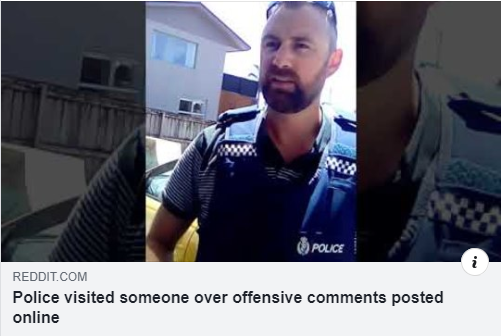
As with the Gestapo and NKVD officers, the Police that hauled you away would have the support of all of the authoritarians within the population. For every Police officer eager to smash some wrongthinker, there are a hundred bootlickers eager to rat out their enemies. This Reddit thread provides ample examples of this kind of thinking, and how readily they support their fellow citizens getting smashed (as long as it’s not them!).

So if a Police officer comes to your house to “check your thinking,” you will not be able to reason with them. You will not be able to logically convince them that the Police themselves are more dangerous than any Internet poster. They simply don’t care whether the person giving them orders is evil, or whether those orders are evil. You don’t pay their wage, so you don’t get their loyalty, that’s all it amounts to.

The way to treat them, therefore, is the same way that you would any other dangerous dog that has wandered onto your territory. Don’t show fear or anger, as either might trigger the prey instinct and provoke an attack. Stay calm, speak firmly, and ask if they have a warrant. If they don’t have a warrant, they have no right to be on your property, and you can ask them to leave directly.

Give them as little information about yourself as you can, because anything you say will be passed on to their masters, who will use it to justify more attacks against you. They will tell you that you are not a suspect – this is absolutely false. Give them as little as if you were an enemy soldier being interrogated for intelligence, because in their eyes you are (do note, however, that you are legally obliged to give the Police your name, date of birth and address if asked).

Unfortunately, there is no way to override the loyalty that the Police have towards those who pay them. As is the case with dogs, the only option is to replace the master. The ruling New Zealand Establishment must be replaced with people who have an entirely different mentality to the mindless, money-grubbing rapists who have ruled New Zealand for decades. An approach based on the Sevenfold Conception of Inherent Human Rights would be ideal.

*

If you enjoyed reading this essay, you can get a compilation of the Best VJMP Essays and Articles of 2019 from Amazon for Kindle or Amazon for CreateSpace (for international readers), or TradeMe (for Kiwis). A compilation of the Best VJMP Essays and Articles of 2018 and the Best VJMP Essays and Articles of 2017 are also available.

*

If you would like to support our work in other ways, please consider subscribing to our SubscribeStar fund. Even better, buy any one of our books!