

How God And Evil Can Coexist

One of the great philosophical and theological conundrums is how God and evil can coexist. This question has been discussed for over 2,500 years, and no resolution has been agreed upon. This essay will describe how the conundrum is resolved by the philosophy of Elementalism.

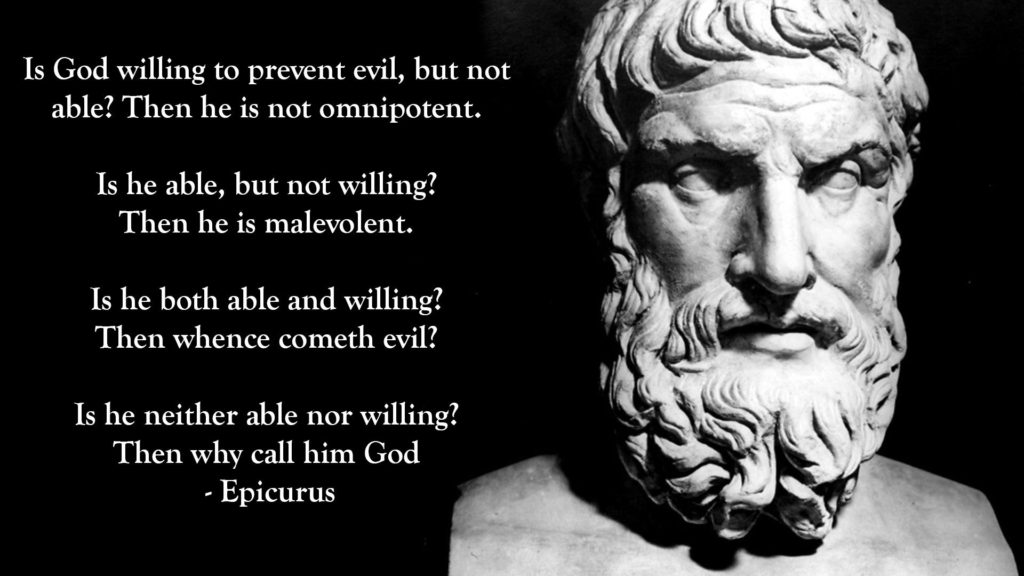
This conundrum is usually expressed in the words of Epicurus (see image at top of page). Believers in God often make the claim that God is both omnipotent and omnibenevolent. This creates a paradox in the mind of non-believers, on account of that evil and suffering exist in the world.

If God is unable to prevent evil, then God cannot be omnipotent. If God is able, but not willing, then God cannot be omnibenevolent. This paradox could be called Epicurus’s Fork, on account of that the believer in God cannot easily reconcile their belief in God’s omnipotence and omnibenevolence with the fact that evil and suffering exist.

Reconciliation of this paradox is easy for the Elementalist, however.

The first thing to state is that Elementalists have a particular conception of God and creation. The Elementalist believes that all individual consciousnesses are fragments of God, and therefore God is not something separate to ourselves. It’s more accurate to say that we, collectively, are God.

Likewise, Elementalists have a different conception of creation. The material world is not something that we woke up in – the material world is a dream that we collectively manifest through our will and karma. More specifically, our experience in the material world is considered to be an infinitely small subsection of something called the Great Fractal.

So how does that relate to the coexistence of God and evil? The answer lies in understanding what existence would be like without the illusion of a material world.

Our consciousnesses only feel suffering because we identify with our bodies. Our bodies are transitory phenomena, and like all transitory phenomena they are in a constant state of flux. This flux is usually painful. As a consequence, we need to act to balance it out. When our bodies get hungry we eat, when they get tired we sleep, when they feel pain we need to attend to it.

Without the illusion of a physical body in a physical world, our consciousnesses would exist in a state of perfect bliss, united with God. Absent a body, we would not have any cause to feel pain or fear of death. Absent a mind, we would not have any cause to feel anxiety or fear of the future. The only thing that would exist would be consciousness.

And it would be as boring as shit.

What would it be like to not suffer? It would be to live a life that was utterly devoid of meaning. Without the possibility of suffering, it wouldn’t matter what actions we chose. Every choice would lead to an identical outcome, at least as far as suffering is concerned. As such, our choices would be totally meaningless. We’d simply drift senselessly through life, like a leaf on a river.

This absence of meaning is the root of spiritual suffering, a worse affliction than any physical suffering could be. People rarely kill themselves from physical suffering, but they kill themselves from spiritual suffering every day. The physical suffering inherent to life, then, is not the worst thing in the world. Neither is the emotional suffering that is also inherent to life on account of that we cannot possibly satiate all of our desires.

We might have to act like physical and emotional suffering is ultimately terrible in order to give life meaning, but the reality is that an absence of meaning would be an even greater suffering.

It’s possible, then, for an omnibenevolent God to allow a minor suffering in order to prevent a major one. If the meaninglessness that accompanies existence in a state of perfect bliss can only be overcome by casting individual fragments of consciousness into a world of eternal misery, then so be it. Cast us, O God, into eternal misery!

At this point, some people will ask: “If Elementalists think that suffering is good, what’s stopping them from deliberately acting to increase suffering? If suffering gives life meaning, then why not go around raping and murdering? After all, it would create plenty of meaning in people’s lives as they struggled to resist you.”

Such questioners must be referred to the Law of Assortative Reincarnation. Elementalists believe that the energy one expresses into the world becomes the energy of one’s consciousness, and that the energy one receives from the world is a reflection of that same consciousness. As within, so without, and as without, so within.

An Elementalist would only act to increase the level of suffering in the world if they themselves wished to incarnate in a world of beings who behaved in that manner. Because this is extremely unlikely, it’s also extremely unlikely that an Elementalist would knowingly act to cause more suffering. The Elementalist belief is that there is enough suffering in the world naturally to give everyone’s life meaning, and so it doesn’t need to be added to.

In summary, Elementalists see no contradiction in believing in an omnipotent and omnibenevolent God despite the presence of evil. It doesn’t matter that a will to cause suffering exists in this world, because that will ameliorates a greater suffering: that of living a meaningless life.

*

If you enjoyed reading this essay, you can get a compilation of the Best VJMP Essays and Articles of 2019 from Amazon for Kindle or Amazon for CreateSpace (for international readers), or TradeMe (for Kiwis). A compilation of the Best VJMP Essays and Articles of 2018 and the Best VJMP Essays and Articles of 2017 are also available.

*

If you would like to support our work in other ways, please consider subscribing to our SubscribeStar fund. Even better, buy any one of our books!

Clown World Chronicles: What Is A ‘Chimpout’?

Some of the most graphic images of recent times have come from the rioting sparked by the killing of George Floyd. The sight of rocks and sticks smashing into human skulls evokes primal feelings of horror. These primal feelings are capable of evoking other primal feelings, and when there are enough of these, a total chimpout is possible.

Primatologists have long been aware of the propensity of chimpanzees and monkeys to become over-excited. Because primates are highly social animals, we are susceptible to emotional influence from others of our kind. When one of us feels an emotion, it’s common for others nearby to come to feel it as well. This is true of joy, of anxiety, of sociability – and of rage.

When enough mutual excitement goes through a group of primates, they can appear to lose their minds completely. Certain monkey troops, upon encountering human outsiders, will shriek loudly, retreat to the treetops, and begin to fling their feces at the intruders. Chimpanzee troops can also become extremely aggressive quickly when meeting others.

This mob mindset is biological. Primate troops that quickly became excited and aggressive when observing novel stimuli were better adapted to dealing with threats to their territory or safety. As such, they survived and reproduced more effectively. When in doubt, it’s much better to chimpout than to be caught passive and on the back foot.

It isn’t much different for us hairless primates.

Wise men love to point out that human civilisation is by no means a deeply-rooted institution. No-one can remember who said it first, but it’s often been stated that society is only nine meals away from a revolution. Machiavelli observed that human nature has never really changed from the beginning of history. It seems that, at the bottom of our hearts, few of us are fully convinced that civilisation is a good idea.

For one thing, the human animal is still a primate. Although human brain capacity has rapidly evolved since we split off from the other apes, the architecture of those brains is basically the same. As with the other primates, the human animal evolved to survive in a world where physical threats were common and often demanded immediate and extreme action.

Under enough stress, the brain circuitry that evolved to make us more effective pack fighters on the plains of Africa can spark to life again. Human history has been so violent that the old chimpout circuitry has never gone away. There has never been any real selective pressure against it, because those who could not chimp out kept getting killed by those who could.

Understanding this brain circuitry is the key to understanding when and why chimpouts happen.

The recipe for a chimpout begins with increased excitement on the part of an individual, perhaps because they have spotted or anticipate an enemy. If that individual’s increased excitement becomes contagious, and begins to heighten the excitement of the individuals around them, then it becomes a social phenomenon.

Should the excitement become so great that members of the group start to lose their composure, and then if no leader among them settles them down, a chimpout is underway.

The definition of a chimpout is when all pretence to civilisation is suddenly abandoned by a large group of people. In popular language, a chimpout is a term that describes the onset of mob mentality. It’s when a large number of people become a hooting, hollering horde, the higher functions of their brain having shut down.

Chimpouts tend to be destructive. The rioting that followed the George Floyd killing in May 2020 led to the destruction of dozens of American inner cities. The Parisian chimpouts of 2005 saw thousands of cars set on fire. That veneer of civilisation, thin though it may be, suppresses some very malicious impulses.

Implicit in the idea of chimping out is that one gives vent to one’s basest and most venal instincts. One takes the opportunity afforded by the cover of the crowd to indulge in temptations that one would otherwise resist. This involves actions like throwing bricks through windows, setting cars on fire, looting, robbing and beating people.

Psychologists consider chimping out to be an example of mass hysteria, or mass psychogenic illness. It’s a subset of what is known as herd mentality. Humans are not sheep, but much of the brain wiring that makes sheep behave the way they do is shared with other mammals. Most social animals are capable of chimping out in some sense, but in primates the potential for excitation is much greater.

The primal nature of the chimpout is evident from what triggers them. In Clown World, news of a pedophile gang that raped 1,000 young girls will not cause a chimpout, but if a white Police officer kills a black man in the process of making an arrest, then it’s time to park your car off the street.

The more depressed, desperate and nihilistic a population is, the more liable it is to chimp out. The simple rule is that the less a person has to lose, the more willing they will be to engage in mindless destruction. Young, disenfranchised males, especially low-IQ ones or ones with histories of childhood abuse and neglect, are the most prone to do so.

The nature of Clown World means that the threat of chimpout is ever-present. One lives in dread of the next act of Police brutality, because the social environment is tinder-dry and any spark could cause a flashfire. Worsening economic prospects raise the terrifying prospect of the Chimpout to End All Chimpouts.

*

This article is an excerpt from Clown World Chronicles, a book about the insanity of life in the post-Industrial West. This is being compiled by Vince McLeod for an expected release in the middle of 2020.

*

If you enjoyed reading this essay, you can get a compilation of the Best VJMP Essays and Articles of 2019 from Amazon for Kindle or Amazon for CreateSpace (for international readers), or TradeMe (for Kiwis). A compilation of the Best VJMP Essays and Articles of 2018 and the Best VJMP Essays and Articles of 2017 are also available.

*

If you would like to support our work in other ways, please consider subscribing to our SubscribeStar fund. Even better, buy any one of our books!

Writing Characters Of Copper

With a moderate amount of spiritual energy, a character becomes a character of copper. At this level, someone will have roughly half of the spiritual spectrum below them and half above them. A character of copper has developed a sense of love or compassion. As such, they are of a significantly higher frequency than the three base elements.

Copper has several noteworthy characteristics compared to the base metals of lead, tin and iron.

Most apparently, copper is colourful. Lead, tin and iron are all grey, but copper is a shiny reddish brown. This makes it desired. A necessary aspect of characters of copper is that they start to become desirable to other characters. Copper is described as a semi-precious metal. This reflects the fact that copper was once used as a currency.

Copper was associated with the goddess Venus in the ancient world. Hindu Yogis associate it with the heart chakra, from where people learn to express compassion. A character at the level of copper can begin to hear whispers of the Word of God. Consequently, they are able to follow their hearts, instead of needing to be led or directed.

In that copper occupies the centre of the spiritual ladder, it represents the union of opposites. In uniting above and below, copper serves as that which brings different elements together in joy. This gives it a harmony with the party-loving element of tin, only copper is less debauched. The characteristic action of copper is a man and woman coming together to make love – at the level of copper one no longer merely has sex, as the baser elements do.

The realm of copper, then, is the realm of courtship, chivalry and romance. This is the realm in which a physically dominant person begins to value something other than physical control. Here they learn to yield to people despite being able to kick their arses. It begins when rising spiritual energy cannot go further towards the masculine and so moves upwards and back towards the feminine. As such, it is where true compassion begins to enter the spiritual ladder.

It could be argued that boundary of the transition into copper comes when the physically dominant character realises that further advancement can only come in metaphysical realms. The character of copper learns that they can tactically choose to yield to the baser elements in the short term, for the sake of being better able to assert themselves in the long term.

The word copper gives us the word ‘capricious’, this being perhaps the characteristic quality of a beautiful woman, around who the world revolves in many ways. A character of copper, knowing themselves to have more value than the base elements, can become capricious if it goes to their head. A beautiful woman who knows that she is desired can come to make unreasonable demands on her suitors.

The combination of tactically yielding to the baser elements and being a beautiful woman suggests motherhood. The attitude of copper is the attitude of a mother towards her young child. The raw, biological essence of copper can best be appreciated by observing the lengths that the females of mammalian species will go to protect their offspring. The baser elements do not have a concept of self-sacrifice for a higher goal.

Thinking in these terms, the difference between copper and lead becomes obvious. A woman at the level of lead will breed without any concern for the well-being of her offspring, whereas a woman at the level of copper will make sure that any offspring she has are well cared for. In life history theory, this approximates very closely the difference between the r-selected and the K-selected.

The difference between copper and iron also becomes clear. A character of iron might be tough, loyal and honourable, but ultimately they fight for fighting’s sake. A character of copper, on the other hand, can have the aforementioned qualities plus the capacity to fight for a higher value. The character of iron finds their greatest expression in killing; the character of copper prefers to capture his enemies so as to ransom them off.

The characteristic neurotransmitter of copper is oxytocin. This is the “love drug” that leads to the formation of pair bonds. The formation of pair bonds creates a space for the higher elements to come into being. A character of copper will have a greater capacity for love than any of the baser elements. This capacity causes them to be cherished.

As is true with characters of iron, there is nothing stopping a character of copper being of either gender.

A male character of copper might be a chivalrous knight. Having proven himself in the realm of iron, the knight might have realised that further achievements in that realm are meaningless. As such, he aspires to achieve in a new realm – that of the nobles. Seeing the nobles display chivalry inspires him to imitate them.

A female character of copper could be a young mother or a striking beauty. If the former, her overriding concern will be the welfare of her family, which distinguishes her from the often neglectful or cruel mothers of the baser elements. If the latter, her beauty might be such that other men come to desire her so powerfully that they compete for her attention. In this sense, a female character of copper will invoke Aphrodite.

It’s worth noting that copper, although yielding to iron as tin does, does so in a different manner. Tin yields on account of that it is softer and is indifferent. Copper yields on account of that it takes a longer-term view. Where iron charges ahead out of rashness, and tin cowers back out of timidity, copper intelligently sums up the situation and makes the correct decision. This is a quality that copper shares with all of the precious metals.

If a character of copper is really a character of copper, they ought to be able to stay one step ahead of characters made of the baser elements. The baser characters might be able to get the jump on a character of copper, of course, but they must do so by underhanded means (or luck). Characters of copper can fight, but like characters of silver they prefer to find other ways to impose order upon the world.

The more precious elements still have an intellectual and spiritual edge over the characters of copper, however. The characters of copper might have intelligence and compassion, but at their frequency it’s hard for them to express either beyond the boundaries of the immediate family. Once issues of higher learning come into play, the character of copper has to yield.

Characters of copper love the idea of being matchmakers. Having risen above the baser elements, they are no longer motivated purely by egoic instincts. As such, they don’t get jealous when two other people form a pair bond. A character of copper, unlike the baser characters, understands that love and goodwill between two people makes the lives of all around them easier, and so they encourage it.

The archetypal situation of copper might be a middle-aged matriarch of the minor aristocracy arranging a marriage between her daughter and a famous knight. After a great party, involving many characters of tin who add a bawdy touch to provide a contrast, they all live happily ever after. It’s not until a character starts to value education that they enter the realm of silver.

*

This article is from Viktor Hellman’s The Alchemy of Character Development, the sixth book in VJM Publishing’s Writing With Psychology series. This book will show you how to use alchemy to create deep, realistic and engaging characters for your creative fiction.

*

If you enjoyed reading this essay, you can get a compilation of the Best VJMP Essays and Articles of 2019 from Amazon for Kindle or Amazon for CreateSpace (for international readers), or TradeMe (for Kiwis). A compilation of the Best VJMP Essays and Articles of 2018 and the Best VJMP Essays and Articles of 2017 are also available.

*

If you would like to support our work in other ways, please consider subscribing to our SubscribeStar fund. Even better, buy any one of our books!

Conservative Parties In Every Western Nation Will Eventually Become White Parties

The National Party has revealed its party list for this year’s General Election, stoking outrage. In an age when it’s not okay to be white, the racial composition of their top ten list candidates is unrepentantly vanilla. This essay will argue that this outcome was not only inevitable, but is likely to intensify in the future.

In the age of social justice, racism is the Original Sin of the white race. The fight against racism, many believe, is one of the most pressing of all social issues. Anyone who doesn’t think so stands alongside Adolf Hitler as a public enemy motivated by sadism. Practically any action can be justified, no matter how ludicrous, if the intent is “anti-racist”.

The social justice warriors seems to think that the best way to fight racism is to minimise the number of white people in positions of power. The best way to achieve this is to oppose white people at every turn. Consequently, Labour and the Greens have become openly anti-white parties.

18 out of Labour’s 46 current MPs are non-white – 39% of the total. This is a much higher percentage than the percentage of non-whites in New Zealand, which is 29%. 11 of those 46 are Maori – 24% of the total. This is also a much higher percentage than the percentage of Maoris in New Zealand (16%). These figures are even more remarkable if one accounts for the size of the Maori presence in the New Zealand First, Maori and Mana parties.

There is nothing wrong with having Maori MPs (or white ones). But if the Labour Party wants to have a disproportionately high number of non-white or Maori MPs, then no-one can be surprised if their opponents in the National Party have a disproportionately low number of non-white or Maori MPs.

This essay predicts that things aren’t going to end there. The problem is that it’s now all but inevitable that National eventually becomes the white person’s party.

As diversity increases in any white country, the in-group solidarity of the white people in that country also increases. This can be extrapolated from known laws of social psychology. As the position of white people gets weaker, and closer to minority status, the more this in-group solidarity will intensify out of a concern to protect their position. Hence, the strongest white in-group solidarity is seen in places like Brazil and South Africa.

As all other Western counties become more like Brazil and South Africa, the white people in those countries will come to face a certain calculus: the more their local social democrat party becomes non-white, the more it makes sense for them to rally behind the local conservative party. This calculus explains why the National top ten is now all white.

This phenomenon is perhaps most advanced in America, where the Republican Party is now the White Party in all but name, while the Democrats are the Party of The People of Colour. The image at the top of this page shows the reality clearly.

If only non-white Americans voted in Presidential Elections, the Democrats would win every single Electoral College delegate. Something similar is true in all other Western countries – namely, that if only non-whites voted, the social democrats would always win. It is certainly true in New Zealand, as Dan McGlashan showed in Understanding New Zealand.

Conservatism has always been about maintaining the status quo. The logic is that things came to be the way they are by way of the collective applied wisdom of our ancestors. But if progress is equated with a smaller and weaker white presence, then conservatism will necessarily come to be equated with maintaining and protecting that presence.

The National Party top ten might be all white, but this is hard to avoid when Labour positions itself as the brown party. What’s also hard to avoid is that increasing anti-white aggression on the part of Labour and the Greens will intensify these sentiments, making National come to seem like the white man’s last stand.

What would really be a coup, from the perspective of Todd Muller, would be for National to take advantage of these pressures to win working-class whites to their side. If National accepted the inevitability of the grim calculus outlined above, they might realise the need to act upon it immediately, rather than be acted upon.

The Labour Party was founded by working-class whites for working-class whites, but its grip on that constituency has never been weaker. The Labour movement has turned its back on working-class whites all throughout the West, preferring to champion middle-class browns and blacks. This has made it highly vulnerable to being split in two, as it has been in places like Sweden.

The National Party could swoop in here – not from introducing racist measures themselves, but from winding back previously-introduced measures that were motivated by anti-white racism. A broad commitment to get rid of all policies based on skin colour and not need would be a good start.

If the National Party promised to scrap the Ministries of Maori and Pacific Island Affairs, as well as to scrap race-based education and health funding, as well as to scrap all race-based differential treatment in the Justice System, they would steal a march on a Labour Party that expects working-class white people to go to the back of the queue behind recent immigrants.

It would provoke fury from the globalist mainstream media, who are committed to propagandising for cheap labour and its importation. However, it might benefit National’s electoral chances, as did Don Brash’s Orewa speech in 2005. More importantly still, such a move is bound to entertain the gods, upon whose favour we all rely.

*

If you enjoyed reading this essay, you can get a compilation of the Best VJMP Essays and Articles of 2019 from Amazon for Kindle or Amazon for CreateSpace (for international readers), or TradeMe (for Kiwis). A compilation of the Best VJMP Essays and Articles of 2018 and the Best VJMP Essays and Articles of 2017 are also available.

*

If you would like to support our work in other ways, please consider subscribing to our SubscribeStar fund. Even better, buy any one of our books!