
Clown World Chronicles: Who Is Waifu?

The suffering of Clown World brings with it great longing. Some people long for respite, others long for vengeance, others long simply for the warm embrace of a devoted wife. Those in the latter category might find themselves pining for the sweet touch of Waifu, one of the Elders of the Clown World pantheon.

As has been described earlier in this book, relations between men and women are at an all-time low. Not only is distrust and misunderstanding between them worse than ever, but young people are having less sex than ever.

This lack of positive relations with the opposite sex – one of the most fundamental pleasures in life – is one of the leading causes of the resentment that exists in Clown World. Worst of all, these poor relations aren’t primarily the result of autism or social fashion – they’re a function of will.

Many men feel that women are now hopelessly degenerate – that they’ve all turned into some kind of roastie. As such, they don’t want to be involved with the average woman. It doesn’t seem worthwhile to devote energy to a relationship with a woman who only wants to drink booze and who will leave you as soon as she gets bored. As such, many men have dropped out of the dating game – but their basic desire for female companionship has not abated.

This combination of feelings has led men to lust after their idea of a perfect woman, the opposite of the roastie. This is the Waifu.

Not being promiscuous, Waifu is deeply devoted to the one man. She is not at all interested in the “cock carousel”. Waifu doesn’t go out drinking with the girls. She’s more interested in social bonding for the sake of creating the perfect family. Her baking skills are more sophisticated than her cock sucking skills.

Waifu relates to Stacy as the Elder Goddess of the Positive Feminine Axis relates to the Younger One. Whereas Stacy is the unrealised positive feminine, Waifu is the realised form. Stacy has the potential to develop into a Waifu or to jump on the carousel and become a roastie. In Waifu, the waveform has collapsed into perfection.

Because so many men have withdrawn from the world to watch anime and to play video games, a large number of them have encountered idealised versions of female companions in those media. Naturally, many of those men come to fantasise about having some of these ideal women as real-life companions. Collectively, these ideal females form the spirit of Waifu.

‘Waifu’ is just a transliteration into Japanese of the English word ‘wife’. It comes from the idea that women in Far East Asia are more devoted, and far less degenerate, than their Western counterparts. Whether or not this is true, there are many Western men who have imagined themselves happy together with an ideal woman.

Waifu is the essence of all of these perfect fantasy wives, distilled into one divine form. She is the Elder Goddess of the Positive Feminine Axis because she represents the ideal feminine in its perfected form, i.e. as a self-actualised version of Stacy. Waifu is the natural companion of Boomer, who is able to sit back and chill thanks to Waifu’s devoted care.

In practice, there are two Waifus: a Western one and an Eastern one.

The Western one is known as the Tradwife. She is usually portrayed as a female Wojak variant, with lustrous blonde hair and wearing a blue dress with a daisy pattern. Sometimes the trad Waifu is depicted as Bavarian or Swiss, the idea being that these places have escaped the moral decay that has afflicted the Anglosphere.

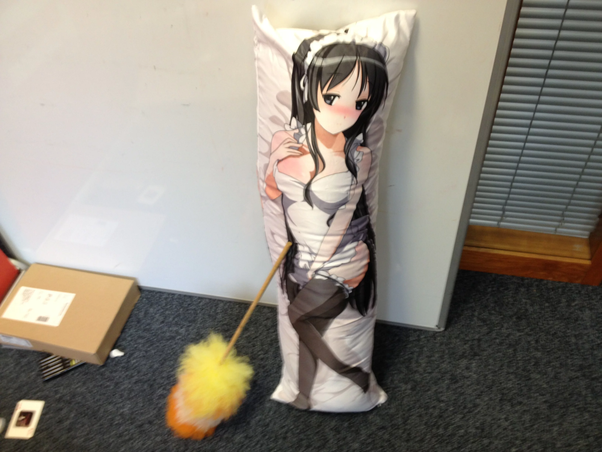
The Eastern one is like the one shown on the waifu pillow in the image at the top of the page. This one is black-haired, usually Japanese, and inevitably depicted in anime form. She is usually blushing, being so wholesome that she considers it improper for another man to gaze upon her.

Many men feel that Clown World has cost them the opportunity to have a Waifu of their own. Much of the rage directed at society comes from this perceived loss. However, these men mostly don’t understand that relations between men and women have always been tough. Lysistrata proves that things were challenging even at the peak of Western civilisation.

This is why the common longing for a return to the 1950s is mistaken. For one thing, 1950s devotion was forced in many ways, which brought with it a great deal of resentment. This was often masked with drinking: 1950s relationships involved a great deal of alcohol and violence. A return to the 1950s would also require that males conform to 1950s workplace expectations, which no-one really wants.

For another thing, attracting a devoted wife is primarily a matter of demonstrating sufficient rectitude oneself. Regardless of how corrupt one’s environment is, there are always men and women who have enough spiritual fortitude to express themselves despite their surroundings. Those who are best able to do this are the gods of the Clown World pantheon.

The spirit of Waifu will always exist, and will always be worshipped, as long as there are men who are unable to find real-life women who can meet their emotional needs. And, even if they do she will still be worshipped, because those real-life women will appear to them as avatars of Waifu herself.

*

This article is an excerpt from Clown World Chronicles, a book about the insanity of life in the post-Industrial West. This is being compiled by Vince McLeod for an expected release in the middle of 2020.

*

If you enjoyed reading this essay, you can get a compilation of the Best VJMP Essays and Articles of 2019 from Amazon for Kindle or Amazon for CreateSpace (for international readers), or TradeMe (for Kiwis). A compilation of the Best VJMP Essays and Articles of 2018 and the Best VJMP Essays and Articles of 2017 are also available.

*

If you would like to support our work in other ways, please consider subscribing to our SubscribeStar fund. Even better, buy any one of our books!
Writing Characters Of Mercury

The second-highest element on the spiritual hierarchy is mercury. Being one level higher than silver, mercury is the realm a person enters when they are close to perfection. This is represented by the liquid nature of mercury, which reflects a great intensity of spiritual power. Metaphorically, this liquidity suggests that mercury is close to moving beyond the material.

The ancients considered Mercury to be the Messenger of the Gods. This reflects the fact that mercury is the closest to the divine element of gold. Mercury is the closet planet to the Sun, so the Sun shines on Mercury before it shines on anything else. Characters of mercury ought to be able to instill a sense of awe in the characters made of baser elements.

Like silver, mercury is lustrous. Unlike silver, mercury is a liquid at room temperature. This is why it was once known as quicksilver, or water-silver. Alchemically, this property of being a liquid suggests that silver has been quickened to reach the stage of mercury. It suggests that something extra has been added to mere silver, some invisible energy that has had visible effects, and which has transmuted that silver to a higher state.

This quickening is from where we get the term ‘mercurial’. The term mercurial is used to describe people whose behaviour is hard to predict. There’s a more precise meaning – people whose behaviour is hard to predict because they are more closely attuned to the Will of God than anyone else. The characters of mercury are semidivine.

The characteristic quality of mercury is genuine intelligence in the form of a divine spark. This is where it contrasts with silver. Although a character of silver might have a rudimentary intelligence, perhaps enough to give them an advantage over the characters of baser elements, characters of mercury are more intelligent still. They are easily able to perceive the weaknesses of characters of silver, let alone the lesser elements.

Characters of mercury are more intelligent than the others, but they are not always more humble. Although they can be megalomaniacal, they are not prone to the Conceit of Silver, on account of that they are too closely attuned to God’s will. A character of mercury will not resent someone greater than themselves, but will rather co-operate with that person as a way of drawing God’s energy into the world. This disinclination to fight presages the frequency of the characters of gold.

Reflecting this humility, characters of mercury have more compassion than characters of baser elements. They are rarely motivated by purely egoic concerns. Rather, they work to end the suffering of others around them, and as such serve as messengers of the gods by expressing the will of the divine.

However, not being perfect, characters of mercury are still vulnerable to any of the lusts, rages and arrogances of the baser elements. They are just much less likely to fall prey to such impulses, and, when they do, they make amends much more readily. As such, they are clearly more noble in nature than most other people, and they tend to get treated as such.

The big danger of the character of mercury is that their ambition can cause great suffering. Although a character of mercury would never torture someone like a character of iron would, and they wouldn’t steal from someone like a character of lead would, they are still capable of causing immense suffering. Alexander was a character of mercury, if anyone was – and his conquests left piles of bodies in their wake.

The example of Alexander mentioned above perhaps best exemplifies the essence of a character of mercury. Being so close to perfection, they are, in a sense, above being judged by normal men. Chararacters made of baser elements have trouble enough understanding characters of silver; characters of mercury are beyond their understanding. To these baser characters, the characters of mercury appear as forces of nature.

Hindu Yogis associate mercury with the third eye chakra. This chakra is itself associated with intuition and foresight. A character of mercury will have great foresight, being able to see into the metaphysical world. This grants them the ability to predict the future and to see into people’s souls. A character of mercury will have powers of perception that the baser elements may not even believe are possible.

These powers of perception distinguish them from characters of silver. Although a character of silver might be able to accumulate a great amount of knowledge and apply it to, for example, building a bridge, this knowledge is limited to knowledge of the physical world and the phenomena in it. The character of mercury can see into the metaphysical world – something that most other characters don’t even believe exists. As such, they are very much the one-eyed man in the kingdom of the blind.

The concept of a third eye relating to spiritual awakening gives away the essential nature of the character of mercury, which is someone who is almost enlightened. Although not perfect, their every action will be permeated with this greater illumination – which is precisely what makes them seem mercurial to the baser elements. Because the baser elements cannot see into the metaphysical world, they cannot understand why the characters of mercury make the decisions they do. Characters of mercury can easily appear mad to those of baser elements.

Characters of mercury are the sort of people who set the course of history. They can be found leading kingdoms and empires. A character of mercury is sufficiently impressive that even characters of silver feel awestruck in their presence. As such, they are capable of provoking immense resentment, as did Julius Caesar.

If your story involves a character of mercury, it’s feasible that resentment for them can provide the impetus for the plot. A character of silver might become envious and try to take them down, perhaps employing a character of iron to do so. A character of copper who serves as a priest, resenting the influence that a character of mercury has among the townsfolk, might assemble a mob to drive them out of town.

If not in politics, characters of mercury can be great artists or scientists. Here they distinguish themselves from characters of silver as genius distinguishes itself from mere brilliance. The characters of silver may be exceptionally skilled at applying methods and techniques to create a masterpiece, but only the characters of mercury have the power to create something truly original.

A modern representation of a character of mercury is William Shakespeare in the film Shakespeare in Love, or John Nash in A Beautiful Mind. Such characters clearly stand out from those around them, even if those around them are of silver or copper.

It’s very tempting to have a character of mercury as the protagonist of your story. Being genuinely intelligent, it’s easy to write a story in which they overcome the challenges placed before them. However, being already of the second-highest element, this leaves little room for the character to develop over the course of your story.

If a character of mercury serves as a minor character, it may be to enlighten your protagonist. Your protagonist might work in their service, or they might engage the character of mercury to teach them about some important issue. In either case, the character of mercury will likely be fundamental to the plot.

*

This article is from Viktor Hellman’s The Alchemy of Character Development, the sixth book in VJM Publishing’s Writing With Psychology series. This book will show you how to use alchemy to create deep, realistic and engaging characters for your creative fiction.

*

If you enjoyed reading this essay, you can get a compilation of the Best VJMP Essays and Articles of 2019 from Amazon for Kindle or Amazon for CreateSpace (for international readers), or TradeMe (for Kiwis). A compilation of the Best VJMP Essays and Articles of 2018 and the Best VJMP Essays and Articles of 2017 are also available.

*

If you would like to support our work in other ways, please consider subscribing to our SubscribeStar fund. Even better, buy any one of our books!

Clown World Chronicles: Who Is ‘Karen’?

Clown World, it is oft lamented, is beset by Karens. Middle-aged women with deep feelings of entitlement are making everyone’s lives harder, but there seem to be more and more of them as society decays further. These Karens are avatars of Karen herself, the Elder God of the Negative Feminine.

A Karen is typically a middle-aged woman with a fashionable haircut and aggressive clothing. She is demanding, aggressive, bossy and rude. She is seldom violent, but that’s precisely why she’s so terrifying – the damage she wreaks is in the invisible, metaphysical realm, and so is harder to defend against.

Retail workers, more than any other, fear the Karen. She will complain that her coffee wasn’t made right, and if you’re not apologetic enough she will ask to speak to the manager. Like a spoiled princess, the Karen thinks the world revolves around her, and she expects others to behave accordingly. A failure to do so is met with rage.

The nightmare scenario is to have a Karen as a boss or a wife. Her vanity is such that one cannot engage with her without becoming drained.

Karen is one of the Elder Gods. Her realm is the space beyond the Roastie on the negative feminine axis. The fundamental energy of the negative feminine is narcissism, and Karen shares with the Roastie a deep self-absorption. If a Roastie continues on her path of manipulating and self-obsessed attention whoring, she is liable to grow into becoming a Karen.

In Clown World terms, the Roastie transforms into a Karen once Chad is no longer interested in fucking her. Normally, by this stage, a healthy woman will have developed enough devotion to transition into a Waifu. The Karen has failed to do so. She is not devoted to a family – it’s still all about her.

The root cause of Karen’s shitty behaviour lies in her dismay that she doesn’t attract male attention like she used to. Instead of moving on gracefully, she exerts herself to remain the centre of attention. She hasn’t figured out that the attention she once received was a consequence of physical characteristics that are now irrecoverably lost. As such, she cuts a tragic and terrible figure.

None of this is to imply that Karen is despised. To the contrary, Karen is both feared and revered, much like the goddess Kali in the Hindu pantheon, and much like the Roastie who is her younger manifestation. Her good will is strenuously courted by the citizens of Clown World, who know that she is the favoured daughter of the Merchant.

A widespread belief holds that good fortune can be had by appeasing the Karen. After all, the majority of followers of the Clown World pantheon are young, and so they are likely to have Karens as managers. Karens are often promoted into managerial roles on account of that the company is often owned by the Merchant. This relationship is one of the Five Alliances of Pain.

The difference between the Karen and the Waifu is stark.

The Karen is fundamentally opposed to the Waifu, who is the Elder God of the Positive Feminine. The Waifu is the metaphysical representation of devotion, and as such is selfless. The Karen is the exact opposite. The Karen cannot find, or is unwilling to recognise, true rectitude. Absent rectitude, she has nothing to be devoted to. Absent devotion, she becomes something bestial.

The Karen is also fundamentally opposed to the easy-going Boomer, who is the Elder God of the Positive Masculine. The Boomer has demonstrated physical rectitude in his chadly youth, and now he demonstrates spiritual rectitude by going with the flow and not clinging to his desires. The Karen is the exact opposite here, too.

In summary, the Karen is a spirit that represents the energy of the divine feminine if it becomes twisted towards egotism as it ages. She is an almost demonic figure to anyone who becomes stuck with her, but can deliver great blessings of fortune to anyone manly enough to win her good favour.

*

This article is an excerpt from Clown World Chronicles, a book about the insanity of life in the post-Industrial West. This is being compiled by Vince McLeod for an expected release in the middle of 2020.

*

If you enjoyed reading this essay, you can get a compilation of the Best VJMP Essays and Articles of 2019 from Amazon for Kindle or Amazon for CreateSpace (for international readers), or TradeMe (for Kiwis). A compilation of the Best VJMP Essays and Articles of 2018 and the Best VJMP Essays and Articles of 2017 are also available.

*

If you would like to support our work in other ways, please consider subscribing to our SubscribeStar fund. Even better, buy any one of our books!
Writing Characters of Silver

The fifth element from the bottom of the spiritual hierarchy is silver. This is the stage a character reaches when they have enough spiritual energy to begin to shine. A person enters the realm of silver once they start to value non-physical treasures. In doing so, they make it possible for people to co-operate on a level above that of the family.

The lustrous nature of silver is what gives it its greater value. Like copper, silver has also been used as a currency for thousands of years, only silver was more desired, and therefore more valuable. Silver is rare and valuable enough that the presence of it can change the energy of an environment. This is true both physically and metaphysically.

A character will begin to enter the realm of silver once they come to appreciate the limitations of the realm of copper. Usually this occurs once they start losing interest in the opposite gender, at least in the sense of starting a family with them. Once they move past that and start thinking about groups of families, they move into the realm of silver. It is characters of silver who hold villages and towns together.

Note that a character of silver loses interest in the opposite gender because they transcend them, not because they start to dislike them. Hating the opposite gender marks one out as belonging to the baser elements. A character of silver is the sort of character who starts to prefer reading books to courtship and romance. As such, getting laid loses relative importance.

In this sense, silver represents knowledge, or intellectual capital. The realm of silver is the realm of psychology. As such, it is rare. The vast majority of the world is preoccupied with surviving, or with getting money or sex, or at least having a good time. To value knowledge for its own sake is rare and precious.

The archetypal character of silver is a librarian. Surrounded by books, each one containing the accumulated wisdom of a lifetime, is where the character of silver feels most at home. The power of silver is that one book can organise a force powerful enough to resist a thousand knights. Thus, silver is higher than and more valuable than copper or iron.

To the ancients, silver represented the Moon, which itself represented the divine feminine principle. Thus, silver came to be associated with the divine feminine. The apogee of silver is in outsmarting a character of iron. The story of Odysseus outsmarting the Cyclops is an archetypal example, as is the fable of Aesop where the Sun outsmarts the wind.

One association of silver and of the Moon is of coldness. The realm of silver is for hard-headed logical thinkers. It’s for those who can trap their chess opponents with sophisticated strategems. In the biological world, the element of silver is best represented by the spider, who spins a silvery web that entraps those of lesser intelligence.

This alchemical representation is from where we get the expression ‘silver-tongued’. This refers to someone with intelligence but no higher spiritual sense. To be silver-tongued is to be able to speak eloquently and persuasively, without necessarily being inspired by any deeper spiritual sense. Many would describe a character of silver as ‘glib’.

The archetypal occupation of a character of silver is a lawyer. A classic modern representation is Al Pacino’s character in The Devil’s Apprentice. Other examples of characters of silver in fiction are Faust‘s Mephistopheles, Loki in the Norse Pantheon or Shakespeare’s Shylock.

Another typical occupation is politician or merchant. The distinctive characteristic of a character of silver is that they do not need physical wealth because they can extract it from other people at any time. Any real character of silver ought to be able to turn up in a new town and weasel his way into the local power structure.

This reveals the dark side of the characters of silver. They have their own conceit, known as the Conceit of Silver, which is the act of mistaking one’s metaphysical capacity for one’s moral capacity (this is shared with characters of mercury, only the latter suffer from it to a lesser extent). Thus, they come to believe that their intellectual aggression or wealth gives them the right to rule over other people.

The reality is that neither knowing a great deal of information nor having a great deal of money confers any righteousness. Neither have any real value if not guided by a refined moral sense. Characters of silver do not inherently understand this, and those that do are on their way towards entering the realm of mercury.

A character of silver might have trouble conceding this point. Although they are illuminated compared to characters of copper, iron, tin and lead, they are not perfect. Characters of silver are entirely capable of being petty, vain and narcissistic, on account of that they are just close enough to perfect to mistake themselves for it.

Typical of this dark side of the characters of silver is intellectual arrogance. Being intelligent but not possessing true humility, the character of silver often has a deep-seated desire to be acknowledged as an intellectual authority. This is not usually a problem if they genuinely are an authority in the subject matter. In cases where they are not, they are capable of misleading great numbers of people, and causing awful damage.

The character of silver often resents the character of mercury, who is truly intelligent. This can lead the character of silver to try and trick the character of mercury, usually by memorising enormous amounts of information under which to bury their opponent. Characters of silver are masters of rhetoric. Although they are intelligent enough to see the truth, they don’t necessarily recognise the need to speak it.

Related to this, characters of silver are often found as cult leaders, pretending to be characters of gold. They might not be of the gold, but characters of silver are still illuminated enough to attract a considerable following from among those who recognise their higher value. Their capacity to accumulate knowledge means that they can often correctly diagnose problems – it’s just that their solutions, not coming from a moral foundation, are lacking.

Despite all this, most characters of silver are good people and all are motivated by less petty concerns than characters of copper, iron, tin and lead. Characters of silver will almost never abuse children or animals, and neither are they prone to lashing out violently or becoming drug addicts. Their flaws are easily forgiven on account of the weight of their virtues.

Generally speaking, characters of silver are held in high regard by decent people for the order they help to impose upon society. Because of their knowledge, their lives tend to be well-run, and their communities tend to be well-organised. A character of silver in your story could well be one that has a great influence on the protagonist or antagonist.

*

This article is from Viktor Hellman’s The Alchemy of Character Development, the sixth book in VJM Publishing’s Writing With Psychology series. This book will show you how to use alchemy to create deep, realistic and engaging characters for your creative fiction.

*

If you enjoyed reading this essay, you can get a compilation of the Best VJMP Essays and Articles of 2019 from Amazon for Kindle or Amazon for CreateSpace (for international readers), or TradeMe (for Kiwis). A compilation of the Best VJMP Essays and Articles of 2018 and the Best VJMP Essays and Articles of 2017 are also available.

*

If you would like to support our work in other ways, please consider subscribing to our SubscribeStar fund. Even better, buy any one of our books!