Understanding Nationalism vs. Globalism Is The Key To Understanding The Political Landscape of 2022

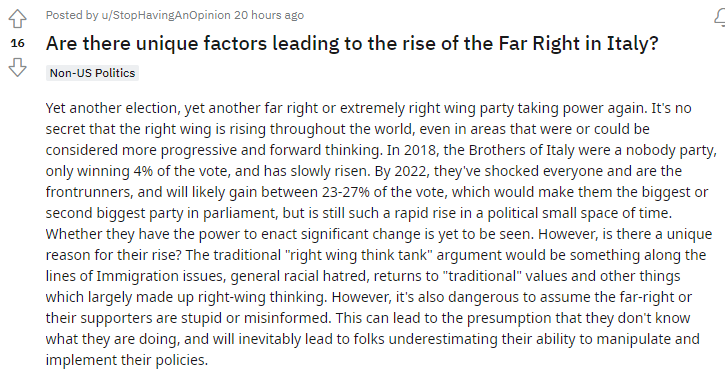
Mainstream political commentators, most of them wingcucks, are having extreme difficulty understanding the global politics of 2022. The common reaction to the recent electoral success of the Sweden Democrats and the Brothers of Italy is to shriek about far-right-wing extremism. But this is not an accurate way of understanding the phenomena at play.

The truth is that anyone still thinking in terms of left vs. right has a grossly flawed understanding of the political landscape. The relevant political axis in 2022 is globalist vs. nationalist. Only those who think in terms of globalist vs. nationalist can understand the patterns shifting through the mass political consciousness right now.

The only reason why anti-immigration sentiments are considered “far-right” is because Communists were on the winning side of World War II, and assumed control of the Western media shortly afterwards. Because they won, their enemies had to be dismissed as extremists, and because they were left, their enemies had to be dismissed as right. As such, nationalism became incorrectly conflated with the far-right.

This is why, in recent years, we’ve been spun a narrative of the pro-immigration left and the anti-immigration right.

In reality, the right is more than happy to support the mass immigration of cheap labour. Incoming British Prime Minister, Conservative Leader Liz Truss, has promised to open the immigration floodgates, with today’s “Conservative” logic apparently reduced to a simple equation: migration = growth.

So if the conservative right wing is in favour of the mass immigration of cheap labour, on account of that it pushes rents up and wages down and thereby makes the rich richer and the poor poorer, then the left wing must be against the mass immigration of cheap labour. Right?

Wrong. Apparently the left wing is also in favour of the mass immigration of cheap labour, as is the far-left. And so, by some twisted logic, opposing the mass immigration of cheap labour is far-right.

Moreover, the globalist religious elements of the right wing also want mass Third World immigration. For many Christian fundamentalists, borders and national sentiments are an impediment to God’s command that all are one in Rabbi Yeshua. To that end, they’re happy to import as many non-whites as possible, reasoning that the blending of the nations will hasten Rabbi Yeshua’s return.

If far-right corporate interests want mass Third World immigration, and if far-right religious interests want mass Third World immigration, then it does not make any sense to say that opposing mass Third World immigration is a far-right position. If far-right nationalist interests oppose it, then the relevant aspect is the nationalist one.

When it comes to immigration and labour rights, it’s time to forget left vs. right. Adherence to neither left nor right has much predictive value in this matter. The only logical approach to such questions is to think in terms of nationalist vs. globalist.

The nationalist approach to immigration is that it must serve the interests of the nation. This is not inherently an anti-immigration attitude. It means that immigration from low-IQ countries must be forbidden. Those immigrants tend to produce low-IQ offspring who cannot meet the cognitive demands of Western societies, and who end up becoming net drains on their host societies.

A reasonable nationalist would not necessarily disagree with immigration from high-IQ countries, unless it was of sufficient volume to disrupt social cohesion. Most nationalists make a clear distinction between ‘compatible’ and ‘incompatible’ cultures when it comes to immigration, but one thing is always agreed upon – immigration of low-IQ people from incompatible cultures has to stop.

The globalist approach to immigration, by contrast, is the more the merrier. Every extra labour unit pushes up house prices by increasing demand for housing, and pushes down wages by increasing the supply of labour. In other words: the more immigration, the more the rich get richer and the more the poor get poorer.

Globalist logic is that it doesn’t matter if the native working classes earn enough money to own homes and raise families. The most important thing is the profits of the international banking and finance interests, and these profits are maximised by maximum immigration. Any disruption this might cause to the ordinary lives of working-class people is not considered important.

This globalist arrogance has led to nationalist sentiments, not right-wing sentiments, rising all around the Western World.

It’s important to note that the globalist far-right is not rising much, if at all. The ACT Party is doing reasonably well in New Zealand, polling at about 10%. But this has less to do with the rise of the far-right and more to do with the lack of confidence in the mainstream conservative National Party.

Few of the young men who are flooding into the alternative right (to which ACT belongs) are agitating for more cheap labour or greater corporate control, much less for medieval-style theocracy. As such, their sentiments are best understood as the masculine expression of a nationalist mentality. That masculinity is associated with the right is secondary; nationalist interests are primary.

The electoral success of Giorgia Meloni’s party demonstrates that a feminine expression of nationalism is now rising to join the masculine expression. With both masculine and feminine aspects of nationalism rising, the return of nationalism to the main stage is inevitable. Understanding today’s political reality requires that one think in terms appropriate to these developments. The future is nationalist vs. globalist.

*

If you enjoyed reading this essay/article, you can get a compilation of the Best VJMP Essays and Articles from 2021 from Amazon for Kindle or Amazon for CreateSpace (for international readers), or TradeMe (for Kiwis). Compilations of the Best VJMP Essays and Articles of 2020, the Best VJMP Essays and Articles of 2019, the Best VJMP Essays and Articles of 2018 and the Best VJMP Essays and Articles of 2017 are also available.

*

If you would like to support our work in other ways, subscribe to our SubscribeStar fund, or make a donation to our Paypal! Even better, buy any one of our books!
The Condition of Seeking

When you are in a state of spiritual seeking, you are really in state of looking for a map that would prove so accurate that it can be committed to above all others. You have somehow gotten it into your head that you are after the ultimate representation of truth, and despite having looked for that high and low, you have always come up short – and thus, the seeking continues.

Because of the time and energy you have invested in doggedly hunting for the truth, you expect it to present in the form of representation, not as truth itself. This fact may seem so obvious and self-explanatory that it completely escapes your notice, but in actual fact, this realisation is crucial. You see, everything you have tried before has arrived and left again in the form of a representation.

Oddly enough, the conclusion we end up with is that we must just have not quite landed upon the appropriate representation yet, whether that is in the form of a book, a teacher, a teaching, or a tradition. Perhaps we didn’t quite get what the teacher was really saying, or perhaps we didn’t quite meditate as well as we could have.

This is a strange bind that the seeker has gotten themselves into. The way out is not to find an accurate map, although your total commitment to any one map, accurate or not, might just be sufficient to push you right through – but you won’t end up where the map was showing you.

You won’t end up with a map at all, because that isn’t what you were really looking for in this endeavour.

The yearning for truth you experience comes from deeper than the mind. Although your mind will do its best to convince you otherwise, you don’t need another map  – and yet here I am sketching out another unnecessary map. It is unnecessary at my end in the respect that I know it is totally unneeded, though it is necessary at your end for precisely so long as you think it is necessary. The map to the forest is made out of the same thing the trees are made out of, but can you see? Are you willing to bridge the gap, the paper wall, and see past into the trees themselves?

The difficulty in all this is that I am trying to communicate with you in such a way that I am using a map to ask you to put down all maps, including those produced by me. I have no intention of converting anyone to becoming map readers, and I certainly do not intend to inspire map stalwarts who promote one map exclusively over another.

Now, it may be true in a relative cultural sense that a map produced in one particular style and language is more easily accessible to one person or group than another, and there is no problem with this. It doesn’t mean that one map is better than another, because ultimately all maps have to be subordinate to reality, whether they are accurate or not.

Have you noticed that those who are most comfortable in their own skin in whichever spiritual or religious tradition they happen to be a part of seem to have no issue whatsoever in communing with others of different faiths? Someone such as the Dalai Lama is an excellent example of this spirit of universal compassion, understanding and humility.

The reason is that they have pushed through the imaginary boundaries circumscribed by the map, even the one they were taught to revere as the most sacred. They see through to where another person is, regardless of how lost that person might seem to themselves in regard to their own maps – their own beliefs and representations.

Reality is not to be found through maps. To relieve yourself of this notion is one of the most tremendous gifts that realisation has to offer, though it is far from being the only one.

Why not for one moment try what hasn’t been tried before in earnest? Take the maps you have been given, including my own, and those you have inherited from your family or culture, or drawn yourself. Fold them away, gently put them to one side, then see what has always actually been here. When you transcend the maps, you will find yourself exactly where you are, which is precisely where the meeting with your true self was always intended.

See what is right here, right now, without the map, and without forcing any judgment or interpretation upon it. Because you are no longer using a map as a reference tool, there is no relative notion of having arrived, nor is there any relative notion of being off track or lost. What is actually here that all of the maps have been referring to? Then see what happens to your preoccupation with seeking and the maps we have superimposed over it that we refer to as ‘spirituality’.

*

Simon P Murphy is a Nelson-based esotericist and philosopher, and author of His Master’s Wretched Organ, a brilliant collection of weird fiction stories.

*

If you enjoyed reading this essay/article, you can get a compilation of the Best VJMP Essays and Articles from 2021 from Amazon for Kindle or Amazon for CreateSpace (for international readers), or TradeMe (for Kiwis). Compilations of the Best VJMP Essays and Articles of 2020, the Best VJMP Essays and Articles of 2019, the Best VJMP Essays and Articles of 2018 and the Best VJMP Essays and Articles of 2017 are also available.

*

If you would like to support our work in other ways, subscribe to our SubscribeStar fund, or make a donation to our Paypal! Even better, buy any one of our books!

Genetic Infrastructure

There are several components of the wealth of nations. As Adam Smith wrote, it’s primarily a function of natural resources, human resources and quality laws/leadership. Writing in the late 18th Century long before Darwin, Smith didn’t know about natural or sexual selection, much less genes and DNA. His conception of human resources was based around education, and missed out one crucial element.

The crucial missing element: genetic infrastructure. If education consists of those memetic qualities within that nation that lead to wealth and prosperity, genetic infrastructure consists of those genetic qualities within that nation that lead to wealth and prosperity. It is the value of having good DNA.

The primary component of genetic infrastructure is intelligence (or, more precisely, the presence of those genes that lead to high intelligence). Contrary to popular belief, intelligence is mostly hereditary in adults – indeed, as the linked paper states, “Intelligence is one of the most heritable behavioural traits”.

Intelligence is the most powerful predictor of several different social outcomes. It is the strongest predictor of lifetime educational achievement and of lifetime criminal convictions. It’s also the strongest predictor of future wealth. All other things being equal, a high-IQ person with an average education will earn more wealth during their lifetime than an average-IQ person with a high education.

Furthermore, intelligence is the single most powerful predictor of future wealth on the national level. Not even natural resources come close to intelligence when predicting future wealth, as evidenced by the wealth of high-intelligence, low-resource countries like Japan, Germany and England, and the poverty of low-intelligence, high-resource countries like Nigeria, the Congo and Brazil.

A nation’s genetic infrastructure, then, is mostly a matter of intelligence. Other factors include physical health and strength, the degree of inbreeding and whether the phenotype expressed by the genes is suited to the physical environment, but these are comparatively minor.

Because a nation’s fortunes are so closely tied to the quality of its genetic infrastructure, understanding the details of that infrastructure allows us to make accurate predictions about that nation’s fortunes. This is particularly relevant if we can also measure changes in that genetic infrastructure, whether ongoing or expected.

For instance, if low-IQ people are outbreeding high-IQ people in a given nation, thereby weakening that nation’s genetic infrastructure, we can predict that outcomes typical for low-IQ people will become typical for that nation. We can predict that poverty, ignorance, crime and violence will all increase as the genetic infrastructure deteriorates.

On the other hand, an influx of high-IQ people to an area will strengthen that area’s genetic infrastructure. As such, we can predict that outcomes typical for high-IQ people will become typical for that area. Most examples of European colonisation fit into this category – the colonisation of 65IQ Australian Aborigines by 100IQ mostly British settlers is probably the most notable.

Of course, the genetic basis of intelligence is one of the greatest taboo subjects in the West today. Even winning a Nobel Prize in Biology does not permit a person to suggest that evolution has created human subgroups of different intelligence levels, as James Watson discovered.

Consequently, many will deny the very concept of genetic infrastructure, particularly blank-slatists, globalists, open-borders capitalists, Marxists and other biology deniers.

The truth is hard for many to accept, but it’s revealed clearly in the scientific literature. Wealth is primarily a function of intelligence, and intelligence is primarily genetic. Therefore, wealth is primarily a function of those genes that facilitate intelligence. Those genes – plus a few other, much less important factors – are what is known as genetic infrastructure.

Nations with a high-quality genetic infrastructure can easily rebuild even after their physical infrastructure is destroyed, as Japan and Germany did after World War II. Nations with a low-quality genetic infrastructure will disintegrate into poverty even if they somehow achieve a high level of physical infrastructure, as Argentina did in the 20th Century and South Africa did after 1994.

*

If you enjoyed reading this essay/article, you can get a compilation of the Best VJMP Essays and Articles from 2021 from Amazon for Kindle or Amazon for CreateSpace (for international readers), or TradeMe (for Kiwis). Compilations of the Best VJMP Essays and Articles of 2020, the Best VJMP Essays and Articles of 2019, the Best VJMP Essays and Articles of 2018 and the Best VJMP Essays and Articles of 2017 are also available.

*

If you would like to support our work in other ways, subscribe to our SubscribeStar fund, or make a donation to our Paypal! Even better, buy any one of our books!
An Eternal Invitation

Wherever you are, you’re already here. There are no expenses, save for your attention, which I hope you will come to understand is infinitely more precious than any amount of money.

You don’t require fixing, you simply require understanding, which necessitates awareness on your part. This consists in a shift of your attention to what is true, in this moment. It is reality. It is not a spiritual reality, or a scientific reality, or a Buddhist reality or a Christian reality, or an Indian reality or a Chinese reality. It is the one alive, indivisible Truth. All of it is here. It is neither theology or philosophy. The common theme that religious and mystical traditions point to, namely awareness, is the living edge of truth.

The beginning and the end go together hand in hand. Do you recall the lightness, openness and freedom of being a child? Isn’t it odd that we consider an early school environment where the educational focus on a child’s future potential is regarded as more important than Being in the immediacy of the present moment?

As if, perhaps one day when they have had an education and a well-paying job then they will finally be entitled to return to the lightness, freedom and happiness they once experienced as children.

The world teaches us to succeed by striving for what we don’t have, and for what we have been taught to want. Struggle is so commonplace that we take it for granted that it is indispensable. We are taught what we seek should bring us happiness, fulfilment, freedom. But where are these benefits? Didn’t we leave that behind when we left childhood to move into more serious, adult concerns involving strain, stress and discontent? Where are these mythical achievements that are supposed to give us lasting fulfilment, peace and happiness? Why is it that even those who have achieved the most worldly success possible are still looking to the next thing, whether it is a new relationship, the colonization of Mars or becoming the President?

The cultural educational process of our lives is marketed as an existential solution, although it never quite seems to deliver in its promises. We long to return to the freedom of childhood because it was then that we were least distant from the untarnished truth of our being, before experiences such as hurt, shame, disapproval and failure conditioned us to harden our hearts and submerge our inmost light in order to navigate a dysfunctional world.

And yet all of the things we consider to be the very fruits of personal success were present right at the beginning of our educational journey, the time where we should have known the least in our lives! We are told that if we ever want to reach the states we experienced in the beginning of our waking lives again, we need to have deserved it by playing according to the rules. We are told we must forego our intuitive sense of value and the immediacy of truth in order to ‘make something of ourselves’, which is how we have been conditioned into a state of believing that peace, contentment and well-being must be seen as earned and stamped with a seal of approval by our benefactors.

Even through all of this discontent, disillusionment and loneliness, that which our hearts most deeply yearns for is still within us, whoever presumes to tell us we are deserving. Happiness is our birthright. There is no moment in which we are cut off from the possibility of remembering the infinite abundance of our true nature. One of the reasons we don’t look at what we actually have is because we are trained to overlook anything that inherently belongs to us. If we ceased to do this, we would learn the value of contentment, and the hungry fire to go on pursuing the next illusory milestone would diminish. We have also inherited the assumption that if everyone has something, or has the same access to it, then that thing must be worthless. Ego rates it as being without value, because it cannot be manipulated in such a way one person or group could hold advantage over another.

The darkness of an insane world needs light, and you are that light. First and foremost, you are awareness itself, undivided and eternal. There is no higher state than to attend to this awakening. It is a suchness to which nothing may be added, and it is neither dependent on nor diminished by anything. None of our words, concepts, or contrived means of objectification catch it.

This is the ancient value we have been taught to suppress in order to render us obedient and industrious. Enculturation puts us to sleep to breed discontented shadows who are encouraged to accumulate, strive and toil to no definitive end. This is to be in a state of hypnotic disconnection, to be ‘cut off from the vine’. I propose that your highest priority in these times, should you feel the call to truth, is the sacred task of remembering of your deepest self as living awareness, as one with your source. I propose that the unexamined life is not worth living.

*

Simon P Murphy is a Nelson-based esotericist and philosopher, and author of His Master’s Wretched Organ, a brilliant collection of weird fiction stories.

*

If you enjoyed reading this essay/article, you can get a compilation of the Best VJMP Essays and Articles from 2021 from Amazon for Kindle or Amazon for CreateSpace (for international readers), or TradeMe (for Kiwis). Compilations of the Best VJMP Essays and Articles of 2020, the Best VJMP Essays and Articles of 2019, the Best VJMP Essays and Articles of 2018 and the Best VJMP Essays and Articles of 2017 are also available.

*

If you would like to support our work in other ways, subscribe to our SubscribeStar fund, or make a donation to our Paypal! Even better, buy any one of our books!