A recent Horizon Poll found that combined support for Labournational has now fallen to less than 61%, the lowest ever. Never before have Kiwis had less confidence in the two biggest parties. The electoral ramifications of this fall in support are major.
The mathematics of building a ruling coalition are simple, but are becoming more complex. According to the Horizon poll, Labour and the Greens together would win 61 seats with almost 40% of the vote. National and ACT together would win only 54 seats, with the Maori Party taking five. This would mean that Labour and the Greens could govern by themselves.
Complicating matters is the unprecedented level of support for the parties currently outside Parliament.
New Zealand First polled at 4.8%, which means that they are on the verge of overcoming the 5% threshold. They have been rising rapidly since 12 months ago, when they were polling around 2-3%. In fact, if one removes the undecided voters from the Horizon poll, New Zealand First gets 5.3% of the remainder.
Should New Zealand First poll over 5% in the general election in October, they will win at least seven seats. Assuming they don’t go with Labour again – New Zealand First Leader Winston Peters having ruled this out – they will probably go with National, which would give the National-ACT-NZF coalition 58 seats.
Labour and Greens, in such a scenario, would have 57 seats, and would therefore need The Maori Party’s five in order to govern.
There are more complications in the form of The Opportunities Party (TOP) and DemocracyNZ. TOP polled at 2.8% in the Horizon poll, which means they’re closer to the 5% threshold than not. Almost as many of the polled voters supported “Another party”, which means that DemocracyNZ could be close to 2% support as well.
If either TOP or DemocracyNZ scored over 5% in the general election, forming a 61-seat coalition would become much more complicated.
Labour doesn’t really want to work with The Maori Party, for the obvious reason that The Maori Party are insane. A Labour-Greens-Maori Party coalition would be a nightmare of infighting. The unreasonableness of people like Rawiri Waititi would make stability impossible.
However, National doesn’t really want to work with New Zealand First either. New Zealand First may have fallen out with Labour, but that doesn’t make them great friends with National. New Zealand First are still primarily nationalist, which puts them in direct conflict with National’s globalist plunderer mindset. Peters and ACT Leader David Seymour are well known to despise each other.
This raises a possibility that some dare not whisper: Labour and National might go with each other.
A Labour and National grand coalition would send a shockwave through the New Zealand political scene. All Kiwis have been conditioned to see Labour and National as implacable enemies and two opposite poles of the political spectrum. For them to team up would force a mass change of perspective on New Zealand.
However, there is precedent for it, if not from New Zealand. Germany’s Angela Merkel was thrice involved in a grand coalition between her conservative CDU party and the social democratic SPD. In all three instances, the primary stated reason for this was keeping “extremists” out of power.
Labournational could easily make a similar justification, claiming that New Zealand First and The Maori Party were both ethnonationalist extremists. If they did, they’d have the full support of the globalist media, who would be more than happy to demonise anyone suspicious of globalism.
A grand coalition in which Chris Hipkins was the external face (dealing with the media and public) and Chris Luxon was the internal face (dealing with management), would make a lot of sense. It would mean the personable Hipkins could keep public sentiments under control, while the unpopular Luxon kept the grand coalition itself under control.
There are two major reasons why a grand coalition might not happen.
The first is pragmatic: a grand coalition would enable a party like New Zealand First to become the main opposition. If they did, they would mostly criticise the globalist establishment, which would see support for Labournational fall even further. It makes more sense for Labournational to trade opposition status between Labour and National, and thereby minimise the influence of the minor parties.
The second is more sinister: both Labour and National want to keep up the illusion that the voters actually have some choice. This is best achieved by them taking turns at ruling. If they would combine, people would realise – when nothing changed – that parliamentary democracy is just a massive scam. Their wealth and privilege depends on keeping up the charade that Kiwis have a say in their own governance.
One thing is certain: a grand coalition would make clear that it’s them against us.
In the (supposedly) fantasy world of George Orwell’s 1984, geopolitical life is divided into three major blocs.
The only one we see in the story world is Oceania, home of protagonist Winston Smith. This consists of Britain, the Americas, Southern Africa, Australia and Oceania. This bloc is always at peace with one of the two other blocs, and always at war with the other.
The other two blocs are Eurasia, which roughly means Europe plus all of Russia and parts of Central Asia, and Eastasia, which roughly means China, Japan, Korea and parts of South East Asia.
Inbetween each of the blocs is a contested zone that is essentially no-man’s land. In the story world of 1984 there is one such zone between Oceania and Eurasia, and one such zone between Oceania and Eastasia (there are others, but only the ones referring to Oceania are mentioned in the book).
1984 was published in 1949, almost three-quarters of a century ago. It has proven incredibly prescient, because if one looks around the world today it appears very similar to the then-future world described by Orwell.
Oceania is today’s Anglo-Judaic Empire, i.e. Britain and most of the former British Empire. Unlike in 1984, the Oceania equivalent today includes Japan and Korea.
Eurasia is today’s Russia. In 1984, Eurasia is Russia plus a conquered Europe. In today’s world, of course, Russia has shown little ability to conquer Europe. Perhaps they have the will, but the ability is another thing.
Eastasia is today’s China plus North Korea. In 1984, Eastasia included Japan, South Korea and some of South East Asia. At the moment, those areas are Oceanian territory. But if the Chinese waged a lightning war at some point in the future, they could conceivably take them over.
Already one combat zone is active on the border between Oceania and Eurasia (The European Union is effectively territory held by Oceania for now), in Ukraine. This zone might drift westward such that Oceania gets pushed back to the British Isles. If it did, it would be exactly like Orwell’s prediction.
Even if Orwell’s prediction wasn’t geographically accurate, it’s still temporally accurate. In 1984, it turns out that wars are supposed to go on forever, specifically because this wastes resources, because if resources are not wasted then people have time to think about their situation and that leads them to rebel against the government.
On the Oceania/Eurasia border in today’s world, Russia and Ukraine also seem to be fighting such a forever war. Even though Western countries are spending tens of billions on arming Ukraine, the front lines move very little. Both sides have been fighting over one town, Bakhmut, for seven months straight. So little has happened in 15 months, it’s easy to imagine the two might still be at war in 15 years.
This has complications for us, seeing as we are a de facto (if not de jure) American ally, and this makes us a potential target from China’s perspective. Being part of Oceania, we’re someone that Eastasia might bomb if we get drawn into conflict against each other.
The third combat zone appears to be be Iran and the Middle East. This one has also been brewing for a while, with John McCain and Hillary Clinton both cheerleading for bombing Iran to protect Israel. Iran’s development of nuclear weapons technology is a clear existential threat to their sworn enemies Israel, and both countries lie in the disputed area between the three blocs.
Other potential combat zones in the near future are India vs. China (in the Himalayas) or Ethiopia vs. Egypt and Sudan (over the Great Ethiopian Renaissance Dam). If some or all of these other combat zones became as hot as the ongoing War in Ukraine, our world would look extremely similar to Orwell’s prediction.
It’s necessary to note that Orwell didn’t really predict these things – he knew about them from what other members of the ruling class said to him, because it’s been a ruling class plan for a very long time. Going all the way back to Babylon, the ruling class has always dreamed of a system where they could divide and conquer the masses to such an extent that it was impossible to overthrow them.
This explains why Orwell was able to predict so accurately the world of 2023, with its three major blocs and an equatorial disputed zone.
Christianity, being one of the world’s largest and most widespread religions, has also played a significant role in causing Religious Trauma Syndrome. The ways in which Christianity can cause Religious Trauma Syndrome are vast and vary widely depending on the denomination and intensity of the beliefs in question.
One of the ways in which Christianity causes Religious Trauma Syndrome is through the belief in original sin, the idea that all humans are born with sin because of Adam and Eve’s disobedience in the Garden of Eden. Children are taught from a young age that they are inherently sinful and that needs to be ‘saved’ through faith in Jesus Christ.
This teaching creates an intense amount of guilt and shame within the individual, as they feel that they have done something wrong even when they have not committed any particular act. Believing that humans are inherently flawed can lead to self-loathing and negative self-talk, which can have long-lasting effects on an individual’s mental health.
Another way in which Christianity may lead to Religious Trauma Syndrome is through the concept of hell. Many Christians believe in a very literal hell, a place of eternal punishment for those who live a life of sin or do not believe in Jesus Christ. The idea of a literal hell can cause immense anxiety and fear in an individual, especially when coupled with the belief in original sin.
The fear of going to hell, not only for themselves but also for their loved ones, can cause significant psychological damage and can result in individuals living their lives in constant fear and worry about death and the afterlife.
Furthermore, Christian teachings around sex and sexuality can often cause immense harm to individuals who subscribe to them. Many denominations teach that sex is reserved for marriage, and anything outside of that context is considered sinful.
In addition, many denominations hold strict gender roles and homophobia, teaching that individuals should adhere to binary gender roles, and that same-sex relationships are morally wrong. The shaming and ostracising of individuals who explore sexual possibilities can cause deep emotional and psychological trauma, leading to feelings of self-hatred, worthlessness, and isolation.
Finally, the concept of spiritual warfare is another aspect of Christianity that can cause Religious Trauma Syndrome. Many Christians believe in a literal devil that actively seeks to deceive and ensnare individuals into sin. Actions that can be deemed as following the devil’s path range from anything from watching certain movies to exploring other religions.
Believing that spiritual warfare exists can lead to a constant state of fear and anxiety, with people struggling to feel safe in the world around them. Individuals can become paranoid about every situation in which they find themselves, never sure if they are following the right path.
In conclusion, Religious Trauma Syndrome is a real and important phenomenon that can have long-lasting effects on an individual’s mental health. Christianity, and the ways in which it is often taught, can play a significant role in causing Religious Trauma Syndrome in individuals who have had these beliefs forced on them.
Today we look at the aptly named Disinformation Project’s latest hit piece. The Disinformation Project, which can be accurately considered Establishment media, serves the same purpose as the other Establishment media: to set the bounds of acceptable discussion, and to smear the enemies of the ruling class. To that end, they run hit pieces on those enemies.
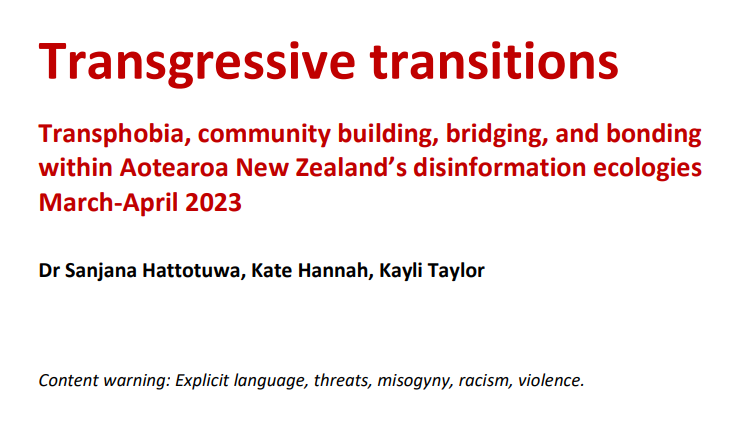
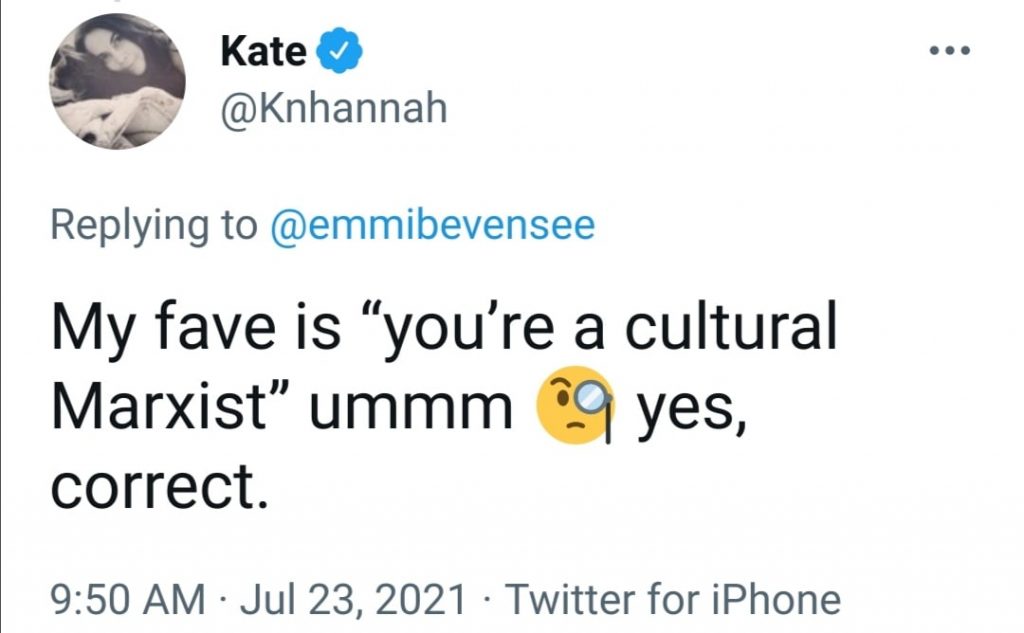
This time, the target was the “disinformation ecology” surrounding Posie Parker’s recent visit to Auckland. This analysis will explain how The Disinformation Project, spearheaded by admitted Marxist Kate Hannah, uses such terms to smear the reputations of those who dare criticise the Labour Government.
This report begins with the cringe-inducingly self-righteous declaration that The Disinformation Project has a legitimate interest in “observing, collating, categorising, and analysing open source publicly available data related to Covid-19 mis- and disinformation.” It’s like having a Ministry of Truth, but limited to the question of Covid-19.
Apparently, those who dissented from the Government’s Covid-19 narrative have now incorporated “more features of international far-right talking points – immigration, reproductive rights, LGBTQIA+ (and particularly trans rights), globalisation, nativism, loss of hegemony – alongside other, localised conspiratorial frames encompassing 1080 drops to co-governance.”
“Conspiratorialism” is a particular concern of theirs, for reasons not given. It’s just a way of smearing anyone who distrusts the Government as an unreasonably paranoid person. Andrew Little is fond of using the term “conspiracy theorist” to sully the reputation of anyone who thinks the Sixth Labour Government is lying about anything, and The Disinformation Project seems to have taken his lead.
In reality, anyone who doesn’t believe that any conspiracies are happening is stupid. Almost every historical event is preceded by multiple conspiracies. The settlement of New Zealand involved one conspiracy after another. Every war is conspiracy and counter-conspiracy until one side wins. The smarter someone is, the more conspiratorial they will be.
‘Transgressive transitions’ cites the theory of American social scientist Robert Putnam, but its authors don’t appear to be familiar with Putnam’s work as a whole. Putnam’s most cited work is titled ‘E Pluribus Unum‘, in which he established that “immigration and ethnic diversity tend to reduce social solidarity and social capital”. This was one of the first studies to demonstrate a statistically significant negative correlation between ethnic diversity and social trust.
Unfortunately for The Disinformation Project, the contention that ethnic diversity reduces social capital has been backed up by a meta-analysis of the science since Putnam’s article was written. So they find themselves mischaracterising concerns about immigration as an “international far-right talking point”, when such concerns are, in fact, backed up by mainstream science.
The Disinformation Project themselves spread disinformation – about nationalists, among others.
This report is notable for its obsessive belief in a “disinformation community”, which amounts to the same thing as their collective ideological enemies. These disinformation communities are primarily online spaces where people question the mainstream narrative. As Orwell put it: wrongthinkers.
Already by page 4 the authoritarian sentiments of the report’s authors are evident, as they rant about “dangerous speech”. Anti-free speech rhetoric is common among the authoritarian left – it was, after all, leftists who got Clown World Chronicles banned from TradeMe. The authoritarian left in New Zealand, as in the Soviet Union, correctly perceives free speech as a major threat to their attempts at narrative control.
Also by page 4 the authors manage to make clowns of themselves, linking anti-Covid sentiment to anti-Maori sentiment. Apparently they were not aware that some 30-40% of the Parliament Lawn protesters at any one time were Maori. Neither were they aware that Maori mothers, understandably concerned about the effects of an improperly tested vaccine on their children, have been one of the core dissident groups from the beginning.
Grandly, The Disinformation Project declares that it “now studies a diverse and dynamic disinformation ecosystem preoccupied with multiple and shifting ideological concerns” – i.e. the Deplorables, the bottom feeders, the Nazis. Anyone who questions the Government is now part of a disinformation ecosystem. The Disinformation Project – in their minds – are heroes fighting these trends on behalf of social cohesion.
The anti-white sentiments of the globalist leftist authors of this report are revealed when they make a determined effort to defend Marama Davidson for her racially abusive outburst to CounterSpin Media during the Posie Parker protests. They link to a propaganda piece from Establishment Left mouthpiece Radio New Zealand which defends Davidson and smears CounterSpin as “far-right”.
The authoritarian sentiments of the report’s authors are further revealed with their rant about Elon Musk that takes up most of page 7. This rant concludes with an accusation that Musk is guilty of “amplification of racism, and other harms” by engaging with accounts that promote, among other things, “disinformation”.
On page 8, this report claims that its observations are backed up by research from the Center for Countering Digital Hate. However, it has been noted elsewhere that the Center for Countering Digital Hate is a British Labour Party mouthpiece, with several of its high-ranking administrators also taking roles in the British Labour Party.
On page 9 the report’s authors further underline their authoritarian credentials by complaining that TeleGram is “unregulated”. Apparently the free speech approach of TeleGram has resulted in “a significant and immediate increase in the use of dangerous speech”. To the authoritarian left, it’s dangerous when people who are unregulated by the government presume to speak.
A multinational effort is being made to pressure TeleGram into banning political dissidents. Since 2021, some German politicians have demanded that TeleGram be banned if they do not submit to government censorship regarding permissible content matter. British political figures also spoke out against the platform. The anti-TeleGram rhetoric in The Disinformation Project’s report is just other example of this globalist anti-free speech trend.
The report then spends several pages crying about neo-Nazis. Again, we are left wondering if they are still talking about the same people as in the Parliament Lawn protests. The 30-40% Maori contingent were presumably not neo-Nazis, and neither were all the old hippie women who comprised at least another 25% of the protesters. So who are all these neo-Nazis? It’s never made clear. It’s just suggested that anyone anti-Establishment is a Nazi.
From there, the report spends a few pages complaining about dehumanising language – but there are few tropes more dehumanising that the one claiming that nationalism is inherently a philosophy of exclusion, and that anyone speaking for nationalism must be in favour of gas chambers full of Jews. This trope, typically pushed by the globalist authoritarian left, has had the effect of demonising and dehumanising all nationalists, as if to prefer one’s own kind was the preserve of bloodthirsty beasts.
Speaking of language, the language used in this report is usually of the bloated and pompous kind used by academics with little real-world experience. An example is the phrase “instrumentalization of stickers” where “use of stickers” would have conveyed the same information more efficiently.
It’s not obvious what purpose is served by complaining about sticker packs on TeleGram, as this report does at length. One suspects that The Disinformation Project is following the lead of America’s Anti-Defamation League, which catalogues every aspect of the online expression of people they hate and then links it somehow to far-right-wing extremism.
This is known elsewhere as the Censorship Industrial Complex. A similar concept to globohomo, the Censorship Industrial Complex refers to the alliance of Marxists and corporate whores who work together to silence true dissidents or freethinkers. The Disinformation Project is part of this complex, and their work (including this report) involves gaining support for the cancellation of their enemies.
Speaking the truth is now dangerous speech if it doesn’t suit The Agenda.
The report then spends several pages crying about GIFs and other memes, and how the spread of such memes can “formulate a norm-setting exercise”. Apparently there is such a thing called the “‘for the lulz’ tactic” and this is nefariously used to advance extremist ends. In the New New Zealand, a sense of humour is grounds for suspicion of wrongthink.
The Disinformation Project monitors 126 FaceBook pages “associated with disinformation narrative production and promotion”. These are contrasted with 84 mainstream media pages, which presumably never produce or promote falsehoods. This shameless cheerleading for the mainstream media further reveals The Disinformation Project’s pro-Establishment bias.
Apparently the Posie Parker visit and protests caused a remarkable uptick in the volume of “hate speech” directed against minorities and other vulnerable groups in New Zealand cyberspace. Hence The Disinformation’s Project’s concern. Christian lobbyists appear to have been particularly incensed at the time of the Parker visit.
The report goes on to state that questioning the validity of trans people is tantamount to “genocidality”. This further reveals authoritarian intent – ‘do what I tell you, else you’re a Nazi’.
On page 26, the authors start complaining about freethinkers on InstaGram. They discovered that “mis- and disinformation accounts studied on Instagram received higher engagement than accounts from mainstream media”, which is another way of saying that alternative media is more honest than the mainstream, and that this honesty drives the higher engagement.
Apparently there is a connection between the Parliament Lawn protesters and the pro-Parker protesters. This is cause for another neologism – “disinformation superspreaders”. This is a new term for high-ranking members of the alternative media who the Establishment would like to silence. The true connection between the Parliament Lawn protest and the Parker protest was that, in both cases, the Government lied about what was really going on. Hence, people flooded to the alternative media on both occasions.
To understand this is to understand the purpose of The Disinformation Project and even the mainstream media itself: to silence dissenters.
On page 29, the authors lament that “disinformation ecologies” are winning the battle for the public’s trust. At no point do they consider the obvious explanation for this: that the alternative media tells fewer lies. Moreover, much of the distrust of the mainstream media comes from their unwillingness to cover certain issues – issues that the alternative media has no problem covering.
Propaganda techniques that can be seen every day in the establishment media, such as “rage-baiting, performative outrage, emotional contagions, inflammatory presentations, aggrieved frames, and dangerous speech” are now “disinformation narrative techniques”, and we are asked to believe that only the alternative media performs them. To suggest that the establishment media does the same thing is to wrongthink.
The authors note on page 34 that the alternative media is not subject to the same decline of trust as the mainstream media. This is because the mainstream media does just as much rage-baiting, performative outrage and inflammatory presentation as the alternative media, if not more. People are no longer as gullible as in the 1950s, and have realised that media authorities are not moral authorities.
With a lack of irony befitting of the NKVD, the report goes on to complain of the “significant and growing implications for democracy and social cohesion” of people no longer trusting the mainstream media. What the authors of this report want is restrictions on the alternative media. But there wouldn’t even be an alternative media if the mainstream one didn’t tell lies and omit truths to suit the interests of their globalist owners.
The report repeats a delusion that is common among the New Zealand Left: that anti-Government, anti-authority or anti-the current thing sentiments are imported from America. They aren’t, and they don’t need to be. We’ve been part of the same global system as America for over 200 years. Anti-trans sentiments are growing because pro-trans sentiments are being pushed on people by globalists who intend to demoralise their subject populations.
On page 34, the report makes an obvious point: “It is possible that disinformation news, media, and information ecologies benefit from declining interest in mainstream journalism”. This is certainly true, but only if you replace “disinformation news, media and information ecologies” with ‘the alternative media’. If the mainstream anything goes bad – not just media – people will look for alternatives. The blame does not fall on the alternatives for providing a better product.
In the Conclusion section, this report rehashes Hillary Clinton’s long-debunked conspiracy theory that Russian propagandists are shaping the anti-Establishment sentiment in the West. Hilariously, it also warns of a “collective narcissism” among New Zealand’s alternative media, as if the camera-obsessed Hannah and Hattotuwa were any better.
The rest of the conclusion is spent in breathless hysteria trying to link all the anti-Establishment ideologies into one uber-conspiracy. Apparently “explicitly far-right content” has embedded itself in New Zealand cyberspace, and we have to stop it because it’s a threat to national security, as well as being a threat to social cohesion.
Ultimately, what The Disinformation Project is trying to do with this report is to build support for the banning or heavy restriction of all alternative narratives. To that end they demonise the alternative media, equating them with Nazis or other hated groups, in order to justify cancelling them. It’s shameless propagandising and disinformation-spreading, but that’s how the political establishment wages war against its domestic enemies today.