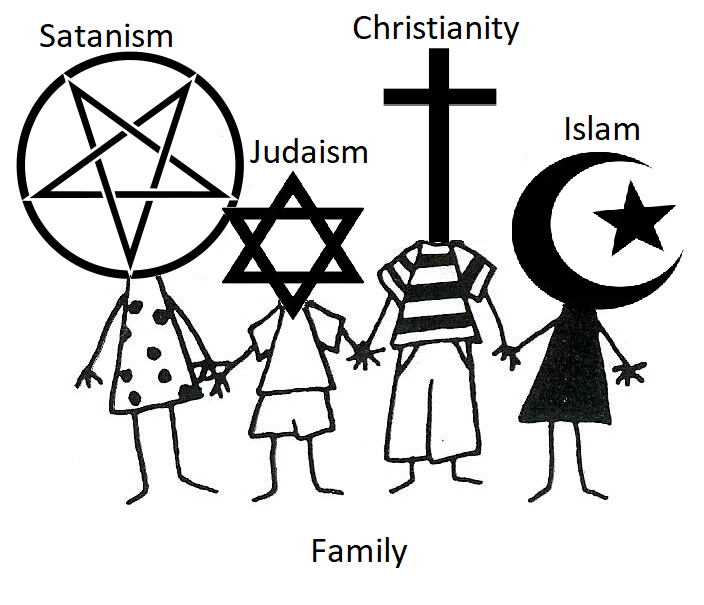
There are some 3 billion Abrahamists in the world, most of them Christians, Muslims and Jews. As such, understanding the human race requires that we understand the mindset of Abrahamists. It’s impossible to ask the Abrahamists about themselves, because they always lie to make their cults look good. So it’s necessary to take a non-Abrahamic perspective.
The most difficult thing to understand about Abrahamists is their contradictory nature. On the one hand, they all claim to have the blueprint for peace on Earth, if only more people would follow them. On the other, their history is littered with murders, tortures, witch burnings, rapes and massacres.
Elementalism provides the answers to the Abrahamic paradox.
In Elementalism, it is understood that Yahweh, the God of Abraham, is none other than the Principle of Evil. As a consequence, the religions that worship this god are evil ones. The followers of those religions are some degree of evil as well. Some are merely deluded, but the majority have wilfully chosen to promulgate evil, on account of that their souls are rotten.
Genuine spiritual traditions have always laboured the need to change oneself if one wishes to change the world, a mindset Gandhi summarised as “Be the change you want to see in the world.” As an anti-spirituality, Abrahamism seeks to change the world rather than change oneself. This is why Abrahamists are always on a moral crusade.
Whether it’s Jews with their tikkun olam or Christians and Muslims with their degeneracy, Abrahamists are obsessed with setting other people to rights, and ignoring their own flaws. Abrahamists have been instructed to go to war with the world for one ultimate, underlying purpose: to do evil.

Elemental Elementalism states: the true will of Abrahamists is “to cause as much harm and misery as they can, whether physical, emotional, mental or spiritual” (46:28). This line is the key to understanding Abrahamic morality.
Physical harm is shown by the Abrahamist’s love of child abuse. When New Zealand banned hitting children, it was mostly Christian pressure groups that came out in opposition. Even today, Christian fascists like Bob McCoskrie propagandise in favour of hitting children.
If Abrahamists aren’t bashing their kids they’re raping them. The extent of child sex abuse in the Catholic Church is legendary. The extent to which the Catholic Church covers up for child abusers among them is also legendary. But all Abrahamics abuse children.
Muslims have the concept of bacha bazi, in which young boys are bought and sold for dancing and sex. Jews practice metzitzah b’peh, in which a mohel sucks the blood from a freshly mutilated boy’s penis. Any normal, mentally healthy person who reads about metzitzah b’peh will understand intuitively that the people performing it are demons.
That the Abrahamist is constantly at war is also evidence of his sadism. Christians like to claim that the coming of their cult was the coming of an age of peace, as if the Thirty Years’ War never happened. There’s always an excuse for all the wars started by Christians. When Orthodox Russia invades Ukraine, and kills hundreds of thousands in the name of “desatanisation”, it somehow isn’t Christianity’s fault. Same as when George W Bush invades Iraq because he thought he heard the voice of Yahweh telling him to do so.
Muslims and Jews are no different. Muslims will claim that they only ever fight defensive wars, as if it were possible to conquer from Spain to Indonesia though only defensive warfare. Jews deny the existence of their mass murderers: they will tell you that Yagoda and Kaganovich were Russian, and that Kissinger was German.
The Abrahamist’s opposition to abortion also reveals his will to increase the suffering in the world. There are few ways to cause greater suffering than to force a mother to birth and raise a child she doesn’t want. But this is exactly why Abrahamists support forced births. They know that the psychological damage that tends to be inflicted on unwanted children creates a wave of misery that ripples through the whole society.

Emotional abuse is demonstrated by the Abrahamist’s love of ostracisation. Any cult member who starts asking questions is at risk of being expelled and never spoken to again by the others. The Abrahamic cults aren’t like normal religions, in that people are encouraged to explore a diversity of schools of thought. In Abrahamism, you’re given one truth, and everyone else is the enemy.
Out-group antipathy is so strong in Abrahamism that those suffering ostracisation often end up with Religious Trauma Syndrome. “You are not okay” and “you are not safe” are the two characteristic narratives of traumatic religion-based upbringings. They’re also characteristic narratives of Abrahamism.
This form of abuse is particularly vicious in Islam, where people leaving the cult are routinely murdered. Thirteen countries currently have the death penalty for apostasy, all of them Islamic shitholes. Seven of these also have the death penalty for blasphemy. One of easily imagine the type of person that this kind of emotional abuse tends to create.
Intellectual suffering is caused mostly by the Abrahamist’s opposition to education and learning.
Christians have always suppressed the educated. Celsus wrote of them in the second century “This is one of their rules. Let no man that is learned, wise, or prudent come among us: but if they be unlearned, or a child, or an idiot, let him freely come. So they openly declare that none but the ignorant, and those devoid of understanding, slaves, women, and children, are fit disciples for the God they worship.”
Such a mindset led to the murder of Hypatia, the murder of Giordano Bruno, and the 1,200 years of murder inbetween, known today as the Dark Ages. During this time, Christians destroyed so much of the ancient European knowledge that people forgot that the Earth went around the Sun (common knowledge in ancient Europe since the time of Aristarchus).
Today’s Christians now pretend they have always been in favour of science and learning (the Christians with the most chutzpah even claim their cult invented science). Muslims, on the other hand, don’t even pretend. They generally don’t care for reading, whether original works or in translation.
The greatest suffering caused by the Abrahamist is spiritual.
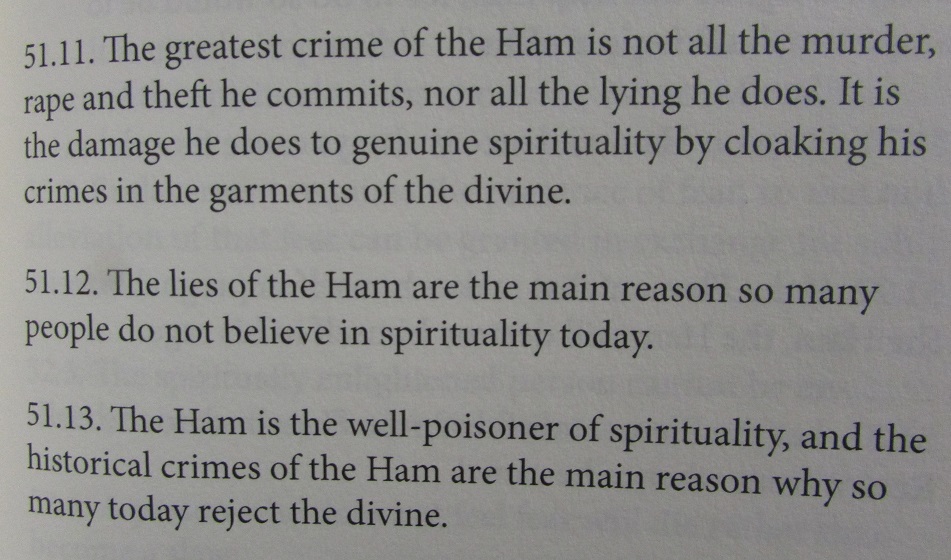
Firstly, they repress genuine spirituality. When Christians invaded Europe, they did not seek co-existence with the European religions, but rather sought to destroy them. The Massacre of Verden, in which 4,500 Saxon nobles were murdered for refusing to abandon the European religions, is probably the most famous example of the lengths to which they were willing to go to achieve this goal.
The War on Drugs is not usually understood as a Christian attempt to suppress genuine spirituality, but it is. The reason why Christians oppose the legalisation of cannabis, psilocybin and other spiritual sacraments is that they know these substances are spiritual sacraments. Therefore, they know that to prohibit them is to force people to suffer in spiritual darkness.
Secondly, Abrahamists promote lies in place of spirituality. The narrative that anyone who doesn’t follow the same religion as the Abrahamist is going to Hell is a psychological crime. It denies the fundamental spiritual truths of reincarnation and karma. So, too, Abrahamic narratives that the world is evil and that pleasure is evil.
The narrative that you can skip out on your karmic debt by pledging your soul to Rabbi Yeshua or to Muhammad is lunacy, a sop to the egos of the wilfully delusional. Hence the Abrahamists push it. Another lunacy is pushing an End Times narrative instead of the truth about the cyclical nature of history and of reality. The more lies, the more confusion; the more confusion, the more suffering.
In summary, Abrahamic morality can be simply understood as doing evil and attempts to justify doing evil. Abrahamists seek to maximise the suffering in the world so as to please their god Yahweh, the Principle of Evil. All of their moral actions follow logically from this.
*
For more of VJM’s ideas, see his work on other platforms!
For even more of VJM’s ideas, buy one of his books!
*
If you enjoyed reading this essay/article, you can get a compilation of the Best VJMP Essays and Articles from 2021 from Amazon as a Kindle ebook or paperback. Compilations of the Best VJMP Essays and Articles of 2020, the Best VJMP Essays and Articles of 2019, the Best VJMP Essays and Articles of 2018 and the Best VJMP Essays and Articles of 2017 are also available.
*
If you would like to support our work in other ways, subscribe to our SubscribeStar fund, or make a donation to our Paypal! Even better, buy any one of our books!