How Well Did The Economy Do Under John Key?

John Key: made New Zealand wealthier compared to other nations, but not by as much as Helen Clark did

This article starts with a very straightforward proposition: that the prosperity of an economy and of the people in that economy is primarily a question of GDP per capita. Given that, we can measure the increase in New Zealand prosperity (if any) under John Key’s tenure by looking at the change in GDP per capita during that time.

The figures that this article uses are taken from the International Monetary Database. Here we calculate GDP on a price purchasing parity basis because we are ultimately trying to measure the change in standard of living.

In 2009, the GDP per capita of New Zealand was USD30,572. This placed us 37th in the world, just behind Italy, Japan and Spain, and just ahead of Greece, South Korea and Israel.

In 2016, the GDP per capita of New Zealand was USD37,294. This placed us 35th in the world, just behind South Korea (who leapfrogged us), Japan and Finland, and just ahead of Italy and Spain (who we leapfrogged) and Israel.

This makes for an increase of 22% over 7 years, which is about 2.9% per year if calculated on a compounding basis.

2.9% over a seven-year period can rightly be considered a decent effort of national economic stewardship from Mr. Key. That level of growth is far from remarkable, but it was enough to move us past a Southern European level of wealth and close to a Far East Asian level.

By way of comparison, the GDP per capita of New Zealand in 2000 was USD21,807, which makes for a 40% increase over the nine years of Helen Clark and Michael Cullen. This works out to just over 3.7% per annum.

Measured that way, the performance of the John Key economy was markedly poorer than the Clark/Cullen economy. However, one has to take into account that Key inherited a global financial crisis, and so it’s worthwhile comparing New Zealand to other nations instead of looking at absolute growth.

In the year 2000, New Zealand was considerably less wealthy than Italy (which had a GDP per capita of USD28,602), Japan (USD26,850) and Spain (USD24,053). It was also less wealthy than Australia (USD28,801), Britain (USD26,425) and America (USD36,433).

By 2009, the GDP per capita of New Zealand had increased from 76% of that of Italy to 89%; from 81% of that of Japan to 92%; and from 91% of that of Spain to 96%. Against other Anglo nations, the GDP per capita of New Zealand had decreased from 76% of that of Australia to 75%; had increased from 83% to 87% of that of Britain; and increased from 60% to 65% of that of America.

This means that under the Fifth Labour Government, New Zealand improved its position strongly against comparable countries, with the exception of the booming Australia.

By 2016, the GDP per capita of New Zealand had increased from 89% to 101% of that of Italy; had decreased from 92% to 90% of that of Japan; and had increased from 96% to 102% of that of Spain. Against other Anglo nations, the GDP per capita of New Zealand had increased from 75% of that of Australia back up to 76%; had increased from 87% to 88% of that of Britain; and remained at 65% of that of America.

This tells us that under the Fifth National Government, New Zealand improved its position against the Southern European countries but stayed the same compared to other Anglo ones.

Ultimately, therefore, we can see that New Zealand’s economic standing in the world is marginally better, in relative terms, after the Key Administration. Apart from the decline of Italy, New Zealand didn’t really improve in relative wealth. This contrasts sharply with the years under Helen Clark, during which time New Zealand improved strongly.


Te Reo With Mnemonics: Natural Cycles

Spring – kōanga

In the middle of a bunch of blossoming flowers is a raging bull. The spring has caused cow anger.

Summer – raumati

If you know anyone named Matthew (or Marty), imagine them rowing a boat really fast under the blazing summer sun while onlookers shout “Row Matty!”

Autumn – ngahuru

A line of prostitutes stand on a street under some falling leaves. The autumn leaves are falling near whores.

Winter – hōtoke

In the middle of a wintry snowstorm, a woman stands drinking a hot cocoa.

Morning – ata

A man wakes up in the morning and then devours a massive breakfast. He is the morning eater.

Afternoon/Evening – ahiahi

As the shadows begin to lengthen for the time period after noon, a crazy man watches the sun start to fall and laughs “Ah he he…”

The Maori word for winter – hōtoke – sounds like the English phrase hot cocoa

Shadow – ātārangi

In the mountains, the Sun shines behind rocky outcropping and creates a lot of shadows. It is shadowy terrain.

Day – rā

The Sun shines on a sleeping lion in the middle of the day. The lion awakens, then roars.

Night – pō

A line of starving homeless people shambles through a city at night. One of them says “We are poor.”

Season – kaupeka

Through all four seasons of sunshine, wind, rain and snow, a giant chicken stands and pecks a cow. The cow never reacts, just watches the passing seasons with the cow pecker.

Dawn – ata hāpara

In the dim light of dawn, a man stuffs his face with food with one hand and plays a harp with the other. The dawn breaks on the eater harper.

Dusk – kākarauri

As the Sun is setting at dusk, a flock of crows lands on a parked car. The dusk wraps around the car crows.

*

The above is an excerpt from the upcoming Learn Maori Vocabulary With Mnemonics, by Jeff Ngatai, due to be published by VJM Publishing in the summer of 2017/18.

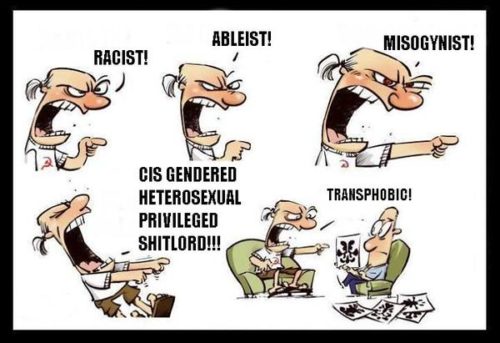
Social Justice Warrior Culture Is The Totalitarianism of Our Age

Every age has its evil. The last century gave us Nazism and Communism, the century before that gave us colonial genocides, the centuries before that gave us horrific religious persecutions and mass murders. This essay looks at the totalitarianism of the early 21st century: SJW culture.

Totalitarianism is defined by a striving to regulate every aspect of both public and private life wherever possible. It’s the antithesis of freedom. Benito Mussolini, one of history’s most infamous totalitarians, declared that even the spiritual life of the citizenry is to be controlled to the finest detail.

According to Hannah Arendt, the appeal of totalitarianism lies in its ideology, which, like religions, provide “a comforting, single answer to the mysteries of the past, present, and future.”

Theocracies achieve this with an ideology about the nature of God and the inevitable triumph of the followers of that God. Nazism achieved this with an ideology about race struggle and the inevitable triumph of the Aryan race, and Communism achieved this with an ideology about class struggle and the inevitable triumph of the proletariat.

The essential point that distinguishes these ideologies from free thought is that an ideology offers an easy, pre-packaged answer to any question that might arise. Because of this it is never necessary to actually think about anything, much less discuss anything with another person – all answers derive directly from reference to the ideology.

Much like a religious scripture does for a religious fanatic, an ideology forms the basis of reality for political fanatics. If a person has a powerful desire to remake the world in their image for political reasons, there will be an ideology at the bottom of it.

Social Justice Warrior culture is a form of Communism, in that it is explicitly horizontalist. Like all other horizontalist ideologies, anyone who distinguishes themselves, for any reason, is assumed to have done so by immoral means. The logic behind this lies in the ideological assumption that all are equal.

Because the belief in the equality of all people is fundamental to SJW culture, a natural corollary is that anyone who has achieved an outcome that elevates them above the masses must have necessarily done so by immoral means.

And so, the higher standard of living in the West, when compared to the Middle East and Africa, cannot be explained outside of the template of colonial oppression. All Western wealth is considered stolen; a crime that needs to be redressed by horizontalist action.

There is no room in Social Justice Warrior culture for anyone to put effort into bettering themselves – everything that betters a person is considered to be the result of unfair privilege. As this column has previously pointed out, this ideology is what Nietzsche would have called a slave morality, in that it is fundamentally based in resentment and a desire to rip everyone down to the lowest level.

Where this ideology really goes wrong – and where it is in danger of becoming a totalitarianism akin to Nazism and Communism – is its utter failure to accept that certain mentalities and cultures create poverty among their victims of their own accord.

And so, the sorry state of the Middle East cannot be explained by the legendary unwillingness of Middle Easterners to live in peace, and neither can it be explained by the extremely high rates of religious fundamentalism, nor the appalling human rights record of their rulers, nor the cultural indifference to education and free thought, nor the widespread practice of infant genital mutilation.

It’s all the fault of colonialism, or America bombing them.

Likewise, the near-infinite hatred that some disadvantaged groups have for other disadvantaged groups is all blamed on influence from the West. The utter contempt that Muslims have for homosexuals cannot be blamed on Muslims themselves, because to do so would be to imply that a disadvantaged group can be less moral than an advantaged one – and this is in direct opposition to SJW ideology.

All of this would be just another half-arsed theory were it not for the demonstrated ability and willingness of this ideology to destroy the lives of anyone who opposes it. The most striking recent example was the sacking of a Google employee for questioning the social engineering practices of his company. James Demore wrote a manifesto that made the assumption that biology trumps SJW ideology, and this was decreed to be wrongthink punishable by the destruction of his career.

Believing that biology is real is a thoughtcrime when it is considered to advance “harmful gender stereotypes in our workplace” – in other words, biology is what we tell you it is, and any disagreement is grounds for retaliation.

The firing of one engineer is not comparable to the historical crimes of 20th century totalitarian states, true, but this example shows how far SJWs will go to deny reality where it conflicts with their ideology, and this bodes poorly for a peaceful 21st century.

The simmering powderkeg is the tens of millions of Muslims who now live in the West, and who can never integrate. The mass resettlement of Muslims into the West was never carried out with the consent of Westerners, and it was never carried out with reference to any study that demonstrated improved social or economic outcomes for Westerners.

This social engineering was, and continues to be, forced on Westerners by people who have adopted SJW ideology. If it leads to a civil war in Europe, then this ideology will be justifiably ranked alongside Nazism and Communism as one of humanity’s greatest mistakes.

VJMP Reads: Anders Breivik’s Manifesto IV

This reading carries on from here.

Much of this section (pages c. 200-286) relates to further elucidation of the nature of the relations between Muslims and Christians. Here Breivik takes care to ensure that the Christians are always cast as the victims. When recounting the Muslim conquest of Lebanon, he draws special attention to the fact that the percentage of Christians there has declined from roughly 79% to 25% in the last century.

One point that is hard to refute is that Islam conquered immense swathes of territory in the century after the death of Muhammad. Breivik points out the unlikelihood of a fundamentally peaceful religion spreading so rapidly and so violently so quickly – indeed, such a rapid, aggressive expansion can only be explained by the religion being fundamentally violent.

This perhaps has led to the world-view expressed in the early part of the document as being one of noble resistance against the plundering Islamic hordes. It also explains why much of this document painstakingly recounts the specifics of the conflicts.

This world-view has led to some far-reaching conclusions, such as that a reluctance on the part of European leaders to protect Christian communities in the Middle East is the equivalent of high treason. This might make some sense if a person considers themselves part of the Christian yang locked into an eternal struggle with the Islamic yin, where all Christians are part of the same “team”.

Most of Breivik’s rhetoric appears designed specifically to appeal to Christians: the “us and them” nature of relations between Christendom and the Islamic world is emphasised. There doesn’t seem to be much room for people who aren’t particularly enthusiastic about Christianity – if these people are Westerners, they have let Team Christian down by refusing to join them in their eternal struggle against Islam.

That concludes this section of Breivik’s manifesto. The next section looks at the problems currently besieging Europe.