
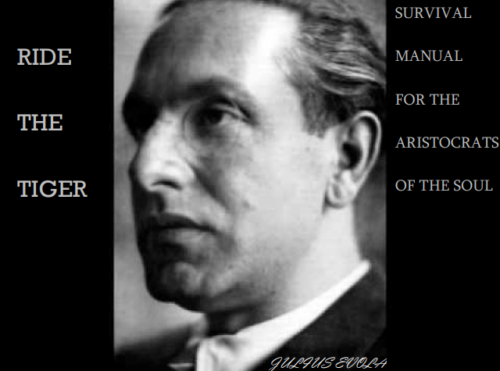
VJMP Reads: Julius Evola’s Ride the Tiger IV

This reading continues on from here.

The tenth essay in Ride The Tiger is called ‘Invulnerability – Apollo and Dionysus’. Here Evola further describes his conception of an aristocrat of the soul as someone who feels very deeply and who is very moved by things. The modern man (the man of clay, essentially), only feels very shallow emotions, and quickly moves from one such shallow impression to the next.

In this essay, Evola touches on the truly aristocratic topic of deliberately exposing oneself to great trials and tribulations, for the sake of learning one’s true nature. Alchemists will recognise this mentality as the one necessary to burn away everything but the gold so as to learn to distinguish Spirit from Nature. The purifying fire is that which burns away body and mind and leaves one with one’s true nature – it is necessary because it burns away everything shallow, leaving only actions which arise from the depths.

A person who has done this may find themselves gifted with a “transcendent confidence” that is characteristic of the aristocrat of the soul. This is important because in purifying oneself down to the gold one also strips away all of the conditioned belief in life’s meaning. To proceed past this stage, the alchemist must find within themselves the will to assert a meaning to life independent of any outside source. Then one is invulnerable.

To open oneself without falling apart is not easy in an age of dissolution. Here Evola takes care to point out that it’s very easy to fall at the second hurdle. Just because mainstream religion is bullshit doesn’t mean that we should abandon it for wild paganism and barbarianism. There is more.

The eleventh essay is called ‘Acting Without Desire – The Causal Law’. Once a person discovers their true nature, they should also learn the ability to act without desire. This entails taking the correct action at any given time instead of becoming distracted by profit or loss, or by what other people might think of you. Doing what needs to be done.

This needs to be qualified, however. There are naturalistic desires, that arise from the biology of the human animal. These are generally to be avoided. There are also, however, heroic desires, that arise from something greater than the merely physical, from something transcendent. These may be acted upon.

An aristocratic person, then, thinks not in terms of sin but in terms of error. The concept of sin is impossible because God has long been repudiated; all that remains is adherence to standards that one sets from within as an expression of one’s true nature.

One ought to act with a mind to what is effectively a law of karma, in that actions have consequences, regardless of whether those actions conform to any conception of good or evil. Those consequences are real and should be regarded as such. This is fine because the real man of gold doesn’t just live, but rather manifests himself and his true nature in the world.

This is the end of the second part of the book. The next part is called ‘The Dead End of Existentialism’, and the first essay here is the book’s twelfth: ‘Being and Inauthentic Existence’. This deals with the two types of existentialism (as Evola sees it): the philosophical, academic tradition and the practical tradition exemplified by Jean-Paul Sartre.

Evola dismisses existentialism almost entirely, for the reason that the existentialist philosophers are too much a product of their times, and because they are not themselves interested in the world beyond. The existentialists are very materialistic and this disqualifies existentialism from being a philosophy that an aristocrat might be concerned with.

Despite this, existentialism can be credited with some things. For one, the idea that “existence precedes essence” serves to keep the existentialist in touch with the metaphysical and transcendent. It also helps to highlight the dual nature of the aristocratic soul, which, as described earlier, is much deeper than that of the pleb.

*

If you enjoyed reading this essay, you can get a compilation of the Best VJMP Essays and Articles of 2017 from Amazon for Kindle or Amazon for CreateSpace (for international readers), or TradeMe (for Kiwis).

The Four Ways to Destroy A Population

The people, united, will never be divided – but there are other ways to destroy them

Ruled as we are by a parasitic, incestuous cadre of abominations, it isn’t easy to get our minds around all the ways that we have been destroyed. So many underhanded tricks have been used to divide and conquer us that it’s impossible to list them all. This essay tries to make sense of them by grouping the tactics of the ruling classes into four major categories.

The first is to disincorporate the target population. This means to take action that prevents them from forming any bonds of solidarity. Interpersonal solidarity, if too much of it is achieved, will allow a group of people to form their own sovereignty without being dependent on the State. Therefore, the State has to smash it.

The easiest way to achieve this has been known for millennia – it is to enclose public space. This is where people meet and where people talk, and where that happens there tends to grow opposition to the State. From the marketplace that spawned Socrates to the beer halls that spawned Hitler, anywhere people can meet and share their discontent about the way things are run is a place where that discontent can fester.

Alchemically, this category is equivalent to clay, because that represents the masses coming together. Disincorporation, therefore, means fences, walls, blockades, moats, trenches and everything else that prevents the natural flow of conversation from taking place.

The second is to disintegrate the target population. This is essentially Plan B, for when disincorporation fails. Here, disintegrating means to literally take away sources of order from within the body of the target population. The result of doing so is to render into chaos the bonds of solidarity that hold the people together, making them less able to take action.

This involves schemes like the War on Drugs, in which half of the population is demonised and persecuted for no good reason while the other half of the population keeps their mouth shut lest they be the target next time. The people don’t need to be literally split apart by force (although that’s an option), because it’s easier to split them apart by turning their own natural greed and cowardice on each other.

Alchemically, this strategy is equivalent to iron, because it’s the sharp edges of iron that cause bodies of clay to disintegrate. Although bullets are definitely one method by which this can be achieved, it’s mostly about forcing people apart by legal boondoggles and trickery.

The third is to disorientate the target population. This is where actual lying comes in. This is Plan C in the sense that the ruling class only uses it if their target population form bonds of solidarity that resist initial attempts to break them. Here they have to spin a web of deceit, confusion, misdirection and pure bullshit.

In the West, which has generally high levels of freedom of movement, association and speech, it’s not easily possible for the ruling classes to prevent the population from forming strong bonds of solidarity. Therefore, the ruling class has to direct the natural rage of the target population somewhere else.

Mainstream media such as television and radio does an outstanding job of this in our societies. There are new, shiny and loud distractions every moment of the day, blasted into our brains in the ever more frequent gaps in the programming. These are the alchemical equivalent to silver, in that they shine things at us to distract and one risks becoming blinded by it all.

The fourth is to demoralise the target population. This is the plan of last resort, and the ruling class only try it if the previous three methods have failed. It’s a question of the will of the people: if they are many, united and well-organised, they will win unless their will to be free can be sapped.

Alchemically this relates to gold and is therefore primarily a question of spirituality. It can be seen that, in the modern West, all spiritual traditions are attacked and persecuted while corrupt and empty religious ones are allowed to thrive. Our natural spiritual relationship with God has been destroyed and replaced with a pathetic McDonaldsisation of old Hebrew myths.

This absence of genuine spirituality has sapped our wills to live, and our ability to feel joy. Instead of being united with our birthright, which is to know spiritual truths about the survival of consciousness beyond the death of the physical body and the laws of karma, we are told that we are merely accidents of chemistry. Consequently, fear of death pervades our every waking moment, and we are thus paralysed.

Demoralisation is arguably a more powerful tactic than any of disorientation, disintegration or disincorporation because it can destroy a population at any level of intellectual advancement or physical organisation. This explains why so many of the problems and stresses we encounter in everyday life exist – they are placed there, deliberately and maliciously, to demoralise us.

*

If you enjoyed reading this essay, you can get a compilation of the Best VJMP Essays and Articles of 2017 from Amazon for Kindle or Amazon for CreateSpace (for international readers), or TradeMe (for Kiwis).
Could New Zealand Ever Imagine Banning Rugby?

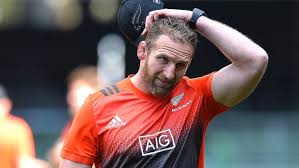
When even men built like this don’t want their kids playing rugby because it’s too violent, you know the sport has a problem

For decades, Kiwis have got used to the idea that wintertime means rugby. Well, we better start getting used to the idea of wintertime meaning soccer, because soon we’re going to have a lot more awareness about the effects of repetitive head injury than we do now, and when we do, there are going to be a lot of shrieking violets trying to get the game they play in heaven banned.

Rugby is popular in New Zealand for two major reasons. The first is that it’s fun as all hell both to play and to watch, the second is that rugby has been an important part of the masonry that cemented white people and Maoris together into a functioning modern culture. For over a century, rugby fields have been the places where Kiwis learned to set aside their racial and class differences and unite of their own free will towards a common goal.

There has always been an undercurrent of concerned mothers, however, who didn’t let their kids play rugby out of fear of head or brain injury. It’s an entirely legitimate concern – rugby is a collision sport, after all, and it’s evident from watching ten minutes of an All Blacks match that not even the best tackling technique in the world is a guarantee that one can avoid head injury entirely.

Perhaps most worryingly of all, even the best of the best rugby players in New Zealand are aware of the risks they are taking. Kieran Read has said that he intends to encourage his children into cricket on the grounds that rugby is too dangerous, and Richie McCaw said, post-retirement, that “I don’t miss getting smashed.”

The question is this: what risk of permanent brain injury is considered too much, given the positive physical and social benefits that come from the game? Because if that limit is exceeded, it may be that the responsible thing to do, from the Government’s perspective, is to ban it. After all, New Zealand schools banned Bull Rush with very little sentiment because of head injury concerns, so why couldn’t they do the same for rugby?

Recent studies on NFL players suggest that the incidence rate of brain damage in adult professional collision sports is many times higher than was previously suspected. It seems that, as brain scanning technology continues to improve, we are gathering a more refined appreciation of how vulnerable the brain really is to repeated blunt force trauma.

Rugby is different to American football, of course, because in rugby the tackle is made with the shoulder, whereas in American football tackles are often made with the head in a manner akin to a charging rhinoceros. But that’s merely a difference in degree, not in category. Rugby is still a sport based around putting the ball carrier on the ground through physical force, and this means the risk of head injury can only be minimised, never eliminated.

Already we’ve been able to observe a change in the culture of the sport in recent years. Avoiding head injuries is sometimes prioritised to an absurd degree, highlighted by the incident in the recent Lions tour when a Lions player leapt into the air to catch a loopy pass from halfback Conor Murray, was tackled before he hit the ground, and then was awarded a crucial penalty for having been taken out in the air.

This looks set to get even more extreme. It won’t be long until a professional match has to be stopped part way through because (for example) two tighthead props on one team have both failed head injury assessments.

This column has previously pointed out that the Government never gives rights back to the peasantry; they always take one new right away for every one they give back. Recent discussions about whether to change the cycle helmet laws have been centred around the idea that forcing people to wear a helmet discourages them from cycling. One can be certain that if we get our rights to cycle without a helmet back, pressure will begin to build to have them taken away somewhere else.

We would never argue for the game of rugby union to be banned, at any level. We don’t even support the softening of the game with the repeated TMO checks for suspected head-high tackles. But there are some wowsers and control freaks out there, and we can confidently state that they would happily ban rugby if they thought of the children long enough. It pays to stay one step ahead of them.

*

If you enjoyed reading this essay, you can get a compilation of the Best VJMP Essays and Articles of 2017 from Amazon for Kindle or Amazon for CreateSpace (for international readers), or TradeMe (for Kiwis).