Westerners are not stirred to rage by many things – not by mass homelessness, not by declining wages, not even by the British Government covering up serial child sex abuse by Jimmy Saville and by various Asian rape gangs. Our spirits have been broken, and this had led us into a state of decline. This essay argues that the Western World could solve many of its current problems with a wholesale conversion of every country to Islam.
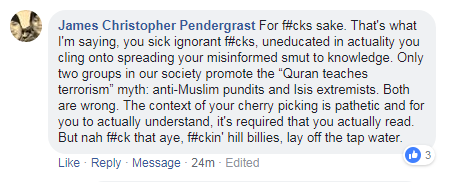
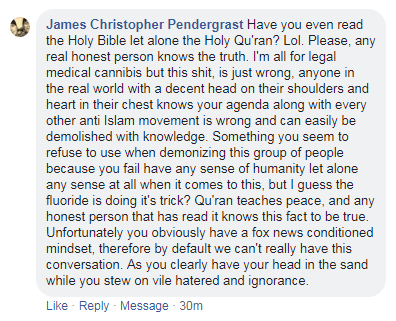
People can criticise what they like on social media, and people can defend what they like. Some criticisms meet with more defence that others. Nothing inspires an impassioned defence more than criticism of Islam. If a person criticises Islam on social media, hundreds of people will line up to scream all kinds of abuse at them, but they won’t do the same for any other ideology. This suggests that Islam has a special place in the heart of Westerners; it’s already holy, in a way.
If one considers that almost all of the Western World was Christian before World War One, it seems that the widespread loss of faith that resulted from that conflict could be resolved with a switch to a similar religion. Islam is also an Abrahamic cult, so it contains much of the same message as Christianity; the idea that God is male and that the feminine is inferior is an Abrahamic idea, as is the idea that homosexuals should be killed and the genitals of infant boys mutilated.
So Westerners have long been conditioned to accept the ideas of Islam, by way of accepting these same ideas in the guise of Christianity. Islam, like Christianity, considers itself a branch of the tree of revelation that began with Adam and continued through Moses and Abraham. In a sense, then, switching to it would represent a natural progression.
Already in Britain, there are more weekly mosque visits than church ones. This fact alone suggests that Islam might already be stronger than Christianity in Britain. The same is likely to also be true of other countries with large Muslim populations, such as France and The Netherlands. So Islam is arguably already stronger than Christianity, and one reason to adopt it would be to recognise this fact.
The most pressing reason for a widespread conversion to Islam would be to arrest the decline of the West.
Western birthrates have fallen to the point where we are no longer replacing our own people. The fertility rates in major Western countries like Italy, Poland and Spain is less than 1.5 children per woman. This is going to cause our populations to shrink ever-further until we are no longer capable of resisting foreign domination. Birthrates in Muslim countries, by contrast, remain high: Afghanistan 4.6, Iraq 4.4, the West Bank 4.0, Pakistan 3.5, Egypt 3.3, Algeria 2.8.
For whatever reason – perhaps the admonition to wage war against the infidel with the wombs of Muslim women – Islamic countries have maintained a much higher birthrate. A switch to Islam might rid us of the meek self-hatred of Christianity that has caused us to believe that we were no longer worthy of continued existence, and inspire our people to ensure a physical future for themselves.
Adolf Hitler once declared that:
“It’s been our misfortune to have the wrong religion. Why didn’t we have the religion of the Japanese, who regard sacrifice for the Fatherland as the highest good? The Mohammedan religion too would have been much more compatible to us than Christianity. Why did it have to be Christianity with its meekness and flabbiness?”
and that logic still holds. The meekness of Christianity has caused the West to lie down and die out of guilt and the resentment of strength; the vigour of Islam might be what is required to revitalise our people.
Some might object that Muslim culture has a number of obscene and immoral practices that ought to be resisted on account of the immense human suffering they cause. Not so.
Many of the most obscene practices of Muslims are already accepted by Westerners. Muslim cultures also practice widespread male infant genital mutilation, much like America. Although this practice results in horrific psychological damage to the victim, it’s not considered too barbaric for America (or many European countries). Moreover, like the Europeans, Muslims despise Jews and can’t wait to exterminate them for good.
Of course, a mass conversion of all Western nations to Islam would be terrible for the homosexual community. Homosexuality is illegal in the vast majority of Muslim countries, and punishable by death in South Sudan, Iran, Saudi Arabia, Yemen, Mauritania, Afghanistan, Pakistan, Qatar, the UAE, parts of Nigeria, parts of Somalia, parts of Syria and parts of Iraq. The Koran repeats the Biblical story of Sodom, and implies at several points that homosexuality ought to be punished severely.
Should the West convert to Islam, a wholesale persecution, if not outright massacre, of the homosexual community would have to be expected. However, against that, it has to be pointed out that the homosexual community is one of the strongest proponents of mass Muslim immigration. Homosexuals are on the front lines of the war against the people who oppose mass Muslim immigration, frequently attacking people for mentioning the deleterious effects of it elsewhere.
A wholesale Western conversion to Islam would also be terrible for women, whose rights are severely restricted in Islam. Women would likely have to face the daily reality of sexual assault and the impossibility of getting Police help for domestic violence or sex crimes against them. Again, however, like the homosexuals, women have been eager proponents of mass Muslim immigration and arguably would be getting what they deserve.
So maybe we should just surrender. Is it time to admit that we don’t have the willpower to resist the Islamic conquest of the West? That Muslims will keep stealing from us and raping our women as long as they see us as infidels and so we ought to join them? The conclusion of this essay is that we should jump on board while we can still get favourable terms.
*
If you enjoyed reading this essay, you can get a compilation of the Best VJMP Essays and Articles of 2017 from Amazon for Kindle or Amazon for CreateSpace (for international readers), or TradeMe (for Kiwis).