

The Five Rejections

It is not easy to say what the alt-centre is, but it is easy to say what it isn’t. The alt-centre is the sixth political position: the one that remains after the explicit rejection of the other five positions. This rejection is necessary because all five positions have evidently failed. This essay seeks to delineate the boundaries of alt-centrism by rejecting the flaws of the other positions.

The alt-centre rejects the position of the old right that the current system is the best system and that the status quo ought to be maintained.

The desire to always keep everything the same is an instinct born of fear of change and greed. Not everything has to stay the same as much as possible and for as long as possible. To fear change is to misorient oneself because everything changes; all of the contents of consciousness are temporary. Therefore, the alt-centre rejects conservatism for conservatism’s sake.

Much the same as all of the non-right-wing positions, the alt-centre is appalled by heavy concentrations of wealth and power in few hands. The alt-centre shares a sense with these other positions that gross inequalities of privilege are obscene, on account of that there is a limit to how much privilege can be earned. Compassion for those who are on the edges of poverty is paramount.

Verticalism is rejected by the alt-centre, for the reason that the majority of people in Western societies are educated to a decent level and can therefore be expected to be reasoned with. Reasoning with people, instead of bullying, mocking, coercing or abusing them, is how bonds of solidarity are formed, and so it ought to be encouraged where practicable.

The alt-centre rejects the position of the old left that the ruling class is inherently illegitimate and that anyone with wealth or power is bad.

Just because someone has wealth and power doesn’t make them evil. Trying to rip people down because of envy is not a behaviour that will lower the prevalence of human suffering on this planet – to the contrary. That sort of resentment-based aggression is precisely the sort of slave morality that the alt-centre rejects.

Horizontalism is therefore also rejected by the alt-centre. Instead, a premium is placed on scientific evidence. This tells us clearly that there are no two things in Nature that are precisely equal, and therefore a desire to equalise everything is a recipe for eternal conflict.

The correct way to get those born into unearned privilege to relinquish it is not by threats and violence and it isn’t by trashing the whole world. It is by reason. The alt-centre seeks to minimise the deleterious effects of unearned privilege by maintaining strong bonds of solidarity across all groups within society, so that none are incentivised to hoard wealth by an indifference to the poverty of others.

The alt-centre rejects the position of the old centre that an insipid compromise between the old left and the old right is the way forward.

You can’t have a compromise between people who seek to cling to power at all costs and people who just want to trash the whole world. This inevitably leads to short-term solutions that fail to meet the genuine long-term challenges of our political and economic climate. These short-term solutions end up causing more damage in the medium to long term.

Neoliberalism is an example of an insipid compromise. In the case of neoliberalism, we get a plastic corporate liberalism that seeks to McDonaldsise the whole planet for the sake of maximum profit and efficiency. Such compromises are considered categorically wrong by the alt-centrist, which abhors reducing things to their lowest common denominator.

In any case, the centre demands the perpetuation of the Establishment, and the alt-centre cannot accept this. The alt-centre cannot accept that the Establishment be allowed to remain on their throne. They have fucked up too badly. In any case, the challenges facing us are too massive, and our culture too sclerotic to adapt to meet them – they can only be overcome with a new paradigm of thought.

The alt-centre rejects the position of the alt-right that segregation and separation are the answers to the failures of the Establishment.

There are many competing ideologies in the world, and most of them have glaringly obvious flaws, it is true. But isolating oneself from these competing ideologies, like a monk hiding in some mountain retreat, is not a philosophy that can sustain an entire nation. Just because the Establishment has failed doesn’t mean we have to throw all of societal advancement and all culture out the window.

Just because the Western World has fallen into chaos, doesn’t mean that we should swing as far as possible in the direction of order. The lessons of the Hemoclysm are still relevant – absolute power still corrupts absolutely. All totalitarian ideas about controlling information or limiting freedom of expression – whether in cyberspace or meatspace – are rejected by the alt-centre.

Related to this, the alt-centre rejects all obsessions with degeneracy, purity and wholesomeness. Altering one’s consciousness for the sake of creativity or social interaction is not “degenerate”. The alt-centre argues that avoiding all drugs is saying no to life, and is therefore an anti-life philosophy. Likewise, the desire for an ethnostate is anti-life, because a diversity of human phenotypes is natural. The alt-centre rejects all anti-life philosophies.

The alt-centre rejects the position of the alt-left that diversity is strength.

It’s obvious that having some things in common is necessary for any group to function as a group. In order for the concept of a group to even be possible, the individuals that institute it have to have something in common. The more they have in common, the stronger the bonds of solidarity will be. These strong bonds of solidarity are necessarily for a society to function.

It’s also obvious that open borders are simply going to lead to a primitive, precarious and paranoid existence where nothing can be certain from one moment to the next. There is no moral imperative to make our societies more diverse just for the sake of it. Indeed, the alt-centre would argue that diversity allows the ruling classes to divide and conquer the masses more effectively. The correct balance between solidarity and diversity has to be struck.

Moreover, the alt-centre completely rejects the new anti-white narrative that is being promoted by the alt-left. The only real privilege is class privilege: a black man with money is more privileged than a poor white man. This remains the core of alt-centre philosophy. The moral imperative is not to God, or to the State, but to alleviate suffering in our fellows.

These five rejections are sufficient for the alt-centre to carve out its own niche in political space. It is one that will grow, and may well eventually come to power. Anyone who repudiates any one of these rejections cannot be an alt-centrist.

*

If you enjoyed reading this essay, you can get a compilation of the Best VJMP Essays and Articles of 2017 from Amazon for Kindle or Amazon for CreateSpace (for international readers), or TradeMe (for Kiwis).

How to Tell if You’re Really A Libertarian

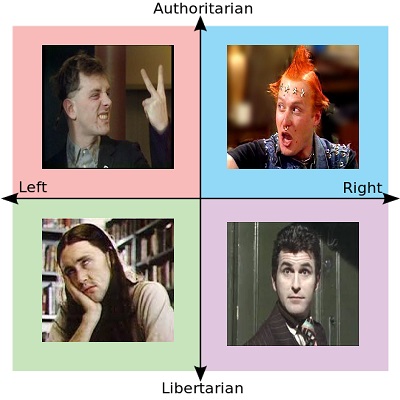
The most famous political chart puts everyone into one of four quadrants: authoritarian left and authoritarian right at the top, and libertarian left and libertarian right at the bottom. It’s fashionable to claim to be libertarian, but not everyone who does so really is. This essay looks at how to tell if you’re really a libertarian.

The political consensus of the Western World is still profoundly affected by the horrors of the authoritarian governments of the 20th century.

Authoritarian governments in the form of Nazism and Communism caused the deaths of some 150 million people, directly or indirectly, through a variety of wars and famines. These acts live on in infamy with names such as the Holocaust and Holodomor, the very mention of which summon images of starvation, misery and death.

Since then, it’s been extremely unfashionable to be authoritarian. But it’s still tempting – as tempting as it ever was. The thought that some ideas are not merely great, but so great that they have to be forced on the populace at gunpoint by a government that will kill its own citizens before it will compromise, is one that reoccurs throughout human history. All that’s necessary for it to actually become a reality is a sufficient degree of arrogance, or self-righteousness, on the part of the rulers.

Once a government has enough hubris – and whether they are left or right doesn’t matter here – they will start thinking that the lessons of history don’t apply to them, or that their actions are so righteous that human nature will change in recognition, or that they are uniquely talented and therefore can achieve things that no previous rulers could.

Once this stage is reached, it’s possible for the government to start doing things to people whether they want it or not, instead of helping them get things done in accordance with their own wills, and at that stage the government meets the definition of authoritarian. We have ideas so good they have to be compulsory! is the rallying-cry of the self-righteous authoritarian.

A person who is really a libertarian will stay committed to liberty no matter how tempting the proposal to abandon it might be. They therefore reject the idea that ideas can be so good that the government has to force them on people. Exceptions to this rule are only made in the gravest circumstances – never to try to make the world better, whether the justification be to “put order to things” or for “the greatest good”.

A person who is really a libertarian will reject proposals from both the left and the right if those proposals are too authoritarian, even if they have minor sympathies towards one of the two poles.

They will not (for example) only reject leftist authoritarian ideas, such as raising taxes or making a minority language compulsory for all school children, while accepting any and all right-wing authoritarian ideas, such as starting wars or drug prohibition.

A person who claims to be a left libertarian will happily criticise the left if it does authoritarian things. Many authoritarian leftists have been agitating to remove speaking rights from various conservatives (or even just people labelled “conservative” by the media), a process they refer to as “deplatforming”. This is blatantly authoritarian, so anyone supporting it on the grounds that it furthers leftist interests cannot also claim to be a libertarian.

Not even if they believe that the left is the side of liberty! Being an authoritarian under the guise that one’s authoritarianism ultimately serves libertarian ends is a fail. All psychopathic dictators claim this.

Likewise, a person who claims to be a right libertarian will genuinely be against crony capitalism and genuinely be against the political influence that large corporate interests exert on the legislation. They will refuse to complain only about taxation, and will also complain about corporate welfare and bailouts of inefficient companies.

Because authoritarianism is so unfashionable, many people will try and sneak authoritarian ideas into the discourse under the guise of them being either left or right. If the person they are speaking with is simple enough to equate either left or right eternally with libertarianism, then getting that person to oppose something is as simple as equating it with whichever of the left or right that person associates with authoritarianism.

The left does this with rhetoric about the need to make up for past injustices and for forced equality of outcome, and the right does this by stirring up fear of government and of minorities. Any person who is really a libertarian will reject all of this reasoning, and will remain steadfast to the belief that ideas should not be forced onto others, because justifying authoritarianism from either the left or the right will justify more of it from the other side as well.

*

If you enjoyed reading this essay, you can get a compilation of the Best VJMP Essays and Articles of 2017 from Amazon for Kindle or Amazon for CreateSpace (for international readers), or TradeMe (for Kiwis).
Writing Autism Spectrum Disorder

Autism has gone from being a little-known condition to being a condition that everyone is accused of having, autistic or not. However, just because everyone is aware of autism doesn’t mean that everything they think they know about the condition is accurate. This article looks at how to write believable and realistic characters with autism.

The most characteristic feature of autism is a pronounced difficulty with social interaction, usually coupled with an obsession with certain repeated actions. This difficulty with social interaction is enough to cause immense difficulty in the lives of some autists and the people around them. This goes beyond mere awkwardness, to a point where fundamental communication becomes difficult.

From the perspective of a person with autism, much of the difficulty about living with the conditions comes from an inability to make the intuitive understandings about other people, and their behaviour, that is usually taken for granted. A person without autism (a “neurotypical”) seems to have an almost psychic understanding of how other people think and behave. Social interaction just seems so effortless for such people.

Your protagonist might have difficulty getting along with someone who has autism, on account of that the autistic character doesn’t seem to understand what the protagonist believes to be the rules of social interaction. The protagonist might make jokes that don’t get laughed at, and come to think that the autistic character doesn’t like them, when the problem is a low level of communication.

Then again, your protagonist might get along with an autistic character just fine. Autists can make a lot of sense, in their own way. Often, a person with autism will be capable of observing human interaction without all the pretense and brainwashing, and can arrive at objective, if odd and unconventional, conclusions. These can sometimes be valuable wisdom (and they can sometimes be juvenile truisms).

Viewed from the outside, an autistic character might appear as excessively orderly, to the point of dysfunction. Autists often like to ritualise certain behaviours (much like Obsessive-Compulsive Disorder), to the point where not being able to perform the ritual sometimes creates unbearable anxiety. Their speech can be likewise regimented and repetitive. It’s common for them to compulsively stack objects or line them up.

Moreover, autists often feel solidarity with other neurodiverse people, and vice-versa. Autism is entirely different to, say, schizophrenia, but much of the lived experience of autism is similar to other mental conditions. The social rejection and the anxiety about more rejection, the anxiety, the shame, the frustration, the despair: these are all emotions that mentally ill people tend to experience more than others. An autist might relate strongly to someone who also feel them, even if that person is not autistic.

If your protagonist has autism themselves, you will have to be very careful about how you render their internal dialogue, should you write about them in the first person. A lot of fiction is poorly written because the characters in it have an unrealistically high level of understanding the behaviour of other people. An autistic protagonist will frequently be baffled by the behaviour they encounter. Much of their behaviour will be a complete mystery.

One of the most dramatic things about autism is the emotional consequences of the social difficulties that arise from having the condition. The awkwardness of autism is often mistaken by other people for malice, psychopathy, pedophilia, terrorist intent and all manner of other things. This makes life extremely difficult and can make for a harrowing story (unless your protagonist turns out to be a pedophile or terrorist).

It ought to be easy to engender sympathy from your reader here, because most people are sympathetic to the sense of injustice that comes from undeserved social rejection. Despite that, the other characters might feel like they have good reasons to reject the autistic character. After all, it is hard to tell the difference between social clumsiness and malice sometimes.

Because autism is a spectrum, there are many subclinical versions of it. A character with a subclinical level of autism will be relatable for many – after all, there is no person who has perfectly smooth social interactions all day every day. For them, their autism might be something that just makes life more colourful or interesting.

Autism can increase in severity all the way up to the point where a character with it will just about live in their own world, divorced from the concerns of most of the others. Realistically, a character with severe autism will have a hard time being a major character in your story because their degree of communication impairment will be so severe that no-one else will understand them. More moderate forms could involve a degree of social impairment that can be more or less overcome.

There is reason to believe that small amounts of autism can be helpful in certain occupational fields, especially those that pertain to the imposition of order upon chaos. Therefore, an autist need not be presented as conspicuously mentally ill. They might have found a niche that suits them perfectly, in some job that requires order to be imposed upon chaos. Mechanics and computer engineers are favourites.

*

This article is an excerpt from Writing With The DSM-V (Writing With Psychology Book 5), edited by Vince McLeod and due for release by VJM Publishing in the summer of 2018/19.

Why the All Blacks Will Do Kapa O Pango Against Argentina

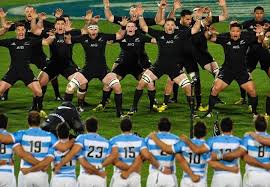
The All Blacks will play the Argentinian Pumas this Saturday night in Nelson. This is the first time the All Blacks have played in Sun City, and as a result it’s expected to be the biggest thing ever to happen here. Only one thing is more certain than an All Black win – and that’s the fact that the All Blacks will do Kapa O Pango and not Ka Mate on Saturday night.

As most people are aware, the All Blacks have two hakas: the traditional Ka Mate, composed by Te Rauparaha around 1820, and the modern Kapa O Pango, composed this century. A smaller number know that Te Rauparaha was some kind of warlord and that Kapa O Pango came in during Tana Umaga’s time as All Black captain.

Te Rauparaha was indeed a war hero – to some. To others, he was every bit the war criminal as other war leaders tend to be viewed as by the people they attacked. He played a leading role in the Musket Wars as a war chief of the Ngati Toa. Armed with musketry, Te Rauparaha’s forces swept all the way down to Kaiapoi, and along the way he carried out some of the most ruthless genocides ever seen in Polynesia.

As this article luridly describes, the existing residents of the South Island were exterminated in a campaign of brutality that would have appalled even the men who destroyed the Aztec Empire under Cortez. Mass murder followed by cannibalism and enslavement of any survivors was the standard practice of war parties in the New Zealand of the 1820s, and the forces under Te Rauparaha were not an exception.

By the early 1840s, the Northern South Island was almost completely depopulated, which made it ripe for European settlement. Nelson and Blenheim were early growth centres on account of this; the road between them, where the Maungatapu Murders took place, was once a relatively busy highway, even if it could only be traversed by horse and cart or by foot.

This is the reason why Nelson has the honour of many national firsts – such as the the location of the first rugby match ever played in New Zealand, an 18-a-side affair at the Botanical Gardens, near the Centre of New Zealand.

So to say that Te Rauparaha is not well thought of by the Maori tribes local to the Northern South Island, or what’s left of them, is an understatement, akin to saying that Adolf Hitler is not well thought of among Poles. For the All Blacks to perform a haka written by him, on the same grounds where he committed possibly the worst atrocities New Zealand has ever seen, would be too great an insult for the local Maori to bear.

Steve Hansen and Kieran Read, ever the master strategists and culturally acute on account of being in charge of New Zealand’s single most successful example of intercultural co-operation, are entirely aware of this, and will no doubt avoid performing the haka that has particular sinister connotations to the local Maoris of Nelson. No surprises: we will see Kapa O Pango this weekend.

*

If you enjoyed reading this essay, you can get a compilation of the Best VJMP Essays and Articles of 2017 from Amazon for Kindle or Amazon for CreateSpace (for international readers), or TradeMe (for Kiwis).