Why the 2018 Labour Budget Was so Underwhelming

The 2018 Budget, like the 2000 one, was extremely tight; the 2020 Budget will be a lolly scramble, as the 2002 one was

“Yet, for all the hype, [the Finance Minister and the Prime Minister] were at pains to reassure big business and employer groups that this was above all a ‘fiscally responsible’ budget. Its commitments to social spending would not jeopardise Labour’s intention to maintain a surplus, they emphasised…” The two Labour Party politicians mentioned here are Grant Robertson and Jacinda Ardern, speaking in 2018 right? Wrong – they are Michael Cullen and Helen Clark, speaking 18 years ago in the year 2000.

The quote in the opening paragraph comes from this article from 2000, discussing the first Budget of the new Fifth Labour Government. Other quotes of interest from the same source are: “the increases fall far short of what is required to address the acute levels of social and economic inequality now embedded deep within the social structure”, “The majority of families forced to rent from private landlords will be no better off than before” and “Labour and the Alliance have done nothing to restore the vicious cuts to unemployment benefits and welfare that were implemented by the National Party”.

So if you’ve been listening to the Sixth Labour Government explain why this year’s Budget helps almost no-one and you’re starting to realise that you’ve heard this exact same bullshit story before, sit tight while we explain why – and what’s going to happen next.

After nine of years of neglect, including closing down rape crisis centres and overseeing the world’s highest youth suicide rate, the Fifth National Government was finally – although narrowly – voted out of power. The Sixth Labour Government came to power with a strong commitment and mandate to do something about the rape and pillage of the New Zealand populace by the plutocrats.

So the 2018 Budget surprised many commentators with how weak it was. The consensus described it as “National-lite”, and, indeed, it did almost nothing to help anyone. Many asked themselves why it was that an incoming Labour Government would deliver such a weak Budget. Didn’t they want to create the impression that they were doing something to help? Why miss this golden opportunity to set things right?

The answer to this conundrum comes from examining the 2002 Budget, which was released a few months before the General Election that year. That year’s Budget sent the New Zealand business community into paroxysms of rage.

The Employers & Manufacturers Association complained that “The huge $3.31 billion increase in new spending in the Budget for the next financial year is more than double the increase in new spending for the past two years combined”, and then National Party leader Bill English was enraged by “Labour and their higher operating balances, as well as higher taxes, increasing debt and billions of taxpayers’ dollars invested overseas”. There was even money for pure luxury items like refugee resettlement.

These increases impressed the population, as they were the first real relief Kiwis had been given in 18 years of relentless neoliberalism, and they duly returned the Labour Party to power. Kiwis contrasted this big spend-up with the cruelty of the National Party Budgets under Ruth Richardson, and the Nats were duly slaughtered, falling to 21% of the votes, their lowest result in 100 years.

It was a lesson for all, not least the Labour Party.

So the reason why the Sixth Labour Government did next to nothing to fix the nine years of neglect that the Fifth National Government put us through is simple: they’re saving the lolly scramble until just before the 2020 General Election. You can almost guarantee that, when the 2020 Budget rolls around, the grip of the New Zealand ruling class around the throat of the population will be loosened just enough to enable us to express our gratitude by returning Jacinda Ardern’s Government to power for a second term.

This is not a nefarious new trick, dreamed up by a crack team of political consultants – it’s straight out of the Helen Clark playbook. We can confidently predict another weak Budget in 2019 before the conspicuous generosity of the 2020 one, and we can also almost guarantee that if Labour wins a second term this would see us having two more weak Budgets in 2021 and 2022 before another lolly scramble in time for the 2023 General Election. Then, if they win a third, there will be weak Budgets in 2024 and 2025 before yet another lolly scramble in 2026.

This pattern is no less predictable than the General Electoral Cycle itself is, and could even be said to be part of it. Plus ça change, plus c’est la même chose.

*

If you enjoyed reading this essay, you can get a compilation of the Best VJMP Essays and Articles of 2017 from Amazon for Kindle or Amazon for CreateSpace (for international readers), or TradeMe (for Kiwis).
Why New Zealand is Now Behind Zimbabwe On Cannabis Law Reform

For all the gloating about how incredibly progressive New Zealand is on issues relating to race and sexual orientation, we Kiwis sometimes fail to notice that we are lagging behind the rest of the world on many other human rights issues. Incredibly, New Zealand is more backwards than Zimbabwe now when it comes to cannabis law reform. This essay examines why.

You read correctly: New Zealand is now behind Zimbabwe on cannabis law reform. The despotic Southern African state announced recently that both individuals and companies can apply to the Minister of Health for a licence to grow medicinal cannabis. You don’t have to be dying, as is the criteria in New Zealand.

So how did our human rights decay to the point where Zimbabwe is beating us on major human rights issues like medicinal cannabis law reform?

Crucial to understanding this is understanding that the National Party has always been the pisshead’s friend. When drinkers wanted pub hours extended for the 2015 Rugby World Cup, the National Party was eager to help. But when Kiwi medicinal cannabis users petitioned them for nine years to allow them equal rights to people in California, they were utterly unmoving, despite the evidence in the research journals and from the examples set overseas.

When the Electoral Commission revealed the list of each party’s donations last month, it became clear why New Zealand is now more backwards than Zimbabwe when it comes to cannabis law reform. Simply put, the National Party has whored itself out to the same alcohol and pharmaceutical interests that have opposed cannabis medicine from the beginning.

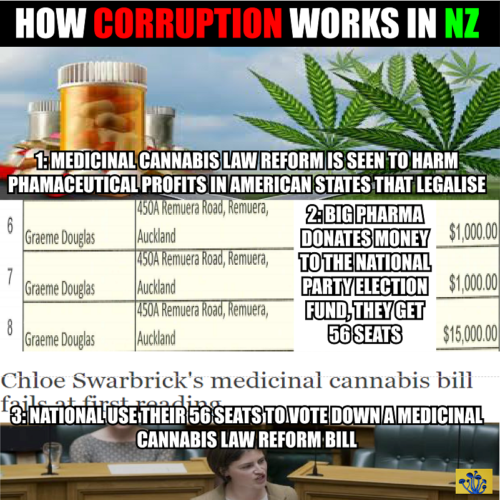
In 2017, the National Party got $41,945 in donations from Stoneyridge Vineyard, $25,438 from Gibbston Valley Winery, $16,700 from Spirits NZ and $42,000 from Graeme Douglas of Douglas Pharmaceuticals, whose morphine product is competing with medicinal cannabis for the billion-dollar analgesic market. This totals $126,083 in donations from industries that are implacably opposed to cannabis law reform.

The National Party spent around $2,500,000 on their 2017 General Election campaign, which means that these donations are reasonably small in the overall scheme of things, amounting to only c. 5% of the total spending. But this has to be contrasted with the fact that the Aotearoa Legalise Cannabis Party, the only party seriously promoting the will of the 80% of Kiwis who want a change to the cannabis laws, spent less than $1,700.

In other words, anti-cannabis forces spent over 70 times as much on bribing National Party MPs as pro-cannabis forces spent in total during the 2017 General Election. Little wonder, then, that National Party MPs unanimously voted against Chloe Swarbrick’s bill that would have allowed sick Kiwis to grow their own medicinal cannabis at home without fear of prosecution.

This all sounds very cynical but unfortunately, this is how the game is played in politics, which belongs ultimately to the paradigm of silver. Our politicians are literally whores – this is a truth universally acknowledged by anyone who has had cause to observe the politically ambitious at close range for any length of time. They will say whatever someone wants to be said for money, so their tongues are for hire as much as those of any streetwalker.

Despite all that, this situation may not last. The experience of American states that have liberalised their cannabis laws (beginning with medicinal cannabis in California in 1996), suggests that money talks both ways.

East Coast medicinal cannabis operation Hikurangi Enterprises recently raised $2,000,000 in their share offering and were heavily oversubscribed – so much so that the crowdfunding site handling it crashed twice. Considering that most people who are interested in medicinal cannabis are sick and therefore poor, being able to raise two million dollars speaks to a tremendous level of support among the population.

What this means is that, sooner or later, there will be a player with extremely deep pockets who wants to break into the New Zealand cannabis market, and this player will see fit to make a “donation” to a reformist party in return for that party supporting some form of repeal of cannabis prohibition. It will probably be a while before this donation matches the six-figure sum that the booze and pills industries are spending on keeping medicinal cannabis illegal, but the gap ought to keep closing.

New Zealanders have fewer rights to access medicinal cannabis than people in Zimbabwe, and the reason for it is alcohol and pharmaceutical industry bribe money going to the National Party. Until we can remove this blatant corruption from our political system, sick Kiwis can only access their medicine in secret.

*

Vince McLeod is a former Membership Secretary of the Aotearoa Legalise Cannabis Party and author of the Cannabis Activist’s Handbook.

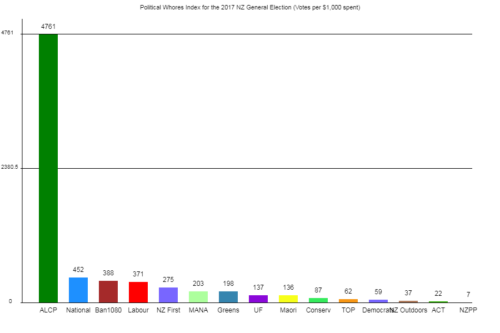
The 2017 New Zealand Political Whores Index

A bar chart of the Political Whores Index, calculated as votes received in the 2017 General Election per $1,000 spent

The New Zealand Electoral Commission has now returned its list of party expenses for the 2017 General Election. This enables us here at VJM Publishing to update 2014’s Political Whores Index. 2017’s Political Whores Index tells us who tried to earn a place in Parliament, and who tried to buy one.

The logic of the Political Whores Index works like this. Political parties spend money at election time to get media exposure, because the more media exposure a party gets, the more votes it gets. This is usually easier and cheaper than actually talking to people and hearing their concerns. Effectively, parties just turn on the media funding tap and votes come out.

The correlation between dollars spent on campaign expenses for the 2017 General Election and votes received is 0.95, which pretty much tells us that our democracy is for sale. The more money you can spend, the more votes, is the hard and fast rule.

So all of our political parties are whores, but it can be said that the more money a party spends and the fewer votes they get, the more of a whore they are. This can be considered whoring because the parties that do it try to buy votes by transmitting a manufactured impression through the media, rather than honestly trying to build goodwill among the people by meeting and talking to them so that they can form their own impression.

This willingness to whore oneself out instead of honestly building a positive reputation among the New Zealand people can be expressed as a ratio of dollars spent on election expenses to votes returned by the populace. As was true of our effort in 2014, which saw the ACT party crowned the whoriest party in New Zealand and the Aotearoa Legalise Cannabis Party the most honest one, we will present those ratios in an ordered list.

In the following table, PWI stands for ‘Political Whores Index’ and is calculated by dividing the number of votes each party received in the 2017 General Election by the declared party expenses for each party contesting the 2017 General Election (in dollars), multiplying the remainder by 1,000, then rounding to the nearest whole number.

In other words, it represents the number of votes won per $1,000 spent.

PARTY $ SPENT VOTES PWI
ALCP 1696 8075 4761
National 2546742 1152075 452
Ban1080 7749 3005 388
Labour 2580523 956184 371
NZ First 679095 186706 275
Internet 2322 499 215
MANA 17921 3642 203
Greens 818525 162443 198
United Future 12963 1782 137
Maori 225552 30580 136
Conservative 71764 6253 87
TOP 1013714 63261 62
Democrats 13761 806 59
NZ Outdoors Party 43508 1620 37
ACT 601487 13075 22
NZ People’s Party 274541 1890 7

For the second election running, the Aotearoa Legalise Cannabis Party was, by far, the least whoriest of all the parties that contested in 2017. They returned a staggering 4,761 votes for every $1,000 spent – unarguable evidence that cannabis law reform is an issue that the New Zealand people are demanding. As shown elsewhere, cannabis law reform is the issue that unites real Kiwis.

No other party achieved so much as 10% of this ratio. Many will be surprised to hear that the National Party was second, with 452 votes for every $1,000 spent. In short, the electorate wasn’t particularly displeased with how National was running things, despite that National lost power. Yes, there was widespread misery among the poor and we have the highest youth suicide rate in the world, but people who vote don’t care much about that.

The Ban 1010 Party was 3rd, just edging out Labour, who won 371 votes for every $1,000 spent. It’s curious, perhaps, that Labour and National are both doing quite well by this measure, as they are both mainstream parties. But this simply speaks further to how there was no real appetite for change among Kiwis. People weren’t particularly interested in upsetting the apple cart.

The New Zealand First Party did moderately well, gathering 271 votes per $1,000 spent. Unlike 2014, this was considerably poorer than the National and Labour parties, probably reflecting Winston Peters’s decline as a public speaker, as many of their votes in 2014 were gained through town hall meetings.

The Green Party were the whoriest of the four major parties. They only got 198 votes per $1,000 spent. So they spent about as third as much as National for about one-seventh of the votes. This tells us that the electorate has partially turned against the Green Party message, despite their strong support of the cannabis law reform issue. It may have been that the Green proposal to raise the refugee quota drove a lot of Maori and working class voters to Labour and New Zealand First.

The Opportunities Party was a poor return on investment, although as it was essentially a vanity project it could not be said to have failed simply on that basis. With wall-to-wall saturation coverage on FaceBook and other Internet portals, they spent over a million dollars for a little over 60,000 votes, thereby achieving a PWI of 62 votes for every $1,000 spent.

It’s illuminating to compare the PWI of The Opportunities Party with that of the ALCP. The Opportunities Party spent almost 600 times as much as the Aotearoa Legalise Cannabis Party, and won less than 8 times the number of voters. Considering that most TOP voters were voting for legal cannabis anyway, this figure shows that TOP was really a joke party that tried to buy its way into Parliament.

Speaking of joke parties that try to buy their way into Parliament, the Conservative Party scored a PWI of 87, only slightly better than TOP. This tells us that the 5% threshold is really an outstanding idea, because it prevents wealthy, narcissistic freaks from assembling a coterie of arselickers and simply spending so much money on media exposure that they can brainwash the mentally weakest twenty thousand of the population into casting a vote for them.

Worst of all, however, was the New Zealand People’s Party. Also the vanity project of a rich Baby Boomer, they pissed away over quarter of a million dollars for a paltry 1,890 votes. This left them with a PWI of 7, which means that their message was 660 times less appealing to the New Zealand people (all factors equalised) than that of the ALCP.

MANA (203), United Future (137) and the Maori Party (136) all had reasonably poor PWIs, but were still significantly higher than the “fuckwit” parties.

Ultimately, the Political Whores Index suggests that the New Zealand people are quite happy with our current arrangement of two major parties and two minor ones, because none of the more radical parties were able to gain any particularly high level of traction for their amount of electoral spending. It was mostly dollars in, votes out.

Just give us some real cannabis law reform.

*

If you enjoyed reading this essay, you can get a compilation of the Best VJMP Essays and Articles of 2017 from Amazon for Kindle or Amazon for CreateSpace (for international readers), or TradeMe (for Kiwis).