Two very tall men, wearing numbers 4 and 5, sit in a cafe wearing tikis and drinking coffee. They are wearing the cafe tikis.
Loosehead Prop – pou waho
The camera shows a heavy-set man wearing a number 1 jersey. Behind him, in the crowd, is a man with a foam “We’re No. 1” hand, and he shouts “Wahooo!”
Tighthead Prop – pou roto
A heavy-set man wearing a number 3 jersey floats down to the ground by means of a helicopter rotor sticking out of his jersey.
Blindside Flanker – pou kāpō
A car pulls up at a rugby ground and four men wearing number 6 leap out. The blindside flankers had been carpooling.
Openside Flanker – pou tuwhera
A tooth fairy wearing a number 7 jersey floats down to take place on the side of a scrum.
Halfback – kairau
A short man wearing a number 9 jersey runs through the streets of Cairo, stopping to pick up a ball from the ground and pass it.
The Māori word for halfback – kairau – sounds like the name for the Egyptian capital, Cairo
Forward – pou mua
A scrum is set down, but instead of a forward pack there are eight cows linked together, mooing. Forwards are mooers.
Back – pou muri
A spectator observes the brown skin of the backline and says “Hey, the backs are all Māori!”
Wing – taitapa
A player wearing a number 14 jersey and a necktie waits out on the wing, nervously tapping his tie. He is the tie-tapper.
Centre – topa pū
The player wearing the number 13 jersey finds a dogturd a starts to tape it up to hide it. Someone asks if he’s ready, and he replies “I’ve got to tape a poo.”
First Five-Eighth – topatahi
Wearing a number 10 jersey and waiting for the pass from the halfback is a very tall potato.
Second Five-Eighth – toparua
The player wearing the number 12 jersey has his shorts pulled up as high as they can go. He is wearing a tall pair o’ shorts.
*
The above is an excerpt from the upcoming Learn Maori Vocabulary With Mnemonics, by Jeff Ngatai, due to be published by VJM Publishing in the summer of 2018/19.
New Zealand: plenty of money for guns, no money to feed kids
Many of the decisions made by New Zealand politicians are baffling to the average Kiwi. How can it be possible that we can find $400 million a year to enforce cannabis prohibition, which the people don’t want, but we can’t find $100 million to feed our own children, which the people definitely do want? This essay explains why so many of these decisions are made: New Zealand is not a real country, but a military outpost masquerading as one.
Key to understanding this is understanding the guns and butter model of government spending. Essentially, we can measure the degree to which a government acts as a steward of its people – compared to using them as tools to achieve the economic ambitions of the ruling classes – by measuring how much of the nation’s production is diverted to consumer goods as opposed to military goods.
Understanding this helps explain why our Government would approve a $20 billion military spending bill while rejecting a $100 million proposal to feed hungry New Zealand children.
Why is buying weapons two hundred times more important than feeding our own children?
The answer is grim, and dark. New Zealand isn’t really a country, in the sense that other countries are countries. We’re not an association of families that formed a tribe and then met other tribes to form a clan and then made peace with other clans to form a nation. Most of us just washed up here, many of us without the consent of the people who already lived here.
It’s obvious that New Zealand itself has no need to spend $20 billion on armaments, any more than Iceland does. But to think like this is to commit the error of seeing New Zealand as an actual nation, whose will is that of individual New Zealanders and made manifest through its leaders, like European nations. That isn’t how it is.
The accurate way to conceptualise New Zealand is as an Anglo-American military outpost in the South Pacific, something like a forward operating base for moneyed interests that mostly operate out of the City of London, who have enslaved the New Zealand population by way of a debt-based central banking system.
Most Kiwis don’t understand the geostrategic importance of the archipelago they live on. It’s very easy to look at a static map and think that New Zealand is a long way from anywhere, and therefore that it can’t have much strategic value. This way of thinking reflects a myopia that’s typical of New Zealanders. The truth is much more involved.
Firstly, whoever controls New Zealand controls Australia, in effect, because controlling New Zealand enables one to project force into the East and South of Australia, which is where all the people live. The Japanese Empire realised that landing an expeditionary force in Northern Australia and then marching to Sydney was not practical, and so their Imperial Navy’s invasion plans assumed a prior invasion of New Zealand. It just makes sense.
Secondly, whoever controls Australia controls Asia. This is because Northern Australia serves as a staging ground for the projection of power into South Asia, in particular naval power into the South Asian Sea, which is necessary in order to keep the main sealanes open (and therefore the global economy humming). Given that the Anglo-American Empire already has effective bases in Japan and the Philippines, being able to project power into the Southern South China Sea is the last piece of the puzzle.
Seen like that, it’s obvious why the New Zealand Government would vote for guns sooner than food for its own children. Because New Zealand isn’t a real country, there’s no incentive for the Government to act in the interest of increasing the well-being of its people – the Government doesn’t represent those people. New Zealand is first and foremost a military outpost run by imperial interests, and as such the mental health of its citizens is far from the top priority, as evinced by our OECD-leading homelessness and youth suicide rates.
If growing up poor, scared or traumatised means that a person will be more useful in a military capacity, then that is what the Government will encourage. Inequality correlates positively with psychopathy, with America being the obvious example. The rulers of New Zealand have also calculated that an underclass of poor and desperate people will make it much easier to recruit the necessary numbers for a professional volunteer armed force, and have structured society accordingly.
Hermann Goering once said “Guns will make us powerful; butter will only make us fat.” Understanding this sentiment is the key to understanding the spending decisions of the New Zealand Government.
The New Zealand ruling class is simply not interested in keeping the population in good physical or mental health, which is why nothing is ever done about our suicide rate or housing crisis. All that matters is keeping the population in a state of war readiness in case it should later be necessary to use them to achieve some geopolitical objective.
The cannabis laws follow the same principle. Every idiot knows that it’s worse for the people to have alcohol legal than to have cannabis legal, given the plague of violence, sex crimes and drunk driving deaths that follow in the wake of alcohol use. So why have that legal, while criminalising a recreational alternative that doesn’t make people aggressive, impulsive and violent? The answer is, sadly, because our ruling class wants broken, damaged, fearful and violent people.
Unfortunately for us, the reason why New Zealand is not run along the lines of Switzerland or Japan or even South Korea is because our supposed leaders are beholden to foreign interests. We are not an independent nation, and we will never be, for our independence would pose too great of a threat to the military position of the Anglo-American Empire. Kiwis are, as Dwight Eisenhower put it when he warned us of the Military-Industrial Complex over 55 years ago, hanging from a cross of iron.
*
If you enjoyed reading this essay, you can get a compilation of the Best VJMP Essays and Articles of 2017 from Amazon for Kindle or Amazon for CreateSpace (for international readers), or TradeMe (for Kiwis).
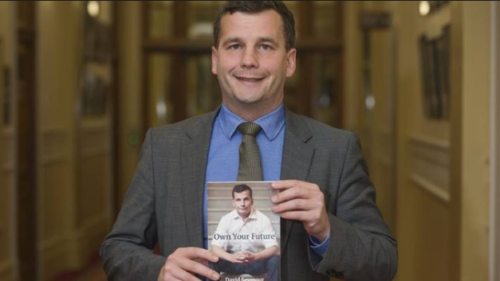
The fourth chapter in Own Your Future is ‘Education’. Seymour opens this essay with a mention of Vanguard Military School, the establishment of which he credits to ACT. This is an “exceptional” story because New Zealand’s education system is “a mess”. Although he writes that no-one begrudges the $12,000,000,000 yearly cost of educating New Zealand’s 800,000 students, many people have problems with the outcome.
New Zealand has a lot of problems because people aren’t literate enough, Seymour says. This is why employers “prefer a stream of immigrants”. There is a long, rambling passage here where Seymour touches on a variety of themes, including having a go at Hekia Parata. Apparently New Zealand is going backwards in PISA rankings. It’s hard to tell who Seymour is blaming for the mess in question.
Without a hint of irony, Seymour writes that “the outcomes have got worse for kids from poorer backgrounds”. Most Kiwis could tell him that the reason for these worsening outcomes were the policies of the Fifth National Government, which raised GST on those kids from poorer backgrounds while cutting other people’s taxes, and cutting services to those same poor.
What Seymour pushes here is the idea of a variety of schools with different cultures, which he believes will better suit the individual needs of the various students than the current “one size fits all” model. It follows from this that the Government is not the best provider of education services, because they don’t tend to tailor things to the individual needs of the citizens.
Much of this section reveals the specifically Auckland-centric focus that ACT has always had, and which leads it to get very, very few votes outside of that city. The logic behind the school zoning system is dissected at length, but this only really applies to Auckland and, to a small extent, Christchurch and Wellington. Perhaps Seymour is writing more as Epsom representative here.
True to form as a politician, Seymour demands that teachers be better trained and better resourced, but doesn’t explain where this money will come from. Despite this budget hole, it’s hard to deny that Seymour has several good points here. The cultures of individual schools are usually too sclerotic to adjust to the changing needs of pupils, so they could be supplemented by Partnership Schools that more specifically meet the needs of their students.
These Partnership Schools would be run more like private schools and could be easily closed down at any time if they were underperforming. Seymour touts this as a major feature, on account of the difficulty with doing so in the public sector. Students would be best served by flexibility in the educator sector, which is an intelligent way of increasing value without spending more money.
*
If you enjoyed reading this essay, you can get a compilation of the Best VJMP Essays and Articles of 2017 from Amazon for Kindle or Amazon for CreateSpace (for international readers), or TradeMe (for Kiwis).
A Government official, in charge of the Government car fleet, instructs a subordinate in a fancy uniform to “Give Car One a tonguing”.
Ministry – manatū
A Government official comes out of a tall building and says “We’re the Ministry of Taxes… and money, too!”
Minister – minita
A man in a suit buys an icecream from a stand. The girl holds up two cones and says “Maxi or mini, Minister?” The man says “Mini, ta.”
Office, Department – tari
Inside a WINZ office, there is tar everywhere: all over the floors and computers. The office is very tarry.
Responsibility, responsible – haepapa
A boy looks at a field strewn with hay and asks his father “Hey, Papa, who’s responsible for this?”
General Election – pōtitanga whānui
A child sits on a potty with its tounge sticking out. It is the potty tonguer. A man says “This General Election I think the best choice is the potty tonguer, far and away.”
The Māori word for ‘to corrupt’ – pōriro – shares a ‘pō’ and ‘ri’ sound with the English word ‘porridge’
Election, vote – pōti
A sign outside a porta-potty says “Election Today! Vote Here!”
Rebellion, Revolt, Revolution – whananga
Hone Heke is giving a speech, he promises to rebel “far and near”.
to corrupt – pōriro
A waitress pours some water into a man’s porridge. He gets up and complains “Now it’s corrupted!”
Officer, Official – āpiha
A man in uniform salutes a man behind a desk and says “Officer Pea Heart, reporting for duty.” The man behind the desk rises and says “Ah, Pea Heart…”
to agree, to assent, Permission – whakaae
Both seated at a desk, a woman shows a man a contract and asks “Do you agree?” He replies: “Fucken A!”
A chief is giving a speech to a war party. He holds up a gold ring and says “By the authority vested in me through my possession of this ring, tear a tongue!”
*
The above is an excerpt from the upcoming Learn Maori Vocabulary With Mnemonics, by Jeff Ngatai, due to be published by VJM Publishing in the summer of 2018/19.