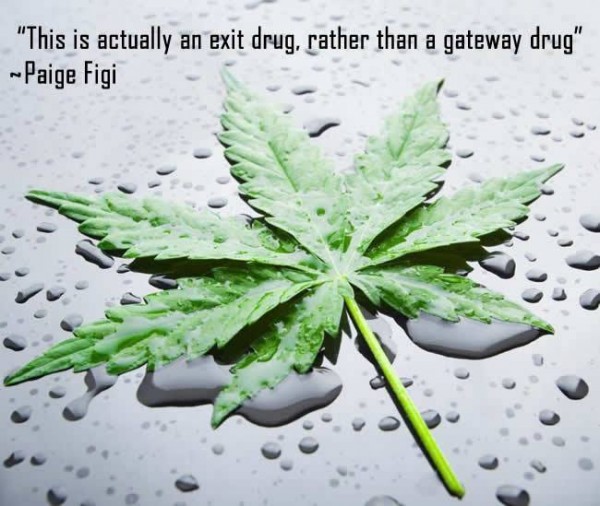
The Case For Cannabis: Cannabis is an Exit Drug

Many people erroneously believe that cannabis is a “gateway drug” that leads to users moving on to harder and harder drugs. The reality, like many myths relating to cannabis, is closer to the opposite of this. As this article will examine, cannabis can serve as an ‘exit drug’ to help people overcome addictions to actually harmful substances, in particular alcohol, synthetics and opioids.

In New Zealand, there is a “synthetic cannabis” epidemic underway. A couple of recent deaths in Christchurch were believed to have been caused by the substances, and the total number of deaths in New Zealand this year attributed to them is approaching 50. This is rightly a public health crisis, and is increasingly being understood as such.

The substances being sold as synthetic cannabis generally have nothing to do with cannabis – they are mostly unknown psychoactives that generate some kind of buzz when smoked. No-one’s really sure where they come from or what’s in them, they’re just sold through shady contacts – often at tinny houses when someone was looking for natural cannabis – and end up killing people in the streets.

It doesn’t matter that these substances aren’t really much like cannabis, because they fill a market niche that would otherwise be filled by cannabis. If a person doesn’t like to drink alcohol, for whatever reason, the major alternative is some form of cannabis. If cannabis is not available, because prohibition has made it impossible to supply, then “synthetic cannabis” might have to do, because it will frequently be available through the same channels that a person would try to access natural cannabis.

For the many thousands of Kiwis believed to be addicted to synthetic cannabinoids, and for the hundreds of thousands who are at risk of encountering some synnies from one of the infamous “bad batches” that kill people from time to time, legal cannabis could serve as an exit drug. With legal cannabis in place, even if only at the medicinal level, a synthetic cannabinoid addict could be weaned off the synnies with a replacement medicinal cannabis regimen.

In America, there is an opioid epidemic underway. Opioid overdoses were believed to comprise 49,000 of the 72,000 drug overdose deaths in America in 2017. This contrasts with about 10,000 such deaths at the turn of the century. This represents several times more deaths than even the infamous American homicide rate – clearly a crisis of such proportions that extraordinary actions must now be considered.

Cannabis has shown immense promise as an exit drug from opioid addiction. Science Daily links a report from the University of British Colombia that found significant evidence to suggest that cannabis can help in the case of alcoholism and opiate addiction. There are already clinics in operation in Los Angeles where cannabis is in a clinical program of rehabilitation from heroin and alcohol misuse.

A study in the Journal of the American Medical Association found that rates of opioid use are lower in American states that have legalised medicinal cannabis, which suggests that individuals who use opiates are themselves happy to wean themselves off by using cannabis, if only there are given the opportunity. The JAMA study found that “States with medical cannabis laws had a 24.8% lower mean annual opioid overdose mortality rate compared with states without medical cannabis laws.”

A report by Time Magazine found that rates of death by opioid overdose had quadrupled from the turn of the century, and that states which had legalised medicinal cannabis had saved hundreds of millions of dollars from alleviating some amount of opioid abuse. Even if a patient does not stop taking opiates completely, it is possible that a synergistic effect from the cannabis can potentiate the opiates they do take, meaning that they can take less for the same painkiller effect.

All this means that cannabis prohibition is effectively killing people, by preventing those addicted to alcohol and opiates from accessing a potential exit drug, and thereby forcing them to remain addicted to the substance. Despite the apparent moralistic intent behind cannabis prohibition, we can safely suggest that the spirit of the law was not that it should kill alcoholics and opioid addicts.

Cannabis law reform is necessary so that medicinal cannabis can be applied as an exit drug to people who are addicted to, or dependent on, more harmful substances. This will have the effect of substituting a substance that heals for substances that harm, and thereby preventing suffering.

*

This article is an excerpt from The Case For Cannabis Law Reform, compiled by Vince McLeod and due for release by VJM Publishing in the summer of 2018/19.


VJMP Reads: David Seymour’s Own Your Future X

This reading carries on from here.

The ninth chapter in Own Your Future is ‘Personal Responsibility’. Seymour opens here with a stark claim that ACT doesn’t believe in the nanny state or in a paternalistic government. Many of our laws are holdouts from an age of Victorian values, he states, and they are enforced by politicians who transparently do not have a deeper grasp on morality than anyone else.

Breaking rank with the other Parliamentarians, Seymour is willing to admit here that cannabis does less harm than alcohol and tobacco (although he points out that cannabis is not without its own harms). He also echoes a point often made by Kiwi cannabis law reform activists (such as here), that the burden of Police enforcement of cannabis prohibition falls mostly on Maori.

Seymour cites a Treasury study that estimated that cannabis prohibition costs the country $300,000,000 annually, as well as tying up 600,000 hours of Police time. Worst of all, the supposed criminal deterrence doesn’t even work – the overwhelming majority of people convicted for cannabis offences go on to use it. Moreover, the law is applied in a haphazard manner, as can be seen by the 26-month sentence initially handed down to Kelly van Gaalen.

In a distinct break from the right-wing that ACT is usually associated with, Seymour repudiates the moralising that is chiefly responsible for cannabis prohibition, pointing out that not only is there a heavy majority in favour of cannabis law reform, but that majority is steadily growing. This contrasts with the proportion of people who oppose actual crimes, such as murder – this proportion remains constant.

True to the libertarian image that Seymour is trying to stake out, he argues for legal recreational cannabis as well. However, true to the conservative streak that binds his party to National, he is torn, claiming that 80% of the New Zealand public opposes recreational cannabis. He does not cite a source here, and neither does he note that such opposition would be unusual in the context of places like Colorado and California voting by referendum to legalise medicinal cannabis.

Seymour takes pains to seat himself as immovably as possible, right in the middle of the fence. He is open to the possibility that countries that legalise cannabis might “lose their morality” and “become cesspits of unmotivated human squalor” (as if alcohol was not well capable of achieving both), and wants to have a Royal Commission that takes five years before he will consider that we have satisfactory evidence to make a decision.

He rightly pillories the Government for its sharp increase in the tobacco tax, pointing out that the people most sharply affected by this are those who can least afford it. Worst of all, it seems that raising the tax further will not help persuade people to give up smoking. Those who are still addicted are so addicted that they will do almost anything to get hold of tobacco. Sensibly, Seymour would legalise vaping and e-cigarettes.

Euthanasia is another thing that Seymour would legalise, promising an end to “morality-based harassment”. His reason for promoting this is to avoid the indignity of the last weeks of life. Having nursed elderly grandparents to the end of a terminal illness, I can commiserate with him in this regard. He is also in favour of abortion, which makes him less hypocritical than the old right. Seymour doesn’t want to pay for your kid either, but he’s happy to help you get it aborted.

It’s hard to find fault with any of Seymour’s proposals in this chapter. Even if the only right he champions with conviction is the right to die, it’s an excellent thing that these libertarian proposals are even being suggested. It is interesting to note how similar ACT is with the Greens on issues such as cannabis, especially if it is considered that being young is highly correlated with both voting ACT and Green.

*

If you enjoyed reading this essay, you can get a compilation of the Best VJMP Essays and Articles of 2017 from Amazon for Kindle or Amazon for CreateSpace (for international readers), or TradeMe (for Kiwis).

Te Reo With Mnemonics: Parts of Language Words

Word – kupu

An old woman walks up to a box and says “Eh, you words shouldn’t be cooped up in that box.” She opens the box and hundreds of words come out.

Sentence, Saying – rerenga kōrero

A woman reads from a piece of paper: “Rare anger, core ear? This sentence doesn’t make any sense!” The man next to her, who has apple cores for ears, gets angry. It’s a rare anger, core-ear.

Paragraph – kōwae

A boy is writing on a piece of paper, and a second boy reads the paper, and says “Paragraph, paragraph, paragraph.” The first boy says “Go away”.

Consonant – orokati

Two canoes are racing. One is covered in consonants and the other is covered in vowels. One of the rowers in the consonant canoe is a cat, and his partner says “Oh, row, catty!”

Vowel – oropuare

Two canoes are racing. One is covered in consonants and the other is covered in vowels. One of the rowers in the vowel canoe is a very wealthy-looking man, and he says to his partner “Oh, row, Poorer!”

Language – reo

A man says to a cat “Hey, do you speak human language?” The cat replies “Rrreoo!”

The Maori word for ‘lower-case’ – pūriki – shares a p-r-k construction with the English word ‘pork’

to spell – tātaki kupu

On a tarry road covered in tacks, there is a chicken coop. It is the tar-tacky coop. In it, the chickens are busy spelling out words.

to define, Definition – tautuhi

A schoolteacher asks a boy “Can you define the word for the class?” The boy says “Totally!”

Letter (lower case) – pūriki

A lower-case letter is being filmed doing a cooking show. It adds some meat into a frypan and say “This is the case of pork.”

Letter (upper case) – pūmatua

A bunch of upper-case letters are spectating a boxing photo shoot. The bout is between an Argentinan rugby player (a Puma) and David Tua. In upper-case letters above the shoot spell out: “P U M A – T U A

Alphabet – arapū

A man says “Hey I composed a rap. It’s about the alphabet.” The man raps off A-B-C.

Phrase – rerenga kupu

Two men watch a chicken coop in which the chickens are angry and fighting. One says “That’s a rare anger coop.” The other says “You know the phrase: it’s a cold winter when you have a rare anger coop.”

*

The above is an excerpt from the upcoming Learn Maori Vocabulary With Mnemonics, by Jeff Ngatai, due to be published by VJM Publishing in the summer of 2018/19.
Will the Sixth Labour Government be a One-Term Affair?

The Sixth Labour Government has already made one colossal error in its short time in power, and it looks like it’s set up to make another. Considering that their grip on power was already slim, and that they are relying on the infamously treacherous Winston Peters to maintain it, there’s every chance that the Sixth Labour Government ends up being a one-term affair. This essay discusses the possibility.

There are many forces that threaten to tear apart every party in every Parliament, but within the New Zealand Labour Party some gigantic fissures are starting to become particularly prominent. The decision to raise the refugee quota was a slap in the face to the poorer voters within Labour, and can be counted as a colossal error. The other error will be forced by the referendum to legalise cannabis.

Make no mistake – raising the refugee quota was an error of profound magnitude. The reality of the situation is this: European governments have, for a couple of decades now, placed the needs of foreign “asylum seekers” above those of their own working classes, and the consequences of doing so are clear. Doing so will lead to a return of authoritarian populists, as has been shown with the rise of the Sweden Democrats in Sweden, the AfD in Germany and Matteo Salvini in Italy.

If you are a poor New Zealander, then you are probably a natural Labour voter, but it’s extremely galling to see Labour spending the money that could have helped you on refugees instead. Adding insult to injury, these refugees are usually dumped in working class areas because that’s where the cheapest housing is. The cherry on the top is that any working-class person who protests their demotion in favour of foreign chancers will be denounced by Labour supporters as a racist.

The decision to double the refugee quota will drive a thick wedge deeply between the working-class faction of Labour, who are dependent on a limited pool of government largesse for their personal well-being and who resent more people claiming a piece of it, and the champagne socialist faction, whose primary concern is virtue signalling for the sake of social status and advancement.

This is the current rupture. It’s unlikely that a populist worker’s movement will arise merely on the basis of this, but it will cause some Labour voters to switch to New Zealand First in 2020 and some to abstain.

The inevitable future rupture comes with the cannabis referendum that will likely be held near the end of 2019. Labour will not admit this, but the referendum has the potential to tear the Labour Party right down the centre, for demographic reasons. This is not a concern for either the Green, New Zealand First or National Parties, because the demographic equation does not apply in their cases.

Maori voters are massively in favour of cannabis law reform – this is one of the strongest relationships in all of New Zealand politics. The correlation between being Maori and voting for the Aotearoa Legalise Cannabis Party in 2017 was 0.91. This is much stronger than all of the other well-accepted relationships in New Zealand society, and is immediately apparent if one observes the fact that the ALCP gets twice as many votes in Maori electorates as it does in General ones.

Pacific Islanders, by contrast, are much more lukewarm on the issue. The correlation between being a Pacific Islander and voting ALCP in 2017 was -0.00 (i.e. perfectly uncorrelated), much weaker than the correlation between being Maori and voting ALCP. The reason for this is clear if one looks at the general demographic profile of Pacific Islanders: they tend to be religious, and the religious tend to be prejudiced against cannabis.

Therefore, the Labour Party cannot avoid being divided when the cannabis referendum comes around, and they cannot avoid losing a large swathe of voters because someone will inevitably feel betrayed. Either Maori voters will punish them for being too strict on cannabis, or Pacific Islander voters will punish them for being too loose. So Labour is damned if they do campaign for change and damned if they don’t.

These two errors need to be viewed in their correct context. Many political commentators assume (incorrectly) that, because all political parties generally fall on a left-right spectrum, if a given voter doesn’t like the government of the day then they will move leftward or rightward to cast their vote next election.

The truth, as Dan McGlashan demonstrated in Understanding New Zealand, is that for many Kiwis, the alternative to voting Labour is not voting at all. If you are a working-class New Zealander, and therefore a natural Labour voter, the preferred option when Labour is too right-wing is not voting Greens but abstaining from voting.

As the article linked immediately above describes, the correlation between voting for Labour in 2017 and turnout rate in 2017 was a very strong -0.72. That tells us that as many as half of all natural Labour supporters actually don’t vote. The real challenge for the Labour Party is not convincing the masses that National is bad or even that Labour would be better, but convincing them that Labour would be better enough to make it worthwhile to vote for them, and to not rather abstain by way of protest.

The two major errors discussed in this article might collectively have the effect of significantly reducing support for the Labour Party. They have already greatly disappointed their voters who are dependent on social assistance, and the cannabis referendum will force them to either greatly disappoint Maoris (who will then abstain from voting in 2020) or greatly disappoint Pacific Islanders (who will then abstain or switch to National in 2020). This disappointment might be enough to tip the balance back towards National in 2020.

*

If you enjoyed reading this essay, you can get a compilation of the Best VJMP Essays and Articles of 2017 from Amazon for Kindle or Amazon for CreateSpace (for international readers), or TradeMe (for Kiwis).