
Does New Zealand Need Commieblocks?

New Zealand was founded on the idea of being a land of opportunity, where enough hard work would see a person rewarded with a standard of life unattainable in Britain. Part of this involved owning your own small house – referred to as “the quarter-acre dream” – but that dream is dead. We may now have to face up to an awful question: is it time for New Zealand to build commieblocks?

The opportunity inherent in New Zealand was mostly about getting away from the horrific overcrowding of England. At the opening of the Industrial Revolution in Britain, millions of workers were forced off the land and into the cities for the sake of supplying manpower to the factories. This new way of life proved hellish for a number of reasons, in particular the disease and pollution that came with the overcrowding, but also because of the unnatural life away from Nature.

This life was miserable enough that many of these millions chose to abandon Britain entirely for an uncertain life in the colonies. So badly did it suck to live in overpopulated filth, these people were willing to trade it all for an uncertain life as a settler on a large island – full of cannibals – on the other side of the planet.

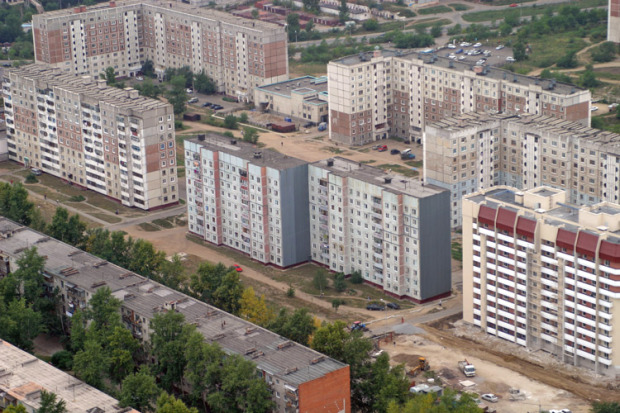
In Europe, where the population density is many times higher than it is in New Zealand, and where workers will protest before they accept living in a car, a solution to the sudden need to house these masses arrived in the form of ‘commieblocks’. The name refers to the mountainous, blocky, concrete-and-steel structures that were a favourite of post-war Communist nations making good on their promises to house the masses.

These enormous buildings were able to contain hundreds or even thousands of apartments in the same space that would have been occupied by a few dozen villas. This meant that the price of the underlying land could be divided up among a multitude of people, minimising the cost of housing. It’s essentially battery farming for humans, and it has the psychological effect on people that battery farming could be expected to have, but it’s unavoidable once the population density increases past a certain point.

New Zealand managed to avoid this nightmare scenario by keeping the population density low. A low population density means that every person can have a certain minimum amount of space to themselves, and so there is no need to wallow in each other’s shit and piss like the populations of Europe, India and East Asia. When this was the case in New Zealand, we had no need for commieblocks.

Unfortunately, the greed of New Zealanders meant that we were unable to maintain a population in proportion to our ability to build houses for it. Helen Clark opened the borders to cheap labour from the Pacific Islands, and then John Key threw them open to the whole world. Now we have so many people here that our ability to grow outwards to give them all space has hit its limits. It might be time to admit that the quarter-acre dream is dead.

Is it commieblock time?

As a previous VJM Publishing article showed, the average New Zealand wage would have to be over $79 today if workers were to have the same chance of owning their homes as workers 26 years ago. This is clearly impossible – New Zealand employers will not pay that much money. Therefore, a majority of the current generation of young people are effectively locked out of home ownership unless they are lucky enough to inherit.

Immigration from sources of cheap labour has been so liberal, and capital investment in worker productivity so meagre, that our wages have plummeted far below the level at which owning a home and supporting a family on a working-class income is possible. With women and a large number of Third Worlders now in the labour pool, any hope of a fair day’s pay for a fair day’s work is gone. Wages will not rise to $79 within the next half a century, and house prices will not come down unless a large number of new ones are built.

We might have to face up to the reality that a large (and growing) proportion of the workforce will simply never be able to own their own home, unless we build large numbers of commieblocks. If a new KiwiBuild home costs $649,000, and if this is supposed to be a cheap alternative to buying a house on the market, then it’s really time to bite the bullet. We need to accept that wages in New Zealand are too poor for everyone to own a villa, and this means that it’s time to build commieblocks.

*

If you enjoyed reading this essay, you can get a compilation of the Best VJMP Essays and Articles of 2017 from Amazon for Kindle or Amazon for CreateSpace (for international readers), or TradeMe (for Kiwis).

VJMP Reads: David Seymour’s Own Your Future XI

This reading carries on from here.

The tenth chapter in Own Your Future is ‘Environment’. Seymour begins with an anecdote that gives us an idea of the moral sentiments that led Seymour to the ACT Party. The child Seymour didn’t like the moralistic implication of the Captain Planet writers that humanity was inherently evil on account of our environmental impact.

Seymour soon has a go at the Greens, who he labels hypocrites. He does make an excellent point: none of the Greens have any scientific background. This is certainly very curious for a party that makes such a point of having scientific backing for their policies. They also waste an incredible amount of money on junkets, especially when climate change is the excuse.

Another fair point he makes is that the price distorting effects of Big Government intervention often have environmental consequences. This is especially noticeable in the case of agricultural subsidies, which tend to lead to overproduction and exploitation of land. Much better to let the market solve such questions, as with water rights.

When talking about the importance of property rights, he unwittingly reveals the secret logic behind much of ACT Party thinking, when he says “pricing and property rights go together”. In the ACT mindset, wealth equals rights. The more money you have, the more rights you have to do things, including doing things to the land and to other people. The RMA gets attacked here again as a quasi-communist institution.

Seymour makes a very clever point when he says that productivity growth is the basis of prosperity. ACT have been heavily criticised in the past for taking a “rape and pillage” approach to New Zealand’s native areas, in which everything can be sold off for money. In this essay, Seymour switches focus to productivity gains from technology and software.

However, he doesn’t stray far from the general neoliberal path. Globalisation is good, and signing the TPP is a good thing. Not for Seymour any sympathy for those who have lost out from neoliberalism. The wealthy benefit from it, and ACT is fundamentally a party for the rich.

Noting that the left/right political divide correlates strongly with alarmist and sceptical positions (respectively) on the issue of global climate change, Seymour declares himself a “luke-warmist” who agrees that some degree of climate change is man-made but does not agree that it will necessarily have devastating effects.

The environmental idea that seems to appeal the most is the idea of having inland sanctuaries, naturally run by private investors. This, Seymour believes, is the only way that New Zealand has a chance of bringing back the dawn chorus that was sung by our birdlife several hundred years ago. Curiously, he wants to have a large trust to dole out grants for these sanctuaries, which, along with his support for foreign refugees, makes one wonder if working-class Kiwis are the only people he doesn’t care about.

It is interesting that ACT might have so detailed an environmental policy, because it seems like an attempt to attract alt-centrist voters. Both ACT and Green voters are young. Indeed, ACT and the Greens could be considered the alt-right and alt-left of a new paradigm of politics, or at least one that has been remodelled to appeal to the young.

*

If you enjoyed reading this essay, you can get a compilation of the Best VJMP Essays and Articles of 2017 from Amazon for Kindle or Amazon for CreateSpace (for international readers), or TradeMe (for Kiwis).

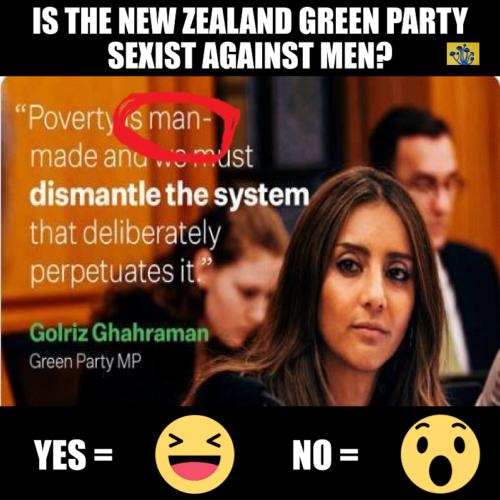
Are The Greens Sexist Against Men?

The male suicide rate is over 300% of the size of the female suicide rate, suggesting that men must suffer a much greater share of society’s burdens.

Despite this, the Green Party has only 2 men out of 8 Members of Parliament, and one of them is willing to state that men are solely to blame for all the poverty in the world.

Are the Greens a sexist party? If so, should they face repercussions?

Why There Are No Honest People in Politics

Westerners have possibly never had less confidence in their politicians than right now. Confidence is so low that an ever-increasing number of people are losing their faith in democracy. Most people are aware that politicians are basically crooks, but it often hard to say precisely why. This essay explains why there are no honest people in politics.

The simple reason why there are no honest people in politics is because they are either filtered out before they get to the top representative level, or they are made to keep their mouths shut while at that level. This is achieved by a variety of mechanisms, some calculated and some incidental.

One of these mechanisms, a very deeply calculated one, was made apparent in New Zealand by the Jami-Lee Ross saga and the ensuing revelations about the National Party culture and its inner workings. It turned out that the National Party had taken six-figure sums worth of dodgy donations in exchange for pulling strings for those donors, and kept it secret. Many members of the National Party were aware of this corrupt conduct, but said nothing until Ross blew the doors open.

Getting to the top only sometimes involves demonstrating competence and winning the respect of your peers. Sometimes it involves finding out secrets about other people and using them to threaten those people into obedience. The value of a piece of information is inversely proportional to the number of people who know it, and therefore there is an incentive to keep secrets. If you can’t demonstrate that you can keep secrets, you can’t be trusted by the other members of your party – after all, the party will have secrets of its own that need keeping.

So not only do you have to keep secrets on the way up, but you have to keep keeping them while up there, otherwise the other people who are up there will throw you down. Jami-Lee Ross threatened to tell the country the secrets of the National Party, and he was swiftly ushered into psychiatric care. A similar fate awaits any other high-ranking politician who comes down with a sudden bout of honesty.

Of course, Jami-Lee Ross had a much easier time of it than Socrates did. Socrates once said “I was really too honest a man to be a politician and live,” which relates to the second of these mechanisms. Just as there is a mechanism from within a politician’s own party to lie, so is there a mechanism from other parties to do so (i.e. from within the political system). This mechanism has accounted for not only Socrates but also Jesus, William McKinley, Abraham Lincoln, Adolf Hitler, John F Kennedy, Saddam Hussein and Muammar Gaddafi.

The people who are permitted to rise up from the masses into the ruling class are heavily vetted before being allowed to progress. The main objective of this vetting process is to determine their inclination towards obedience. The ideal candidate will be perfectly obedient to all those above them, and will demand perfect obedience from all those below them. To the degree a candidate deviates from this pattern, their advancement through the mainstream political parties will be hindered.

If a candidate shows signs of creative ability, or signs of any original thinking, they will find their progress blocked. This is why the current ruling class is full of lawyers, and almost entirely absent of writers or artists. Lawyer is an inherently dishonest profession (in contrast to novelist or poet), and this is seen by the incumbents in the ruling class to be a qualification for office.

The less honest you are, the more able you are to keep secrets by twisting and distorting truths and shamelessly dodging questions. Related to this is the fact that, if you go into politics, many of your fellow politicians will be absolute scum, and you will have to accept and account for this otherwise they will destroy you. Some of them, like Peter Dunne, are happy to kill people to advance their careers.

In 2002, Dunne forced the Fifth Labour Government to accept a confidence and supply agreement that promised no movement on cannabis law reform. As a consequence, many people died from either being unable to access medicinal cannabis, or from taking the synthetic drugs that Dunne did allow in lieu of natural cannabis. If Dunne is willing to cause the deaths of hundreds of Kiwis for the sake of his political ambitions, he’s certainly willing to have you killed for them.

A third mechanism serving to keep honest people out of politics comes from the nature of the whims of democracy. Politicians have to follow fashions, or they will rapidly be turfed out of office by the voters. The populace cares not for right or wrong, nor for any issue of justice: they merely get angry when they’re told to get angry. If the television tells them to get angry about apartheid, or the prohibition of homosexuality, or cannabis prohibition, they will do so.

Observe what happened to the individuals who spoke out about the issue of widespread clerical sex abuse within the Catholic Church before it became fashionable. Sinead O’Connor did it in 1992, and it was a career-terminating move. If something is unfashionable, a democratic politician will not support it: it’s as simple as that. It doesn’t matter if it’s morally right.

Male infant genital mutilation, for example, is an obscenity, one of the most evil practices that the human species has ever devised, but Western politicians remain too cowardly to oppose it on account of that doing so is yet to become fashionable. You could bet money, however, that when opposing this practice does become fashionable, the politicians will claim to have always opposed it.

The opposite can be observed with the case of cannabis law reform. Until recently, a desire for reform was an exceptionally libertarian position for a politician to take, and only the real mavericks were willing to do so. The Cannabis Activist’s Handbook was published by this company in 2012, and copies sent to all of the political parties then in Parliament, but politicians remained resolutely silent on the subject until very recently.

Even though many people knew decades before the Cannabis Activist’s Handbook was written that cannabis prohibition was a complete sham, these politicians all calculated that it was in their best interests to maintain the net of lies. This even though it was killing their own people. If politicians are willing to yield to pressures like this, what hope is there that they will tell the truth about anything but the least controversial of things?

In summary, the reason why there are no honest people in politics is because both our culture and the political system itself weeds them out before they get to the top, or it destroys anyone at the top who reveals themselves to be honest. There are at least three major mechanisms by which this takes place, and the combination of all three means that our democratically-elected political class are some of the most pitiful, wretched and corrupt individuals that anyone could be burdened with.

*

If you enjoyed reading this essay, you can get a compilation of the Best VJMP Essays and Articles of 2017 from Amazon for Kindle or Amazon for CreateSpace (for international readers), or TradeMe (for Kiwis).