The Only Reason to Still Oppose Medicinal Cannabis is Sadism

The New Zealand Parliament will soon get another chance to bring our cannabis laws into the 21st century, with Julie Anne Genter’s Misuse of Drugs (Medicinal Cannabis and Other Matters) Amendment Bill drawn from the Member’s Bill Ballot this week. This ought to herald the long-awaited national conversation on the subject.

The Bill allows for any Kiwi suffering from “any debilitating condition” to use cannabis or a cannabis product if they have approval from a doctor. It also allows for such patients to cultivate cannabis themselves or to nominate someone to do it for them.

This latter point is extremely important and often underappreciated. One of Peter Dunne’s strategies to keep cannabis illegal by boondoggle has been to restrict supply to extremely expensive overseas sources, such as Sativex (which costs over $1,000 per month), instead of simply allowing people who need it to cultivate it themselves. This Bill would remove this deliberately-placed hurdle.

As Genter points out, the decision to make cannabis illegal was not based on evidence in the first place. Doctors in the 1930s were prescribing medicinal cannabis to patients in New Zealand, as they were all across the world.

The decision to stop doctors from prescribing cannabis was pushed on us by moronic do-gooders forcing their Puritan ideology on the rest of the world.

There was never any science involved, nor any common sense, foresight, empathy, compassion or concern for good order.

From the beginning, cannabis prohibition was based on nothing but a sadistic need to control the masses through causing them suffering, and on the gullibility of legions of morons willing to bleat whatever they heard from an authority figure as if it was the Word of God.

For a person to still not know that cannabis is medicinal they have to be willfully stupid.

The Aotearoa Legalise Cannabis Party first stood in a General Election in 1996. Already in 1996 the party platform had the need for medicinal cannabis as one of its core tenets.

In 1996 it got 1.66% of the vote, so even twenty years ago it was true that one in sixty Kiwis considered cannabis law reform a major issue. After all, California legalised medicinal cannabis that year, so the medicinal properties of cannabis were already known and accepted by experts even then.

Since then, twenty-eight US states have made medicinal cannabis legal and eight have made recreational cannabis legal – and none of them have gone back to prohibition after making the change.

So to deny that cannabis law reform is inevitable is like denying that a heavyweight boxer who has won forty consecutive knockout victories is a title contender.

For a person to continue to believe that the prohibition of medicinal cannabis helps New Zealanders, they have to possess a willful ignorance that borders on malice.

They would have to continue to ignore all the stories from hundreds of medicinal cannabis users, over twenty years, in which they detailed the reduction in suffering that cannabis gave them.

They would have to think nothing of the fact that supporters of medicinal cannabis are winning a victory every month either in New Zealand or in another Western jurisdiction.

They would have to believe that it was fair that any of Martin Crowe, Paul Holmes and Helen Kelly could have been prosecuted and sent to prison for using medicinal cannabis to alleviate pain caused from dying of cancer.

And a person cannot think like that unless they purposefully deny reality for the sake of bringing cruelty into the world.

When the debate about medicinal cannabis does, finally, after over twenty years of campaigning, happen in Parliament, the MPs who oppose it will mark themselves out as particularly sadistic old dinosaurs who need getting rid of.
Black Caps vs. Bangladesh, Champions Trophy Pool Match Preview

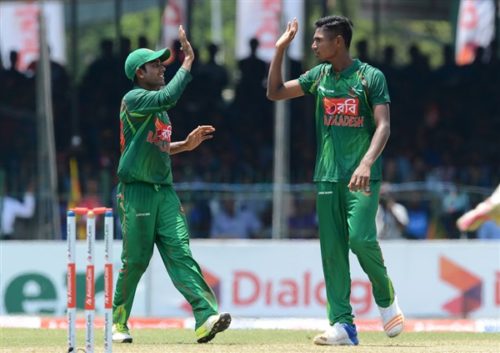
Mustafizur Rahman, with a strike rate of 22.7 in ODIs, would fancy himself against the Black Caps middle order if he gets a chance against them in tonight’s do-or-die encounter in Cardiff

This Champions Trophy has been one of upsets. The Black Caps got themselves into a position of control before the rain set in against the slightly favoured world champion Australia side, then Pakistan defeated the moderately favoured South Africa side, and last night Sri Lanka defeated the massively favoured India side.

An even worse omen for the Black Caps is the fact that they lost their previous encounter with Bangladesh in the Ireland tri-series a few short weeks ago.

This will give the Bangladeshis confidence before their crucial Group A encounter with the Black Caps in Cardiff tonight. They will, however, have to contend with facing a very different Black Caps side to the one they beat in Dublin.

Most notably, the Black Caps will now have the presence of all of their four genuinely world-class players, with Martin Guptill, Kane Williamson and Trent Boult, all of whom missed the Ireland tri-series for IPL duty, rejoining Ross Taylor in the side.

This explains why the Black Caps are still the favourites to win the encounter on BetFair. They are only paying $1.33 compared to Bangladesh’s $3.90, making them heavy favourites.

Martin Guptill has looked very good in his two starts this tournament, but has been unable to go on and play a punishing innings. With Luke Ronchi likely to continue partnering him at the top, Bangladesh will be forced to take early wickets or risk getting hit out of the game.

With Kane Williamson and Ross Taylor completing the top order, the most likely outcome of the match appears to be the Black Caps top four batting the Bangladeshi bowlers – a class weaker than the English and Australian batteries – out of the game.

If they don’t, Bangladesh will feel confident of rolling the rest of the order. The Black Caps lost 7 for 37 against Australia and 8 for 65 against England, and Bangladesh know that if they can get Williamson in early and then out early, they will be in a very strong position.

The Black Caps might be tempted to fiddle with their middle order a bit, knowing that this has been their soft underbelly for a long time.

Neil Broom’s returns have been poor this tournament – only 11 and 14 – but he has averaged 43.53 since coming back into the Black Caps side last December. His position should be okay for now.

The real question is how to fit both of Jimmy Neesham and Corey Anderson in the team. It may be that one of them comes out for Colin de Grandhomme, who has shown the ability to come to the crease and start hitting straight away.

It may also necessary to drop Mitchell Santner below Adam Milne in the batting order, as Santner has had great struggles with the bat recently.

Another option is bringing Latham in to open and moving Ronchi back down the order.

Bangladesh may find it much more difficult to chase down scores like 271, as they managed to do in Dublin, because they will have to do it against Boult, Tim Southee and Adam Milne.

However, their batting down to 7 is much stronger than it has ever previously been in Bangladesh cricket history.

Tamim Iqbal is their strongest bat on recent form. In 30 matches since the last Cricket World Cup he averages 59.53 with the bat, and has scored over 200 runs in two innings so far this tournament.

Around him there are a number of very talented batsmen, in particular Sabbir Rahman, Soumya Sarkar, Mushfiqur Rahim and the allrounder Shakib al Hasan.

If they can keep Boult, Milne and Southee out with the new ball, as England managed to do, then it will be possible for them to milk a plethora of runs in the middle stages.

A major danger for Bangladesh is that if they fail to bowl New Zealand out, they may lack the hitting power to match them across 50 overs. Despite the talent in the Bangladeshi side it’s hard to see them chasing 300 or more, even in the most favourable circumstances.

All of this could be moot in the very real circumstances of rain, as a washout would see the Black Caps eliminated and Bangladesh with only a mathematical chance of progress.

For the winner, however, an Australian loss in their matchup against the bookies’ favourites England, or a washout in the same encounter, would see them progress to the semi-finals.

Considering the chaos in the other group, there’s every chance that they would then play a relatively soft team like Pakistan or Sri Lanka in the semifinal.

So there’s all to play for tonight.

Understanding New Zealand: Demographics of Flag Referendum Voters

Given what is already known about the demographics of the various party voters, we can tell a lot about who supported the flag referendum just by looking at the correlations between voting for a given party and one of three other major variables.

The first major variable is the turnout rate in the first flag referendum.

The correlation between turnout rate in this first referendum and voting National was a very strong 0.86. That is enough by itself to suggest that the bulk of the people who did end up voting in it were National supporters.

The correlation between turnout rate in 2014 and voting National was, however, 0.76, so we can see that the people who voted in the first flag referendum were mostly those who are generally inclined to vote whenever they can. This was also true for Conservative Party supporters, who had a correlation of 0.70 with turnout rate in the first flag referendum.

Green, ACT and New Zealand First voters were only mildly interested. The correlation between turnout rate in the first flag referendum and voting Green was 0.07, with voting ACT it was -0.01 and with voting New Zealand First it was -0.21. None of these were significant.

Labour Party voters were almost entirely indifferent to the whole idea. The correlation between voting Labour in 2014 and turnout rate in the first flag referendum was a very strong -0.84.

This was something broadly shared by all of the Maori-heavy parties. The correlation between turnout rate in the first flag referendum and voting for both the Maori Party and Internet MANA was -0.67, and with voting for the Aotearoa Legalise Cannabis Party it was -0.55.

Predictably, given these statistics, it was mostly Kiwis of European descent who were interested in the first referendum. The correlation between being of European descent and turnout rate in the first flag referendum was 0.85.

The correlation between turnout rate in the first flag referendum and being either Maori or a Pacific Islander was -0.65, and with being Asian it was -0.27.

Perhaps the most striking correlation of all is that between turnout rate in the first flag referendum and turnout rate in 2014 – this was an extremely strong 0.90. Those who like to vote tend to take every opportunity they can to actually do it.

There was also a correlation of 0.89 between turnout rate in the first flag referendum and median age.

The correlations between wealth and turnout rate were significant, but only marginally so.

All of the income bands above $70K were significantly positively correlated with turnout rate in the first flag referendum, but only marginally so – the strongest of them was 0.31. None of the income bands below $70K had a significant positive correlation with turnout rate in the first flag referendum.

By contrast, all of the income bands below $10K had a correlation of -0.50 or more strongly negative, the strongest of all being for those who had a negative income. The correlation between being in this income bracket and turnout rate in the first flag referendum was -0.84.

Likewise, the correlations between education and turnout rate bordered on statistical significance.

Although there were significant positive correlations between turnout rate in the first flag referendum and having either an Honours degree (0.25) or having a doctorate (0.27), this was true for neither a Bachelor’s nor a Master’s degree (both 0.13).

Mirroring this, the correlation between turnout rate in the first flag referendum and having no academic qualifications was not especially strong, at -0.28.

One of the strongest correlations of all was between turnout rate in the first flag referendum and living on freehold land: this was 0.87.

All of this gives us a clear picture. The sort of person who turned out to vote in the first flag referendum was the same sort of person who is most heavily involved in running the country: rich, old, white and National voting with leisure time.

The second major variable is the turnout rate in the second flag referendum. Here it is only really meaningful to speak of the differences in voting pattern to the first flag referendum.

Although the second flag referendum was still mostly a vehicle for Kiwis of European descent (the correlation between the two demographics strengthened from 0.85 to 0.88), the people who turned out for it tended to be more Maori. The correlation between turnout rate in the second flag referendum and being Maori came in to -0.57 from -0.65.

Against this, turnout rate for the second flag referendum faded among Pacific Islanders and Asians. This may have been because the further the process wound on, the more likely the least established Kiwis were to drop out of it.

People who voted Green were also less likely to turn out in the second flag referendum. The correlation between the two fell to 0.02 from the 0.07 of the first flag referendum. This was probably because the correlation between being in the 20-29 age bracket and turnout rate fell from the -0.41 of the first flag referendum to the -0.50 of the second.

All of this reflected the fact that the second flag referedum saw a considerably higher turnout rate among those who did not want to change the flag. The correlation with voting to change the flag fell from 0.86 for the first flag referendum to 0.80 for the second.

The third major factor is the percentage of people who voted to change the flag.

These people were almost all National voters. The correlation between voting National in 2014 and voting to change the flag in the second flag referendum was a whopping 0.95. This is an extremely strong correlation, and it tells us that basically the only people to even vote to change the flag were died-in-the-wool National voters.

Maoris really didn’t want to change the flag – the correlation between the two was -0.77. These numbers suggest that there was a small core of Maoris who knew from the beginning of the process that they didn’t want to change the flag, but who waited until the second flag referendum to voice their disapproval.

Asians were a curiosity, because they had a negative correlation with turnout rate in either referendum, but a slightly positive correlation of 0.11 with voting to change the flag.

Some will find it very curious that the old were much more likely to vote for change than the young, which goes against the usual pattern of the old being more conservative.

The correlation between being aged 65+ and voting to change the flag was a very strong 0.62, which is amazing if one considers that one of the arguments for keeping the flag in the first place was that old people had become accustomed to it over many years of living under it.

For their part, the young preferred to keep the flag. The correlation between being in the 15-19 age bracket and voting to change the flag was -0.53.

Some might find these latter points extremely interesting, because they support anecdotal evidence from overseas suggesting that the generation to follow the Millenials – those who some have dubbed Generation Z – are more conservative than their immediate predecessors.

This question will be revisited in the second edition of this book, to be written after the 2017 General Election!

*

This article is an excerpt from Understanding New Zealand, by Dan McGlashan, published by VJM Publishing in the winter of 2017.

Black Caps vs. England, Champions Trophy Pool Match Preview

The Black Caps demolished England the last time these two sides met in a major competition, with Tim Southee taking 7/33. The England team of today, however, is an entirely different beast

The washout against Australia a few nights ago gave Black Caps fans a lesson in expectation akin to being given a lesson in orgasm denial from a professional dominatrix. With Australia reduced to 53/3 in the tenth over of their chase, all signs were pointing towards an opening round upset as shocking as the Black Caps’ win over Australia in the 1992 Cricket World Cup.

Instead, the rain came in to deny us a fair finish to the contest. So the Black Caps will be champing at the bit to have a go at England tonight (9:30 p.m. NZT) in Cardiff, in a match that they almost have to win in order to advance to the semifinals.

The English side has been heralded as prospective champions from all corners, and this is reflected in the short odds offered on BetFair for England to win this contest: $1.52, compared to $2.90 for the Black Caps.

Looking at the achievements of the England batting unit it’s not hard to see why.

Joe Root looks unstoppable at the moment, with an ODI batting average of 49.68 and just coming off 133* against Bangladesh. Around him are three batsmen who are ranked just behind Ross Taylor on the ODI charts right now: Alex Hales, Eoin Morgan and Jos Buttler.

All of these batsmen, including Root, are capable of batting at a very fast clip, and so are opener Jason Roy and allrounder Ben Stokes.

So the Black Caps will go into the match knowing that a failure to take early wickets will likely leave them chasing a gigantic score. They need to at least get Joe Root out early if they want to have a real chance of bowling England out.

But if English batting stocks are strong, the bowling stocks are another question.

Chris Woakes has been ruled out of this match through injury and Ben Stokes may not be able to bowl his full quota of 10 overs on account of a minor knee injury.

On top of this, Jake Ball has been very expensive in recent games and neither David Willey, Mark Wood nor Steven Finn have shown a particular talent for taking wickets. This means that Liam Plunkett – at 16th – is likely to be the highest-ranked English bowler on display.

The weak English bowling is where, if anywhere, the match is most likely to be decided. They will have to get Kane Williamson and Taylor out cheapish, and avoid being hit out of the game by Martin Guptill or Luke Ronchi at the top, to have any realistic chance of winning.

If they can, then they will be into the currently misfiring Black Caps middle order. The Black Caps lost 7 for 37 at the end of their innings against Australia, mostly thanks to their middle order finding Australian fielders with most of their lofted shots.

The New Zealand middle order had already been identified as a point of weakness before this tournament, so the English bowlers should feel confident of restricting the Black Caps to a small total if they can get into it before the death overs.

However, if they can’t, then they will not be able to defend anything less than 350, because otherwise the Black Caps will hit them out of the game.

Adam Milne was extremely impressive against Australia, despite only bowling a few overs. This will make him, alongside Trent Boult and Mitchell Santner, the likely choices for bowlers.

They will be partnered by either Tim Southee or Jeetan Patel, depending on which of the two appear best suited for the conditions, and a combination of Corey Anderson and Jimmy Neesham as the fifth bowler.

All of Milne, Boult and Santner are more impressive than any bowler England is fielding – for reasons of pace, skill and economy respectively – so it is most likely to be here that the Black Caps win the match.