New Zealand Political Journalism Is Such Absolute Garbage

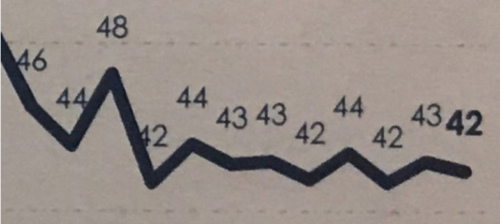
Presstitutes like Patrick Gower would have us believe that the above line – representing a nine percent loss of support in six months – is a sign that the National Party is in the ascendancy

The standard of mainstream political journalism in New Zealand is worse than school newspaper level. This is not because of a lack of English language skills, but because our journalists are bought-and-paid-for whores who will say absolutely anything if the price is right. Examination of a recent propaganda piece on Newshub shows how dire the situation is.

Patrick Gower, who wrote the article, is well representative of the kind of arse-licker that infests the New Zealand Lugenpresse. Enchanted by wealth, Gower has produced a piece intended to create the impression that the conservative National Party is doing a great job of governing and should be re-elected later this year.

Referring to supposedly leaked poll results which “show [Labour] is in big trouble, two-and-a-half months out from the election,” Gower has penned a piece intended to give the impression that the Labour Party is falling to pieces (and, by elimination, National must be the best choice for running the country).

Gower writes that “National is chugging along as usual – currently on 42 percent”, but this statement is absolutely false on its face.

National has no real coalition partners, apart from the “Hemorrhoid of the House” Peter Dunne, the fake libertarian David Seymour and the race traitors in the Maori Party. These three groups only draw five seats between them, which required National to win 47% of the vote in the 2014 General Election to have the numbers to govern.

So 42% is far from “chugging along as usual” – in fact, it represents a fall in support which would see it kicked out of power if an election were to be held today.

Gower writes about a “fascinating trend” from the last six months, in which “Labour is crashing down and is at pretty much its lowest point since Andrew Little took over after the last election.”

So poor is the level of political journalism in this country that the graphics supplied for the article contradict Gower’s own statement. The natural oscillations of the poll results suggest that Labour is currently in a lull – but the graphic in the same article shows that they were on 26% six months ago, and are on 26% now.

Considering that Labour won only 25% at the last election, it’s apparent that Gower has deliberately selected an extremely small section of the polling graph and omitted the rest, in order to give the impression that this short-term fluctuation is really a major trend.

The very same graphic shows that support for National is, in fact, crashing down – from 51% as recently as the start of the year to 42% now.

So even though the line graphs supplied in the article show that National has fallen 9% since the start of the year and that Labour has remained steady, Gower, in his shameless, ham-fisted propagandising, has spun things to make it sound as if the exact opposite is true.

Unfortunately, this is the standard of political journalism in New Zealand. Presstitutes take corporate money to write propaganda pieces favouring moneyed interests, and then these lies are pumped through the national consciousness via every possible medium, until every retard in the country bleats them out mindlessly all day.

Worst of all is that the more dishonest a journalist is, the more likely they are to be given a public platform, for the reason that this dishonesty means profit for those pushing the propaganda.
Is New Zealand The Worst Country On Earth?

New Zealand – paradise if you’re wealthy, but if you’re not (and especially if you’re also young), living here is a curious psychological torture. We have the highest teen suicide rates in the developed world, and this essay looks at some reasons why.

Like every other country on Earth, our mainstream media likes to paint a picture of everything being excellent and the country having never done better – this being the well-known strategy for putting the receivers of such media in the optimal mindset for buying the products advertised in it.

Our mainstream media has a unique level of shamelessness in doing so, however, because in no other country in the developed world are teenagers as likely to decide that they’d rather be dead than living here.

New Zealand is close to the worst country on Earth to be young. There’s nothing to do here, we’re all psychologically damaged and our authority figures lie to us all the time.

This is especially true for the current generation of youth, who grew up in the wake of Ruthanasia, the sadistic welfare policies of the Fourth National Government. These policies taught our youth that the country couldn’t give two shits about them and that empathy is for the weak – once you’re born, you’re on your fucken own.

The consequence of this lack of empathy is a generation of youth without much empathy, and a consequence of that is that they kill themselves at world-record rates. There’s nothing surprising about it – they’ve simply internalised the lack of worth with which they were treated.

Understanding how we got like this requires that we understand how isolated New Zealand is. Australia is itself an isolated country at the arse-end of the world, but they’re practically Greece compared to us.

In almost any other country on Earth, it’s possible to get into a car, drive a short distance across a border and have an entirely different cultural experience, with new people, new thoughts and new ideas.

We don’t have any of that in New Zealand. We’re stuck here. For all of the generations before the one that grew up with the Internet, all we had was the television, and that taught us to consume, not to think.

And as we stagnated, we turned our rages on each other.

Perhaps the worst thing about New Zealand is the petty, vicious, cowardly streak in the national character that has us always lashing out at the person at the bottom of society rather than daring to criticise the people at the top.

This is reflected in our obscene school bullying culture. Unfortunately for New Zealand teenagers, our culture of abuse is so deeply entrenched that many teachers will argue that bullying is a good thing because it forces kids to develop social skills or “toughens them up for the real world” (or some other 19th-century logic).

It’s also reflected in our third-world mental health system, which regularly throws sick people out onto the street with no help or funding. Many teenagers have committed suicide after trying to get help from the New Zealand mental health system only to find that no-one working in it could care less about them.

Unfortunately for this country’s mentally ill, especially if they are also young and poor, being mentally ill is still seen as a personal failure in New Zealand – depression is a failure to harden the fuck up, bipolar disorder is a failure to calm down, schizophrenia is a failure to sort your shit out.

In this way, New Zealand has failed to move on from the 1950s, in contrast to almost everywhere else.

A natural consequence of this brutal, brain-dead attitude is a national unwillingness to talk about mental illness. Doing so engenders so little natural sympathy that our youth would rather kill themselves than try and broach the subject with an adult New Zealander.

Not only do we have less of an influence from without, but we actively stomp down any new thought that might arise from within – and not only through the Tall Poppy Syndrome.

New Zealand managed to produce an intellect great enough to win a Booker Prize recently in Eleanor Catton, and Prime Minister John Key bullied her out of the country by publicly stating that her opinion on intellectual matters wasn’t worth more than that of a rugby player.

No other country is shit enough to do that. Almost anywhere else, it would be recognised that intellects like Catton’s are necessary to prevent a culture from rotting from the inside, and especially so in New Zealand where new ideas do not flow in from across the border.

We weren’t always like this: studies have shown that our teen suicide rate actually used to be lower than that of other countries.

But in the mid-80s we got sucked into the con job that was neoliberalism, and none of our current politicians have the guts to suggest any change of track.

The country that once led the world on social issues like women’s suffrage and old-age pensions is now more backwards than South Africa on social issues like gay marriage and cannabis law reform.

Without a fundamental change of attitude that brings us into 21st-century modes of thinking, the standard of living here will only continue to deteriorate, and our teen suicide rates will only increase.

National and the Greens Could Form A Globalist Alliance Post-Election

A recent leaked poll suggests that the Green Party might find themselves snookered after the election on September 23rd. Although they are polling fairly well, Labour is not, and so the Green-Labour alliance might find themselves dependent on New Zealand First, who the Greens have intimated they cannot work with.

The Greens have also suggested that they would not like to support a Labour-New Zealand First minority Government on the grounds that New Zealand First is “racist”.

This raises the disaster scenario of New Zealand First choosing to go into coalition with National, which would form a comfortable majority, with the Greens left out in the cold again.

Sounds like an everyday drama at a girls’ high school – and the participants are every bit as catty – but for us plebs out there in New Zealand it’s what decides whether we eat at the end of the week or not.

One scenario, however, has been relatively ignored – the Greens can always come around from the other side and form a globalist alliance with the National Party.

National wants to remove capital controls; the Greens want to remove border controls. This makes the two of them natural bedfellows.

After all, the only reason why the Greens are making noises about how “racist” New Zealand First is is because New Zealand First represents the nativist axis on the great globalist-nativist spectrum (that may define the politics of this century).

In other words, New Zealand First represents the people who are born in New Zealand – principally the Maoris and the majority of the white people.

But as Understanding New Zealand demonstrates in the section about Maori voting patterns, the Greens are themselves clearly more of an established power structure party than New Zealand First.

The correlation between voting New Zealand First in 2014 and being Maori was 0.66, whereas between voting Greens in 2014 and being Maori it wasn’t even positive, being -0.09.

So why would the Greens make a big song and dance about how not wanting tens of thousands of “refugees” is racism when the racism in question is an expression of the will of the indigenous Maori people?

Globalism.

The commitment of the Green Party to the globalist dream of destroying any connection between land and ethnicity is so great that they’re willing to further water down the Maori presence in Aotearoa by bringing in 5,000 “refugees” a year.

This may be so strong that, by itself, it tips the true home of the Greens away from the Maori they claim to be taking care of (and subsequently from New Zealand First and Labour) and towards the wealthy white people in the National Party, for whom any connection between land and ethnicity is merely an impediment to business.

Furthermore, as is also discussed in the Understanding New Zealand section about Green voters – “…the correlation between voting Green in 2014 and median personal income is 0.31, which is not as strong as National’s 0.53 but is much closer to that than to Labour’s -0.51…”

The Greens are, simply put, a much wealthier and whiter group of people than either Labour or New Zealand First.

The Greens essentially represent the urban wealthy, and as such it’s arguable that they could more naturally form an alliance post-September with the rural wealthy in the National Party, rather than the urban poor in the Labour Party.

Of course, an alliance with the rural poor – the diametric opposite of the Greens – in New Zealand First would be the most difficult of all.

*

Dan McGlashan is the author of Understanding New Zealand, published by VJM Publishing in the winter of 2017.

Te Reo With Mnemonics: Nature Words

Wind/Breeze – mātangi

A roaring gust of wind pulls up into the shape of a wild mustang.

Cloud – kapua

A mist floats through a section, and when it reaches the owner’s carport underneath their house it condenses into a cloud.

shine (Sun) – whiti

Thousands of rays of light burst out of the face of the Sun, and each of the rays has a foot at the end of it. The sunshine is very feety.

Sky – rangi

A man puts a phonecall through to someone. In the sky, another man picks up a phone made of clouds and says “You rang?”

Star – whetū

In the night-time sky, a star unwraps a block of feta cheese and starts eating it.

River – awa

An explorer stops by a river to get a drink of water, when an arrow lands in the water beside him.

The Maori word for mountain – maunga – shares a m-ng- pattern with the English word mango

Mountain – maunga

From the precipice of a craggy mountain, an avalanche of mangos roll down the cliff face.

Moon – marama

In the night-time sky, shining down in the place of the Moon is the face of Marama Davidson (if you don’t know who she is, imagine the Moon’s face is smeared with marmite).

Storm/stormy – tūpuhi

Seen from an inside window, a storm sets in, so bad that it blows a man’s toupee off his head.

Thunder – whaitiri

A skyful of clouds emits a peal of thunder and then, out of the clouds, comes a squadron of fighter planes.

Land – whenua

A Land Rover drives across a wide range of different landscapes, then hits a rock and damages its fender.

Rain – ua(-ina)

It starts raining. Instead of raindrops, weiner sausages fall from the sky.

*

The above is an excerpt from the upcoming ‘Learn Maori Vocabulary With Mnemonics‘, by Jeff Ngatai, due to be published by VJM Publishing in the summer of 2017/18.