

Category: politics
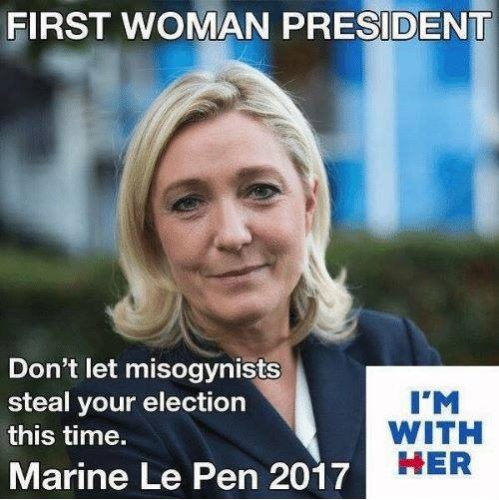
Marine Le Pen is More of a Feminist Than Hillary Clinton Ever Was
Rational feminism is based on two things. The first is the recognition that women have generally been treated badly historically. The second is the recognition that addressing this difference is primarily a question of reducing the suffering of women in general.
Fear of physical or psychological abuse, and stress borne of anticipated economic, social or sexual insecurity, are the obvious ways in which women have been treated badly historically and the major ways that women are still suffering in the world today.
This means things like not being taken seriously by the Police or by the community when you make an allegation of abuse. It also means anxiety about increasing rent and living expenses as a consequence of immigration driving up demand for these things in your neighbourhood.
And, crucially, it means freedom from male supremacist religions and their strictures on women that amount to little more than psychological abuse by intimidation. This means freedom both in the home and in the streets.
What passes for feminism from the bleating heads in the mainstream media is something much different to this rational feminism. It is something grossly disconnected from the reality of the everyday woman. It utterly fails to recognise the anti-feminism inherent in the strictures of Abrahamism in general and Islam in particular.
What passes for feminism in the mainstream media is a kind of feminism that represents the collective class interests of the women in the political, business, professional, academic and media sectors.
As a consequence one can hear many women in the mainstream media complaining about the proportion of female CEOs, but very few women complaining about the naked fact that they are treated akin to animals in much of the Middle East, and that this affects many thousands of times more women than those who miss out on C-suite jobs.
Hillary Clinton represents this shallow strain of virtue-signalling feminism. It’s not so much a political movement of women as it is a political movement of highly ambitious, urban, unusually masculine women who want to claim a lion’s share of the wealth.
As for women who are not doing so well, they generally find very little that appealed to them in Hillary’s “I’m With Her” rhetoric.
Hillary Clinton promised to let in 500,000 Syrian refugees. Not a problem for upper-middle class feminists who probably own rental property and could expect that any immigration would boost their incomes in accordance with the increased demand for housing.
These feminists do not live in the areas that the Syrians would have moved to, and so they would not have had the experience that many working class European women are now familiar with: that of seeing your neighbourhood taken over by a fundamentalist religious culture that considers you of similar value to a dog.
The unusually intellectual Marine Le Pen, then, represents an entirely different kind of feminism. As alluded to in the opening paragraph of this essay, a rational feminism would be aimed towards reducing the suffering of women as a whole, not exclusively helping upper-middle class women achieve their ego-fuelled career objectives.
The French sociologist Sylvain Crépon conducted an analysis of the 2012 FN (National Front, Le Pen’s party) vote. His conclusion was that “The FN vote is made up of the victims of globalisation. It is the small shopkeepers who are going under because of the economic crisis and competition from the out-of-town hypermarkets; it is low-paid workers from the private sector; the unemployed.”
In other words, the same sort of person that Hillary Clinton dismissed as “deplorable”. It is this segment of society – both men and women – who are looking for an alternative to the shitshow dished up by the Baby Boomers.
Indeed, it has been noted elsewhere that many more women are becoming attracted to Le Pen’s message. This is entirely unsurprising when one considers that the biggest losers from the increasing Islamic influence on France are women.
Moreover, a French woman becoming President of her country is a much bigger victory for feminism that an American one becoming President of hers, as French women did not even have the right to vote until after World War II.
Le Pen is of a different generation to both her paratrooper father (who she was forced to expel from the National Front in 2015) and Hillary Clinton. Le Pen is, like Justin Trudeau of Canada, a member of Generation X, who are just now assuming power.
In wanting to keep the streets safe for women today instead of mindlessly promoting tired old globalist rhetoric at the expense of the working class, Marine Le Pen is more of a feminist than Hillary Clinton ever so much as pretended to be.
Probably what she can expect is that the globalist and nationalist Baby Boomers will come together to oppose her in the second round of this year’s French Presidential Election.
But that generation is now dying out, and Le Pen’s Generation X is more concerned with Islam than with CEO positions. That will make them a much less disparate entity than they previously had been.
Generation X, We’re Now On Our Own

The last of the Silent Generation are leaving us. The oldest Baby Boomers, born in 1945 and so 71-72 years old, are now the bulk of the elderly. Pretty soon, those of us of Generation X will be the voice of reason wedged between the insanely selfish Baby Boomers and the insanely pathetic Millennials.
There are many repeating patterns in Nature that skip one or two generations. The mindlessly narcissistic hubris of the generation that led the world into the hemoclysm of World Wars I and II is re-expressing itself in the consumer-rapist greed of the Boomers.
The grim cynicism of the generations that stopped Hitler is another pattern that has skipped some generations. The Boomers don’t get it: their world is very serious. The God-given mission to squeeze every last cent of material productivity out of the Earth is one that brooks no levity.
Neither do the Millennials get it: their world is also very serious. In the hyper-connected cyberworld of the Millennial, to take your finger off the pulse for one moment is to risk becoming fatally unfashionable.
Their great taboo is to never ask who is pulling the strings of all these fashions and fads and to what ends. The Millennial merely follows, a perfectly feminine creation for an excessively feminine age.
We in Generation X – often raised by our grandparents in the Silent and Greatest Generations while our parents were building careers – do get it. Make no mistake: for us, in between two opposing and mutually annihilating generations that are both deeply detached from reality, survival for our generation will involve getting out of the way while the nutbars fight each other.
As the 21st century takes a more definite form, four distinct groups of enemies have arisen to challenge those who wish for a peaceful world. These are Boomer globalists, Boomer nationalists, Millennial globalists and Millennial nationalists.
The Boomer globalists and nationalists are already familiar to us as the representatives of the various political interests. The globalists are the alliance of the capitalists and communists who want to bring the whole world under the yoke of one system.
The nationalists are those resisting this process, who usually bring with them masses of conservative baggage in the form of disrespecting anyone not like them, in particular women, other races and other sexual orientations.
The Millennial globalists and nationalists are their useful idiots on the streets and in cyberspace. Millennial globalists like Antifa and other social justice warriors will attack nationalist interests under the delusion that they are doing “good”, because there’s nothing a brainless dog enjoys more than biting someone and then getting a pat on the head from the master.
Their opposition, the Millennial nationalists, are naturally the foot soldiers of the wealthy, often religious and ethnonationalist interests who oppose the globalist interests. In practice, many of these people (usually men) are involved in the burgeoning alt-right movement.
This is the arrangement of major sociodemographic forces in the West as we drift towards the second quarter of this century.
However, the timeline before us is chaos, about which little can be known. We can say this for certain: the Baby Boomers will cling to power like shit clings to a blanket, and the Millennials will demand power as if they were all royalty and born to it.
Keeping the world on a even keel will involve making sure that the balance of these forces does not come out of alignment and cause the whole shithouse to go up in flames.
Probably the best historical example of the current plight of Generation X is the way in which Britain was, 80 years ago, caught between insane right-wing Nazis and insane left-wing Communists. At that time, the best strategy was to work on consolidating the strength of one’s position, and to wait for a future opportunity to expand while enemy forces exhaust themselves.
Understanding New Zealand: Maori Party Voters
The Maori Party is a bit of a misnomer. Sure, they represent Maori, but not all Maori – only some. Let’s get the obvious one out of the way: the correlation between voting Maori Party in 2014 and being of Maori descent is an extremely strong 0.91. The correlation between voting Maori Party in 2014 and being a Pacific Islander was a not significant 0.01, and the other two correlations, with being European and being Asian, were both significantly negative at -0.35 and -0.30 respectively.
What may seem incredible if you look at Parliament, but not surprising if you knew about Kiwis, is the size of the negative correlation between voting National in 2014 and voting Maori Party in 2014: this is -0.75. That is enough to suggest that the average Maori Party voter has very, very little in common with the average National voter, even though the Maori Party supports National in Parliament.
With no other party was there as large a negative correlation with voting Maori Party in 2014. Voting Maori Party had a correlation of -0.64 with voting Conservative, and -0.29 with voting ACT. Imagining some kind of blend of National, Conservative and ACT voters can give us an idea of what an anti-Maori would be like if one existed.
Maori Party voters were indifferent to the Greens. Voting Maori Party in 2014 had a correlation of 0.02 with voting Green in 2014. They do, however, seem to like the other strongly pro-Maori parties. Voting Maori Party in 2014 had a correlation of 0.41 with voting Labour and a correlation of 0.46 with voting New Zealand First.
The strongest correlations with voting for the Maori Party were with Internet MANA (0.84) and the Aotearoa Legalise Cannabis Party (0.85). Those two correlations may give a clue as to the sense of betrayal that many hard done by Maori will be feeling at the actions of the Maori Party MPs elected to Parliament, who raised tobacco taxes and did nothing about cannabis prohibition.
There is a fairly big difference between some correlations that the reader may have expected to be close to equal. One set of them relates to the strength of the correlation between being educated and being Maori and between being educated and voting Maori Party.
The correlation between being Maori and having a Bachelor’s degree is -0.45, but the correlation between voting Maori Party in 2014 and having a Bachelor’s degree is only -0.28. There was a similar pattern for all of the postgraduate degrees.
For being Maori and having an Honour’s degree the correlation was -0.46, but for voting Maori Party in 2014 and having an Honour’s degree it was only -0.29. For being Maori and having a Master’s degree the correlation was -0.45, but for voting Maori Party in 2014 and having a Master’s degree it was -0.28. And for being Maori and having a doctorate was -0.41, but for voting Maori Party in 2014 and having a doctorate it was 0.27.
A similar pattern repeats itself if we look at correlations with income bands. The $60-70K income band is perfectly even, in that the correlations between being in this band and being either Maori or voting Maori Party are both exactly 0.00.
For all of the income bands below this, the correlation with being Maori was more strongly positive than it was for voting Maori Party in 2014, but the opposite was true of the three income bands above this one.
A similar pattern repeats if one examines the difference when it comes to claiming benefits. The correlation between being on the unemployment benefit and voting Maori Party in 2014 is 0.79, but the correlation between being on the unemployment benefit and being Maori is 0.91. Similarly, the correlation between being on the invalid’s benefit and voting Maori Party in 2014 is 0.59, but the correlation between being on the invalid’s benefit and being Maori is 0.77.
One difference, and one major clue as to how Maori Party voters differ from general Maori, is that the correlation between being on a student allowance and voting Maori Party in 2014 (0.26) is stronger than the correlation between being on a student allowance and being Maori (0.20). This tells us that the average Maori Party voter is generally more driven and aspirational than the average Maori.
A general picture emerges of Maori Party voters being significantly better off than the average Maori person. This cannot be explained by turnout alone. The correlation between turnout rate in 2014 and being Maori is -0.75, and with between turnout rate in 2014 and voting Maori Party in 2014 it is -0.74. So there is no significant difference there.
This is supported by general measures of health and well-being. The correlation between having never smoked tobacco and voting Maori Party in 2014 (-0.55) is weaker than the correlation between having never smoked tobacco and being Maori (-0.73). In a similar vein, the correlation between being a solo parent and voting Maori Party in 2014 (0.66) was not as strong as the correlation between being a solo parent and being Maori (0.79).
There are several potential implications of this. One of the most notable is that, if Maori Party voters are actually significantly wealthier than the average Maori, a partnership with National as not as odd as it might otherwise appear.
*
This article is an excerpt from Understanding New Zealand, by Dan McGlashan, published by VJM Publishing in the winter of 2017.