
The Politico-Retard Spectrum

The term “political spectrum” is not descriptive enough to really explain what’s going on in people’s heads. It seems to imply that there are two rational poles opposing each other, usually represented by a conservative and a social democrat party, and that all political philosophy necessarily falls in between those two poles and nowhere else.

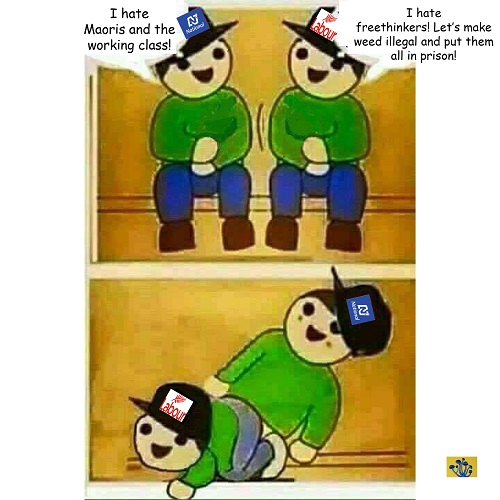
This fails to describe the reality of the situation, which is that politics is a small number of shamelessly lying psychopaths pretending to oppose each other in order to pull the strings of a large number of morons in order to enslave the rest of us.

Neither does it describe, for example, the fact that the less intelligent a person is, the more faith they will put in politicians, or that if a reasonable person defies a politician they will die thanks to the power gifted to that politician by the people at the retard pole of the politico-retard spectrum.

The politico-retard spectrum, therefore, has two different poles: the retarded one, as described above, and the other one. Anyone at this other pole will reject any label the author of this essay puts on them, so let’s call that end the freethinking pole.

The retarded pole is defined as consisting of people who have full faith in politicians and in the political system. A person at this pole genuinely believes that politicians are there to help him or to do good, and if they hear a politician say something on television, they will believe that this is true.

These people genuinely believe that cannabis causes mental illness, and they genuinely believe that there were weapons of mass destruction in Iraq, and they genuinely believe that it is necessary to borrow the nation’s money supply at interest from private banks.

The politico-retard spectrum is much like a food chain, in the sense that people at the retarded pole spend all of their time and energy fighting other people at the retarded end (usually in the form of the democratic election circus) and inevitably lose ground to anyone closer to the other pole.

Cognitive dissonance is the enemy of the person at the retard pole of the spectrum.

Like all authorities who have taken their position by aggression or by lies, politicians frequently contradict themselves. The more retarded one is, the more confusion this contradiction will create, because anyone stupid enough to believe a politician will have to suffer cognitive dissonance every time that politician contradicts themselves, which will be often.

And so, like dumb people everywhere, the experience of a person at the retard pole of the spectrum is mostly one of confusion. A facial expression of confusion – with a furrowed brow, downturned lips and blank, unfocused eyes – is consequently one of their most recognisable characteristics.

A person here does not realise that a vote for either the centre-left party or the centre-right party is a vote for the establishment. They do not realise that, to the degree that all parties have bought into the political system, voting for any of them will deliver no more and no less than what the system is set up to deliver.

Having a poor memory is associated with a position on the retard pole of the spectrum. This is especially evident when people fall for the same lies every electoral cycle, despite having been severely burned by those same lies last time.

For instance, every non-incumbent candidate runs on a platform of change, every single time. Also every single time, they fail to change anything once they win.

They may force through a cosmetic change or two, but the people who have power under the incumbent aren’t just going to let it go because a new person wins the election.

Anyone who doesn’t fall for this bullshit is necessarily up the freethinker end of the politico-retard spectrum, by default. A feature of being at this pole of the spectrum is that it becomes very difficult to draw lines around any part of what is being thought and to say that it is characteristic of this pole.

Perhaps the best way to understand it is to consider the far pole of the politico-retard spectrum as the pole one is at when one is no longer susceptible to the crude lies told by politicians which appeal to the reptilian complex of the human brain.

Understanding New Zealand: Voting Patterns of the Non-Religious


Interestingly, the Electoral Profiles do not distinguish between atheist, agnostic and non-religious, lumping all such positions under the appellation of ‘non-religious’. This might not have a major impact here, and it is likely that future versions do make such a distinction.

The non-religious especially didn’t seem to think much of the Labour Party. The correlation between being non-religious and voting Labour in 2014 was -0.50. The major reason for this is the large numbers of Pacific Islanders that vote Labour, because the vast majority of them are religious.

The sort of young person who has grown up after New Zealand made forced religious instruction illegal tends to be a Green voter. The correlation between being non-religious and voting Green in 2014 was 0.56.

Taken with other statistics, that suggests that the bulk of Generation X – the first really post-religious generation in New Zealand – are Green voters.

These two statistics, taken together, suggest a clear fault line between the shared territories of the Labour and Green parties. The former is very religious whereas the latter abhors it. Grimly, the way that this is likely to be resolved is by a further marginalisation of the highly religious working-class Pacific Islanders.

The parties that get heavy support from Maoris did not have significant correlations with being non-religious, but they were positive. The correlation between being non-religious and voting New Zealand First in 2014 was 0.12, with voting Internet MANA it was 0.14, and with voting Maori Party it was 0.20.

This reflects how Maoris have generally grown out of religious belief but not to the same extent that young Kiwis of European descent have.

People with no religion don’t seem to think much of the far-right parties either. The correlation between having no religion and voting Conservative in 2014 was -0.04, and with voting ACT in 2014 was -0.23.

Probably the reason for this latter correlation is that the non-religious young middle-class people tend to vote Green, and these heavily outweigh those who vote ACT. Moreover, a very large proportion of ACT voters are from North East Asia and consequently are (at least nominally) Buddhists.

Perhaps demonstrative of a shared interest in free-thinking, there was a significant positive correlation between being non-religious and voting Aotearoa Legalise Cannabis Party in 2014 – this was 0.34.

After all, it’s plausible that if a person rejects the propaganda of one pack of aggressive liars in the form of the priesthood, they might do the some with the propaganda of another pack of aggressive liars in the form of the politicians who have prohibited cannabis.

There was also a significant positive correlation between having no religion and turnout rate in 2014 – this was 0.24. This was probably because of the large degree of disenfranchisment among highly religious Pacific Islander immigrants, as well as the large number of Maoris, in particular solo mothers who are doing it hard and have become religious primarily for the sake of social support.

*

This article is an excerpt from Understanding New Zealand, by Dan McGlashan, published by VJM Publishing in the winter of 2017.

r/K Selection Theory and Political Orientation

r/K selection theory is an ecological concept that applies to the attitudes that a breeding creature will have towards its offspring. Simply put, all sexually reproducing creatures fall along a spectrum that has zero parental input into the survival of the offspring at one end (the r end) and extremely high parental input at the other end (the K end).

The classic r-strategy is one that has a very high rate of breeding, and a correspondingly very low rate of parental investment, like that of a reptile or a mouse. The classic K-strategy, by contrast, is one that has a low rate of breeding and a correspondingly high rate of parental investment, like that of an elephant or a human being.

As above, so below: the thinking of people can be understood along this exact same parallel. Although biologists don’t look at it like this, it’s possible to view this r/K arrangement as representing the degree of solidarity that exists between human generations.

The r-strategy could be compared to the kind of male that gets a woman pregnant and then disappears from the scene before he is called upon to provide any resources for the offspring. It is even described as “opportunistic”, in much the same way that that kind of male behaviour is.

The K-strategy would then be compared to the kind of male that forms a monogamous pair bond for life, with no intention of finding future female partners to inseminate, and who makes a large investment in terms of time and/or energy in making sure that the offspring of the bond grow up to be fit to deal with the selective pressures of life.

Practically speaking, a male running the r-strategy would have to inseminate more females than a male running the K-strategy, because fewer of the former male’s offspring could be expected to survive to adulthood, on account of the lower degree of parental investment they received.

Moreover, a smaller proportion of those who did survive to adulthood would reproduce, because those who did survive would more frequently be socially or emotionally defective in comparison to those who had a more natural level of paternal investment.

The r/K selection strategy parallels closely the objective of the various political wings. What’s odd, though, is that both wings of the left-right spectrum see themselves as representatives of the K-strategy and their opponents as the representatives of the r-strategy.

Conservatives would consider that the optimal K-strategy would be a monogamous marriage, and preferably a Christian one, and this is the kind of family that appears to be held up in our culture as some kind of ideal. In such a marriage the father would stick around and provide a large amount of investment in a relatively small number of offspring.

They would consider that paying out money in welfare is a mistake because it incentivises r-strategy men to impregnate women and then disappear. In many cases the fear is that welfare incentivises women to get inseminated by dead-beat males and that the rest of us therefore have to carry the burden for children who would not otherwise have existed.

Liberals would consider that the K-strategy involved paying an amount of tax that was sufficient to cover all the requirements every citizen has to grow into a healthy, productive adult. This would mean a high level of investment in every child – schooling, healthcare, freedom from abuse and neglect etc.

They would consider the r-strategy to be what religious conservatives do when they have large numbers of children in adherence to a religious admonition to populate the Earth, and then raise them to be fearful, prejudiced and superstitious.

It appears somehow natural, when reading about the difference, to associate humans and mammals with the K-strategy and reptiles and insects with the r-strategy. Probably this is why both sides of the politico-retard spectrum consider themselves to represent the K-strategy.

Oddly, this gives us a potential way forward for the political system. If both left and right can agree that a K-strategy is morally superior to an r-strategy, then why not forget left and right entirely and run the system along the lines of a K-strategy?