Can You Hear The Echoes Of The 1920s On Our Streets?

The 1920s were a tumultuous time in the Western World. Rebuilding from the carnage of World War One, Westerners – especially Europeans – found themselves unable to decide on a peaceful way forward, and this absence of agreement expressed itself violently in the streets. This essay examines whether or not we’re looking at a repeat.

The German defeat in World War One saw a revolution that swept away the monarchy of Wilhelm II, replacing it with a fragile democracy known as the Weimar Republic. The well-founded fear of those who wanted peace in Central Europe was of a civil war between the socialist forces that had inspired the revolution and the reactionary conservatives representing those who held power and wealth under the Second Reich.

Communist agitation, inspired by the Russian Revolution of 1917, was eventually put down by an alliance between the ruling Social Democratic Party of Germany and right-wing paramilitaries known as the Freikorps, and peace finally reigned.

But it wasn’t to last.

The severe economic problems of the 1920s, coupled with a sense of humiliation at the restrictions imposed on Germany by the victorious Allies, alongside continued communist agitation and growing nationalist sentiment, meant that chaos would soon usurp the shaky peace.

The far left didn’t like the Weimar Republic because they considered it to be holding back a communist revolution, and the far right didn’t like it because they preferred the authoritarianism that existed under the previous monarchy.

This state of affairs is very similar to what faces the West today.
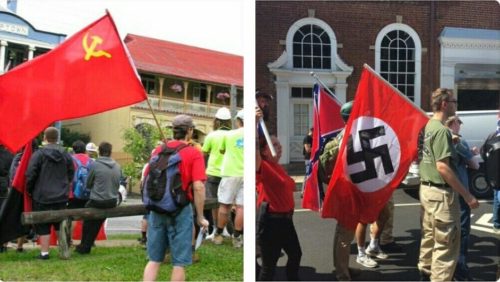
Just like 1920s Weimar, the streets are again filling with far-left and far-right extremists who want to fight each other

Communist agitators have made a significant impact on Western society in recent years. They have successfully destroyed belief in tradition, resulting in plummeting birthrates, mass immigration that has changed the make-up of Western nations forever, and widespread and righteous anti-white racism.

Nationalist agitators have also made significant strides recently, most notably with the election of Donald Trump to the American Presidency. Many Trump supporters are shameless authoritarians, and much of the appeal of this authoritarianism lies in the belief that they are protecting the West from degeneracy.

The surge in both groups of extremists has led to increasing levels of street violence in America, most notably at the ‘Battle of Berkeley’ and then last weekend in Charlottesville. A sense of unfinished business lingers over both of these incidents, and after a fatal terrorist attack in Charlottesville the desire for revenge is a factor predicting further bloodshed.

What is the most foreboding is that Antifa is growing in strength because of rhetoric about the need to resist Nazism, and the far-right is growing in strength because of rhetoric about the need to resist Communism.

The echoes of the 1920s come from the fact that both sides are correct in their basic fears of the other side. Both sides are growing in strength because of sharply increasing dissatisfaction with the idea of liberal democracy, in a very similar way to how increasing dissatisfaction with the Weimar Republic led to widespread street violence.

The left opposes liberal democracy because it wants to shut down free speech and free expression. The Communists believe that they need to control the narrative in order to bring about revolution, and this demands that even scientists like Richard Dawkins be denied the right to speak at a university.

The right opposes liberal democracy because it wants to shut down the free movement of people. The Nazis believe that the West is sinking into chaos, anarchy and degeneracy, and only by rallying around authoritarian figures can a sufficient degree of order be imposed upon society.

Both of these sides, therefore, have grounds to eschew dialogue and democracy in favour of raw assertions of power in the streets.

Also foreboding is the belief, shared by many commentators, that the economic hardships of the Weimar Era laid the foundations for massive German discontent with the idea of democracy, which paved the way for extremists like Adolf Hitler.

The West has not really recovered from the Global Financial Crisis of 2008. Employment prospects are poor all across the West, with the dream of owing your own home now out of reach for most young Westerners, and working-class resentment at the amount of money spent on refugees risks growing into further discontent.

Perhaps all of this is building towards another climactic struggle.
VJMP Reads: Anders Breivik’s Manifesto VI

This reading carries on from here.

In this section (c. pages 366-425), Breivik traces some of the reasons for the weakness of the modern West. Although the reasons for the West’s decline are many, some weigh more heavily than others.

Curiously, from the perspective of 2017, the document points out that in the absence of a meaningful life people will gravitate towards mindless destruction. In this sense, the document appears to be somewhat prescient.

Breivik laments a lack of order and structure in the modern West. Society, he claims, has essentially broken down. Nobody wants to have children any more because they want to live carefree lives of perpetual adolescence. The plummeting birthrates have led to a demand from many quarters for mass immigration to replace the non-existent native children.

And so, conflict between the natives and immigrants becomes ever more likely, following the maxim “demography is destiny”.

Not that mass immigration is proposed merely for economic reasons. Breivik details a large conspiracy on the part of European elites to radically transform the make-up of their nations, especially in Britain under Tony Blair. Interestingly, Breivik is willing to criticise big business for their complicity in mass immigration – something that few on the right are willing to dare.

Perhaps unavoidably for a document of this length, the rhetoric swings from entirely reasonable libertarian critiques of Marxism to unreasonable demands, such as the total banning of the discipline of sociology. Sociology is inherently untrustworthy: “Their academic weapons are to deliberate spread their falsified and corrupted Marxist world view.”

Breivik makes an accurate criticism when he points out that the advocates of cultural Marxism are seldom the black, poor or disabled people that the Marxists claim to be agitating on behalf of. Instead, the vast majority of Marxists in the West are from privileged, wealthy families.

When Breivik writes that “Cultural Marxists tend to hate anything that has an image of being strong, good and successful” he agrees with some of the columnists of this newspaper, who have previously written about the overlap between modern leftist thought and slave morality, in particular the feeling of resentment that induces the weak to oppose anything strong.

This tendency is also equated with the feminine, with masochism and with suicidal ideation.

He also echoes this newspaper when he quotes a British politician as saying “When all the politicians agree, the rest of us should suspect a plot against the ordinary citizen.” Like this newspaper, the intent in raising such paranoid conjectures is to crystallise dissent against the system.

Breivik makes no effort to hide his dissatisfaction with the political process. Electoral politics is dismissed as an “empty ritual” directed by the collusion of the political and media classes. Important issues are not discussed by the media, who has failed to do its job as a Fourth Estate holding the government to account. Instead, they are decided upon “behind closed doors”.

In this section, Breivik manages to list who his enemies are. In short, his three major groups of enemies to the European people are:

1. The media and academia, who have an anti-Western bias
2. The political elites, who seek to remake the world in their image regardless of the cost, and
3. Muslims.

For Those Ignored By The Political Class, The Only Real Protest Is Not Voting

Several opinion pieces have appeared in the mainstream media in recent days exhorting Kiwis to vote in next month’s election. With choice phrases like “not voting won’t solve anything”, “the 2014 result was determined by the people who turned up” and “Voting builds our political power”, all mainstream propaganda organs are doing their best to get you to consent to the status quo.

Because that is all that voting is – you giving your consent for things to carry on pretty much exactly as they already are. The political class will interpret the fact that you voted as a sign that you are content with the overall system – and therefore as a sign that nothing need be changed.

And so, your vote has a zero percent chance of changing anything. You might as well dance naked in a thunderstorm praying for the lightning gods to strike down the enemies of the nation.

How the country will be run for the next three years has already been decided by the mutual agreement of the sort of person who politicians really do listen to – rich old people, who have got together long ago with those politicians and hashed out the precise details of how things are going to be, whether the masses like it or not.

If you’re not a wealthy Baby Boomer, the politicians couldn’t give a fuck what you think. But they do want your consent for what they’re going to do to you.

If they don’t have that then they run the risk of provoking the rise of some kind of revolutionary movement that might actually make a difference to how society is run. Such as: a movement that campaigned on an expensive universal basic income, or on an equally expensive capital gains tax, or on an immigration policy that reflected the will of all Kiwis instead of just multiple property owners and those looking for cheap labour.

And this is the reason why there is all the propaganda right now to get people to vote. Voting in a democratic system is the same as you giving your consent to how the country is governed – and to the people who own both sides of the political system, the consent of the population they’re exploiting is the only thing left that they don’t already have.

If you do vote, then politicians of both the left and right wings of the ruling party tend to naturally assume that you’re more or less happy with the direction of things.

Knowing in advance that the winner of the election is going to ignore your will in favour of those who have money, your only means of protest is to not vote at all. Past a certain level of disenfranchisement, the only action one can take to affect the system is to not vote. A refusal to vote is the only way your voice can really be heard.

If the turnout rate in next month’s General Election was less than 50%, the measured degree of public discontent would be too great to just shrug off, it would then become possible for some hard questions to be asked about the direction the country was going. The mainstream media would be forced to ask whether or not the political system was really a democracy or just an oligarchy masquerading as one.

The higher it is, the more likely it becomes that political discourse is replaced with photos of spaghetti on pizzas, videos of dropping in to London for a sister’s wedding, and witch-hunts against outsider candidates.

You can help force New Zealand politicians to take the will of New Zealanders seriously by withholding your vote this September 23rd.

VJMP Reads: Anders Breivik’s Manifesto V

This reading carries on from here.

This section (pages c. 286-415) is entitled “Europe Burning” and details a deliberate strategy, on the part of Breivik’s enemies, to destablise the European continent. This is achieved through a variety of political and sociological means.

Breivik appears to be an ardent believer in the Eurabia theory. This theory has it that the elites of the European and Muslim spheres have secretly agreed to come together in order to act as a counterweight to the influence of America and Israel.

The Eurabia theory sounds plausible on the face of it. But much of the rhetoric around it is misleading. A cynic might argue that the Eurabia rhetoric was deliberately dishonest.

Mass Muslim immigration to France happened not because of a conspiracy but because of economic reasons. We can surmise this because other Western nations also saw an influx of poorly educated third-worlders to work the jobs that the natives had become too highly educated to want to do.

Likewise, European prejudice against Jews and Israel did not arise as a consequence of Muslim and Arab leverage on European politicians. Anyone with so much as a passing knowledge of European history will be aware that native Europeans were more than capable of hating Jews without outside encouragement.

This document exhaustively references antisocial actions taken on behalf of certain Muslims and explains them in terms of collective Islamic anti-Western action. It’s certainly true that if a person would read a several hundred page list of crimes committed by Muslims they could come away thinking that such an agenda existed, but the document does not make an effort to determine whether such a list of crimes is unusual.

Another place in which the document makes implausible assertions is with regards to the sentiment that Judaism and Christianity are traditional European religions and Islam is not. Why Christianity and Judaism should be considered any more European than Islam, when all three Abrahamic sects come from the same place and exhibit similar characteristics, is not discussed by Breivik.

Neither does Breivik explain why he can so ardently attack Communism, Marxism, liberalism, globalism and feminism, but defend the very same Judaism that is most commonly associated with those ideologies.

This unusually benevolent stance towards Judaism is underlined by the multiple references to the work of Bat Ye’or, – who is the most energetic proponent of the Eurabia conspiracy theory – and the claim that Israel is a “cultural cousin” to Europe.

It is, true, however, that Breivik’s grasp of history is much deeper than those of the mainstream commentators whose political opinions inform the masses. He points out that the advent of the nation state, this enemy of the globalist, was itself a reaction to the religious wars that plagued Europe until the mid 17th century, and that wars predated the nation state by thousands of years.

Therefore, there is no reason to agree with the lazy consensus pushed by mainstream leftists that the end of the nation state will bring about a greater level of peace.

Ironically, Breivik “the neo-Nazi” comes across as decidedly less totalitarian than some of his enemies in certain regards. His dislike of the European Union is based in part on the phenomenon of unelected Eurocrats having more power than elected representatives of national governments.

He is correct to point out that critics of the unelected Eurocrats are often dismissed as “anti-democratic” elements – an absurdity on its face.

Although Europe has many enemies in Breivik’s analysis of the world, from the European Union to the mainstream media to mainstream academia to right-wing libertarians who deny the pull of culture, the major enemy is undoubtedly Islam: “The Islamic world always has been our enemy and always will be.”

Throughout this section, Breivik demonstrates an acute historical knowledge on the one hand, and a tendency to rapidly jump over several logic steps on the other. This leads to a number of uneasy conclusions.