Undiagnosed Schizophrenia

Schizophrenia is one of the most devastating mental conditions in existence. The term means “split mind” and refers to a condition in which the patient – or a large part of the patient – appears to be working against themselves. It’s a terrifying condition for both sufferers and their friends and family. This essay argues there’s a lot more of it in existence than most people realise.

In the same way that physical trauma from a knife or axe can cause a person’s body to split, psychological trauma from abuse or neglect can cause a person’s mind to split. The difference is that physical trauma is well understood, whereas psychological trauma is not.

For one thing, psychological trauma is often hidden. If a person cuts their arm open, it’s obvious to everyone that they’re injured. But if a person’s mind splits, they can often convincingly pretend to be well. Even so, the trauma exists, and if it is not treated it can manifest as all kinds of mental illness. Undiagnosed schizophrenia – schizophrenia that has not yet come to the attention of the mental health services – is one of the most common of these.

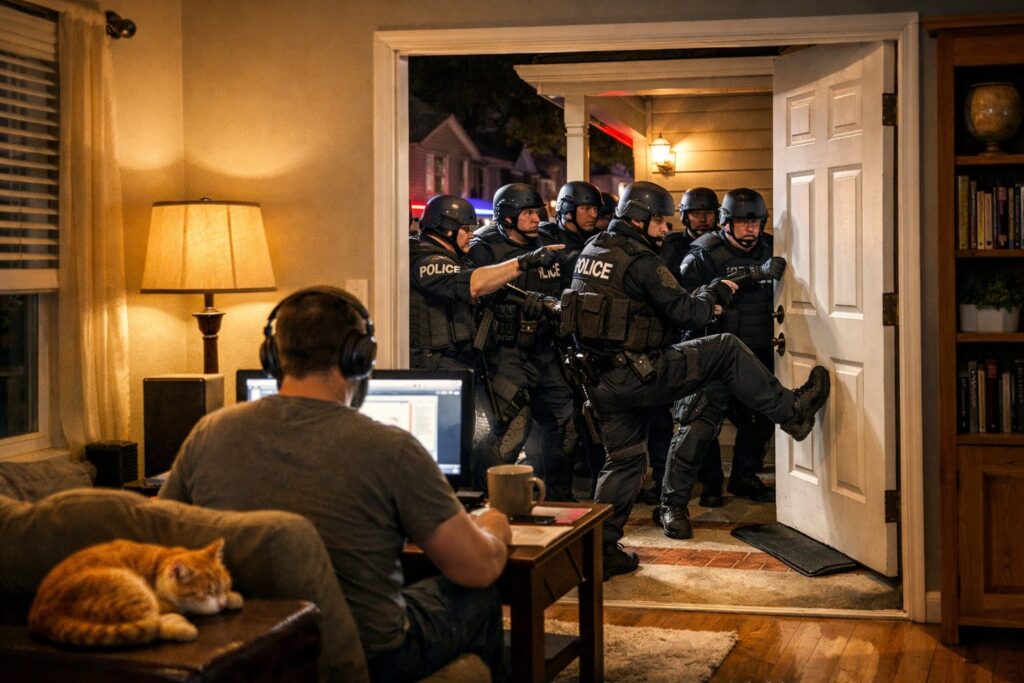
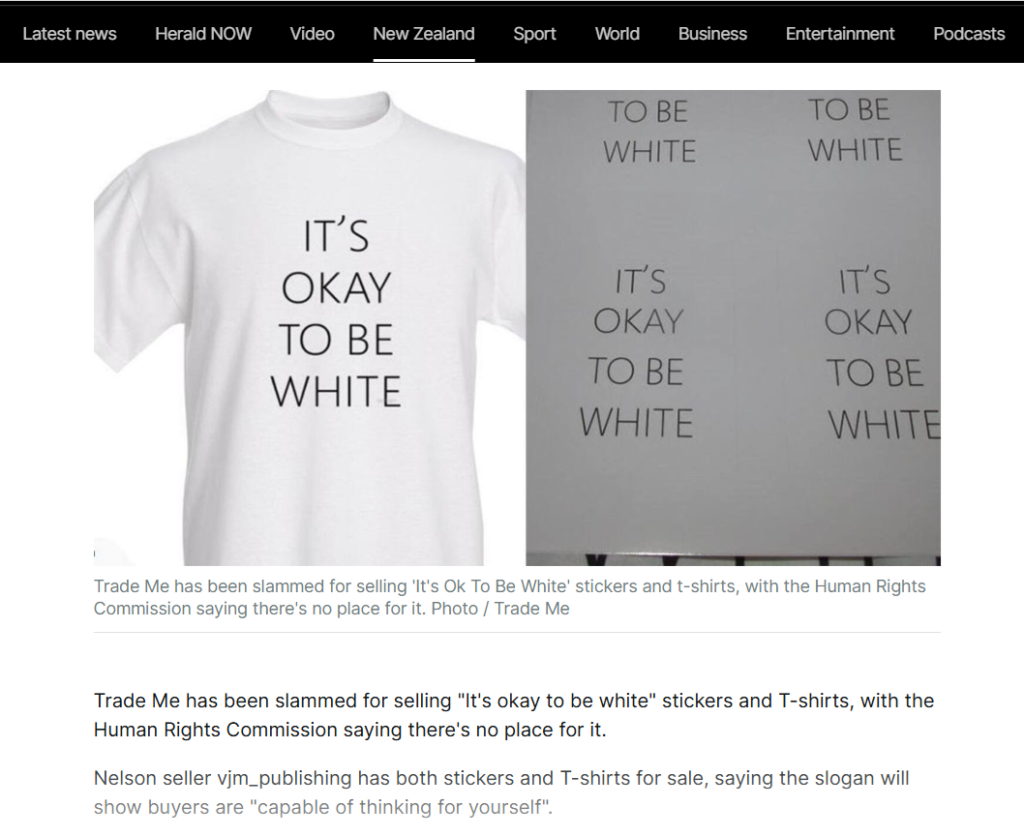
This condition is on the rise today because society is naturally traumatising. It’s naturally traumatising to work a full-time job for minimum wage, just to see most of it disappear in taxes and rents, or to live in a media environment where it’s not okay to be white, and, if you say that it is, you get a visit from the cops, or to live in a culture where spirituality is reduced to either worshipping an idol of a dead rabbi or nothing. Thus, there are a lot of people out there who are damaged.

Because society is so traumatising, and because there are so many damaged people in it, schizophrenia has come to appear more and more normal. In a vicious cycle, this leads to it getting diagnosed less. So there are a lot of people out there with split minds who are completely unaware that their minds are so split. Many of them have extremely difficult lives emotionally and socially, but are never able to figure out why.

These wretched masses are the undiagnosed schizophrenics.

The first sign of undiagnosed schizophrenia in another person is extreme moodiness. If a slight irritation causes so much rage that it feels like another personality has been brought out, chances are a split mind underlies them both. Schizophrenia and multiple personality disorder (dissociative identity disorder, or DID) are different conditions, and borderline personality disorder is different still, but they all overlap to some degree. If excessive moodiness is not part of DID or borderline personality disorder, it could be undiagnosed schizophrenia.

A deeply traumatised person will often react strongly to reminders of the trauma, even if those reminders are only subconsciously perceived. Thus, being asked to do something, even politely, can provoke a powerful anti-social reaction because it reminds the hearer of being ordered around by their parents. Such reactions are typical of undiagnosed schizophrenia.

Perhaps the most telling sign is self-contradiction. If a person claims to hold a certain moral value one moment and then deny it the next, something isn’t stitched together right in their mental fabric. This is also true if they say one thing and do another. This is especially true if a person doesn’t keep their promises, which often happens because they feel that one part of the mind made the promise and another part is being asked to keep it.

Another sign is substance abuse to deal with the suffering. As mentioned above, schizophrenia is a deeply unpleasant condition to live with. It’s common for people with the condition to use drugs in an effort to alter their emotions into something more tolerable. If someone’s natural state is so unpleasant that they need substances to cope, it’s very possible they’re an undiagnosed schizophrenia case.

The popular narrative is that people get “addicted” to drugs on account of that the drugs are inherently pleasurable. But this narrative misses the reality that some people are much more susceptible to habitual drug use, because their natural state is unhappiness. For the people who have schizophrenia, undiagnosed or otherwise, it costs enormous emotional and mental energy trying to figure out what’s going on. Without release in the form of substances, many of these people would crack.

Perhaps the most salient sign of undiagnosed schizophrenia is poor decision making. If a person consistently makes truly bad decisions, as if sabotaging themselves, there’s a very high chance they’re an undiagnosed schizophrenia case with one part of their mind working against the other. This goes double with the point above about substance abuse: if they keep sabotaging themselves with hard drugs, for no obvious reason, undiagnosed schizophrenia is very possible.

Taken together, these four signs often reveal an underlying pseudo-schizophrenic condition.

Undiagnosed schizophrenia is a vastly underestimated problem in our society. Only by taking trauma and mental health seriously can we hope to overcome it.

*

For more of VJM’s ideas, see his work on other platforms!
For even more of VJM’s ideas, buy one of his books!

*

If you enjoyed reading this piece, buy a compilation of our best pieces from previous years!

Best VJMP Essays and Articles of 2023
Best VJMP Essays and Articles of 2022
Best VJMP Essays and Articles of 2021
Best VJMP Essays and Articles of 2020
Best VJMP Essays and Articles of 2019
Best VJMP Essays and Articles of 2018
Best VJMP Essays and Articles of 2017

*

If you would like to support our work in other ways, make a donation to our Paypal! Even better, buy any one of our books!
Free Range Slavery

For most of human history, slavery has been central to all economies. Ownership of human livestock has always been the single most profitable endeavour of all, as it allows the owners to claim the productivity of the slaves. Countless wars have been fought both to capture slaves and to free them. But a number of misconceptions have arisen about the practice of slavery, both in the past and in the present.

The story we are given is that slavery has existed forever, and continued up until the British Empire banned the trade in 1807. From there it was gradually banned throughout the rest of the world. Except for one particularly violent disagreement in America in the 1860s, the world was happy to get rid of slavery, and in doing so we all moved forwards into a more equitable and respectful future. Today we are all equals, born with the same opportunities.

In reality, slavery continued, it just switched from the plantation slavery model to the free range slavery model.

In the old days, slaves were usually bound to a particular plot of land. This was because the demand for their labour initially came from landowners, who wanted someone to work their farms without payment. The origin of this practice can be seen in the behaviour of the alphas of chimpanzee troops, who control access to food and sexual resources. In the same way subordinate chimpanzees must obey the alpha or face physical violence, the slaves must obey their masters.

The landowners in such cases were often plantation owners. This is the model of slavery most common to the New World, a.k.a. the hacienda model. In the antebellum American South, slaves would often spend their entire lives on the same plantation. The problem with this model is that the slaves are obviously slaves. Therefore, they are liable to rebel.

Free range slavery is the solution to the problem of rebellion. Permit the slaves some freedom of movement, and the freedom to choose the plantation upon which they will labour, and they won’t get discontented enough to rebel. This is doubly true if you also have a gigantic propaganda apparatus brainwashing everyone into thinking they’re as free as they could ever wish to be. It’s triply true if you also have a security apparatus devoted to destroying anyone who realises any of the above.

The new ruling class of the Industrial Age were factory owners, not plantation owners. This ruling class had the insight that enclosing the commons, making it impossible for many to sustain themselves, would create a large number of desperate people willing to work for very little. Free range slavery began with the enclosure of the commons in acts such as the Highland Clearances. The people so cleared had to move to the cities and take work in factories, where they were regularly put to work for 70-80 hours per week.

In spirit, free range slavery is enslavement on the class level, something made more possible by modern technology. This technology allows for an unprecedented level of co-operation among the slave-owning classes. These ruling classes co-operate closely through two-way technology such as the telephone, while the middle and working classes are divided and conquered through one-way technology such as the television.

In the free range slavery model, each slave is free to choose the plantation on which they work. But the system is rigged so that, no matter which plantation they choose, they can never overcome slave status. No matter how high their wage, they have to pay so much in taxes, rents and other expenses that they are just as incapable of improving their position as the plantation slave.

A man who works 60 hour weeks, 250 hours/month, making $10/hour, will make about $2000/month after tax. Average rent for a one bedroom apartment is $1000/month in many American states. His bills for groceries, healthcare, electricity and other utilities will come to at least $500/month. This will leave him at most $6,000/year to put towards a house – and the average American house price is now above $370,000, so it will take him at least 60 years to get there. In practice, he will never get there, because working 60 hour weeks for 60 years is not realistic. But he will probably put in a lot of effort before he realises this.

Those who already own all the land are laughing all the way to the bank at this arrangement.

There are several advantages to the free range slavery model, which essentially maximises horizontal freedom at the same time as minimising vertical freedom.

The first, and most obvious, is that the slave owners no longer have to bother with the feeding, shelter and upkeep of the slaves. Those things are now the slaves’ problems. This is much more efficient for the slave owners, who now only have to manage the slaves during working hours. Outside of working hours, the free range slave manages itself.

A second advantage is that the free range slave can be manipulated into believing that his difficulties are his own fault. This makes him much less likely to blame the slave owners and landlords. If a free range slave can’t afford housing, he can simply be told that he isn’t working hard enough. Likewise if he can’t afford decent food. If he gets killed by rent, he can be blamed for choosing to live in a high cost-of-living area. Can’t or won’t relocate? Then he doesn’t really want freedom enough.

The main advantage to the model is that the slaves never figure out that they are slaves. If they were forced to wear shackles, or if they were whipped by overseers, they would figure it out in short order. But because they are free range slaves, any of them who complains about their conditions is met with “You can always get another job somewhere else.” Because they’re always scrambling to find or to keep employment, they never figure out that they are structurally enslaved in a way that individual action cannot overcome.

Free range slavery is, therefore, correctly understood as an ingenious system of mass enslavement with minimal resistance.

*

For more of VJM’s ideas, see his work on other platforms!
For even more of VJM’s ideas, buy one of his books!

*

If you enjoyed reading this piece, buy a compilation of our best pieces from previous years!

Best VJMP Essays and Articles of 2023
Best VJMP Essays and Articles of 2022
Best VJMP Essays and Articles of 2021
Best VJMP Essays and Articles of 2020
Best VJMP Essays and Articles of 2019
Best VJMP Essays and Articles of 2018
Best VJMP Essays and Articles of 2017

*

If you would like to support our work in other ways, make a donation to our Paypal! Even better, buy any one of our books!
What Orwell Meant By “War Is Peace” And Why It’s So Relevant

One often hears reference to the phrase “War is Peace” from George Orwell’s 1984. VJM Publishing mentions it all the time. In fact, we mention it so much, that I often cringe when making essay compilations, because it comes up so often. I say “surely this is a cliche now?” In truth, it’s not a cliche because 1984 is as relevant as The Iliad. Everyone knows the basics of it by now because they must.

In 1984, Big Brother has three mottos. The first of these is “War is Peace”. The application of these mottos is how order and control is maintained (this ordering and controlling is discussed at length in the book-within-a-book, The Theory and Practice of Oligarchical Collectivism, which is in my opinion the most important 20 or so pages ever written in English).

It’s understood by most that this phrase refers to external war. If an authoritarian government provokes a state of war with a neighbour, the people’s anger will be deflected from their government to that neighbour. Thus authoritarian rulers start wars to deflect blame for how poorly run their countries are.

Many of us were taught about Saddam Hussein as a classic example of this phenomenon. Hussein, the television told us, attacked Kuwait to deflect the dissatisfaction of those he ruled over onto an external enemy. This is actually a pattern common to Middle Eastern rulers in recent times, and also in various other times and places throughout history.

But not enough people understand that this phrase also refers to internal war.

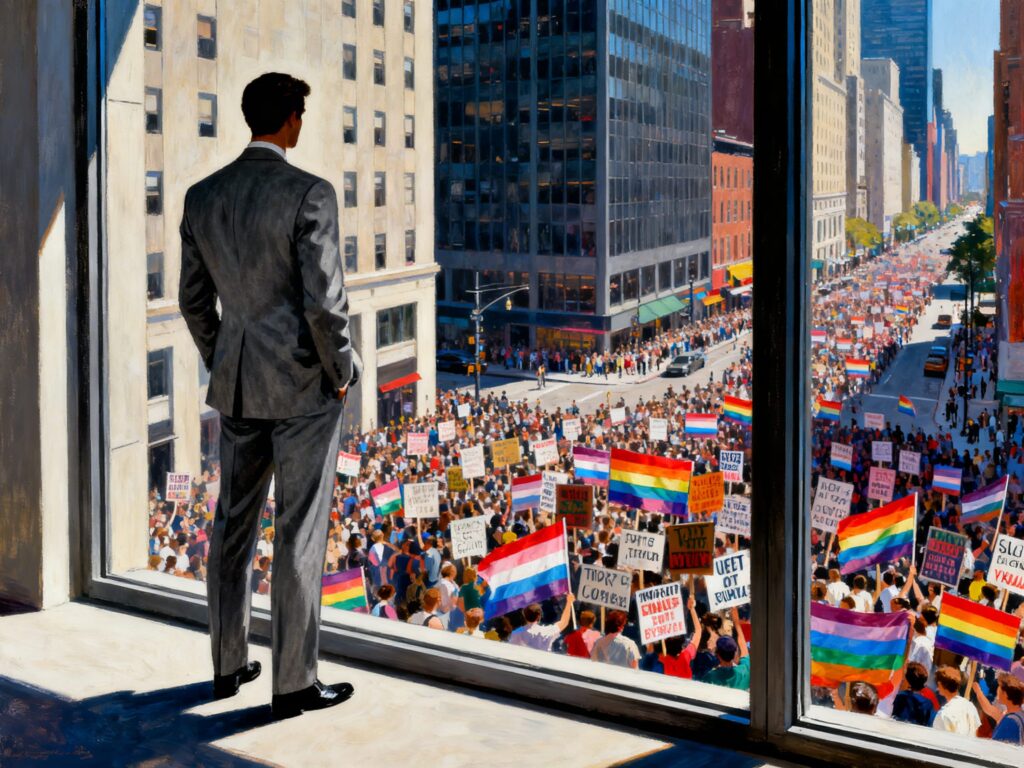
If the ruling class can set the masses against each other, they can secure their own position at the top of the pyramid. They do this, in practice, by fomenting discord along every existing social fracture line, and by creating new ones. The middle class is set against the working class by telling the former that the latter are lazy, and telling the latter that the former are greedy. Whites are set against browns in the same manner. Men are set against women by telling the latter that the former are trying to control them, and by telling the former that the latter are trying to vote away all their money.

In this manner, everyone is encouraged to have someone to hate who isn’t the ruling class. All discontent is directed horizontally at someone else on the same level. This leaves the ruling class safe and secure above it all.

Without this concept, the modern world can’t be explained.

It’s simply impossible to explain why Western ruling classes imported so many Muslims and Africans without reference to War is Peace. Everyone honest and intelligent knew that these Muslims and Africans would attack and harm the people in the neighbourhoods they were dumped in. But it must be understood this was precisely the point. The point was to subject working-class families to countless violent and sexual crimes. The point was to encourage those working-class people to hate the newcomers. In doing so, the working class would forget their grievances against the ruling class. And thus the position of the ruling class was secured.

It’s also impossible to explain the War on Drugs without such a reference. Why would the political establishment destroy so many of the finest minds of their younger generations by saddling them with criminal convictions, when all they wanted to do was explore consciousness and spirituality? War is Peace explains: the ruling class wanted the pro-drug and anti-drug segments of the population to be at each other’s throats. So it must either err on the side of excess restriction (War on Drugs), or err on the side of excess liberty (as with alcohol): it cannot take a reasonable middle ground. In either case, rationality must be eschewed, because that would lead to peace, which, viewed from the perspective of the ruling class, is war.

It’s also impossible to explain why the mainstream media pushes so much cortisol-raising fear porn unless this concept is understood. Why does the mainstream media constantly stir discord and misunderstanding? Why does it platform the worst examples of almost every demographic, and ignore the best? Because the owners of it want discord and misunderstanding. Not because it “drives clicks” – they don’t need money. They want control. They want to be the boot stamping on the face of the masses, forever. To achieve this, they need to foment war among those masses.

Everyone with any real chance of becoming part of the ruling class understands this principle, and habitually applies it by setting normal people against each other. Demonstrating an ability to do this is how people audition for a place in the ruling class.

Essentially, the logic behind “War is Peace” can be explained as: war for my enemies is peace for me. This is relevant because the Western ruling class is using this exact logic to destroy the Western middle and working classes. In most cases where there is clear evidence of social dysfunction or decay, the War is Peace principle is being applied somewhere.

*

For more of VJM’s ideas, see his work on other platforms!
For even more of VJM’s ideas, buy one of his books!

*

If you enjoyed reading this piece, buy a compilation of our best pieces from previous years!

Best VJMP Essays and Articles of 2023
Best VJMP Essays and Articles of 2022
Best VJMP Essays and Articles of 2021
Best VJMP Essays and Articles of 2020
Best VJMP Essays and Articles of 2019
Best VJMP Essays and Articles of 2018
Best VJMP Essays and Articles of 2017

*

If you would like to support our work in other ways, make a donation to our Paypal! Even better, buy any one of our books!
21st Century Signs Of A Slave Mindset

Many people believe that slavery ended in the 1860s in America, in the 1820s in the British Empire, and it hasn’t existed since then. In reality, slavery just changed forms. It became more subtle.

In truth, our rulers don’t need to put chains on our bodies, because they already have chains on our minds. In the 21st Century, people are made into slaves not through beatings but through relentless, all-pervasive media propaganda, psychological brutalisation in schools, unforgiving work schedules and an irrational, capricious government. This mental beatdown creates slave mentality, of which various signs are evident.

The first and most obvious sign that a person is spiritually a slave is being against freedom. If they don’t understand what motivated the American Revolutionaries, they are very likely to possess powerful slave sentiments. Note that this doesn’t mean free people necessarily support degeneracy: the degenerate is as much a slave to their biological impulses as anyone is a slave to anything.

Freedom as a philosophical concept is rejected by all spiritual slaves. They simply don’t understand the pleasure that comes from exercising free will. Ever the yin element, they prefer to be directed.

A slave mentality is often present in cases where a person doesn’t understand the important freedom issues of the day. Those who vote against cannabis freedom in the various referendums want the government to tell them what they’re allowed or not allowed to do, which is pure slave mentality. Someone without a slave mindset will naturally try to maximise their agency. Thus they support freedom as a general principle.

A second sign of a slave mindset is a tendency to lick upwards and kick downwards. The tendency to fawn towards one’s social superiors and abuse one’s social inferiors is extreme in many Third World cultures, and Western travellers immediately notice.

The tendency exists in Western countries too (but to a lesser extent) as it reflects an aspect of human nature: when enough fear is put into a person they become vicious. This viciousness is the reason for the abuse of the weak. In contrast to the truly belligerent, however, those with slave mindset do not challenge the strong.

A third sign is respecting violence more than intelligence. In a normal, healthy society, people think further than their immediate environment. Those who are the best at that naturally gain esteem and rise in the social hierarchy, where they are given power to make some decisions on behalf of the collective. This is natural because the survival of the tribe is best served by giving the most power to those who have the deepest understanding of reality.

In slave morality, normal morality is inverted. Long-term thinkers are resented, and short-term, impulsive thinkers are prized. Anyone who thinks long-term is assumed to be weak, nerdish, sickly of mind. Thoughtfulness is hesitance is weakness. Being “tough” is more important than being wise or intelligent. Thus, the most thuggish and aggressive are at the top. The slave doesn’t see such people as thuggish, of course, but rather cool, fun, spontaneous, powerful etc.

A fourth sign is perhaps the most subtle, but also the most characteristic: resentment. As Nietzsche understood, slaves feel immense resentment at the strength and beauty of free people. A person deep into a slave mindset will feel resentful at life itself. If a person resents the role that Fate seems to have placed them in, and makes life harder for others thereby, they are a certainty to possess a slave mindset.

A perpetual bad mood is a clear sign that a person knows they’re a slave and can’t get over it. If a person is constantly surly, disagreeable, sullen – chances are very high you’re dealing with a slave mindset.

A fifth, and probably the most telling sign, is that a person has given up. There is a great word in Swedish called ‘uppgivenhet’, which means ‘resignation’ in English, but which literally means ‘given-upness’. A person’s level of slave mentality correlates highly with their level of uppgivenhet.

Much like the dog that has been shocked so many times that it lacks the will to take an obvious escape offered to it, a person who has given up will do nothing to better their situation even when presented with opportunity. Those who, when given freedom, spend it watching television, mindlessly scrolling, gossiping or boozing are slaves by any other name.

It’s best to avoid people who demonstrate these five signs of a slave mindset. They won’t lead you into physical bondage but even worse: psychological enslavement.

*

For more of VJM’s ideas, see his work on other platforms!
For even more of VJM’s ideas, buy one of his books!

*

If you enjoyed reading this piece, buy a compilation of our best pieces from previous years!

Best VJMP Essays and Articles of 2023
Best VJMP Essays and Articles of 2022
Best VJMP Essays and Articles of 2021
Best VJMP Essays and Articles of 2020
Best VJMP Essays and Articles of 2019
Best VJMP Essays and Articles of 2018
Best VJMP Essays and Articles of 2017

*

If you would like to support our work in other ways, make a donation to our Paypal! Even better, buy any one of our books!