

Writing Characters of Silver

The fifth element from the bottom of the spiritual hierarchy is silver. This is the stage a character reaches when they have enough spiritual energy to begin to shine. A person enters the realm of silver once they start to value non-physical treasures. In doing so, they make it possible for people to co-operate on a level above that of the family.

The lustrous nature of silver is what gives it its greater value. Like copper, silver has also been used as a currency for thousands of years, only silver was more desired, and therefore more valuable. Silver is rare and valuable enough that the presence of it can change the energy of an environment. This is true both physically and metaphysically.

A character will begin to enter the realm of silver once they come to appreciate the limitations of the realm of copper. Usually this occurs once they start losing interest in the opposite gender, at least in the sense of starting a family with them. Once they move past that and start thinking about groups of families, they move into the realm of silver. It is characters of silver who hold villages and towns together.

Note that a character of silver loses interest in the opposite gender because they transcend them, not because they start to dislike them. Hating the opposite gender marks one out as belonging to the baser elements. A character of silver is the sort of character who starts to prefer reading books to courtship and romance. As such, getting laid loses relative importance.

In this sense, silver represents knowledge, or intellectual capital. The realm of silver is the realm of psychology. As such, it is rare. The vast majority of the world is preoccupied with surviving, or with getting money or sex, or at least having a good time. To value knowledge for its own sake is rare and precious.

The archetypal character of silver is a librarian. Surrounded by books, each one containing the accumulated wisdom of a lifetime, is where the character of silver feels most at home. The power of silver is that one book can organise a force powerful enough to resist a thousand knights. Thus, silver is higher than and more valuable than copper or iron.

To the ancients, silver represented the Moon, which itself represented the divine feminine principle. Thus, silver came to be associated with the divine feminine. The apogee of silver is in outsmarting a character of iron. The story of Odysseus outsmarting the Cyclops is an archetypal example, as is the fable of Aesop where the Sun outsmarts the wind.

One association of silver and of the Moon is of coldness. The realm of silver is for hard-headed logical thinkers. It’s for those who can trap their chess opponents with sophisticated strategems. In the biological world, the element of silver is best represented by the spider, who spins a silvery web that entraps those of lesser intelligence.

This alchemical representation is from where we get the expression ‘silver-tongued’. This refers to someone with intelligence but no higher spiritual sense. To be silver-tongued is to be able to speak eloquently and persuasively, without necessarily being inspired by any deeper spiritual sense. Many would describe a character of silver as ‘glib’.

The archetypal occupation of a character of silver is a lawyer. A classic modern representation is Al Pacino’s character in The Devil’s Apprentice. Other examples of characters of silver in fiction are Faust‘s Mephistopheles, Loki in the Norse Pantheon or Shakespeare’s Shylock.

Another typical occupation is politician or merchant. The distinctive characteristic of a character of silver is that they do not need physical wealth because they can extract it from other people at any time. Any real character of silver ought to be able to turn up in a new town and weasel his way into the local power structure.

This reveals the dark side of the characters of silver. They have their own conceit, known as the Conceit of Silver, which is the act of mistaking one’s metaphysical capacity for one’s moral capacity (this is shared with characters of mercury, only the latter suffer from it to a lesser extent). Thus, they come to believe that their intellectual aggression or wealth gives them the right to rule over other people.

The reality is that neither knowing a great deal of information nor having a great deal of money confers any righteousness. Neither have any real value if not guided by a refined moral sense. Characters of silver do not inherently understand this, and those that do are on their way towards entering the realm of mercury.

A character of silver might have trouble conceding this point. Although they are illuminated compared to characters of copper, iron, tin and lead, they are not perfect. Characters of silver are entirely capable of being petty, vain and narcissistic, on account of that they are just close enough to perfect to mistake themselves for it.

Typical of this dark side of the characters of silver is intellectual arrogance. Being intelligent but not possessing true humility, the character of silver often has a deep-seated desire to be acknowledged as an intellectual authority. This is not usually a problem if they genuinely are an authority in the subject matter. In cases where they are not, they are capable of misleading great numbers of people, and causing awful damage.

The character of silver often resents the character of mercury, who is truly intelligent. This can lead the character of silver to try and trick the character of mercury, usually by memorising enormous amounts of information under which to bury their opponent. Characters of silver are masters of rhetoric. Although they are intelligent enough to see the truth, they don’t necessarily recognise the need to speak it.

Related to this, characters of silver are often found as cult leaders, pretending to be characters of gold. They might not be of the gold, but characters of silver are still illuminated enough to attract a considerable following from among those who recognise their higher value. Their capacity to accumulate knowledge means that they can often correctly diagnose problems – it’s just that their solutions, not coming from a moral foundation, are lacking.

Despite all this, most characters of silver are good people and all are motivated by less petty concerns than characters of copper, iron, tin and lead. Characters of silver will almost never abuse children or animals, and neither are they prone to lashing out violently or becoming drug addicts. Their flaws are easily forgiven on account of the weight of their virtues.

Generally speaking, characters of silver are held in high regard by decent people for the order they help to impose upon society. Because of their knowledge, their lives tend to be well-run, and their communities tend to be well-organised. A character of silver in your story could well be one that has a great influence on the protagonist or antagonist.

*

This article is from Viktor Hellman’s The Alchemy of Character Development, the sixth book in VJM Publishing’s Writing With Psychology series. This book will show you how to use alchemy to create deep, realistic and engaging characters for your creative fiction.

*

If you enjoyed reading this essay, you can get a compilation of the Best VJMP Essays and Articles of 2019 from Amazon for Kindle or Amazon for CreateSpace (for international readers), or TradeMe (for Kiwis). A compilation of the Best VJMP Essays and Articles of 2018 and the Best VJMP Essays and Articles of 2017 are also available.

*

If you would like to support our work in other ways, please consider subscribing to our SubscribeStar fund. Even better, buy any one of our books!
How God And Evil Can Coexist

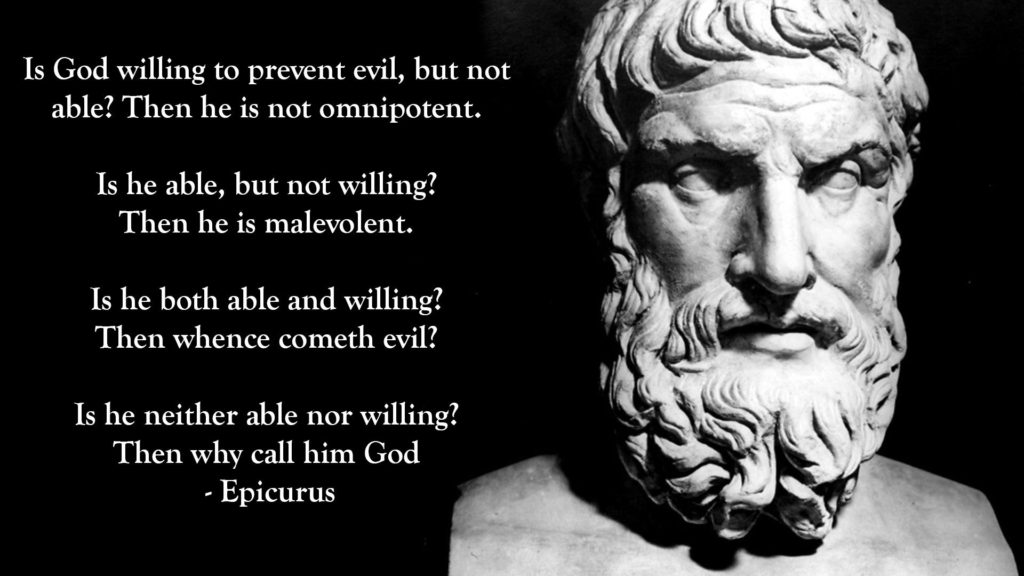
One of the great philosophical and theological conundrums is how God and evil can coexist. This question has been discussed for over 2,500 years, and no resolution has been agreed upon. This essay will describe how the conundrum is resolved by the philosophy of Elementalism.

This conundrum is usually expressed in the words of Epicurus (see image at top of page). Believers in God often make the claim that God is both omnipotent and omnibenevolent. This creates a paradox in the mind of non-believers, on account of that evil and suffering exist in the world.

If God is unable to prevent evil, then God cannot be omnipotent. If God is able, but not willing, then God cannot be omnibenevolent. This paradox could be called Epicurus’s Fork, on account of that the believer in God cannot easily reconcile their belief in God’s omnipotence and omnibenevolence with the fact that evil and suffering exist.

Reconciliation of this paradox is easy for the Elementalist, however.

The first thing to state is that Elementalists have a particular conception of God and creation. The Elementalist believes that all individual consciousnesses are fragments of God, and therefore God is not something separate to ourselves. It’s more accurate to say that we, collectively, are God.

Likewise, Elementalists have a different conception of creation. The material world is not something that we woke up in – the material world is a dream that we collectively manifest through our will and karma. More specifically, our experience in the material world is considered to be an infinitely small subsection of something called the Great Fractal.

So how does that relate to the coexistence of God and evil? The answer lies in understanding what existence would be like without the illusion of a material world.

Our consciousnesses only feel suffering because we identify with our bodies. Our bodies are transitory phenomena, and like all transitory phenomena they are in a constant state of flux. This flux is usually painful. As a consequence, we need to act to balance it out. When our bodies get hungry we eat, when they get tired we sleep, when they feel pain we need to attend to it.

Without the illusion of a physical body in a physical world, our consciousnesses would exist in a state of perfect bliss, united with God. Absent a body, we would not have any cause to feel pain or fear of death. Absent a mind, we would not have any cause to feel anxiety or fear of the future. The only thing that would exist would be consciousness.

And it would be as boring as shit.

What would it be like to not suffer? It would be to live a life that was utterly devoid of meaning. Without the possibility of suffering, it wouldn’t matter what actions we chose. Every choice would lead to an identical outcome, at least as far as suffering is concerned. As such, our choices would be totally meaningless. We’d simply drift senselessly through life, like a leaf on a river.

This absence of meaning is the root of spiritual suffering, a worse affliction than any physical suffering could be. People rarely kill themselves from physical suffering, but they kill themselves from spiritual suffering every day. The physical suffering inherent to life, then, is not the worst thing in the world. Neither is the emotional suffering that is also inherent to life on account of that we cannot possibly satiate all of our desires.

We might have to act like physical and emotional suffering is ultimately terrible in order to give life meaning, but the reality is that an absence of meaning would be an even greater suffering.

It’s possible, then, for an omnibenevolent God to allow a minor suffering in order to prevent a major one. If the meaninglessness that accompanies existence in a state of perfect bliss can only be overcome by casting individual fragments of consciousness into a world of eternal misery, then so be it. Cast us, O God, into eternal misery!

At this point, some people will ask: “If Elementalists think that suffering is good, what’s stopping them from deliberately acting to increase suffering? If suffering gives life meaning, then why not go around raping and murdering? After all, it would create plenty of meaning in people’s lives as they struggled to resist you.”

Such questioners must be referred to the Law of Assortative Reincarnation. Elementalists believe that the energy one expresses into the world becomes the energy of one’s consciousness, and that the energy one receives from the world is a reflection of that same consciousness. As within, so without, and as without, so within.

An Elementalist would only act to increase the level of suffering in the world if they themselves wished to incarnate in a world of beings who behaved in that manner. Because this is extremely unlikely, it’s also extremely unlikely that an Elementalist would knowingly act to cause more suffering. The Elementalist belief is that there is enough suffering in the world naturally to give everyone’s life meaning, and so it doesn’t need to be added to.

In summary, Elementalists see no contradiction in believing in an omnipotent and omnibenevolent God despite the presence of evil. It doesn’t matter that a will to cause suffering exists in this world, because that will ameliorates a greater suffering: that of living a meaningless life.

*

If you enjoyed reading this essay, you can get a compilation of the Best VJMP Essays and Articles of 2019 from Amazon for Kindle or Amazon for CreateSpace (for international readers), or TradeMe (for Kiwis). A compilation of the Best VJMP Essays and Articles of 2018 and the Best VJMP Essays and Articles of 2017 are also available.

*

If you would like to support our work in other ways, please consider subscribing to our SubscribeStar fund. Even better, buy any one of our books!

The Elementalist Exhortation Against Suicide

Camus wrote that humanity is constantly challenged by the ever-present prospect of suicide. To many people, it isn’t obvious why one should keep going in a world with as much suffering in it as this one. Elementalism exhorts people not to kill themselves, a position that is outlined in this essay.

The approach of many other ideologies is to say that committing suicide will cause you to go to Hell. There’s some truth to this, but it’s a crude and superstitious explanation, and as such is not convincing to most adults. Elementalism offers a much more persuasive admonition: to commit suicide is to cause oneself to be reincarnated in a world where people commit suicide.

At this point, a distinction needs to be drawn between tragic suicides and understandable suicides.

A tragic suicide is usually one where the suicide leaves behind people that cared for them. That is to say, the suicide increases the net amount of suffering in the world. The vast majority of suicides of young people are tragic ones, on account of that young people usually have a number of family and friends who care for them and who would be upset by their death.

An understandable suicide is one that does not increase the net amount of suffering in the world. An example might be when a person is so old that their remaining life is no longer worth living, but to continue is to suck up resources that could be used on someone else. If a person has outlived all their friends, their brothers and sisters, and their wife or husband, they might not be causing more suffering by ending their life.

Elementalists believe in the Law of Assortative Reincarnation. This is the belief that the consciousness of individuals and the consciousness of worlds are matched by a process of metaphysical assortment that occurs after the death of the physical body. A corollary of this is the belief that people incarnated into this world because they deserved to.

Fundamentally, it doesn’t really matter if a suicide is tragic or understandable, because one is not assorted into the next world based on categorical variables (such as suicide or natural death, believer or non-believer) but based on a continuous variable, namely one’s frequency of consciousness. Therefore, the assortment is much more precise than what most people think it is.

As stated above, a person reincarnates into the next world because the frequency of that person’s consciousness matches the frequency of that world. Thus, it can be stated that the actions of the beings in the next world will be reflective of your actions here in this one. If your actions here are violent, reckless and indifferent to human suffering, then the actions of the beings in the next world will reflect that.

So a suicide might well find that they reincarnate in the next world, and start to live a life in the hope and expectation that they can wring some joy out of it, only to have (for example) a child of theirs kill themselves at a vulnerable moment. Or perhaps they reincarnate in the next world and are left orphaned by a parent’s suicide. The extremely callous and violent nature of a tragic suicide means that being confronted with such things in the next life is all but inevitable.

Note that the above examples are only examples. It is not possible to say that simply because you do something in this world that it will get done to you in the next, therefore it’s not as simple as saying that suicide leads to suicide. But if you live a life on a frequency of murderous self-hatred that leads to suicide, you will manifest in the company of similar beings, and you might not like it.

More to the point, perhaps, someone who struggles with depression or despair and overcomes it will also find that their frequency of consciousness comes to reflect that. Therefore, the sort of people they will attract, both in this life and the next, will be the sort of person who suffers and then overcomes it. In other words, men and women of gold.

Gold is made by transmutation of energies. If a person can suffer and yet transmute that energy into something positive – so that the initial suffering eventually led to a net reduction of suffering – then they have successfully practised gold magic. The ability to transmute suffering into its opposite is the highest of all arts, and commensurately, the transmutation of suicidal suffering into its opposite is among the greatest of all achievements.

An Elementalist who properly understands these doctrines will be extremely disinclined to kill themselves, for these reasons. It would be much better to not kill oneself, and instead to take the opportunity presented by life in this place to raise one’s frequency of consciousness by transmuting suffering into joy. This is the true path of liberation.

Understanding the Law of Assortative Reincarnation is to understand that, in the next world, we will be enveloped in the very same energy that we expressed in this life. Therefore, the greatest imperative is to act to transmute suffering into its opposite, and the least imperative is to act to bring further suffering into the world.

*

If you enjoyed reading this essay, you can get a compilation of the Best VJMP Essays and Articles of 2019 from Amazon for Kindle or Amazon for CreateSpace (for international readers), or TradeMe (for Kiwis). A compilation of the Best VJMP Essays and Articles of 2018 and the Best VJMP Essays and Articles of 2017 are also available.

*

If you would like to support our work in other ways, please consider subscribing to our SubscribeStar fund. Even better, buy any one of our books!

Navigating The Great Fractal

The vastness of the Great Fractal cannot be described in words, and describing how to navigate through it is hardly less complicated. But those unable to navigate it are condemned to live lives of maddening confusion as they are hurled to and fro by the winds of change. It is for them that this essay is written.

It is assumed that the reader already understands the basics of Elementalism, i.e. that materialism is bullshit, that consciousness is the prima materia and that all of the possible contents of consciousness relate to each other as if in a fractal of virtually infinite size. This essay will discuss how to navigate through that fractal, which Elementalists call the Great Fractal.

On account of that the materialist paradigm is dominant, people are used to thinking about setting goals in terms of time. We say to ourselves, “I would like to complete my degree/save up for a house deposit in four years’ time, so I need to do this and that now.” Then (according to the received wisdom), time passes, and eventually when enough time has passed and enough effort has been expended, the goal is achieved.

Elementalists understand that the material world and time are illusions. So how, then, does one get from Point A to Point B?

It has to be reiterated here that everything that one could possibly wish for is in the Great Fractal, one simply has to find a way to navigate there. Every possible situation in every possible world exists in the Great Fractal. Getting to where one wishes is not easy, primarily because most people are used to thinking of reality as a planet that one walks around, and are unused to thinking of reality as a metaphysical fractal that one navigates through.

Understanding this navigation is a matter of understanding frequency and the Law of Attraction.

By a person’s ‘frequency’ it is meant the frequency of their consciousness. This can be estimated on a scale from 0 to 1, where 0 is pure unconsciousness (like an NPC) and 1 is pure consciousness (like Buddha). The lower the frequency, the closer to psychopathic behaviour will be exhibited. The higher the frequency, the more it will ease the suffering of the beings around them.

A person’s frequency is the sum total of their actions, in both this life and in previous ones. If that person has taken selfish actions that ignore the divinity of others, their frequency will be dark and heavy. If they have taken actions that respect the divinity of others, their frequency will be bright and light.

Almost everyone who has ever lived has eventually asked themselves the question “How did I get here?”. Not in the context of any prosperity they may have achieved, but in the context of how they actually arrived to be on Planet Earth. The usual story is the materialist one – the Big Bang happened, then biogenesis happened, then life evolved into humans and then you were born. Elementalists understand it differently.

Everyone got to this place thanks to the Law of Attraction. The actions that you have made in your previous lives has caused your consciousness to resonate at a particular frequency. This frequency happens to be a close match to the frequency of this planet. In the context of the entire Great Fractal, it’s an extremely close match.

Every part of the Great Fractal has a frequency of consciousness that matches closely to the level of consciousness possessed by its inhabitants. It’s well-known that buildings and natural features can have a vibe or an energy of their own. Well, so can universes. Given that there are a practically infinite number of universes in the Great Fractal, there is a universe to match every possible frequency that a consciousness might resonate on.

In your previous lives, you would have been presented with a string of moral dilemmas, just as you were in this one. In response to those dilemmas, you would have made a variety of decisions. The sum total of the correctness or otherwise of those decisions is now represented by the frequency of your consciousness.

Thus, if you have lived a life where you were selfish and cruel, you will incarnate in a universe populated with other beings on a similar frequency. And this will be perfectly fair – after all, you justified those behaviours by performing them yourself. Therefore, you decreed that such actions were legitimate – even when they’re performed against you.

Elementalists call this process assortative reincarnation. It’s an application of divine justice, because every individual consciousness gets assorted to a universe that is appropriate to their frequency. This is a slower and more drawn-out version of the Law of Attraction. The difference is that navigating the Great Fractal is an endeavour that spans countless lifetimes.

In sum, navigating through the Great Fractal is simple. All one has to do is resonate at a frequency of consciousness that matches one’s desired destination. If one’s frequency of consciousness matches one’s desired destination, eventually one will find oneself manifesting there, whether in this life or a life to come – this is actually unavoidable.

The laws of the Great Fractal demand that this must be the case, for it is unjust for a high frequency of consciousness to be cast among the lower. This applies on the scale of both one lifetime and a hundred thousand.

*

If you enjoyed reading this essay, you can get a compilation of the Best VJMP Essays and Articles of 2019 from Amazon for Kindle or Amazon for CreateSpace (for international readers), or TradeMe (for Kiwis). A compilation of the Best VJMP Essays and Articles of 2018 and the Best VJMP Essays and Articles of 2017 are also available.

*

If you would like to support our work in other ways, please consider subscribing to our SubscribeStar fund. Even better, buy any one of our books!