Are You Trapped At Stage 4 of Kohlberg’s Scale of Moral Reasoning?

The majority of people can’t get past the idea that the law is the law and must be obeyed without question – which makes things hard for people who need medicinal cannabis

American psychologist Lawrence Kohlberg had a lifelong obsession with morality and moral reasoning, and the best-known result of his research was his six-point scale of moral reasoning. A continuation of the child development studies of Jean Piaget, the theory suggests that people develop through discrete stages of moral reasoning, with each stage more sophisticated, effective and enlightened than the previous ones. This article discusses the tremendous number of people trapped at stage 4 of the scale.

Kohlberg’s scale suggests that moral sophistication develops over the course of a person’s life, with entry into each new stage marked by a brand new perspective which is different to the old one but still a derivative of it, in the sense that the individual holding it has “grown up” and become more of a functioning adult.

Essentially, most people start out with a similar level of moral reasoning to that of a wild animal. Kohlberg euphemistically referred to this stage as “Pre-conventional” and it consists of the wretches who do nothing but try to avoid punishment in stage 1, and the narcissists and psychopaths who are only interested in personal advantage in stage 2.

Conventional reasoning is where most people are. In this stage, moral decisions are justified with reference to what other people in society do or believe. Stage 3 of this involves an effort to display good intentions as defined by social approval, and a person here tries to be good and be thought of as good, wanting to earn a pat on the head.

In stage 4, a person comes to appreciate the value of the law. In this stage it becomes possible for a person to reason to themselves the need to follow a law or social convention despite that the people around them are not doing so. Someone here is capable of overcoming being induced by peer pressure into doing something immoral or criminal.

This is not the most sophisticated stage of moral reasoning, but in the same way that most people are intellectually unremarkable they are also morally unremarkable. In other words, most people just follow the herd and are neither vicious nor Buddha-like, and so they develop to here and no further.

It is speculated that most people never reach stages 5 and 6 of moral reasoning – collectively known as “Post-conventional” reasoning – on account of that they have neither the courage to stand out from the herd nor the intelligence to determine when it might be correct to do so. At these stages a person is willing to break the law if doing so would uphold a higher moral principle.

Kohlberg used to test the participants in his studies with something called the Heinz dilemma. This is a thought experiment in which the participants are invited to ask themselves if they might consider it morally permissible to steal a medicine if this was necessary to afford the medical treatment of a loved one.

New Zealanders often find themselves faced with something that we might call the Renton dilemma, after Rose and Alex Renton, who faced it. The Renton dilemma could be described as whether or not to act in order to help a sick person get hold of medicinal cannabis despite that the medicine has been prohibited by whatever local ruling power has claimed the authority to do so.

If a person was stuck at stage 4 of Kohlberg’s scale of moral reasoning, at which point they put the importance of the law above everything else, they would argue that Rose Renton should not have tried to get hold of medicinal cannabis without the relevant government approval, because laws like this must be obeyed for the sake of social cohesion.

The reason why this is dilemma is because a person who follows the law would not help a sick person get hold of medicinal cannabis, ergo they would let a sick person suffer needlessly for the sake of upholding the law.

A person at stage 5 of Kohlberg’s scale might not reason in such a manner, perhaps deciding instead that acting to reduce the sum total of human suffering in the world was more important than mindless obedience to a law that the people never consented to, and which was forced upon them on false pretenses and supported by lies.

Anyone who can’t get their head around the idea that the law can be wrong is likely stuck at stage 4 of Kohlberg’s moral reasoning scale, and it’s on issues at the forefront of cultural change, like cannabis law reform, where they get the most confused. Unfortunately, these people are by far the majority and the herd rules under the laws of democracy.

*

Vince McLeod is the author of the Cannabis Activist’s Handbook.
What’s Defective in the Brain of Gareth Morgan?

Most Kiwis have now had occasion to listen to Gareth Morgan and have realised that there’s something missing from his brain

New Zealanders have had a collective experience this year – 97.6% of us have seen Gareth Morgan on television or social media and thought to themselves “There’s something fucking wrong with that guy.” Even by the mediocre, ignorant, bombastic standards of the puffed-up pissants who comprise New Zealand’s political class, Morgan stands out as a particularly vile specimen. This article takes a psychological perspective to examine what might be wrong with the man.

Having a go at someone on the occasion of the sudden death of a beloved pet, as Morgan did upon the death of Jacinda Ardern’s cat this week, is about as worthy of admiration as having a go at someone on the occasion of the death of a grandparent. It’s a really low thing to do, and a person wouldn’t normally think to do it unless something was missing from their brain. After all, many pet owners consider their animal friends a legitimate part of the family.

Imagine if Sam Morgan suddenly died and Jacinda Ardern had a go at Gareth on social media, taunting him on account of the damage Sam did to the environment with frequent international air travel. It would be the most appallingly unprimeministerial conduct ever witnessed in the history of the country. The whole nation would be united in agreement that someone who behaved like that was not fit to run a pub, let alone lead a country, on account of lacking basic compassion.

That this sort of conduct is not beneath Morgan won’t surprise the large numbers of people who have observed him speak and got a creepy vibe from the man, as if he was someone who you wouldn’t leave alone in a room with a pet or a small child.

Probably the reason for this is that Morgan, like most individuals who give other people the creeps, has a very low opinion of the importance of other people. As evidenced by his proposal to buy a section of Awaroa Beach, Morgan considers other people lesser beings, their opinions less worthy, their feelings less valuable.

This is not news to anyone who criticised Morgan’s refugee policy on one of his billions of sponsored FaceBook threads, and was verbally abused as a consequence.

It is cause to believe that Morgan has utterly failed at what a psychologist would call the development of a Theory of Mind – in other words, Morgan has absolutely no idea what’s going on in other people’s heads.

This hypothesis is supported by Morgan’s rude, crude, almost autistic dismissals of other people’s viewpoints. Like most narcissists, Morgan responds firstly with disbelief and rage when people disagree with him, and then when this cools becomes snarky and contemptuous. No effort at creating a common understanding with another person is made – you agree with the truth as divined by Saint Gareth or you are simply subhuman.

No amount of explaining could get it into Morgan’s head that most people are appalled by a tax plan that calls for taxing the family home. For the vast majority of people, their tenure of dwelling is their basic security in life: their castle and their home base. Of course, someone with hundreds of millions who can buy a house with pocket change cannot understand these sentiments, but the telling thing is that Morgan made no effort to – anyone who disagreed was simply a misinformed idiot.

Neither does he seem to have the faintest idea how much joy people get out of cats, and therefore the great anti-depressant effect that cats have on the people that spend time around them. He seems to have completely failed to understand that most cat owners see their cats as fellow beings of a similar order of importance to other people. This is pretty weird, all things considered, because there are very few people who are mentally defective on such issues of empathy.

Probably the main reason for this failure is that Morgan just doesn’t care. Judging by his behaviour on the campaign circuit, other people are, for him, just tools to be used in the achievement of a greater objective.

In other words, Morgan shares a failure to develop a theory of mind with all manner of criminals, psychopaths and dictators, who, like him, are missing the basic empathy that makes people truly human.

Why Christianity Will Destroy The West (Again)

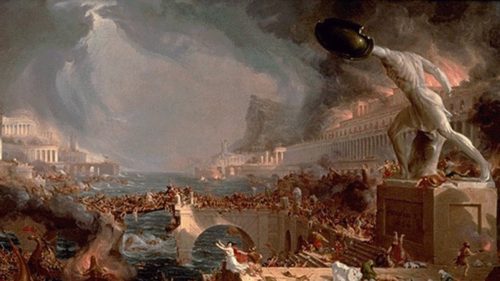
Christianity caused the 4th century Roman Empire to rot from within, until they were unable to secure their borders against invaders and collapsed. A similar fate is befalling 21st century Europe

Christian culture is defined by many things; virtue signalling, slave morality, resentment, passive aggression and self hatred are the foremost of these. This Abrahamic disease of the collective consciousness was fatal for the Roman Empire before us, and, unfortunately, the Western world hasn’t been able to shake it off for nearly 2,000 years. It’s going to be fatal for us too.

Mass immigration destroyed the Roman Empire – this is a matter of historical record. Fat, lazy and decadent, the Romans no longer had the will to defend their own Northern borders against Germanic barbarians, and that led to those barbarians having their will with the place. Free plunder resulted.

The Gothic War started in 376 when a huge number of Goths turned up on the border of the Roman Empire seeking refuge from the Huns. At first, Emperor Valens was pleased at the prospect of cheap labour for his workforce and willing soldiers (heard this story before?), but the unwillingness of the local population to support this foreign multitude of hungry mouths (what about now?) led to insurrection, and aided by traitors within the local Roman population (what about now?) the Goths were able to sack the place, leading to the eventual collapse of the Roman Empire.

All of this was made possible by the conversion of the Empire to Christianity, which turned the minds of the Romans away from reality and replaced their natural morality with the slave morality that we see expressed today in the legions of social justice warriors and cultural Marxists.

Angela Merkel is the daughter of a Lutheran minister, and her Christian morality was instrumental in her decision to open the borders of Germany to the hordes of Syrian migrants seeking refuge from people exactly like themselves.

Thinking like a Christian and striving to make a show of piety, and supported by wealthy, fashionable virtue signallers, Merkel decided to allow a million Syrians to have their way with the country she ruled, on the basis that they were claiming to need help and that submitting to this invasion would be charitable.

The same catastrophe is going to happen to us, for the same reasons, and the same people will be cheerleading for it.

The immensely privileged Alison Mau used her platform in the mainstream media to let us know yesterday that we were all racists for not wanting to take hundreds of refugees, despite acknowledging that these refugees were severely mentally ill, which would require that the mentally ill New Zealanders already present go to the back of the healthcare queue to accommodate them.

Her logic is that, if you are one of the tens of thousands of Kiwis who are desperate for mental health care from a system that you have paid taxes into and which your grandparents built, you’re going to have to get to the back of the queue behind a horde of people who have not inherited a birthright to the wealth of the nation.

As Dan McGlashan points out at several points in Understanding New Zealand, this is the major division on the left, between the privileged, usually Green supporters and the unprivileged, usually Labour and New Zealand First supporters. The privileged, like Alison Mau, having enough money to protect her from the cruel vagaries of life, are happy to support whatever cause is trendy this week without care for the consequences, because the consequences of mass “refugee” resettlement will fall upon the unprivileged. The unprivileged, like the working class of New Zealand, will see the community bonds of the neighbourhoods destroyed, and the queues in front of them for getting mental health care become longer, and the security of their women and elderly start to become jeopardised.

The self-righteous Christian sentiment that expresses itself as a desire to be seen to be virtuous and compassionate will destroy the West, and it isn’t the Muslims that necessarily do all the damage. They just do enough damage to make people lose their minds, as the Jews once did in Germany. And then, all Hell breaks loose.

The real danger is not Muslims, because they are a century from being a real threat to the West. The real danger is what we ourselves might get tempted to do when the hordes of Muslim “refugees” fail to integrate, and start to achieve territorial dominance in certain areas.

A Holocaust of Muslims in Europe this century is entirely plausible – not because such a genocide is itself plausible but because all the stupid shit that leads up to one is apparently in the process of being repeated. Like the yin and the yang, the excesses of one ideology lead to the excesses of its counter, and the excess of a narcissistic desire to virtue signal one’s likeness to the ideal of tolerance and compassion as embodied in Jesus Christ will be violence.

VJMP Reads: Anders Breivik’s Manifesto XV

This reading carries on from here.

In this section (pages 1235-1290), Breivik turns to the question of how to consolidate and organise European conservative groups. This is mostly to be achieved through the promulgation of what Breivik calls the “Vienna School” of ideology, so named because it was in Vienna where the last great expression of a European will to not be ruled by Islam took place.

For Anglo readers, some of Breivik’s philosophy will appear very curious. Some of this originality is a consequence of being European, such as his desire to resist “excessive US cultural influence”. He also believes in the idea of partitioning South Africa in two countries, with one for the Europeans. These sentiments he shares with many other European thinkers, not all of whom are right-wing.

Fundamentally, as is repeatedly emphasised, Breivik is looking for space away from what he considers hate ideologies. These hate ideologies are all as bad as each other in Breivik’s mind, and he claims to oppose any such ideology based on hate: “A multiculturalist is just as bad as a Nazi, which again is just as bad as a true Muslim, a communist or a fascist.”

The four most prevalent hate ideologies in the modern world, against which all nationalists and patriots much stand, are according to Breivik:

1. National Socialism (anti-Jewish hate ideology, racist in nature).
2. Islam (anti-Kafr hate ideology, Christians, Jews, Buddhists, Hindus, Atheists etc).
3. Communism (anti-individualism, anti-freedom).
4. Multiculturalism (anti-European hate ideology, anti-white racism).

Sometimes Breivik’s argumentation is so reasonable that one is forced to consider whether or not he may have become demented after composing this document. For instance, he correctly points out that it isn’t a good or honourable idea to fight the hate of multiculturalism with the hate of Nazism, and one ought to strive to find an ideology without hate. He also points out that young people should not be considered “lost causes” just because the media labels them racists, a level of tolerance severely at odds with his infamous actions.

Much of this section is taken up with talk about the “seven fronts” of peaceful activism, which involve ways of promoting a cultural conservative message and resisting the hate ideologies of Communism and Multiculturalism while acting within the law at all times, and how people in these fronts must officially deny support for the “eighth front” of armed resistance.

Breivik gives a sense of having left no stone unturned when he writes at length about the reality of time in prison for anyone really interested in being a member of the eighth front. How to conduct oneself in prison in order to undermine Islam is discussed at length.

The most interesting thing to take away from this section is the question Breivik raises when he talks about the need for reasonable cultural conservative movements. He makes the claim that multiculturalists have sown the seeds for their own downfall by making moderate cultural conservatism impossible, because this has driven a large number of impressionable young people into the embrace of hate ideologies like Nazism.

This might be the aspect of Breivik’s philosophy that people will have the most difficulty understanding. He has the historical understanding to foresee a counter-reaction to leftism, and he knows that the greater the excesses of one age, the greater the excesses of the counter-reaction. So he is a voice of moderation in a very real way, somehow managing to be a centrist on the paranoid and aggressive axis.

Interestingly, however, Breivik puts the responsibility of creating this reasonable cultural conservative movement on his readers. He argues that any unwillingness to do so will inevitably result in impressionable youth having their social needs met by more insidious movements.