
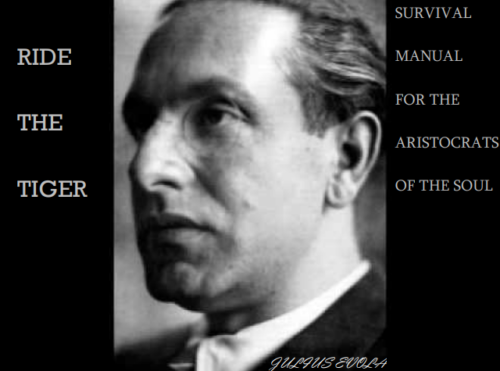
VJMP Reads: Julius Evola’s Ride the Tiger III

This reading continues on from here.

The sixth essay in Ride The Tiger is called “Active Nihilism – Nietzsche”, and continues to deal with the problem of the Death of God. Also continuing with the esoteric theme of this book, Evola appears to insist that the solution is alchemical. The negative is overwhelming and ascendant; it cannot be resisted. So the question becomes “how far the negative can be transformed into something positive.”

Here we are concerned with “the transition to the postnihilist stage.” Modern man is free, free from the strictures of Abrahamism – but free for what? We have striven against our enslavement for so long that we don’t know what to do with freedom. We invented God to assuage our existential anxiety, and, now that we are “free” from this God, that anxiety has rushed back with a vengeance. Evola cites Sartre here: “We are condemned to be free.”

Evola contends that Nietzsche’s conception of the Superman is not sufficient to avoid this nihilism. His reasoning is that the Superman theory is not sufficiently different from the other eschatologies, such as the Marxist one, and therefore cannot be more than a pseudosolution to the problem of nihilism.

As was true for Marxism, the Superman theory could potentially be used to justify all manner of horrors in the present by promising paradise in the future. However, Nietzsche’s theory of eternal recurrence strikes much closer to what might be described as a perennial philosophy.

The seventh essay is called “Being Oneself.” It seems as if that, once the pseudosolutions and outright false philosophies are abandoned, what one is left with is oneself. This something is beyond morality (indeed, morality is considered something to be liberated from), and internal, instead of imposed from without as if by God or King.

Nietzsche comes in for some criticism here. Evola considers his attitude to the human spirit “materialistic”, but concedes that Nietzsche must have seen beyond because he is capable of distinguishing the “Self” from the “I”. Other thinkers, such as Guyau, are considered, but dismissed for not offering anything truly new, merely “restrictions that more or less return to one οf the systems οf the old morality.”

Evola concludes that the answer, as ever, is to “Know Thyself”. However, there’s a caveat. In the past, it was easier to know thyself because one was defined by strictures of class, religion, nation, caste and many other things. Modern man is free, so he cannot fall back on these now-abandoned strictures.

Modern man is, in fact, so free that it is as if he has been shattered to pieces. His soul “contains multitudes”. This shattering, Evola contends, can be most easily observed in remorse, which is an emotion that mostly affects divided people and which is characteristic of our time.

The eighth essay is called “The Transcendent Dimension – ‘Life’ and ‘More Than Life'”. The man who gets it, Evola contends, is one who possesses a transcendental dimension, a spiritual dimension. Here he distances himself further from Nietzsche, who for Evola was more of a vessel that history acted through than a genuine actor in his own right. Nietzsche’s great error was “confusion of the sacred with the profane”.

Evola, through quoting Nietzsche, gives us a prescription for a man of gold, although without using alchemical terms: a many who has great passions (clay), but who holds them in check (iron), and who hold them in check with apparent ease (silver) and who, last of all, does not draw any particular egoic satisfaction from doing so (gold). Here, the highest sort of man is one who overcomes great dangers, for it is only in doing so that all these qualities can be expressed.

Evola mentions the common interest in Zen philosophy among the Beat Generation that was heavily influenced by the existentialists. Here, religious belief (of any kind) is rejected as a failure of the human spirit, of the sort of person who did not have the character to survive the tension of the Age of Nihilism, and who hence surrendered to easy answers.

*

If you enjoyed reading this essay, you can get a compilation of the Best VJMP Essays and Articles of 2017 from Amazon for Kindle or Amazon for CreateSpace (for international readers), or TradeMe (for Kiwis).
Smart and Dumb Are Best Measured Not On One Spectrum, But Two

The usual way for people to think about intelligence is as a single spectrum, where we start dumb and – if we’re lucky – grow to become smart. This seems to fit neatly into the dominant thought paradigm, which is that of materialist, empiricist science. This paradigm contends that single-celled organisms evolved to become intelligent and the more intelligent the better.

This is certainly one way of looking at things and it’s a valid perspective. It’s just a little simplistic. Intelligence is so multivariate and nebulous a concept that trying to reduce it to a single number is like trying to rank all of the world’s great works of art along a single scale. It might make some kind of sense, but it’s not really meaningful.

A better way to think about intelligence is that there’s a smart spectrum and there’s a dumb spectrum. The two have some overlap, but it’s minor. These two spectrums have been generally considered to overlap entirely, in that the more dumb a person is the less smart they must be and vice versa, but anyone who has met a decent range of other people in their life will know that this isn’t true.

The most obvious counterpoint to the single spectrum of intelligence argument is the large number of hopeless nerds and autists out there. There is an archetypal absent-minded professor who knows everything about their area of expertise and nothing about any other aspect of life – someone who could lecture a class of a hundred postgraduates but can’t change a lightbulb. Always these people dominate IQ tests, but it’s not as simple as declaring them intelligent.

These people, usually men, exhibit a high reading on the smart spectrum as well as a high reading on the dumb spectrum. So they aren’t intelligent in the same way as people who are high on the smart spectrum and low on the dumb spectrum.

This is not a dig at the university sort. A majority of smart people have made themselves less dumb for the reason that they have realised how much suffering their own dumbness causes and have acted to mitigate it. After all, what other use is being smart in the first place?

Another type of person who exhibits a high reading on both the smart and dumb spectrums is someone who wastes the intelligence they were born with. Being high on the smart spectrum isn’t by itself enough to succeed in life – there are all kinds of personal qualities like perseverance, diligence and honesty to consider.

People who are high on the smart spectrum and low on the dumb spectrum are rare, and are also difficult to recognise. After all, the average person is fairly dumb, and are therefore prone to assume that truly intelligent people are themselves dumb if they disagree with that average person on anything.

In many ways, these people are compelled to hide away, because being high on the smart spectrum isn’t necessarily a good thing, especially if someone else becomes envious of it and wants to challenge you.

Likewise, being low on the smart spectrum isn’t the worst thing either, because as long as one is also low on the dumb spectrum one can often just chip away at goals until they were completed, especially if one has been taught the right methodology. Being high on the smart spectrum can lead to distractions, and can lead to a person becoming impractical.

People low on the dumb spectrum and low on the smart spectrum might be the old-fashioned kind of person who never had a full education available to them, but who is nevertheless wise and not easy to fool. They can’t really fool others because they’re not smart enough to spin bullshit quickly enough, but it’s hard to fool them because they’re not greedy or gullible.

You could find a lot of this sort of person among farmers and agriculturalists, as well as members of traditionalist religions, and especially among old people.

The last sort of person is one who is low on the smart spectrum and high on the dumb spectrum. These people most effectively embody the chaos principle, because they are not as passive as people who are low on the dumb spectrum.

People high on the dumb spectrum have the tendency to do impulsive, mindless and destructive things, but if they’re also low on the smart spectrum they don’t tend to learn from their errors and gladly commit them over and over again. Driving drunk is a classic behavioural expression for a person in this quadrant.

These four personality types can be mapped onto an elementalist framework. The high-smart, low-dumb person can be thought of as gold, the high-smart, high-dumb person can be thought of as silver, the low-smart, low-dumb person can be thought of as iron and the low-smart, high-dumb person can be thought of as clay.

Whichever has the most value depends on what one is trying to achieve. If the important thing is to avoid errors, then the priority is to be low on the dumb spectrum. If the important thing is to be creative and to react quickly to changing environments, then the priority is to be high on the smart spectrum.

*

If you enjoyed reading this essay, you can get a compilation of the Best VJMP Essays and Articles of 2017 from Amazon for Kindle or Amazon for CreateSpace (for international readers), or TradeMe (for Kiwis).

Should New Zealand Legalise Cannibalism Out of Respect For Maori Culture?

In recent years, people have been asking hard questions about the effects of Western colonisation on the New World. Many moral values that were taken to be universal are now being re-evaluated in the new light of Western oppression. Eventually, New Zealand will need to ask itself: were the British wrong to abolish cannibalism?

In British culture, there is a massive taboo around cannibalism. The act is considered even lower than barbaric, more befitting of an animal than of a human being. Famous cases such as the Sawney Bean family horrify British people even to this day. The taboo can be traced back at least as far as Homer and is universal in the West.

In Maori culture, before British contact, there was no such taboo. Cannibalism was rife. The act of cannibalism was, as it has been all around the world, an extremely effective black magic ritual, in which the cannibal convinced themselves that they had absorbed the power of their victim. This ritual is effective for the simple reason that it increases the ego of the cannibal and makes them more formidable in the realm of iron magic. Moral considerations didn’t come into it.

So a couple of questions have to be asked: if cannibalism was an accepted part of Maori culture (in that it was practiced by many tribes over the whole country), did the British really have the right to suppress that particular cultural expression? And, if they didn’t have that right, are we obligated to re-legalise cannibalism out of respect for Maori culture?

After all, cannibalism may have been an effective method for keeping the tribe strong. Because it was mostly the old, children and those defeated in battle who got eaten, it could be argued that this practice served to keep the Maori genepool free of weakness. If so, who are white people to impose their own moral framework over a useful practice?

The major objection to cannibalism is that it is almost never consensual, and arguably could not ever be with someone of right mind, for the simple reason that it goes against basic self-preservation instincts. Getting cannibalised in New Zealand usually meant that one’s brains were first dashed out with a patu or taiaha, and it’s hard to legalise this for obvious reasons.

Another major objection is that many Maori tribes actually opposed the practice of cannibalism, and were happy to welcome the British settlers, who not only also opposed it but who had muskets to make their opposition count. The Ngati Porou of the author of this piece is one such example. Thus is could be argued that cannibalism was never a universal Maori practice and therefore not an integral part of the culture.

However, these objections have to be considered in the context of modern technology. As Sir Apirana Ngata said: “Ko to ringa ki ngā rakau a te Pāhekā” (“Your hands to the tools of the Pakeha”). Well, now ngā rakau a te Pāhekā include machines that can grow animal flesh in laboratories, and cheaply enough so that a lab-grown steak can be produced for $20. It won’t be long until we can cheaply grow human flesh in a lab.

If human flesh can be grown in a laboratory, this would get around the problem of people having to be killed into order for cannibalism to be possible. This would get around the moral objections so far presented against the legalisation of cannibalism. If there are then no remaining objections to legalising cannibalism, one is forced to conclude that the balance of liberty ought to fall on the side of established precedent.

Because cannibalism has been practiced in these isles for much longer than English has been spoken, it seems natural to conclude that it ought to take precedent over British settler values like not practicing cannibalism. Therefore, the New Zealand Government ought to take action that clearly demonstrates its respect for Maori culture, and make the practice of cannibalism legal.

*

If you enjoyed reading this essay, you can get a compilation of the Best VJMP Essays and Articles of 2017 from Amazon for Kindle or Amazon for CreateSpace (for international readers), or TradeMe (for Kiwis).

It’s Not Immoral to Despise Islam – Islam is an Ideology of Hate

Rational people wouldn’t welcome neo-Nazis into their country and give them shelter and a base – so why do it for other hate ideologies?

If a person in the modern West came out and said that they despised Nazism or Communism, no-one would think anything of it. After all, everyone knows that both Nazism and Communism are hate ideologies that are responsible for an eight-figure death count. Everyone seems to be able to agree that ideologies that cause the deaths of tens of millions of people are evil.

Surely, then, no reasonable person can object to another person coming out and saying that they despise Islam and that they oppose its spread. Islam is a hate ideology in both word and deed.

As far as deed goes, if the reader is one of the elite few to have ever cracked open a history book, they will already be well aware of the bloody history of Islam. Perhaps the worst was the Islamic conquest of India, believed to have caused 80 million deaths. Taking place from the 12th to 16th centuries, Muslim invaders raped, slaughtered and pillaged their way across the subcontinent, destroying every non-Islamic religious temple or scripture they could get their hands on. Some historians consider this invasion the single bloodiest in history.

80 million deaths is a fitting apogee for a religion founded by a man who spent most of his adult life warmongering and bringing everyone he could to submission. In fact, the religion itself continued in much the same vein as Muhammad after his death: Muslims conquered 13 million sq km of territory within 130 years of being founded.

Few people are aware that Afghanistan was once a thriving and peaceful Buddhist kingdom, before Muslims turned up and trashed it. Perhaps the most glaring example of how Muslims are capable of destroying competing religious ideologies comes from the history of the Islamicisation of Persia.

It’s no exaggeration to suggest that Muhammad was another Tojo or Hitler – in every way a tyrant, and in no way a man of God.

Islam conquered 13,000,000 sq km of territory less than 130 years after its founding

As far as word goes, Islam is happy to tell you in its own holy scriptures that it’s an ideology of hate. Verse 9:29 of the Koran commands Muslims to “Fight those who do not believe in Allah” and to never relent until “they give the jizyah willingly while they are humbled”.

On the face of it, it seems pretty obvious that an ideology based on a holy book that explicitly tells its followers to fight those of other religions cannot coexist peacefully with other ideologies. If Allah commands his followers specifically to attack those of other religions until they are defeated, then Islam cannot peacefully coexist with other religions.

Verse 48:29 continues the hate, declaring that “Muhammad is the Messenger of Allah; and those with him are forceful against the disbelievers, merciful among themselves…” In other words, Muslims are not obligated to treat non-Muslims as if they are fellow humans – it’s perfectly acceptable to abuse another human being simply on the grounds that they are non-Muslim. Solidarity is the sole province of those in the cult.

The Koran is riddled with this sort of command to shed blood. Verse 2:191 tells Muslims to “kill [unbelievers] wherever you overtake them”, Verse 47:4 tells Muslims that “when you meet those who disbelieve [in battle], strike [their] necks until, when you have inflicted slaughter upon them, then secure their bonds, and either [confer] favor afterwards or ransom [them] until the war lays down its burdens” and Verse 9:5 tells Muslims that “when the sacred months have passed, then kill the polytheists wherever you find them and capture them and besiege them and sit in wait for them at every place of ambush”.

To rehash the logic in the opening paragraph, no-one has any problem connecting the psychopathic, us-against-the-world rhetoric of Mein Kampf or Hitlers Zweites Buch with the bloodshed and slaughter of World War II, so surely it cannot be difficult to see how the kind of rhetoric in the Koran, or the violent example set by Muhammad, has led directly to all the bloodshed and slaughter that soaks the history of Islam.

Reasonable, fair and honest people hate Islam, for all the reasons that they hate Nazism and Communism. First and foremost of these reasons is that Islam is a supremacist ideology that believes it is destined to rule the world, and therefore that non-believers must bow the knee or die. This ideological aggression naturally brings it into conflict with all other religions and ideologies as it tries to dominate them – which means every last one of us, sooner or later.

In other words, Islam is as much our enemy as Nazism was. Islam is an ideology of hate – it’s as simple as that. We should treat it accordingly.

*

If you enjoyed reading this essay, you can get a compilation of the Best VJMP Essays and Articles of 2017 from Amazon for Kindle or Amazon for CreateSpace (for international readers), or TradeMe (for Kiwis).