
The Three Orientations of Bravery

Bravery is generally thought of as an ability to maintain calmness and composure in the face of danger, especially in the context of going forward into that danger for the sake of achieving some moral goal. It’s almost univerally thought of as a highly desirable personal quality and usually thought of as a masculine one. Originally bravery referred to physical courage, but, as this essay will show, there are at least three major perspectives that one can take on the concept.

These three perspectives translate into the perspectives of iron, silver and gold if one takes the approach of elementalism or esoteric alchemy. These can be thought of as forms of bravery that evolved from a successful resolution of the challenges that led to the previous form.

The form of bravery that corresponds to the iron is the simplest and most universally understood of the four orientations. Here the iron responds to upwards – a form of bravery that is oriented up the dominance hierarchy, towards one’s parents, one’s boss or the local king. Here, being brave is a matter of standing up to those who would try and hurt you.

This orientation of bravery is usually understood in a martial sense, and indeed we can see that Mars, which represents iron, gives us the etymological origin to words like ‘martial’. In the context of esoteric alchemy, ‘martial’ means ‘like the iron’ and therefore reflects a sense of being sharp, strong and unyielding.

As a warrior proves his bravery in the arena of iron (by whatever means) and succeeds in keeping dependents safe, he naturally comes to take on a shine, which represents his entry into the arena of silver. He learns that keeping the peace is as much a question of diplomacy as it is a question of beating the shit out of people, and he finds that he no longer needs to orientate himself up so much.

This form of bravery is the form of bravery that goes outwards. In the same way that a given volume of silver can cover more area, when hammered flat, than the same volume of iron, the bravery of the man of silver is that which orients itself over a wide area.

Once a great warrior comes to take responsibility for his tribe and becomes a chief, the next step up the hierarchy of silver is to take responsibility for a wider and wider geographical area. This is natural as long as he continues to shine, because this will cause people from far and wide to seek his judgment and mediation.

The bravery involved here is not so much slaying dragons and more a will to confront the real nature of the physical world and to strive towards its mastery. This means the real nature of the world in terms of its physics, chemistry, mathematics, biology and related disciplines, as well as statecraft.

When the man of silver moves beyond his prime years for taking responsibility for his people, he enters the arena of gold. Gold represents the form of bravery that goes inwards. This is like gold because it is the rarest and most precious form of bravery.

A person who orients their bravery inwards learns to make peace with God, which is the hardest thing of all to achieve because this orientation has the fewest biological instincts giving it power. Biological instincts are not generally concerned with bravery in general, because that is a moral orientation – they are concerned with survival and dominance.

One reason why this form of bravery is so rare is that not everyone understands that it takes bravery to truly look within – but it does. It takes a lot of bravery to look into your own soul and to ask yourself if you are truly good or evil, or if such things really exist. It takes incredible bravery to really truly ask yourself if you can be comfortable saying goodbye to all of your attachments with this world upon the moment of your physical death.

The three orientations of bravery, therefore, relate to the challenges that naturally faced people in the historical past as they overcame the dangers of their environment.
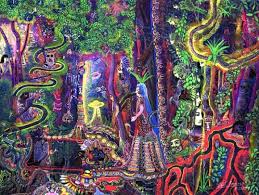

Psychedelics Fill The Vacuum Left By The Destruction of Genuine Spirituality

In the West we have no common spiritual tradition. The closest we come is an empty imitation of the old myths and legends of a Middle Eastern tribe of genital mutilators. Where the Buddhists pray for an end to the suffering of all sentient beings and the Hindus know for certain that consciousness survives the death of the physical body, we Westerners are still mutilating the genitals of our baby boys and living in utter terror of the day our vital organs shut down. Luckily, there is historical precedent for solving these problems.

The natural spiritual traditions of Westerners were destroyed by successive waves of Abrahamic invasions, beginning when the Romans made the terrible mistake of taking in Abrahamic refugees. Allowing this evil supremacist tradition into the West had the effect of corrupting those tasked with maintaining these natural spiritual traditions, ending with their replacement by hollow lies.

Before the Abrahamists invaded, Europe was rich in folk spiritual practices, with use of the amanita muscaria mushroom in the North and psilocybin mushrooms in the South allowing our forebears to reconnect with God. Not only did the ancients use psychedelics, but they did so frequently and with reverence, like any skilled practitioner would use them today.

The amanita muscaria folklore lives on in our stories about Santa Claus and his reindeer (Santa’s red and white costume represents the mushroom, his rotund build represents its roundness. The reindeer are there because Nordic shamans would potentiate the psychedelic effect of the mushroom by inducing reindeer to eat it and then drinking the animals’ urine).

The ancient Greeks partook in the ceremony at Eleusis once every mushroom season, and they did so with such reverence that to this day no-one is quite sure of precisely what the recipe of the kykeon was. This enabled them to see the world beyond in a way that had up until then been the province of exceptionally gifted shamans.

The Abrahamists destroyed as many of these traditions as they could, as Abrahamists have done everywhere in the world they have set foot, on account of the unique viciousness of that religious tradition. But they could not destroy the mushrooms themselves, no matter how severely they punished their use. And so it was only a matter of time until they lost their grip and the folk spiritual traditions reasserted themselves.

This causes problems, although we don’t realise it because you need a little bit of spirituality to realise it, and we have none left. If one of us does become a little bit spiritual, they tend to realise all of these problems, and this often leads directly to the state of psychological collapse known as psychosis.

Because our culture is rotten with materialism, we have no commonly understood way of recognising when one of us has achieved a state of spiritual insight. Indeed, the usual response appears to mock them for being a “loony”, as if the eternal truth of materialism was so self-evident that only a mentally ill person would even pause to question it.

This is why Westerners who achieve a spiritual breakthrough usually end up with a psychiatric diagnosis in short order. Our culture is so spiritually dead that we cannot recognise spiritual gnosis even when it’s right in front of us. We sneer and jeer at any hint of it.

But knowledge of magic mushroom use (alongside that of LSD) has slowly seeped into the Western consciousness since the 1950s. Thanks to the Internet and what’s left of our culture of intellectual free inquiry, it has been possible for those who have heard the call of the shaman to share their experiences with others, and after much discussion it has become clear that the psychedelic experience and the spiritual experiences of the ancients are much the same thing.

The Church did such a good job of destroying natural spirituality, and they did it for so long, that they are unable to act when it starts to arise again (as it is doing now), because they have forgotten what their enemy even is. This means that knowledge of how to use psychedelics will once again become widespread, and this will once again lead to a spiritual golden age.

*

If you enjoyed reading this essay, you can get a compilation of the Best VJMP Essays and Articles of 2017 from Amazon for Kindle or Amazon for CreateSpace (for international readers), or TradeMe (for Kiwis).

What is Worshipped by the Luciferian?

Insofar as Luciferianism is a religion, it holds something to be divine, but what that thing is is not obvious

Whereas the Abrahamist worships his genital-mutilating Big Man in the Sky and the Satanist worships his personification of the adversary, Luciferians don’t seem to make a big thing out of worshipping any Lucifer figure. Nonetheless, Luciferians are entirely capable of comprehending and appreciating the concept of the divine. So what do they worship?

The word ‘Lucifer’ is usually thought of as a proper noun, but its original usage was as a title. More specifically, Lucifer means ‘bringer of light’. It was once the title given to the King of Babylon, and like everything religious, it has an exoteric and an esoteric meaning.

The exoteric meaning ties into the sun worship that is closely related to the religious sentiment in primitive man.

When the Sun starts sinking in the sky after the Summer Solstice the natural reaction for a human bereft of knowledge is fear. It seems like the world is dying as it gets colder and darker and all signs of life diminish. It feels like one has been abandoned by God, and if one is superstitious some of that fear might be mixed with guilt and blame.

So when the Sun returns after the Winter Solstice the natural reaction is one of incredible joy, as if God had shifted attitude from hatred to love. With the Spring comes new life, more light, more warmth, and everywhere there is joy and good cheer (this is, incidentally why Christmas, the major Western festival, is celebrated at the same time as the return of the Sun in the Northern Hemisphere).

Any early ruler opportunistic enough could easily convince the people around them that it was the ruler who was responsible for the return of the Sun, and only by treating that ruler with sufficient respect and obedience would the Sun return. This is the reason why the God-King model was so prevalent. Hence, the King of Babylon was given the title ‘Lucifer’ out of respect for that King being credited with the return of the Sun after the Winter Solstice.

The esoteric meaning is related, but different. In the esoteric sense, Lucifer refers to that impulse within humans that drives them to seek out the light of metaphysical knowledge and then carry it back to the rest of humanity to enlighten them as well. To this end, Lucifer has taken taken many forms in popular culture, the next most famous of which might be Prometheus.

Lucifer is not really a personage in this sense either, because anyone is capable of embodying that impulse at the right time in their lives. In this sense, Lucifer is someone that the individual becomes as they harness their own will to bring light into the world. Lucifer can therefore just as well be manifested by the worshipper as sought out in the external world, as the precise locus of this sentiment is not relevant.

In other words, Luciferianism is a continuation of the same shamanic tradition that led to human mastery of fire, which led to being able to cook food, which led to effectively being able to pre-digest food outside of the body, making us far more efficient, which meant that we had surplus energy that was able to be used for brain development, which led to humans being able to differentiate ourselves meaningfully from the other great apes – a kind of apotheosis of the species.

This impulse is responsible, in the eyes of the Luciferian, for most of what’s good in this world. All medical, scientific, philosophical and technological advancements (and all the human misery alleviated by them) can be attributed to it.

What is that impulse that leads a person to understand how to master fire and its application, and how to distill this mastery into principles simple enough that the mastery can be transmitted to others who might bear a similar impulse, so that they might progress ever further than before?

It’s not easy to describe precisely what this impulse is or from where it might come, but this is what the Luciferian holds in highest regard. This suggests that ‘worship’ is possibly the wrong word to use, because it implies a degree of loss of reason, while the Luciferian venerates something akin to that ability to reason (or, at least, the will to be able to reason and enlighten).

When the Abrahamists subverted the Roman Empire and perverted all truth, one of the first things they did was to destroy all the wisdom inherent in the plentiful Roman mystery cults, which had themselves descended from the Greek mystery cults such as the one around Eleusis.

In the Eleusinian Mysteries, participants drank something called a ‘kykeon’, which was a mix of a variety of intoxicating substances, one of which was believed to have been a strained tea made of psilocybin mushrooms. Consuming this kykeon, only ever done in ritual secrecy, had the effect of propelling the whole congregation into hyperspace. That so many of them did so, and that so many returned from hyperspace and returned to everyday society enlightened is arguably the reason why the Golden Age of Greco-Roman thought took place.

When the Abrahamists destroyed this culture in an effort to enslave the population, they made taboo all the things associated with it. This is the reason why mainstream Abrahamist culture hates women (the Eleusinian Mysteries were open to men and women equally), hates cosmopolitanism (they were open to anyone who spoke Greek, regardless of ethnicity) and hates psychoactive substances (they dispensed their wisdom, at least in part, through the ritual alteration of consciousness).

The Luciferian could not care less if wisdom is to be found in the mind of a woman, or a black man, or as a result of a drug-induced epiphany. Wisdom is wisdom, and it’s enough to venerate the light, and the methodologies that lead to the light, for their own sake.

Hierarchies of Silver Versus Hierarchies of Gold

There is a lot of discussion about power dynamics, and whether the people who end up at the top of them have got there through competence or by machination. A person’s position on this question will correlate extremely strongly with their level of revolutionary zeal. This essay seeks to illuminate the subject from an esoteric perspective.

There are three ways for a person to dominate another one. They can do so physically, in a manner akin to the effect iron has on clay; they can do so with trickery, in a manner akin to the effect silver has on clay; they can do so by offering up an example of behaviour that ought to be emulated and allow the clay to imitate it, in a manner akin to the effect gold has on clay.

For the most part, people can generally agree that hierarchies of iron are illegitimate, except for the odd occasion when they are entered into legitimately, such as an army volunteer or a consensual BDSM participant. In nature, the effect of iron upon the clay is necessarily coercive and non-consensual, and the majority of people find this sort of thing unpleasant, so hierarchies of iron are generally discouraged.

Everyone generally agrees that hierarchies of gold are ideal. The ideal form of hierarchy is for an excellent person to behave excellently and for people who aspire to a similar excellence to support that first person on account of their great deeds. This is identical to the philosopher-king model proposed by Plato in The Republic and most people can immediately see the merits in it.

The difficulty arises when a hierarchy of silver is formed in imitation of the hierarchy of gold. To some extent this is unavoidable because almost all hierarchies of silver are – in the human world at least – imitations of the hierarchy of gold.

For example, a man might arise who is crafty enough to swindle the people around him into believing whatever he said. He might then, as many men have previously chosen to do, take advantage of this opportunity and tell them all that he’s a living god and that his every word is infallible and that his will cannot be questioned.

This is an ancient trick – it worked 10,000 years ago and the Pope is still running it now. It works because the hierarchy of silver built by the swindler is sufficiently close to the ideal hierarchy (assuming a sufficient level of stupidity among the peasantry) that the dull cannot tell the difference, and those who do can be silenced by swift application of sharp iron.

Hierarchies of silver have a multitude of forms, as numerous as there are opportunities to cheat others. They all have in common, however, the property of illegitimately acquiring and concentrating power.

Either they put the power into the wrong hands or they put it in the right hands but in the wrong amounts. The hierarchies of silver share this quality with the hierarchies of iron, but unlike the iron they do not do so by acquiring powerful weapons, but rather by controlling the minds of the men who control the weapons.

In other words, a hierarchy of silver will misdirect the men of iron. This means that the men of silver will make laws that are unjust, such as levying unfair taxes, or banning certain luxuries that should remain freely available. The men of silver will not be able to adjust their system to reflect accurate criticism because, not being of gold, their hierarchy is not intended to represent correct rule.

Hierarchies of gold are when the right people have the power in the right amounts, and usually result in Golden Ages for the people within them. However, they are more fragile than the others, in the same way that gold is the softest of all metals. The proximate challenge for the philosopher-king is usually keeping the men of silver from hatching some plot to steal the loyalty of the men of iron.