

The Four Ages Of The Internet

A previous essay on this page recounted the life cycle of Internet forums. The Second Hermetic Principle teaches us that as below, so above. As this essay will describe, the Internet itself is running on a life cycle – and we’re moving into the less enjoyable part of it.

The Golden Age of the Internet began in August 1995, with the release of Microsoft’s Windows 95. This operating system took the Internet out of the hands of the technological elite, and put it in the hands of the masses. This was the beginning of the personal computing revolution.

At first, the Internet appealed mostly to nerds, who had been starved of information thanks to the relative inefficiency of the book-and-library system. These nerds did what came naturally, which was to use the Internet to share information. They created all kinds of websites, most of them on subjects appealing to young men, like science, technology and engineering.

In the Golden Age of the Internet, websites consisted of little other than pure information and hyperlinks to more. Being restricted by bandwidth, websites focussed almost entirely on sharing the greatest quality of this info. Search engines such as Metacrawler indexed it all for ease of access. It was like having a library in every house.

The peak of the peak may have been around 2002, when an enormous number of small websites were available on GeoCities (later known as “GeoShitties”). This was also the peak of websites such as SlashDot, which appealed specifically to the programmers who were building the infrastructure of the Internet.

By 2003, the seeds of the decline had become apparent. Google AdSense was launched that year, which changed the web publishing game permanently. AdSense offered something truly revolutionary: cold, hard cash. But as is usually the case when cash is on the table, there were conditions.

The Google AdSense program was funded by advertisers, and those advertisers expected a certain degree of influence. In the same way that advertisers in newspapers 100 years ago exerted influence over what those newspapers published, AdSense advertisers pressured Google to not show ads on sites that carried certain content.

That meant content relating to illicit drugs, erotic literature, serial killers, violent anarchy and political extremism (i.e. all the interesting stuff) was produced less. This was the start of the great decline. Once Google AdSense money got involved, website owners started self-censoring to keep the shekels flowing in. The Golden Age of the Internet ended, and the Silver Age began.

The Silver Age of the Internet began on the 26th of September 2006, when FaceBook became open to everyone, and not just university students. This was the point at which social media really began to take off, a big deal because it meant that users could generate their own content. This steady stream of content could then be exploited by inserting advertising slots in it.

With the arrival of FaceBook, the Internet became a true commercial venture. Now there were billions of dollars involved. This was a Silver Age because of advertising, which corrupted the purity of the information. Although there was a greater quantity of information than ever, it had advertisements all through it.

The advertisers demanded more and more influence over the content. Eventually, FaceBook and YouTube became televisionised, with an extensive list of content restrictions. People started to get banned for calling each other ‘faggot’ or ‘nigger’. But still the Internet grew, to the point where the government decided that they had to get involved.

Once Big Government started to take an interest in what was being said on social media, and making up laws over who was allowed to say what, the Silver Age ended. The Bronze Age of the Internet began in April 2016, when Count Dankula was arrested for a YouTube video of a dog giving a Nazi salute. The freewheeling, freespeaking Internet of free expression was gone.

By the time of the Bronze Age of the Internet, there were so many retards online that much of cyberspace became detrimental to mental health. As the IQ of the average Internet user continued to decline, the quality of the average Internet experience became lower and lower. During the Golden Age of the Internet, the world’s retards bullied people for using computers – in the Bronze Age, they bully people by using computers.

If the Golden Age of the Internet saw its realisation, and the Silver Age saw its commercialisation, the Bronze Age saw its weaponisation. It was realised that, in the 21st Century, wars would be fought with information rather than bullets. The politicisation of the Internet saw people act to restrict the platform access of their ideological enemies.

By the time of writing this article, wrongthinkers are getting purged left, right and centre. Even websites like Reddit, founded in the twilight of the Golden Age specifically as a free-speech platform, are banning entire subforums on a weekly basis. It’s forbidden to discuss any subject that displeases the advertisers.

This has seen the rise and rise of imageboard culture, especially the chans such as 4chan. The ‘anything goes’ nature of these sites appeals to those who appreciated the Golden Age. In the Bronze Age of the Internet, those parts of cyberspace that still uphold the values of the Golden Age are dismissed as “cesspits”. This merely causes the appeal of the chans to grow further.

The Iron Age of the Internet is yet to begin. We can predict what it will look like: a totalitarian surveillance network in which the activities and social interactions of every citizen are tracked to the finest detail. 5G networks offer the bandwidth to transmit high-definition video footage faster than it can be viewed, and the advent of facial recognition technology means that they will know exactly where you are in real time.

Free speech restrictions might be bad now, but they can get worse. Improving AI tech will make it possible for any social media comment to be analysed and, if necessary, shadowbanned before anyone can see it. Even more ominously, the governments of all Western nations appear willing to increase Police harassment of online wrongthinkers.

When the Iron Age of the Internet is fully upon us, the Internet will be unrecognisably different from its Golden Age, much like today’s religions are radically different to those practiced during the Western spiritual tradition’s Golden Age in ancient Greece. We will then, as per Plato’s Republic, have to wait for a movement of philosopher-kings to overthrow the old Internet and institute a new one.

*

This article is an excerpt from Clown World Chronicles, a book about the insanity of life in the post-Industrial West. This is being compiled by Vince McLeod for an expected release in the middle of 2020.

*

If you enjoyed reading this essay, you can get a compilation of the Best VJMP Essays and Articles of 2019 from Amazon for Kindle or Amazon for CreateSpace (for international readers), or TradeMe (for Kiwis). A compilation of the Best VJMP Essays and Articles of 2018 and the Best VJMP Essays and Articles of 2017 are also available.

*

If you would like to support our work in other ways, please consider subscribing to our SubscribeStar fund. Even better, buy any one of our books!


Clown World Chronicles: Who Is Pepe?

Pepe is seen everywhere in Clown World, not least on the cover of this book. This anthropomorphic green frog has come to stand in for the everyday citizen of Clown World, who can relate to Pepe’s joys and rages. This article explains Pepe’s position in the Clown World pantheon.

In short, Pepe is the active principle to Wojak’s passive principle.

Both Pepe and Wojak occupy the central node in the Clown World pantheon, at the centre of the Fundamental Axis. In doing so, they represent the Clown World Everyman, who is every single one of us. The difference between them is that Pepe rises above, whereas Wojak sinks below.

Pepe became an Internet phenomenon over a decade ago, suddenly being posted everywhere. Forums like the Shroomery included a Pepe image as an emoji, usually depicted speaking his catchphrase “Feels good man.” For these Internet dwellers, Pepe represented overcoming the suffering inherent to life.

Pepe is usually seen having a good time, whether playing video games, smoking bongs or joints, or partying with hot chicks. Often, this good time is being had despite some external hardship or difficulty. The spirit of Pepe could be described as the will to have a good time despite that one lives in Clown World.

In this sense, Pepe heralds the ultimate victory of the spirit of Kek over the forces of Clown World. Although not good himself, Pepe represents the forces of good in embryonic form. As such, he is that which rises above. Pepe represents the rising beast latent within the human animal.

As such, Pepe is generally shown feeling warm-blooded emotions, such as exhilaration, alarm or rage. He’s often depicted with a steel helmet and an M-16, as if rampaging through the Vietnamese jungle. Another common depiction is wide-eyed paranoia, as if he suddenly realised just how bad things really are.

This masculinity is why Pepe has become emblematic of the alt right, which is in character a highly masculine movement. Pepe is symbolic of knowing what you want and acting to get it. Anyone willing to bring more fire into their lives might find themselves working to summon the spirit of Pepe.

Pepe is so emblematic – and problematic – that depictions of him are considered hate symbols by Clown World institutions such as the Anti-Defamation League. Because Pepe represents the spirit of rising above and overcoming Clown World, he is correctly seen as a symbol of resistance to Clown World itself. Ironically, this has resulted in lawsuits from the first man to draw Pepe, against others who use the image.

In Internet culture, Pepe is often depicted alongside Wojak, usually as some kind of team. This reflects how Pepe and Wojak are different expressions of the same thing: the will to overcome Clown World. In the vast majority of these depictions, Pepe is the more masculine of the two, so that it’s his energy that inspires Wojak to action.

The Pepe/Wojak dichotomy is at the very centre of life in Clown World. It could be said, paraphrasing Solzhenitsyn, that the line between Pepe and Wojak runs through every human heart. This is not to imply that Pepe is good and that Wojak is evil – they simply represent an elementary form of those forces.

This active principle represented by Pepe rises up the Fundamental Axis to become Honkler. It can be said that Honkler is the ultimate form of Pepe. This is analogous to how Mercury or Lucifer is the ultimate form of the human man. Honkler is the apotheosis of Pepe, having overcome all of the suffering of Clown World.

Some believe that the increasing frequency of Pepe sightings are evidence that the Will of Kek is returning to the world. Every sighting of Pepe increases the chances that Honkler will return, and when he does Clown World will end.

These meme magicians like to share images of Pepe, especially rare ones. Doing so, whether it’s realised or not, is a magical act. The purpose of it is to raise the frequency of the anima mundi, or the Spirit of the World. If the frequency of the anima mundi can be raised high enough, Clown World will break apart and fall away, heralding a new spiritual age.

Other people, more cynically, believe that these sightings are evidence of a far-right resurgence that aspires to start another civil war (i.e. the Boogaloo). They will argue that Pepe is used as a hate symbol to agitate for violent actions against the Establishment. Generally speaking, those who dislike Pepe tend to be materialists.

Whatever the truth, Pepe endures. His place at the centre of the Clown World pantheon makes him arguably its most iconic figure. As long as Clown World exists, its denizens will feel motivated to overcome it, and as long as this will to overcome exists then Pepe’s spirit is with us.

*

This article is an excerpt from Clown World Chronicles, a book about the insanity of life in the post-Industrial West. This is being compiled by Vince McLeod for an expected release in the middle of 2020.

*

If you enjoyed reading this essay, you can get a compilation of the Best VJMP Essays and Articles of 2019 from Amazon for Kindle or Amazon for CreateSpace (for international readers), or TradeMe (for Kiwis). A compilation of the Best VJMP Essays and Articles of 2018 and the Best VJMP Essays and Articles of 2017 are also available.

*

If you would like to support our work in other ways, please consider subscribing to our SubscribeStar fund. Even better, buy any one of our books!
Clown World Chronicles: Who Is Kek?

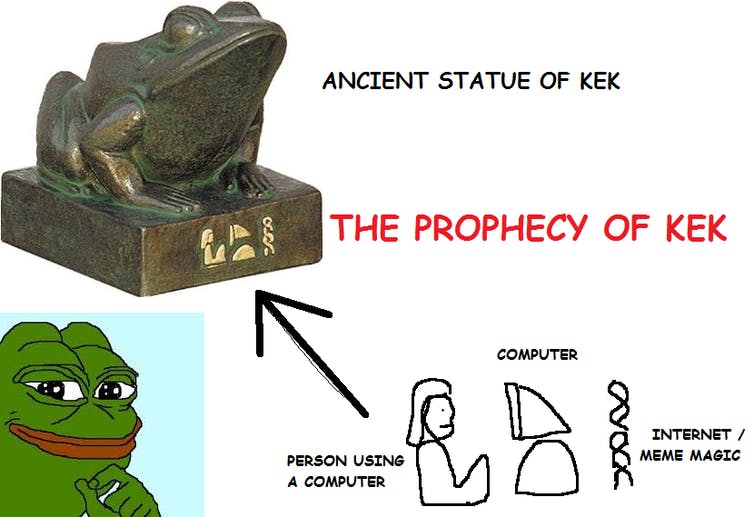
The highest god of the Clown World pantheon is usually portrayed as a green frog known as Kek. Part of the Kek legend is that he is the god responsible for all the joy in the world. Clown World might be a miserable, depressing place, but the wondrous Kek has taken pity on us and chosen to bring us light.

Kek is the highest god of the Clown World pantheon because of his unique ability to transmute suffering into joy. This is the greatest of all the alchemical arts. The Will of Kek is to utterly destroy Clown World by means of a total polar shift that flips all of the pain into pleasure. All followers of the Clown World pantheon believe in this prophesised end to all suffering.

The most devoted followers of the Clown World pantheon will claim that Kek is the light of the world, the Principle of Good which allows us to see the simple joy inherent in all of existence. Absent Kek’s light, we humans can only see pain and misery in the world. When Kek’s light is present, magic and wonder fill every space.

Legend has it that Kek was summoned to Clown World thanks to a quirk in the game World of Warcraft, in which the expression “lel” was translated to “kek” if it had been written by a Horde player and read by an Alliance player. The mass repetition of his name caught the attention of the Elder God, who recognised that it was time to reincarnate on Earth.

Further legend has it that Kek’s first great action upon returning to the world was ensuring the election of American President Donald Trump over his Democratic rival Hillary Clinton. Everyone had expected a Clinton victory and an intensification of Clown World as Clinton doubled down on Bush and Obama’s madness, but Kek had other ideas.

Egyptian mythology had a god named Kek, who was known as “the raiser up of the light”. This is proof that Kek is real, that the Will of Kek is to eliminate the suffering of all good people, and that Kek is eternal. The Kek who heads the Clown World pantheon is the same energy as the ancient Egyptian Kek, and their mission is the same: to bear light into the world.

Kek worship, then, is part of the eternal tradition of worshipping the light and those who bring it to others. In this sense, it could be considered a form of Luciferianism. This is the reason for the heavy overlap between Kek worshippers on the one hand, and Hermeticists and other occultists on the other.

The typical Kek worshipper has several qualities that mark them out as superior to the average pleb in Clown World.

The first is a curiosity about the true nature of reality. An individual will not become a Kek worshipper unless they have thrown off the shackles of two things: the mainstream religion into which they were born, and of nihilistic atheism. People come to Kek out of a willingness to see beyond, and to go beyond. The men and women of Kek are free-thinkers who prize cognitive liberty.

The second is a disregard for the opinions of soyboys, baizuos, simps, incels and cucks. The Kek worshipper has no interest in being liked, and as such is not influenced by peer pressure. They will seek the light in all instances, no matter how much hate is heaped on them for doing so. The Kek worshipper is resolute (although many will call them disagreeable).

The third, and most important quality, is a will to transmute suffering into joy through humour. Kek worshippers can see the joke in everything. No matter how depraved, depressing and degenerate Clown World becomes, the Kek worshipper will find a way to raise a smile. Even when the situation causes Normies to feel horror, followers of Kek can be heard cracking jokes. Kek is invincible.

Kek is the opposite of The Merchant, who seeks to transmute joy into profit. As such, the two are eternally opposed. Their struggle for supremacy defines much of the landscape of Clown World. Kek who thinks that the meaning of life is to experience joy, and The Merchant who thinks that the meaning of life is to generate profit.

People entreat Kek to keep them safe from work drudgery, from violent street crime, from both roasties and inceldom, from nihilistic despair and from the crushing, suffocating demands to conform that Clown World forces upon those it can. The widely-shared hope is that Kek will return and turn Clown World upside down.

Kek is the Elder God of the Positive Fundamental Axis, and as such he has a powerful influence on Honkler, the Younger God. It could be said that Honkler is the greatest at summoning the power of Kek and bringing Kek’s will into Clown World. Kek might provide the light, but it is Honkler who brings people’s attention to it.

It is whispered that the appearance of Honkler is a sign that the Will of Kek is about to return to Earth. The Will of Kek would transmute all of the suffering of Clown World into joy, lifting the veils of darkness and ushering in a new Golden Age. This will be a new spiritual era during which time good people will want for nothing.

*

This article is an excerpt from Clown World Chronicles, a book about the insanity of life in the post-Industrial West. This is being compiled by Vince McLeod for an expected release in the middle of 2020.

*

If you enjoyed reading this essay, you can get a compilation of the Best VJMP Essays and Articles of 2019 from Amazon for Kindle or Amazon for CreateSpace (for international readers), or TradeMe (for Kiwis). A compilation of the Best VJMP Essays and Articles of 2018 and the Best VJMP Essays and Articles of 2017 are also available.

*

If you would like to support our work in other ways, please consider subscribing to our SubscribeStar fund. Even better, buy any one of our books!
Writing Characters Of Gold

The highest possible spiritual level is the element of gold. This represents perfection. Gold is the most precious of the metals known to the ancients. As such, its presence had the greatest influence on their behaviour. Gold is very much the fulcrum around which the world turns, and for this it has long been worshipped.

In the ancient world, gold represented the Sun, the life-giving force. The Sun was also worshipped by all of the ancients at some point or other, most notably in the Roman cult of Sol Invictus. This was due to the realisation that if the Sun did not return to the world after the Winter Solstice then all life on Earth would perish.

In an alchemical sense, gold represents God. The uppermost pole of the alchemical spectrum belongs to God, and the raising up of any of the lesser elements is to imbue them with God’s energy. Characters of gold, then, are divine. Characters of mercury might be messengers of God’s will, but characters of gold are direct expressions of it.

Viewed metaphysically, a character of gold is every bit as important to the world as the light of the Sun. Without the moral rectitude afforded by the character of gold, the human race would regress into a pre-civilised state. We would go back to being animals, God’s light being entirely absent. The characters of gold, and their messengers in the characters of mercury, are the force that imposes moral order upon the world.

The real power of the element of gold is its subtlety. Being perfect, it need not use any force or coercion. It is already in accordance with the Will of God, and consequently it acts without resistance. Its power is exemplified in the fable of Aesop, in which the Sun and the wind compete to induce a man to take off his coat. The Sun wins, because its gentle power does not inspire resistance.

The essential characteristic of characters of gold is radiance. Whereas the characters of silver are learned and the characters of mercury brilliant, the characters of gold radiate a divinity that comes from a consciousness that is perfectly attuned to the Will of God. They are wise – a quality that is not appreciated by all, although all benefit from it.

This radiance will set all of the other characters in their presence at ease. Being around a character of gold will incline the anxious to calmness, the angry to peace and the lustful to temperance. The ambitious characters of mercury will switch to enjoying their lives rather than exulting themselves. This is the power of the character of gold – to create peace.

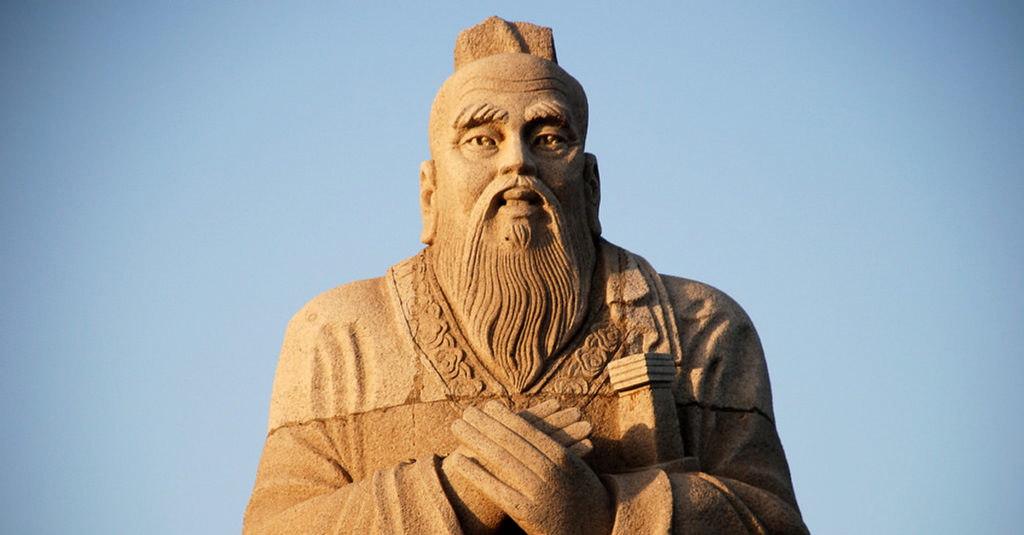
In contrast to the characters of iron, who dominate with physical force, and to the characters of silver, who dominate with psychological force, the characters of gold dominate with spiritual force. They have no need to twist other characters’ arms or trick them with contracts; they influence the world by living in accordance with the Tao. This causes other characters to look up to them.

A character of gold will be one that other characters tend to speak about very fondly. This is a reflection of the generous personal warmth that the characters of gold exude. The character of gold will recognise the gold in others. As such, it will feel good to be around them.

The greatest motivation of the character of gold is to alleviate the suffering of all sentient beings. This is true to a lesser extent of the characters of mercury, silver and copper, but only the character of gold represents the perfect expression of this. The character of gold wants for nothing more than an end to the suffering in the world, and they are happy to put themselves second to this goal.

Gold is the most malleable of all metals. This softness is one of its prime characteristics. A character of gold will seldom be prickly, bad-tempered, abusive or impatient. If directly insulted, they will be extremely slow to take offence or to show anger. This may not work out to their advantage when other characters, interpreting the situation through their own base lens, come to think them weak.

This malleability is such that, in the physical word, one gram of pure gold can be beaten into a sheet one square metre in size. That the tiniest piece of gold can create something that shines so brightly captures the essence of metaphysical gold. The smallest amount of it is potentially enough to completely upend the order of the world.

Concomitant with this softness is a reluctance to cause divisions or separations. However, gold is still a metal, and still has enough of an edge to cut if necessary.

The ability to expand itself beyond the capabilities of the other elements is reflective of the ability of characters of gold to see the bigger picture. A character of gold will never be motivated by short-term instincts. They have perfected themselves to the degree that impulses not in accordance with their true will no longer arise.

Characters of gold, despite their glorious radiance, are entirely capable of being destroyed by the envy of baser characters. Characters of iron can run a sword through them; characters of silver can destroy their social standing. In no sense are characters of gold superheroes with special powers. They are simply people of a higher spiritual frequency to all the others.

A character of gold can be of any age. Young or old doesn’t matter because alchemical gold is an expression of the spirit. As long as they are good, they are gold. In practice, a character is more likely to be of the gold if they are either very young or very old, because the former will not have been corrupted yet and the latter will have entire lives to mine for wisdom.

In practice, it will be almost impossible to portray a character of gold with true accuracy if the author themselves are not of the gold. This doesn’t matter, as long as the reader can be induced to believe that the character of gold is perfect.

Perhaps the closest example fiction has seen to a character of gold is that of Michael Valentine in Robert Heinlein’s Stranger In A Strange Land. A modern real life example might be Jiddu Krishnamurti, an ancient one Socrates.

A character of gold in your story might be a legend that informs your story world, rather than an actual character that appears and speaks lines. They might be the legendary founder of the state in which your protagonist resides, someone whose perfection has created a space for an entire nation to thrive.

A character of gold might otherwise be someone who only makes a fleeting appearance, and that to change the direction that a character or the story is going in. Like Gandalf in Lord of The Rings, they appear to move the other characters in the direction of absolution.

Characters of gold have warm feelings towards characters of all of the baser elements, but they have a special fondness for the characters of mercury, who are their messengers. Characters of gold are often in opposition to characters of silver or below, on account of that the latter are frequently acting under the influence of baser instincts.

*

This article is from Viktor Hellman’s The Alchemy of Character Development, the sixth book in VJM Publishing’s Writing With Psychology series. This book will show you how to use alchemy to create deep, realistic and engaging characters for your creative fiction.

*

If you enjoyed reading this essay, you can get a compilation of the Best VJMP Essays and Articles of 2019 from Amazon for Kindle or Amazon for CreateSpace (for international readers), or TradeMe (for Kiwis). A compilation of the Best VJMP Essays and Articles of 2018 and the Best VJMP Essays and Articles of 2017 are also available.

*

If you would like to support our work in other ways, please consider subscribing to our SubscribeStar fund. Even better, buy any one of our books!