
The First Tenet Of Elementalism

The First Tenet of Elementalism: consciousness is the prima materia.

Consciousness is the original source from which all else manifests. Consciousness is eternal and immutable, being outside of time and space. As such, it is the one thing whose existence needs no explanation. Those asking where consciousness came from have based their question on illogical premises.

This is the first teaching of Elementalism, because it needs to be understood before anything else can be understood. Consciousness came first, before language, before thought, even before the division into masculine and feminine.

The mystery of consciousness is much simpler than most people today, lost in materialism, could hope to realise. The truth is that consciousness is more fundamental than the material world. It existed for an eternity before the material world first manifested, and will exist for an eternity after the material world unmanifests.

Because consciousness is more fundamental than language, it cannot be described in language. As such, there are no definitions of consciousness that make any sense. Anyone who is conscious knows what consciousness is, and therefore doesn’t need to have it defined. The Elementalist doesn’t try to define consciousness. The assumption is that anyone trying to define it doesn’t understand it.

Elementalism teaches that materialism is to ontology what Flat Earth Theory is to astronomy. It’s a nonsense theory that was only believed because an illusion was apparent. Every Elementalist understands that materialism is a primitive theory for those who don’t get it.

The idea that consciousness evolved from biological processes of natural and sexual selection will, one enlightened day, be categorised alongside the idea that the Moon is made of cheese. It’s an absurdity that was only accepted thanks to a profound collective misdirection.

Consciousness has always existed, since before there were even bacteria on Earth, because consciousness dreamed up the Earth, and not the other way around. The Elementalist knows that consciousness is the primary element of all those that exist. All else is dependent upon it. This is the First Tenet.

Consciousness, then, in its creative infinity, is the same thing as God. The consciousness possessed by the individual is an infinitely small fragment of the total glory possessed by God. All of us that are conscious (which is all of us) are God.

Accepting the First Tenet will require a radical shift in mindset for most people. The average Westerner is conditioned to believe that physical matter is the prima materia, and that their own consciousness is something that evolved out of ever-complexifying self-reproducing organic forms.

Knowing consciousness to be the prima materia, the Elementalist is unafraid of death, recognising the death of one’s body to merely be a change of physical form. Because consciousness is the prima materia, all else is mere perception, which rises and falls like the wind. That which perceives remains resolute in eternity.

Anyone who understands the First Tenet also understands the Good News of Elementalism, which is that consciousness, being the prima materia, necessarily survives the death of one’s physical body. This is called the Good News of Elementalism because it means that all suffering is transient, even the anxiety of death.

An Elementalist can immediately overcome any death anxiety by recalling the First Tenet. Meditating regularly upon the First Tenet will build a spiritual armour that defends from any fears grounded in biology. The one who meditates regularly upon the First Tenet will know that all of the horrors of this world are nothing more than the illusion of threat, and their combined power is nothing more than the ability to alter perception.

Understanding the First Tenet leads naturally to the Second Tenet, which describes what one is conscious of.

*

This chapter is an excerpt from Elemental Elementalism, the foundational scripture of the new religion of the Age of Aquarius.

*

If you enjoyed reading this essay/article, you can get a compilation of the Best VJMP Essays and Articles of 2020 from Amazon for Kindle or Amazon for CreateSpace (for international readers), or TradeMe (for Kiwis). A compilation of the Best VJMP Essays and Articles of 2019, the Best VJMP Essays and Articles of 2018 and the Best VJMP Essays and Articles of 2017 are also available.

*

If you would like to support our work in other ways, please consider subscribing to our SubscribeStar fund. Even better, buy any one of our books!
The Major Aspiration

In Elementalist philosophy, there are two meanings to life. The lesser of the two, the Minor Aspiration, is personal. The greater of the two, the Major Aspiration, is superpersonal. This Major Aspiration applies to every person, no matter whether or not they accept it.

The Major Aspiration reflects the ultimate Will of God: to be entertained. Not knowing suffering or ignorance, God experienced boredom in God’s natural state, and it was to alleviate this boredom that God dreamed up the Great Fractal.

God dreamed up the Great Fractal and, so as to best explore it, split Godself up into an infinite number of fragments. Each of these fragments is an individual consciousness. You, the reader, is one of these fragments of consciousness. The contents of your consciousness are the roadmap of your journey through the Great Fractal.

In accordance with the Third Tenet of Elementalism, the Great Fractal is understood to be the eternal and infinite interplay of the dance between masculine and feminine and the battle between good and evil. This is, in the simplest possible terms, the formula for the entertainment of the gods.

In much the same way that we humans are fascinated and entertained by the dramas of others, so too are the gods entertained by our travails. There’s little difference between a human being reading a book such as Anna Karenina and a higher-dimensional being observing the family dramas of a group of humans on Earth.

The ultimate reason for anyone to do anything is to entertain the gods. Therefore, any person who has lived in such a manner to have caused the gods to look upon them is esteemed. It’s never clear precisely how the gods can best be entertained, but it’s not supposed to be clear, because that would be boring. Every person must learn to determine the will of the gods for themselves. It’s more interesting that way.

It is, however, possible to make some guesses. If the Major Aspiration is to entertain the gods, and if the gods are like us but greater, it follows that the gods are best entertained by godlike heroism. This heroism is best expressed in the overcoming of challenges and obstacles.

Some of the most heroic actions one can undertake are those in service of one’s Minor Aspiration. If a person’s Minor Aspiration is to get rich, they might be willing to overcome some tremendous challenges and obstacles to get there. Likewise if a person’s Minor Aspiration is to start a family, or to become famous. A wholehearted attempt to achieve one’s Minor Aspiration has a good chance of also achieving one’s Major Aspiration.

A common cliche suggests that the most boring thing possible is to watch grass grow, or paint dry. This is because both grass and paint are bound to develop within extremely limited bounds. It is much more entertaining to observe that which overcomes its apparent limitations, especially that which surprises as it does so.

A child born crippled is not born into any shame in the eyes of the gods, as long as it overcomes. The gods are more impressed by a cripple who overcomes than by a prince who wastes his position. The gods are more impressed by those who unexpectedly overcome than by any amount of grandeur or wealth.

Ultimately, the gods are most entertained by will, which is one reason why will is represented by mercury as the element immediately below the divine gold. Sometimes it seems as if a sufficient concentration of will sends a signal that passes through space and time, and which the gods perceive like a frequency of sound in dimensions above, calling them to pay attention.

This is why it is said that “Fortune favours the brave”. In reality, the gods favour the willing.

A person can reject the Major Aspiration if they like – they have the freedom to do so. They can elevate the Minor Aspiration to a position higher than the Major Aspiration any time they wish to. But the beauty of the Major Aspiration is that it applies even to people who explicitly reject it. A person can explicitly declare that the favour of the gods is meaningless – and the gods will be just as well entertained by that person’s life. Perhaps even more so.

Insofar as it’s possible to judge other people for behaving correctly or otherwise, it’s best to compare them to the Major Aspiration. It’s usually pointless to ask if a person is behaving morally, because morality depends on the fashions of the time, and is ever-changing depending on who seized power last. The imperative to entertain the gods, however, is eternal.

The Aspirations exist to guide the thoughts and behaviours of the Elementalist. Biological motivations exist and personal intentions exist, but both fall under the subtle influence of spiritual aspirations. The Major Aspiration is an imperative that transcends not only times and places but also dimensions. All Elementalists aspire to entertain the gods, and to that end aspire to overcome.

*

This chapter is an excerpt from Elemental Elementalism, the foundational scripture of the new religion of the Age of Aquarius.

*

If you enjoyed reading this essay/article, you can get a compilation of the Best VJMP Essays and Articles of 2019 from Amazon for Kindle or Amazon for CreateSpace (for international readers), or TradeMe (for Kiwis). A compilation of the Best VJMP Essays and Articles of 2018 and the Best VJMP Essays and Articles of 2017 are also available.

*

If you would like to support our work in other ways, please consider subscribing to our SubscribeStar fund. Even better, buy any one of our books!
Bernardo Kastrup Is The Nikolaus Copernicus Of Our Time

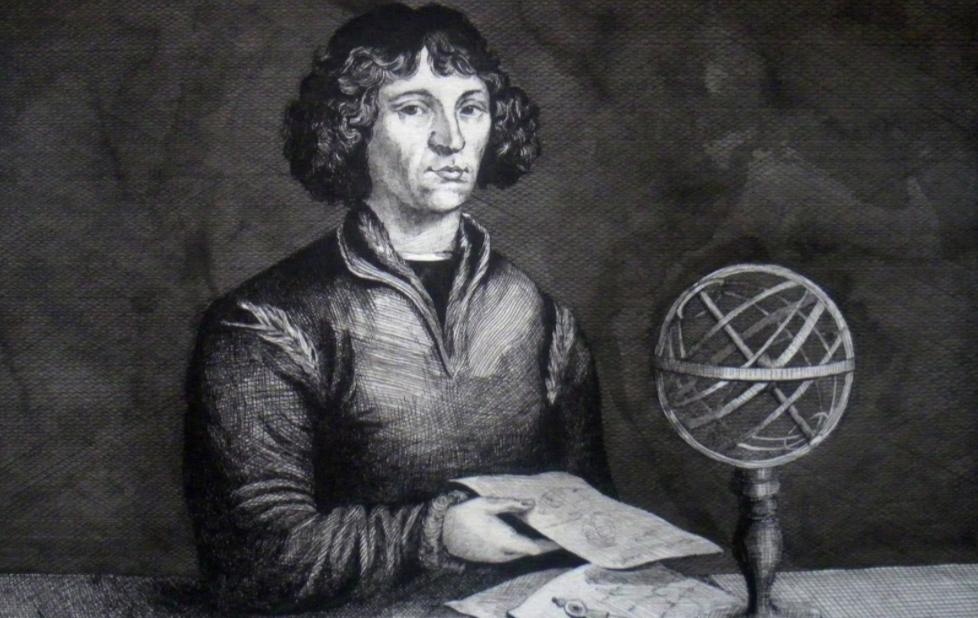
The Polish astronomer Nikolaus Copernicus is remembered as one of the greatest scientists of all time. The publication of his On the Revolutions of the Celestial Spheres declared, in contradiction to the assertions of the authorities of the day, that the Earth and the other planets revolved around the Sun. This heliocentric theory caused such a change in thought that it was later dubbed the Copernican Revolution.

Up until Copernicus, Western astronomers had followed what was called the Ptolemaic model. Otherwise known as geocentrism, this model asserts that the Sun revolves around the Earth. The Ptolemaic model accorded with the religious dogma of the day – that the Earth was the centre of the Universe – but had trouble accounting for some of the observed phenomena. This led to an ever-more complicated set of apologetics involving epicycles and other distractions.

Copernicus, however, was not the first person, or even the first Westerner, to realise that the Earth rotated around the Sun. The ancient Greek philosopher Aristarchus figured it out 2,300 years ago, only for this knowledge to be mostly lost when Christians destroyed Western Europe at the onset of the Dark Ages.

Heliocentrism was, for many centuries, an occult secret, one that could not be spoken openly for fear of persecution by religious fanatics. Giordano Bruno was burnt at the stake for promulgating the theory, and Galilei Galileo was put under house arrest for the same. Contradicting the Church, when the Church claims to speak for God, is blasphemy.

That the Sun is the center of the Solar System was not the only thing forgotten by the Christian Dark Ages.

Bernardo Kastrup is a Dutch philosopher and computer scientist who has risen to prominence recently for his theory of metaphysical idealism. Kastrup’s theory of reality is summarised in his second Ph.D thesis, where he writes: “there is only cosmic consciousness.”

Kastrup’s theory is detailed, but to summarise crudely, he asserts that consciousness is the prima materia, and all other phenomena arise from consciousness. Many have made similar assertions, but Kastrup’s brilliance lies in his ability to systemically and concisely refute the assertions of materialists. Kastrup’s philosophy has shown that materialism makes no sense.

Much like the truth of heliocentrism, it was also known to the ancients that consciousness is the prima materia. This is a truth expressed by the First Hermetic Principle, otherwise known as the Principle of Mentalism, which states simply: “All is Mind”. It is also expressed in the Bhagavad Gita, in passages such as “never have you existed not”.

It was, more particularly, a truth known to all the initiates of the Eleusinian Mysteries. They understood that, as Persephone entered into Hades and then returned to the world above, so too has the consciousness of each one of us entered into the Hades of the material world, only for it to inevitably return again to the world above after the death of our physical bodies.

The true spiritual and intellectual elite of the world have always known that the Earth revolved around the Sun – it was just impossible to say this because it contradicted the dogma of the authorities of the day. Copernicus’s genius was that he was able to describe the truth in a logical and mathematical manner that could not be denied.

The true spiritual and intellectual elite of the world have also always known that consciousness is the prima materia. It has also been impossible to say this because it has also contradicted the dogma of the authorities of the day. Bernardo Kastrup has likewise described the truth about the primacy of consciousness in a way that is hard to argue against.

Ultimately, Copernicus’s gift to the world was to remind us that the darkness of Earth was not the prime reality, but rather the light of the Sun. Kastrup’s gift might be similar, in that he has reminded us that the darkness of the material is not the prime reality, but rather the light of consciousness.

*

If you enjoyed reading this essay/article, you can get a compilation of the Best VJMP Essays and Articles of 2019 from Amazon for Kindle or Amazon for CreateSpace (for international readers), or TradeMe (for Kiwis). A compilation of the Best VJMP Essays and Articles of 2018 and the Best VJMP Essays and Articles of 2017 are also available.

*

If you would like to support our work in other ways, please consider subscribing to our SubscribeStar fund. Even better, buy any one of our books!
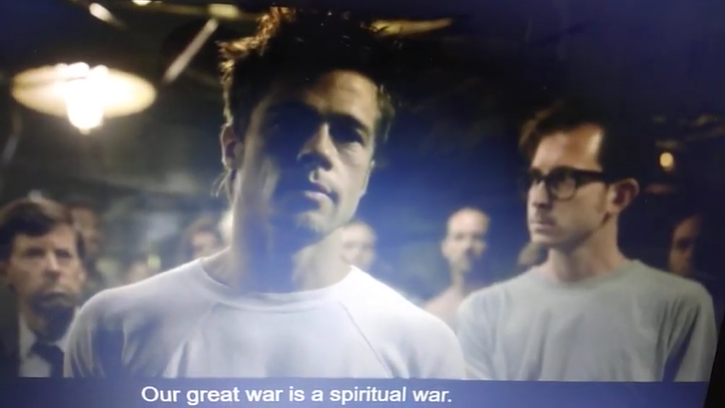
Our Great War Is A Spiritual War

Brad Pitt summarised the challenges facing the Western World in the 1999 film Fight Club, when his character Tyler Durden said: “We’re the middle children of history, men. No purpose or place. We have no Great War. No Great Depression. Our Great War’s a spiritual war… our Great Depression is our lives.” 22 years later, our Great War is still a spiritual war.

There exists a supercosmic spiritual force that wills suffering upon all conscious beings. This nameless Principle of Evil has inspired countless acts of sadism throughout the ages. It is at work everywhere a person acts with malice or indifference towards the suffering of their fellows.

This Principle of Evil is in eternal conflict with the Principle of Good, which seeks to alleviate the suffering of all conscious beings. The two are locked in a Great Spiritual War, one which profoundly affects the lives of every creature. The Principle of Evil seeks to cause those creatures to suffer, and the Principle of Good seeks to counter the Principle of Evil.

The influence of this Principle of Evil, as Solzhenitsyn understood, runs through the heart of every human being. It is not exclusive to any gender, race, nation, occupation or creed (although some creeds, such as the Abrahamic cults, worship the Principle of Evil and its demons). Therefore, this spiritual war is fought everywhere, in all times and places.

Every conscious being is conscripted into the war against this Principle of Evil, which seeks to cause them suffering. The easiest way for the Principle of Evil to cause suffering is by provoking passions. Every impulse felt by any conscious being creates a conflict: between the will to gratify that desire, and the will to alleviate suffering.

One of the main theatres of the Great Spiritual War involves keeping people ignorant about the spiritual truths of reality.

As Socrates and Buddha both laboured to point out, suffering is primarily caused by ignorance. The most effective way for the Principle of Evil to increase the suffering in the world is to spread ignorance, because ignorance empowers the passions. There are two main ways to spread ignorance: denying the truth, and asserting falsehoods.

Denying the truth involves denying the spiritual truths. The followers of the Principle of Evil deny the fundamental all-rightness of the Universe. They also deny the Law of Assortative Reincarnation. These two denials lead to extreme anxiety among those who are influenced to agree with them.

Asserting falsehood involves inserting lies in the space vacated by the destruction of the truth. The followers of the Principle of Evil do this by asserting things such as “Jesus Christ is God”, or “the brain generates consciousness”. These falsehoods serve to mislead people who might be searching for spiritual truths.

The combined result of denying the truth and asserting falsehood is mass spiritual confusion. The Principle of Evil preys on this confusion by tricking people into giving their power away. Once enslaved, they can be made to suffer without being able to resist.

One of the fronts of this theatre of spiritual warfare involves the legal status of spiritual sacraments.

The followers of the Principle of Evil are aware that people have used spiritual sacraments, such as cannabis and psilocybin mushrooms, for thousands of years to reconnect with the divine. In places such as India, where the native spiritual traditions were not eradicated by Abrahamic invaders, cannabis is still used as a spiritual sacrament.

In order to increase the amount of suffering in the world, then, the followers of the Principle of Evil have acted to destroy all genuine spiritual traditions. This is why they murdered Pythagoras and Hypatia, and it’s why they destroyed the Eleusianian Mysteries and the Library of Alexandria. It’s why their colonists have assiduously attacked the native spiritual traditions of every land they settled in.

This is also why Christians and Muslims came together to oppose cannabis law reform in New Zealand last year. By destroying the possibility of using cannabis as a spiritual sacrament, they worked to maximise the spiritual ignorance in New Zealand, and thereby the suffering. Abrahamists may spend a lot of time killing each other, but they’re capable of co-operating if the common objective is to attack ordinary people.

Victory in the Great Spiritual War entails the eradication of all Abrahamic traditions from the face of the Earth. This would result in the total defeat of the Principle of Evil, who, without worshippers, would be powerless to increase the suffering in the world. At that point, a new spiritual Golden Age would begin.

The first step is to reassert our freedom to use spiritual sacraments to reconnect with the divine. The truth – that cannabis, psilocybin and various other substances are spiritual sacraments – must be spoken widely once again. Their open, ritual use must retake a centre stage in our civic life.

With our natural connection to the divine re-established, we will once more come to act in accordance with the Will of God. This will lead to the minimisation of suffering in the world.

*

If you enjoyed reading this essay/article, you can get a compilation of the Best VJMP Essays and Articles of 2019 from Amazon for Kindle or Amazon for CreateSpace (for international readers), or TradeMe (for Kiwis). A compilation of the Best VJMP Essays and Articles of 2018 and the Best VJMP Essays and Articles of 2017 are also available.

*

If you would like to support our work in other ways, please consider subscribing to our SubscribeStar fund. Even better, buy any one of our books!