

If The Nazis Had Won World War II

Trade is a human universal and, as such, is more fundamental than trivialities like who exterminated who

The common perception of World War II is that, had the Nazis won it, the world would now be a wasteland of rubble and burning wreckage. It’s true that the world would certainly be different in some major ways to the timeline we currently live in, but there are many things that would be recognisable. This essay asks the question: what would our societies look like today if the Nazis had won World War II?

If the Nazis had won World War II, and united all of Europe under one Reich, our political leaders would have found an accommodation with it. If the Nazis had knocked out the Soviet Union and made peace with Britain, our political leaders would have shrugged, said “fair enough” and started to do business with the new bosses.

Some might doubt this, but an examination of history and human nature make it very clear. If the Nazis had won World War II, our political class would be lining up to whore themselves out to them.

If the Nazis had won World War II, and established a Lebensborn project to populate Poland with German settlers, and if this had led to an excess population such that many of these Germans sought to emigrate to other countries, our political system would tell us that this was a good thing. We would be told that we had to accept it otherwise we were evil.

Politicians all around the world would be clamouring to curry favour with the Nazi Empire by forming trade and diplomatic links with Nazi territories, or by agitating in favour of further immigration from Nazi territories or by attacking those who criticise Nazi actions. These politicians would dismiss anyone who accused them of siding with evil as conspiracy theorists, bigots and haters.

Politicians of German ancestry would be climbing onto social media saying that it’s hate speech to mention the Hungerplan, or that the Hungerplan didn’t really happen, or that the Poles deserved it because of genocidal attacks on Germans in Polish territory in the lead up to World War II. As with the Armenian genocide, a sufficiently strenuous denial would cause people to either doubt or to not care.

Many outside Europe would have ended up marrying Germans once the war tensions cooled off (as they have done in this timeline). They would say “Yes, the Nazis are evil, but Ulrike/Heike/Beate is against all that stuff.” Some of the fathers of these brides and grooms would be Nazi Party functionaries, and would have done some horrific things, but their sons and daughters-in-law would operate on a “Don’t ask, don’t tell” basis.

If the Nazis had won World War II, it would be an accepted fact that the Nazi Empire was too big to not trade with. People would say “Yeah I know that they starved a hundred million people to death but you can’t just not trade with an entity that comprises X% of the world’s GDP.” Even if they still had millions in concentration camps this would not matter.

No doubt the Nazi Empire would have established a competitive advantage in some economic manner, such as vehicle manufacture. It might be possible that the whole world would be driving German-made cars, or flying in German-made aircraft. In such a case, most people wouldn’t think anything of using such goods. Some might make jokes about the tens of millions who were exterminated to make it possible, but this wouldn’t prevent trade any more than the North American genocides prevent trade.

Had the Nazis won World War II, there would be politicians and pundits trying to curry favour with them by talking about Naziphobia. An excessive dislike of Nazis would be likened to a mental illness by politicians and by media enterprises chasing the Nazi advertising dollar. There would be mutterings that hate speech legislation ought to be introduced to prevent people from being too open about their dislike of Nazism.

If the Nazis still had people in camps, their plight would be ignored, save for the propagandising of a small number of social justice activists. These activists would widely be seen as obsessed or unhinged. In much the same way that the imprisonment of many Uighur people is dismissed as an outcome of the Uighurs’ religious fanaticism, so too would the imprisonment of the Jews be dismissed as an outcome of their predations.

If the Nazis had won World War II, our entire education system would be different. Naturally, we wouldn’t be taught that Germany started World War II by invading Poland. We would instead be taught about the German Revolution of 1918-19, and who was behind that revolution. We would be taught about the Holodomor, and how the Holodomor influenced anti-Communist attitudes in central Europe in the 1920s.

Nazism more general would be seen as an anti-Communist movement that arose in response to the horrors of Soviet rule. The role of the British and the French in forcing the Versailles Treaty on the Germans after World War I would be emphasised. The psychological effect of hyperinflation would be explained at length to all schoolchildren.

Perhaps it may even have been necessary, had the Nazis won World War II, to accept that many of the actions of the British and French Empires in colonising the world were effectively criminal. Perhaps conquering 40 million square kilometres of territory and then declaring war on Germany was a bit hypocritical. Winning the war meant we never had to face up to this charge, but losing it would have meant that we were forced to.

None of this is to say that the world would have been any better if the Nazis had won World War II. The fact is, however, that a Nazi victory in Europe would not have changed human nature in any way. Humans would still be opportunistic, acquisitive and dishonest. The winners would still write the history books, and they would still do so in a way that absolved them of all guilt.

*

If you enjoyed reading this essay, you can get a compilation of the Best VJMP Essays and Articles of 2018 from Amazon for Kindle or Amazon for CreateSpace (for international readers), or TradeMe (for Kiwis). A compilation of the Best VJMP Essays and Articles of 2017 is also available.

If you would like to support our work in other ways, please consider subscribing to our SubscribeStar fund.
Who Are Virgin And Chad?

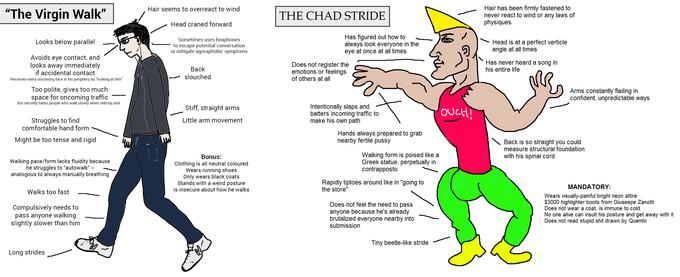
A common meme contrasts two opposing figures: the Virgin and the Chad. These two figures represent a diametrically opposed pairing in the Clown World pantheon. Like Apollo and Dionysus, who represent human reason and human nature, the Virgin and the Chad represent manifestations of the divine in human form. This essay explains.

At the most basic, Virgin and Chad represent opposite ends of the spectrum of sexual success with women.

Virgin, as suggested by his name, has had no sexual success with women. He is deeply neurotic, the sort of person that women feel uneasy around or even find creepy. He shuffles along, staring at the ground, downcast. His mind is plagued with thoughts of rejection and worry. Dressed in pallid greys and wearing cheap sneakers, his very appearance suggests rejection and despair.

There is nothing Virgin desires more than female attention, but there is also nothing that his nature is less likely to attract. This enraging paradox means that the Virgin is a deeply pitied figure. All of the memes that include the Virgin use him as a figure of fun – the example of what not to do or be like.

Chad strides along, his bearing perfectly upright at all times. His mind is clear, untrammelled by self-doubt. The appearance of Chad is the opposite to that of the Virgin: where the Virgin blends in with his grotty surroundings, Chad extrudes light and colour. His clothing is bright, with a cheery, glib slogan emblazoned without shame on the front. A genital bulge protrudes suggestively from his pants.

It’s wrong to think of Chad as a mere peacock, something that attracts females only through a visual display. Chad is also a genuine athlete, probably a wrestler or rugby player. His musculature and height are such that women notice him from a great distance just from his silhouette. He is the stuff of female fantasy.

The Virgin-Chad dichotomy represents the contrast between good and bad in a judgmental sense. In other words, the Virgin is something execrable, to be avoided. The Chad, by contrast, is a kind of ideal man similar to Hercules. Every Earthly man is morally obliged to make himself as chadly as possible – indeed, transcending the state of the Virgin could be said to be the act that makes a man a man.

This dichotomy is not merely a physical distinction. Implicit to all the Virgin-Chad jokes is that the Virgin always makes the wrong decisions, or fails to make the right decisions, because he doubts himself too much and lacks courage. The Virgin might be able to make himself physically attractive, under the right circumstances, but his mind will always preclude him from being a Chad. He is mentally weak, unable to control his baser impulses.

Chad, on the other hand, has no concept of fear. He doesn’t need fear, as he is naturally so in touch with his inner being that he can act on higher instinct. If Chad wants to do something, it is always the right thing to do. Therefore, he can act with perfect self-confidence.

Ultimately, the real advantage of the Chad is spiritual, and this is why the Virgin-Chad pairing has a spiritual dimension in the Clown World pantheon.

The Chad is in tune with the Tao, and this is why he always makes the right move. He does not desire anything other than a world precisely like the one that he moves in. Having no desire to change the world, the world has no desire to change him. Consequently, the Chad can operate without resistance. Women don’t resist him because they understand his advances to be the Will of God.

The Virgin, by contrast, is a creature of ego. This ego clouds his vision, which means that he cannot see reality accurately, and this is why he makes so many mistakes. He is desperate for recognition, for attention and for adulation, and this thirst frightens and repels people (especially women). The Virgin is entirely trapped in the illusion of materialism, in the commercial and advertising matrix.

There is a sense in which the Virgin represents the everyday man, and Chad represents, by way of contrast, a Zeus-like figure, something larger than life. According to this manner of thinking, Chad is envied by the Virgin, but is not resented. The Virgin sees Chad not so much as a competitor, but as a force of Nature that has its way with mortals, something to be emulated if possible and appreciated if not.

In magical terms, the Virgin can be thought of as an energy to be rejected and Chad as an energy to be summoned. A man going to a bar in the hope of getting laid wants to summon his inner Chad. The Virgin is, therefore, elementary masculine sexual energy that is rejected by the natural feminine, whereas the Chad represents elementary masculine sexual energy that is accepted by the natural feminine.

*

If you enjoyed reading this essay, you can get a compilation of the Best VJMP Essays and Articles of 2018 from Amazon for Kindle or Amazon for CreateSpace (for international readers), or TradeMe (for Kiwis). A compilation of the Best VJMP Essays and Articles of 2017 is also available.

If you would like to support our work in other ways, please consider subscribing to our SubscribeStar fund.

Is Being A Worker in 2019 Preferable To Chattel Slavery?

The school system and the mainstream media put a lot of effort into convincing us to be grateful for our lot. An entire apparatus of propaganda is devoted to pre-emptively quell rebellious impulses, so that our ruling classes can go about their business unaffected. As this essay will discuss, the overall quality of the lives of many of us today may be lower than that of chattel slaves in times past.

Although it is not acknowledged today, there are many advantages to being a chattel slave that are not enjoyed by modern workers.

The physical body of the slave is an expensive asset. The joke is that slaves are antique farm equipment, but there’s truth to it. In relative terms, spending on maintenance to keep the bodies of the slaves healthy is one of the largest expenses borne by a plantation owner.

One thing about the modern system of employment is that responsibility for the maintenance of the body of the worker is placed back on the worker. The worker is paid when the slave is not, and this single fact alone is supposed to entail perfect freedom. But this means that the worker themselves have to bear the cost of maintaining their body so that they can continue to work.

In today’s economy, there are many workers who are also homeless. This doesn’t happen under a system of chattel slavery, because under such a system the slaveowner is obliged to provide shelter to his valuable assets, lest they become sick and unproductive. This incentivises the slaveowner to build and provide adequate housing.

The modern employer has no such concerns. The worker themselves is responsible for their housing, and if they have to go homeless then tough shit. The employer doesn’t need to care because, if the homeless worker becomes sick or dies, they can just import some more cheap labour from overseas.

The modern worker is also responsible for their own food and medicine. One might argue that the range of food choices available to the modern worker greatly exceed that available to the slave. Against this, it has to be pointed out that the slave ended up eating more nutritious food on average – as evidenced by lower rates of obesity and diabetes. The slave may not have had a banquet every night, but their owner did have an interest in maintaining their body.

This interest in maintaining the body of the slave, on account of that it was a valuable asset, is why slaves were not beaten and whipped as much as is often supposed. The degree to which this happened would seldom have exceeded the point at which it cost the slaveowner money. A slaveowner isn’t going to beat a slave to death any more than a farmer is to set his own combine harvester on fire. It would just cost too much.

This disinclination to abuse underlings does not apply to the modern working environment. Although corporal punishment is illegal, in practice any amount of psychological abuse is legal. Bullying and threats are considered normal and acceptable ways to establish compliance.

So those who say that a slaveowner wasn’t punished for working a slave to death have to balance that with the fact that a modern employer isn’t punished for working an employee to suicide.

Some might make the argument that the modern worker is free to choose another workplace if they don’t like their arrangement at the current one. At least the modern worker is not bound to one physical area like the slave is.

The reality, however, is that all employers within a country collude to make sure that labour costs never rise above a certain point. This they primarily achieve by lobbying the government to allow, and by propagandising the population to accept, the mass importation of cheap labour. This has the effect of driving labour costs to the floor. Therefore, it doesn’t matter where the worker goes – he can only earn a pittance.

If the worker wants more than a pittance, then fuck him out the door and replace him with an immigrant who lives thirty to a house and who is (ironically) supporting a family in their homeland with their remittances. They will be happy to be earning minimum wage because they’re not trying to raise a family here.

Others might make the argument that the modern worker is free to upskill if they don’t want to take a position where they are treated poorly.

For one thing, this ignores the fact that many people are not capable of upskilling to the middle class on account of that middle-class jobs almost invariably require an IQ of 100 or higher – and only 50% of the population has that.

For another, it ignores the fact that mass immigration has been so intense in recent decades that even wages for skilled labour have been driven to the floor. Realistically, in our modern society, there are owners and the owned – and the owners feel they have the right to staff their properties with whoever they see fit.

A further advantage to being a chattel slave on a plantation is that it was possible for your work to get done. A cotton plantation only has a certain acreage, and the harvest only occurs at certain times. Outside of these times, if there’s no work to do then no work gets done. When it was time to work the days would have been long and arduous, but the shifts wouldn’t have been longer than those worked by oilmen or hospital staff today.

This contrasts with the modern workplace. In the modern workplace, the employer has their systems optimised to squeeze every last second of productivity out of their worker, who works to an industrial schedule. The average workplace is no longer supporting a local industry, but is now part of a globalised network of industries that pillages the local area for the profit of someone who lives on another continent.

Perhaps the foremost advantage to being a chattel slave, however, is that it was possible to have someone to hate. The slaveowner might expect that you will work a certain number of hours for no pay, but at least you could hate him and talk to the other slaves about how terrible and evil he was, and you could expect them to agree.

The modern workplace offers no such simple pleasure. Hating your employer will see you fired nine times out of ten, and even confessing such a hatred to a workmate is liable to see you sacked. You’re expected to absorb psychological abuse and remain grateful for the fact that you’r able to eat.

All in all, the modern industrial worker might have many reasons to feel envious of a chattel slave from bygone times. That kind of life would not have been easy, but at least the suffering inherent to it would be limited by what was technologically possible for the time. The advanced and sophisticated psychological cruelty of the industrial system would not have been a factor.

*

If you enjoyed reading this essay, you can get a compilation of the Best VJMP Essays and Articles of 2018 from Amazon for Kindle or Amazon for CreateSpace (for international readers), or TradeMe (for Kiwis). A compilation of the Best VJMP Essays and Articles of 2017 is also available.

If you would like to support our work in other ways, please consider subscribing to our SubscribeStar fund.

Clown World Chronicles: The Great Awokening

For thousands of years, intellectual and spiritual humans have dreamed of an age where people would come to cherish truth and wisdom – a Great Awakening. Such a golden age would bring peace and harmony to the entire world. Unfortunately for us, we’re not getting such a thing. Even worse – we’re getting a sickly, plastic, pallid imitation of it – The Great Awokening.

“Wokeness” is one of the foremost sociological trends of our time. This refers to a particularly shameless form of virtue signalling that has become extremely common today. The point of it is to present oneself as morally superior to ones fellows – more sensitive, more refined, more enlightened.

There is little more to wokeness than the usual ego-driven posturing and oneupmanship that has depressed honest people since before civilisation. At its core, it’s a desire for the little dopamine hit that comes with triumphantly rubbing another person’s face in the shit. The sort of person who participates in the Great Awokening is generally incapable of doing this to a person physically, so they do it metaphorically.

One notable thing about wokeness is that it is equally as hateful and discriminatory a philosophy as anything that has come before. Wokeness has its ingroup and its outgroup, and the ingroup is fully encouraged to shun, bully and abuse the outgroup. In this sense, it can be said that wokeness, and SJW culture more generally, is like a sort of cult. As with other cults, abusing outgroup members can strengthen solidarity among ingroup members.

The outgroup of the Great Awokening are the unwoke. In theory, the unwoke are those without the moral strength to act with compassion. The woke believe that the moral values held by the unwoke are primitive, backwards and animalistic. The unwoke have failed to undergo the necessary self-reflection to achieve wokeness, and therefore any abuse one feels to give them is justified. The unwoke are the untermensch, the infidel, the goyim, the heathen.

In reality, wokeness is not based on any transcendental truth but is rather based on whatever is fashionable in the moment. It was once woke to oppose Islam on the grounds that it was cruel to women and homosexuals – now it’s woke to support Islam on the grounds that Muslims are non-white. The same people who were praised for an enlightened attitude to Islam are now excoriated for being Nazis – without changing a thing.

Likewise, the unwoke are bullied for little more than being unfashionable. This is one reason why people from the working class are seldom considered woke – it takes a lot of leisure time and a lot of socialising with the right people to learn the right values. Because these values can change on a whim, knowledge of them has to be maintained via continual access to the high priests. Poor people don’t have this access.

The Great Awokening could be described as the grand climax of the worldwide epidemic of virtue signalling that has now run for some years. Never before has the world been this pretentious. Never before have people at large made such a strenuous effort to create a false image of themselves for the sake of preening their egos. Never before have the social stakes been so high, and the error margins so thin.

The problem is that we’ve started to believe our own lies.

For decades now, we’ve been blaming everything on white men because it was the woke option. White men had most of the power, therefore it stood to reason that they took most of the blame. No-one woke could oppose this because the woke attitude is that all wealth was earned by theft, and all privilege stolen from someone else. Opposing this meant to believe that non-whites and women deserved their relative poverty – a horribly unwoke position.

This has led to a situation where if you don’t openly hate white people now, you’re unwoke. The paradox of claiming to be the least racist person while at the same time hating white people is an example of the doublethink that is now everywhere. The Great Awokening doesn’t worry about contradictions like this because the most important thing is the intention. Hating white people isn’t racist if you do it for the right reasons.

The hypocrisy is how the highest echelons of woke can get away with jetsetting around the world to browbeat us into reducing our carbon footprint. Prince Harry and Meghan Markle represent the most vomit-inducing excess of unearned wealth. They are triple distilled privilege. But for them, the Great Awokening is an opportunity to market themselves as enlightened world leaders.

The Great Awokening is why comedy is essentially dead today. In order for humour to exist, someone has to be willing to tell the truth. Humour is when needles of truth prick the balloons of falsehood, and laughter is released as a form of catharsis. It has been a fundamental part of civilisation forever, but today people are so afraid of getting a moral browbeating that they’re less willing to crack jokes.

The Great Awokening is essentially the final victory of slave morality over life on this planet. Resentment now has free rein, and the slaves are trying to rip down everyone and everything in the world. The total victory of slave morality means that everything of value in the world is to be destroyed, and the weakest and most execrable aspects of humanity are to be held up as exemplars.

As there is always a seed of yang even when yin appears to be triumphant, so is there a seed of truth within the bullshit of The Great Awokening. That seed is the small number of truth-tellers who are not tempted into telling lies, despite the social pressure of the woke hordes. The longer the Great Awokening goes for, the more ridiculous it will become, and eventually it will become so ridiculous that the merest whisper of truth will cause the music to stop.

*

If you enjoyed reading this essay, you can get a compilation of the Best VJMP Essays and Articles of 2018 from Amazon for Kindle or Amazon for CreateSpace (for international readers), or TradeMe (for Kiwis). A compilation of the Best VJMP Essays and Articles of 2017 is also available.

If you would like to support our work in other ways, please consider subscribing to our SubscribeStar fund.