
Category: propaganda
The Government Needs to Draw Up A List of Opinions We’re Allowed to Express

The Western World risks falling into confusion. Most of us have lived our lives under the impression that we were free people, at liberty to pursue happiness and to discuss ways of achieving it. As we’re now finding out, we don’t actually have the rights that we thought we had. This essay suggests a way out of the predicament.
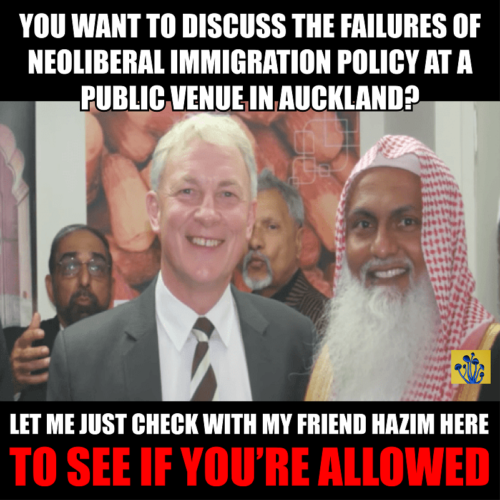
New Zealanders have, in recent weeks, been surprised to learn that we don’t actually have the rights to free assembly and free speech. This has been demonstrated by the example of controversial speakers Lauren Southern and Stefan Molyneux, who were forbidden from using a public hall by Auckland Mayor Phil Goff. Stating that he doesn’t believe that the political opinions of the two should be permitted to be spoken, Goff banned them from using the Auckland Town Hall.
Southern and Molyneux, whose talks frequently criticise the suicidal policy of mass immigration, have come in for a savaging from the banker-owned New Zealand media. Because the banks are the ones that profit the most from the bloated house prices and rents that come with opening the borders, they are the biggest cheerleaders for it. Consequently, their peons in the New Zealand media whipped up a mob which threatened violence to get the speakers banned.
This imbroglio has raised an important question: what are we actually allowed to talk about?
One potential solution lies in Peter Dunne’s Psychoactive Substances Act. The logic behind introducing this piece of legislation was that synthetic drug manufacturers were coming up with novel, dangerous substances so quickly that the authorities were unable to ban them all fast enough to keep the public safe. So instead of banning specific drugs that were known to cause harm, the Act simply bans all psychoactive substances.
This was a breakthrough in jurisprudence. Anyone wishing to use any psychoactive substance, no matter what it is, even if they just invented it themselves, is automatically a criminal unless they have Government permission to use that substance specifically. An entire class of actions are thereby criminalised, without any proof that actions within this class are harmful to people. They could even be helpful, but they’re still criminal.
We could apply this same logic to free speech and assembly. New ideas come and go in an ever-mutating memescape, and the Government can’t keep up with all the new ideas and opinions that people have and which might be dangerous. The spread of the Internet means that New Zealanders are frequently exposed to opinions that have been formed overseas and brought into the country by way of underground networks, such as 4chan. These new opinions have not had time to be dissected and discussed.
Why not simply ban them all?
The Government could pass a law that bans expression of all political ideas and opinions apart from those that are on a pre-approved list. This list would contain all of the speech that the Government believes is not harmful to anyone else. It could be called the Dangerous Opinions Act. It would then become illegal to express any political opinion that didn’t have an exemption under the Act.
Because talking about the effects of mass immigration on European society risks stirring up ethnic tensions and hatreds, we could simply ban all such talk in advance, thereby precluding anyone like Southern and Molyneux from ever speaking. Discussing racial differences in IQ would then be illegal. Questioning the mainstream media would be illegal. Questioning the Government would be illegal.
Perhaps the Government could create some kind of central authority that can be tasked with determining what opinions may be freely expressed and what opinions have to be criminalised and repressed for the greater good. This Ministry would be concerned with the truth and the promulgation of same, so naturally it should be called the Ministry of Truth.
All of this might sound fairly draconian, but the people would still have the right to petition the Government to allow certain opinions to be expressed. If enough people wanted to express a certain opinion, they would merely need to petition the current Minister of Truth, and perhaps get enough signatures for a referendum on that opinion. Over time, good opinions would become legal while the bad ones stayed illegal.
*
If you enjoyed reading this essay, you can get a compilation of the Best VJMP Essays and Articles of 2017 from Amazon for Kindle or Amazon for CreateSpace (for international readers), or TradeMe (for Kiwis).
Why Minds is Vastly Superior to Facebook
FaceBook, otherwise known as FaecesBook, is like the Titanic about half an hour after hitting the iceberg. They are no longer gaining new users, and many of their current users are discovering other social media networks, such as Minds. This article shows why Minds is a vastly superior social media network, for decent people, than FaceBook is.
The reason why FaceBook used to be fun is because it used to offer an escape from all the shit in the world. It was a space where people could speak freely and avoid censure for off-colour jokes and pisstakes. This was the reason for its initial uptake – it provided a release from the stuffy, formal nature of schooling and employment, like a virtual clubhouse.
This was, of course, some years ago now, and FaceBook has since deteriorated into a Big Brother-style cyberdystopia. From being a bastion of free speech and free interaction, it’s now a place where you can’t even say ‘faggot’ without getting banned – not even if you are using the term ironically in defence of homosexuals. The demands of advertisers have induced Mark Zuckerberg into making FaceBook like television. Hitler jokes, race jokes, nation jokes, religion jokes, sexual orientation jokes: all banned.
Minds is different, and appears to intend to stay that way. Free speech is the reason for many people joining the network: you can say what you like, without fear of getting banned. The easy-going, fun and joking culture that FaceBook once had still exists there. There is no feeling that the Thought Police are monitoring and censoring your speech to ensure compliance with a corporatist globalist agenda.
Another reason why Minds is a superior social network is the relative absence of the human lowest common denominator. FaceBook is the McDonald’s of social media. This means that, much like television, the information on FaceBook is aimed at people with IQs of about 90-100. This maximises the possible audience.
One drawback with this is that content tailored for people at such a level of intelligence tends to be simplistic. People with IQs of 90 cannot understand complex sentences, so the material shared is often little more than a list of bullet points, with no deeper analysis possible. This means that a truly comprehensive and accurate understanding cannot be gained.
The major drawback, though, is that this content also tends to be outright false. Advertisers know that people with IQs of less than 100 are not educated and therefore are not very good at distinguishing truth from falsehood. Therefore, it’s possible to target them with sensationalised false news and to thereby sway their beliefs to whatever the advertiser wishes. If not enough people believe the fake news, it’s a simple matter of buying more advertising.
The major and most distinctive factor, however, is that Minds is prepared to reward its users for posting quality content.
Like any broadcaster, FaceBook sells advertising. As a consequence, like any broadcaster, they need engaging content that they can broadcast between the ads. On FaceBook, this content is mostly provided by the users themselves in the form of posts and status updates. FaceBook therefore makes a product out of its users – and this is before they start selling your personal data to advertisers.
Minds works on a different principle. There, posts that get likes, comments and shares are rewarded with a share of the daily advertising proceeds. In other words, Minds shares with its users some of the value of their content, unlike FaceBook, which keeps it all for itself.
Ultimately it has to be conceded that Minds is a vastly superior social network from a user perspective (unless said user is a pleb). FaceBook might have its advantages for corporate advertisers or political entities looking to influence a large group of people, but Minds is a better choice for intelligent people looking to broaden their horizons.
*
If you enjoyed reading this essay, you can get a compilation of the Best VJMP Essays and Articles of 2017 from Amazon for Kindle or Amazon for CreateSpace (for international readers), or TradeMe (for Kiwis).
VJMP Reads: David Seymour’s Own Your Future VIII
This reading carries on from here.
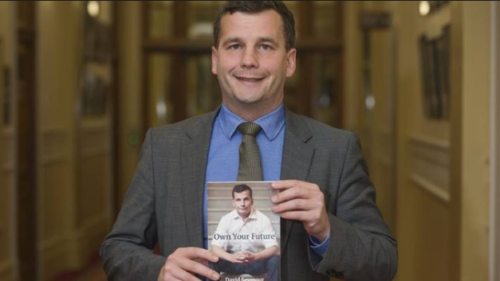
The seventh chapter in Own Your Future is ‘Public Safety’. Here Seymour opens the chapter with one of the non-sequiturs that seems to be characteristic of his style. He talks about visiting a prison, and seeing the downcast faces on the prisoners there. For some reason he lurches directly from this to stating his belief in deterrence being the primary solution to the crime problem.
It’s hard to believe that Seymour is writing this chapter with a straight face. He claims to be tough on the causes of crime – yet his party supports National every step of the way in ripping down the social welfare that people need to get out of the poverty that causes crime.
Indeed, the facade soon slips, and he openly admits that ACT Policy is based around “making the consequences of committing crimes sufficiently bad that people will decide not to do it in the first place.” Within the space of a few sentences he goes from complaining about the cost of prisons to crowing about ACT success in keeping people in prison for longer through their three strikes policy.
From there, Seymour launches into a rant against burglary. Fittingly for a party that values property more highly than people, he wants to add burglary to the list of crimes that involve the three strikes law, the third offence being punished by a minimum three years without parole. Helpfully, he informs us that “The aim [of burglary] is getting more money or goods without working for them or being given them.”
At this point, Seymour serves up a genuinely good idea. Prisoners often find it difficult to return to civilian life after their sentence on account of poor literacy and numeracy, so Seymour proposes that they can get time knocked off their sentences by completing adult reading and maths courses while in prison. Any prisoner who is already educated can get time off for helping to tutor the other prisoners.
This is actually a really good policy, but it’s incredible that Seymour, as a supposedly principled libertarian, doesn’t mention cannabis law reform here. If it costs $105,000 a year to keep a person in jail, we could save tens of millions immediately just by letting cannabis growers and dealers out. He doesn’t suggest this, even though it seems like such an obvious thing for a principled, libertarian party to suggest at this juncture.
This newspaper wondered some time ago if perhaps David Seymour is the biggest coward in the New Zealand Parliament. It’s astonishing that ACT, who barely get more votes than the Aotearoa Legalise Cannabis Party, aren’t willing to support cannabis law reform as their libertarian counterparts everywhere else have done, when the entire country is crying out for it. They could take votes off the Greens and the Opportunity Party simply by offering a right-wing alternative to how to legalise cannabis.
*
If you enjoyed reading this essay, you can get a compilation of the Best VJMP Essays and Articles of 2017 from Amazon for Kindle or Amazon for CreateSpace (for international readers), or TradeMe (for Kiwis).