
Category: drugs
The Case For Cannabis: Cannabis Is A Religious And Spiritual Sacrament

We are supposed to have freedom of religion in the West, but in practice this only applies to certain favoured religions, in particular Abrahamism and its derivatives. Other religious traditions, particularly those that employ psychoactives as part of their rituals, are effectively discriminated against by the War on Drugs. This article will discuss the established tradition of cannabis use as a religious and spiritual sacrament.
The Indo-European peoples have been using cannabis as a religious and spiritual sacrament for thousands of years.
Cannabis is mentioned in Indian texts going back to 1,000 B.C., primarily for its use as a medicine, but also for its purported ability to facilitate contact with the divine. There is an age-old tradition in India of weed-smoking holy men known as sadhus. These are ascetics who have renounced worldly wealth and pleasure, and who use cannabis to get into touch with Shiva. Among sadhus, use of cannabis is especially popular when meditating, for the moments of tranquillity and serenity that it is capable of bringing.
The Nepalese smoke it publicly and ceremonially during the festival of Maha Shivaratri. The enlightenment brought about from the cannabis high is said to represent the coming-to-awareness of the first guru in the world. It is said that it was at this moment that the consciousness of the first guru transcended the material and the illusion of space and time, and the cannabis high is intended to replicate this.
In ancient China, cannabis was used by holy men in healing and early magical rituals. Early Taoist shamans systematically experimented with the ritual use of cannabis, with some declaring that smoking it was as good as climbing into the mountains for those who were physically unable. Their traditions began with burning cannabis as incense for the sake of smoking out demons and evil spirits, and soon evolved into inhaling cannabis for the sake of drawing in good energy from God.
Cannabis was also used by the Scythians in a ritualistic form that amounting to the hot-boxing of small smoke tents. The participants would gather inside these tents as part of funerary rites and cast buds onto superheated rocks, causing them to burn and to fill the tent with cannabis smoke. The change in consciousness brought about by these rituals were considered to bring the participant into contact with the spirits of the dead.
From there, it spread to Germany, and from there to Britain and Scandinavia. The Vikings came to associate its aphrodisiac effects with the fertility goddess Freya, and spring festivals sometimes involved the ritual consumption of cannabis. Viking herbalists were also aware of the pain-killing properties of cannabis, and they appear to have cultivated it in Southern Norway since 650 A.D. Evidence suggests that at least some of this cannabis was cultivated for ritualistic and shamanic purposes.
Therefore, cannabis use has been part of our natural spiritual traditions for thousands of years. The state of cannabis prohibition brought about by Abrahamism is an obscenity, the kind that comes from such false doctrines. It is not right for us Westerners to live in a state of cannabis prohibition, because it separates us from our natural connection to the divine, replacing it with a doctrine of women-hatred, gay-hatred, genital mutilation and ignorance.
Many modern people could tell you that cannabis use is still part of our natural spiritual traditions. It is the Western subcultures that smoke cannabis who are most likely to reject the obsession with materialism that has captured our culture. After all, the spiritual effect of cannabis comes from its ability to separate the user from the material. By inducing a state of physical and emotional calm, consciousness focuses instead on the spiritual. By pacifying the user’s base physical desires, they can concentrate on a form of living that pays homage to God.
Rastafarians say of cannabis that “The herb is the key to new understanding of the self, the universe, and God. It is the vehicle to cosmic consciousness”. Many Westerners who do not follow an organised religious tradition can likewise tell you that smoking cannabis gets you closer to God. There are millions of us who could tell you that we have had profound spiritual epiphanies from sacramental cannabis use, and that these epiphanies are worth gold.
Cannabis being illegal therefore amounts to religious discrimination. It’s essentially no different to a law that makes the Bible or the Koran illegal. If cannabis use is a means by which some people get closer with God, how can it possibly be anyone else’s right to say otherwise? The people who support cannabis prohibition would be appalled at the thought of Government agents going into someone’s house to take their Bible away, but they do much the same thing with cannabis without a second thought.
There is a need for cannabis law reform so that religious and spiritual alternatives to Abrahamism can be explored. There is no valid reason for people to be forced to follow an Abrahamic tradition, and therefore no valid reason for the law to prohibit the spiritual sacraments of non-Abrahamic traditions. True spiritual and religious freedom requires that none of the established methods for coming closer to God are made illegal – this includes cannabis use.
*
This article is an excerpt from The Case For Cannabis Law Reform, compiled by Vince McLeod and due for release by VJM Publishing in the summer of 2018/19.
The Case For Cannabis: Cannabis is an Exit Drug
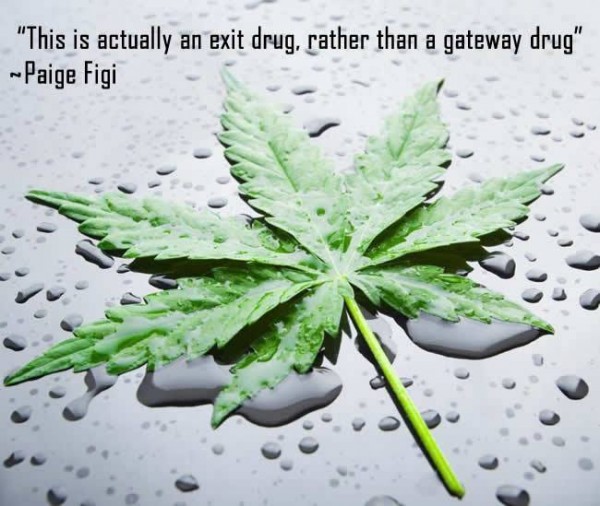
Many people erroneously believe that cannabis is a “gateway drug” that leads to users moving on to harder and harder drugs. The reality, like many myths relating to cannabis, is closer to the opposite of this. As this article will examine, cannabis can serve as an ‘exit drug’ to help people overcome addictions to actually harmful substances, in particular alcohol, synthetics and opioids.
In New Zealand, there is a “synthetic cannabis” epidemic underway. A couple of recent deaths in Christchurch were believed to have been caused by the substances, and the total number of deaths in New Zealand this year attributed to them is approaching 50. This is rightly a public health crisis, and is increasingly being understood as such.
The substances being sold as synthetic cannabis generally have nothing to do with cannabis – they are mostly unknown psychoactives that generate some kind of buzz when smoked. No-one’s really sure where they come from or what’s in them, they’re just sold through shady contacts – often at tinny houses when someone was looking for natural cannabis – and end up killing people in the streets.
It doesn’t matter that these substances aren’t really much like cannabis, because they fill a market niche that would otherwise be filled by cannabis. If a person doesn’t like to drink alcohol, for whatever reason, the major alternative is some form of cannabis. If cannabis is not available, because prohibition has made it impossible to supply, then “synthetic cannabis” might have to do, because it will frequently be available through the same channels that a person would try to access natural cannabis.
For the many thousands of Kiwis believed to be addicted to synthetic cannabinoids, and for the hundreds of thousands who are at risk of encountering some synnies from one of the infamous “bad batches” that kill people from time to time, legal cannabis could serve as an exit drug. With legal cannabis in place, even if only at the medicinal level, a synthetic cannabinoid addict could be weaned off the synnies with a replacement medicinal cannabis regimen.
In America, there is an opioid epidemic underway. Opioid overdoses were believed to comprise 49,000 of the 72,000 drug overdose deaths in America in 2017. This contrasts with about 10,000 such deaths at the turn of the century. This represents several times more deaths than even the infamous American homicide rate – clearly a crisis of such proportions that extraordinary actions must now be considered.
Cannabis has shown immense promise as an exit drug from opioid addiction. Science Daily links a report from the University of British Colombia that found significant evidence to suggest that cannabis can help in the case of alcoholism and opiate addiction. There are already clinics in operation in Los Angeles where cannabis is in a clinical program of rehabilitation from heroin and alcohol misuse.
A study in the Journal of the American Medical Association found that rates of opioid use are lower in American states that have legalised medicinal cannabis, which suggests that individuals who use opiates are themselves happy to wean themselves off by using cannabis, if only there are given the opportunity. The JAMA study found that “States with medical cannabis laws had a 24.8% lower mean annual opioid overdose mortality rate compared with states without medical cannabis laws.”
A report by Time Magazine found that rates of death by opioid overdose had quadrupled from the turn of the century, and that states which had legalised medicinal cannabis had saved hundreds of millions of dollars from alleviating some amount of opioid abuse. Even if a patient does not stop taking opiates completely, it is possible that a synergistic effect from the cannabis can potentiate the opiates they do take, meaning that they can take less for the same painkiller effect.
All this means that cannabis prohibition is effectively killing people, by preventing those addicted to alcohol and opiates from accessing a potential exit drug, and thereby forcing them to remain addicted to the substance. Despite the apparent moralistic intent behind cannabis prohibition, we can safely suggest that the spirit of the law was not that it should kill alcoholics and opioid addicts.
Cannabis law reform is necessary so that medicinal cannabis can be applied as an exit drug to people who are addicted to, or dependent on, more harmful substances. This will have the effect of substituting a substance that heals for substances that harm, and thereby preventing suffering.
*
This article is an excerpt from The Case For Cannabis Law Reform, compiled by Vince McLeod and due for release by VJM Publishing in the summer of 2018/19.
VJMP Reads: David Seymour’s Own Your Future X

This reading carries on from here.
The ninth chapter in Own Your Future is ‘Personal Responsibility’. Seymour opens here with a stark claim that ACT doesn’t believe in the nanny state or in a paternalistic government. Many of our laws are holdouts from an age of Victorian values, he states, and they are enforced by politicians who transparently do not have a deeper grasp on morality than anyone else.
Breaking rank with the other Parliamentarians, Seymour is willing to admit here that cannabis does less harm than alcohol and tobacco (although he points out that cannabis is not without its own harms). He also echoes a point often made by Kiwi cannabis law reform activists (such as here), that the burden of Police enforcement of cannabis prohibition falls mostly on Maori.
Seymour cites a Treasury study that estimated that cannabis prohibition costs the country $300,000,000 annually, as well as tying up 600,000 hours of Police time. Worst of all, the supposed criminal deterrence doesn’t even work – the overwhelming majority of people convicted for cannabis offences go on to use it. Moreover, the law is applied in a haphazard manner, as can be seen by the 26-month sentence initially handed down to Kelly van Gaalen.
In a distinct break from the right-wing that ACT is usually associated with, Seymour repudiates the moralising that is chiefly responsible for cannabis prohibition, pointing out that not only is there a heavy majority in favour of cannabis law reform, but that majority is steadily growing. This contrasts with the proportion of people who oppose actual crimes, such as murder – this proportion remains constant.
True to the libertarian image that Seymour is trying to stake out, he argues for legal recreational cannabis as well. However, true to the conservative streak that binds his party to National, he is torn, claiming that 80% of the New Zealand public opposes recreational cannabis. He does not cite a source here, and neither does he note that such opposition would be unusual in the context of places like Colorado and California voting by referendum to legalise medicinal cannabis.
Seymour takes pains to seat himself as immovably as possible, right in the middle of the fence. He is open to the possibility that countries that legalise cannabis might “lose their morality” and “become cesspits of unmotivated human squalor” (as if alcohol was not well capable of achieving both), and wants to have a Royal Commission that takes five years before he will consider that we have satisfactory evidence to make a decision.
He rightly pillories the Government for its sharp increase in the tobacco tax, pointing out that the people most sharply affected by this are those who can least afford it. Worst of all, it seems that raising the tax further will not help persuade people to give up smoking. Those who are still addicted are so addicted that they will do almost anything to get hold of tobacco. Sensibly, Seymour would legalise vaping and e-cigarettes.
Euthanasia is another thing that Seymour would legalise, promising an end to “morality-based harassment”. His reason for promoting this is to avoid the indignity of the last weeks of life. Having nursed elderly grandparents to the end of a terminal illness, I can commiserate with him in this regard. He is also in favour of abortion, which makes him less hypocritical than the old right. Seymour doesn’t want to pay for your kid either, but he’s happy to help you get it aborted.
It’s hard to find fault with any of Seymour’s proposals in this chapter. Even if the only right he champions with conviction is the right to die, it’s an excellent thing that these libertarian proposals are even being suggested. It is interesting to note how similar ACT is with the Greens on issues such as cannabis, especially if it is considered that being young is highly correlated with both voting ACT and Green.
*
If you enjoyed reading this essay, you can get a compilation of the Best VJMP Essays and Articles of 2017 from Amazon for Kindle or Amazon for CreateSpace (for international readers), or TradeMe (for Kiwis).