On Boxing Day, 2008, I took a heavy dose of psilocybin mushrooms for the first time. It wasn’t a reckless decision. I had been a heavy cannabis user for some years already, and as a schizophrenic I was well accustomed to strange and sometimes terrifying thought patterns. It was about six o’clock in the evening.
Perhaps forty minutes later, I started to feel unusually good. The come-up had already become more pleasant than was possible with cannabis alone (much less alcohol). I felt so good that I decided to go over to my neighbour’s house to split the rest of the mushrooms.
Standing on the road outside my house, on my way to my neighbour’s, I started to feel unusually good. I was certain that this was the best I had ever felt in my life. It was a sense of exhilarating peace, in that all of my suffering had been abolished, replaced with an overwhelmingly confident sense that everything was going to be alright.
My neighbour and I divided up the rest of the mushrooms. After a while, he suggested that we smoke some weed to “kick it on a bit”. So we did. At about 8 p.m. the experience started to become unusual – I started to enter psychedelic space for real.
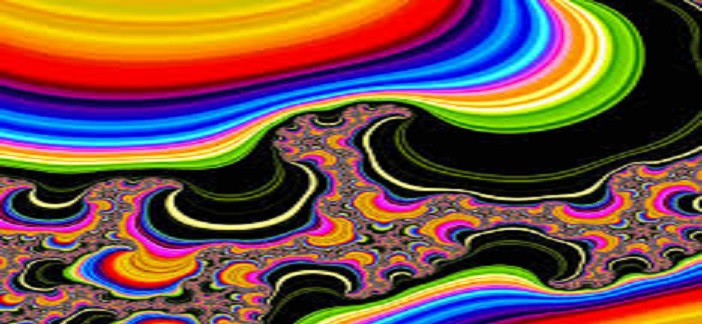
My ordinary vision started to be replaced by a shimmering field of reds, yellows, greens and blues. These colours took on more and more of my view, but when someone spoke, or if I moved my head suddenly, the room I was in would become apparent again. These colours were not simply placed on top of my ordinary vision, but were a higher-order interpretation of it, as if I was seeing elemental fire, air, earth and water.
Soon this vision collapsed from four colours into two: an electric neon blue, and black darkness. The neon blue was alive, and it seemed to reach out into the darkness as if by sexual impulse. It reached out with tendrils that curved into every available space, but not merely three-dimensionally – the electricity reached into every available space in a countless number of higher dimensions.
What I was seeing was the material world represented as masculine and feminine. This was an ancient Taoist secret: that the world is yang and yin, interdependent and meshed together so tightly that it is impossible to ever see pure masculine or pure feminine in a state of Nature. That I was able to see it was because my mind was rising through the dimensions, into metaphysical space.
Soon this vision also faded, and I was left with no sensations at all, just pure awareness. My mind no longer contained words, until I was asked how much of it I wanted to see. In my mind, I responded: “The full measure.” This is the Luciferian in me – I had waited my entire life, perhaps even several lifetimes, for this exact moment, and I knew what to do.
As if by lightningbolt, the Veils of Isis were lifted, and I looked directly into the face of God. What was seen cannot be described, for reasons that will shortly be explained. It is sufficient to say that the ancient Vedics were correct when they claimed that there is no such thing as space or time, and that behind Maya is absolution.
Looking into the face of God, I realised that everything I knew was wrong. It wasn’t that everything I knew was factually wrong, it was that reality was so fundamentally different to what I thought it was that every assumption had to be revisited. I was open to all possibilities – and in that state of maximum receptivity, and in the presence of God, some things were revealed to me.
There is no such thing as time and space. In the same way that twenty-five still frames a second gives the impression of a moving image, what we think of as time is closer to multiple universes flashing in and out of awareness. This happens so quickly that we think we’re actually moving around, but we’re really just jumping through the multiverse.
The multiverse is not merely a large number of universes. It is, in fact, a practically infinite number of universes, that are related to each other by way of a fractal pattern. This was called the Great Fractal, for the simple reason that it contained all possible perceptions. Maya, or the material world, is a fractal that contains every single possible universe, in every single configuration. Every universe that can exist, exists somewhere in the Great Fractal.
Now aware of this, I felt so profoundly different that I knew I had opened a door that would not be closed again on this side of the death of my physical body. I was now a master of the physical world, in that I could explain it from first principles of yin and yang. But there was more. Eventually I realised that it was necessary to spend some time with God – perhaps years.
As if on cue, knowledge came, about God. I had more-or-less been a materialist atheist up until then, despite considerable dabbling in Eastern traditions, so what came was shocking.
Consciousness is God. This is why it can fairly be said that God is all-knowing, all-powerful and all-wise. God is all knowing because everything that is known is perceived by consciousness, and God is consciousness. God is all-powerful because everything that exists has been created by consciousness, and God is consciousness. God is all-wise on account of the combination of the previous two.
It is true that consciousness cannot be described empirically. It cannot be sensed, and therefore cannot be described in terms of appearance, sound, taste or touch. Neither can it be measured. There is no instrument that can detect its presence or absence. Therefore, it cannot be a material phenomenon.
In understanding this, I understood the first line of the Tao Te Ching: “The Tao that can be spoken of is not the Eternal Tao.” God, as consciousness, is the prima materia of reality. Therefore, God is more fundamental than any human conceptions that may be dreamed up, such as words and language. God is even more fundamental than yin and yang, and therefore there is nothing about God that can be said. Therefore, all the claims of organised religion as to the nature of God are false.
Consciousness is more fundamental than the physical world because consciousness is the prima materia. God is the prima materia. The first thing ever to exist was consciousness, and it is more fundamental than time, and therefore does not need a cause. Therefore, it is not necessary to suppose some kind of “creator” that “willed” consciousness into being.
The only thing that really exists is consciousness, and this is eternal and without blemish. Everything else is merely something that consciousness is aware of, and, because no two consciousnesses are the same, that which is apparent to one is not necessarily apparent to any other. Therefore, nothing material can meaningfully be said to definitely exist.
Because there is no material world, there is also no death. The realisation of this brought me immense elation; I realised that I had suffered awfully under the delusion that the death of my physical body meant the cessation of my consciousness. In reality, it is the consciousness that creates the material body, and therefore the death of that body – like the death of all bodies – does not impact consciousness.
The persuasiveness of the illusion of the material world is the reason for the so-called “hard problem of consciousness”. The hard problem only makes sense if you already assume the presence of a solid material world, inside of which consciousness arose. Explaining how consciousness arose within a material world is, indeed, a hard problem, because it’s impossible. The reality is that consciousness exists, and has dreamed up a world that is as close to plausible as possible, when viewed from the perspective of the conscious present moment.
All that exists is consciousness and the contents of consciousness. Consciousness is more fundamental than the contents of consciousness; the latter is dreamed up by the former. The contents of consciousness, for every individual, is a slice of the Great Fractal. Therefore, it is possible for any individual consciousness to experience anything whatsoever that is possible – it’s just a matter of navigating to that part of the Great Fractal, which may take several lifetimes.
Every possible arrangement of the contents of consciousness is being experienced by God right now, because God is split into an infinite number of consciousnesses. These are not inferior in any way to the original, or to each other. God is experiencing your life ten seconds ago, and ten days ago, and whatever decisions you will make ten days or ten years in the future are already being experienced by God, and forever will be.
Therefore, all of the other people in life are also God, in exactly the same way that you are. They all are consciousness, an extrusion of God into the material world, so that God might experience something. It is true that All is One. We may be separate – and even competitors – in the material world, but behind it all, everything that exists is on the same team, God playing at the experience of being God.
Becoming God is not a question of growing in power as if life were some kind of game of Dungeons and Dragons. There is no spiritual progress to be made, and there are no spiritual points to be earned. You are already God, perfect and complete; you just forgot. Apotheosis is nothing more than anamnesia, remembering something that has been forgotten.
The reason why you forgot – why we all forgot – is clear, if you consider what it means to never forget. Being God is a state of perfect bliss. It is the absence of all suffering and longing. Looking into the face of God, I also felt this complete absence of desire – and realised its drawbacks.
Sitting for eternity in a state of perfect bliss is extremely limited from an experiential point of view. It is boring. It is so painfully boring that it makes sense to dream up the material world, for the sake of having something novel to experience. Thus, you chose to forget that you were God because it’s more interesting that way.
The problem is that, because God is perfect and complete, any change to this must necessarily be a desecration. Because God is a state of perfect knowledge and bliss, the process of individuation into a human consciousness necessary implies the introduction of ignorance and misery. Awareness of this is why so many religious traditions have a conception of a “Fall of Man”.
This is also true of the Great Fractal. There is an ideal life, and there are a practically infinite number of fractally similar lives. All of the fractally similar lives involves imperfections in comparison to the ideal one. Each one of us has a unique pattern of suffering, much like how the fractal forms of other things within Nature are variations of one ideal.
The real mind-bender is that it’s better this way, with all the suffering, than without. Existence as God is so painfully boring that all the misery in the entire Great Fractal is preferable (at least temporarily, and for a change). This means that there is a higher order of morality than mere pleasure and suffering. God seeks relief from boredom, and therefore the suffering of individuals is a good thing, as long as that suffering entertains God.
Therefore, it makes sense for individual consciousness to get slung into the material world (or, at least, to appear to have been) and to fully adopt the illusion of being a particular creature, separate from the wider whole and with desires that work against that whole.
All of this knowledge was downloaded into my mind in an infinitely small passage of time, because God is more fundamental than time and therefore not subject to its laws. Had I not already been a Luciferian, and therefore somewhat prepared, this downloading of knowledge probably would have fried my brains completely.
As it was, it took four years for me to make any sense of it all, six years before I could think about it calmly, eight years before I could be happy about it and ten years before I could write it down. The distillation of the wisdom of those ten years with God is the essay that you have just read.
*
If you enjoyed reading this essay, you can get a compilation of the Best VJMP Essays and Articles of 2017 from Amazon for Kindle or Amazon for CreateSpace (for international readers), or TradeMe (for Kiwis)