
Who Is My Guru?

Recently I asked the readers and viewers of VJM Publishing material to ask me any question they liked, in the fields of psychology, politics or spirituality, and I would answer it. The question answered in this essay – and I apologise for not being able to remember who asked it! – is who my guru is.

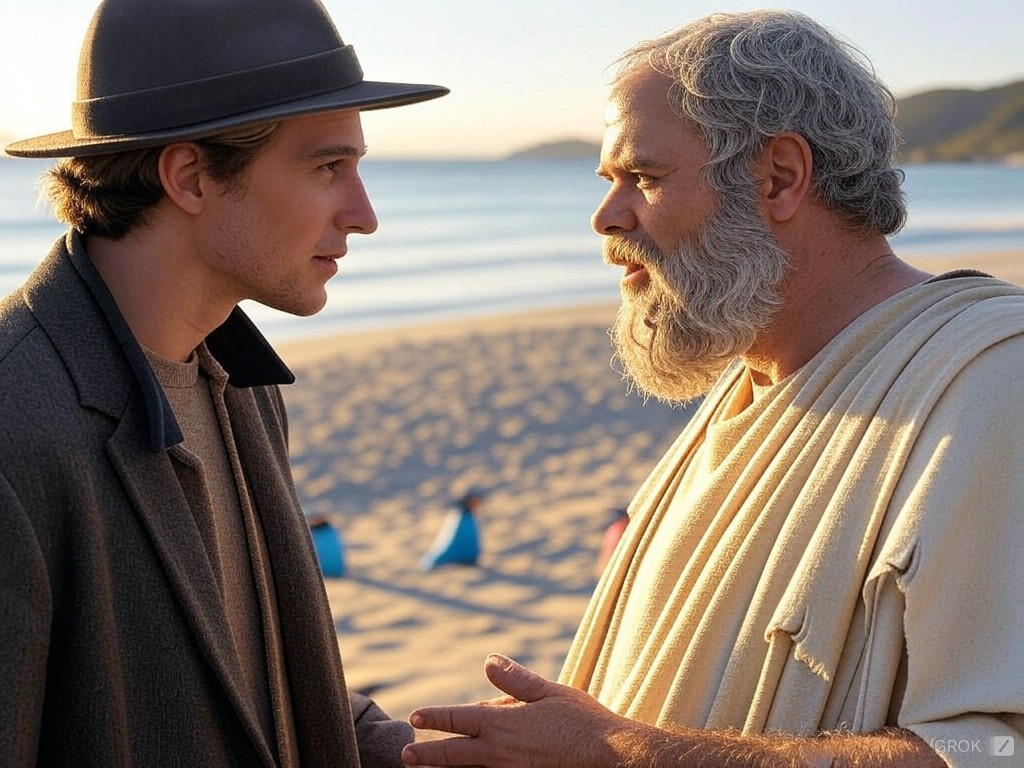
There’s a very simple answer to that question: Socrates.

There were few positive male role models in my childhood environment. I was the son of a gang member, and various uncles were also gang members, drug dealers or junkies. I was fortunate enough to have an excellent grandfather, who taught me a basic sense of honour and decency, but my philosophical ambitions soon brought me beyond what my family could fulfill. I needed a guru.

My male teachers at school were generally decent men, typical of the high-trust society that was 20th Century Nelson. But they weren’t gurus. The pains of life etched in their faces were understandable even to a child. Clearly, they were struggling through life much like I was, and needed a guru much like I did.

In Classics class during my final year of high school, one assigned topic was the trial and execution of Socrates. We learned how Socrates brought wisdom to the ungrateful masses of Athens, who eventually voted to have him killed. His form of execution was to drink a deadly hemlock tea. As I first learned the story, I presumed that he would refuse to do this, but he did, reasoning that it was not only his duty but he wasn’t afraid of death anyway.

I was awestruck.

Soon I developed a total fascination with this feat. This equanimity in the face of death seemed superhuman to me. Everything I had believed – or been taught – about human nature suggested that death was the most terrifying thing possible, the darkest of all mysteries, the termination of all of one’s dreams.

Everyone around me behaved as if scared stupid of the subject, never speaking about it. Socrates’s example proved that man need not fear death, and not in the delusional, heroin-high manner of the Christians and other religious fanatics. It was possible to die without fearing death simply through philosophy.

About a decade after I finished high school, I had lived a full life. I had earned a couple of degrees, been around the world a few times, even been married and divorced. The problem of death still plagued me though. Haunted me. What was the point of any of this, if I was doomed to die and all of it would be forgotten?

Here Socrates still acted as the guru. It was through studying him, and his disciple in Plato, that I came to realise the role of the Eleusinian Mysteries in the philosophy of fearlessness in the face of death. These Mysteries were famous in ancient Greece for alleviating the participants’ fear of death; Plato and Cicero wrote about their effects, and Aristotle, Epictetus, Plutarch, Alcibiades, Euripides, Sophocles, Pindar, Augustus, Hadrian, Marcus Aurelius and Julian were known to have been initiated.

Through learning about these mysteries, I came upon psilocybin mushrooms – believed by Terence McKenna to be the main psychoactive ingredient of the kykeon drunk by all participants in the Eleusinian Mysteries. This led me to taking psilocybin mushrooms myself and undergoing a total spiritual transformation at age 27, something discussed at length on this website.

Later, when I came to think more about politics, Socrates was still the guru, being the hero of Republic and Plato’s explication of political reality. Socrates’s unsurpassed example of honest reason as a tool to uncover the truth of political questions, despite opposition from liars and fools, inspired me. Like Socrates, but to a lesser extent, I have also been banned, cancelled and suppressed. I am proud to have followed in Socrates’s example!

Even now, I can still gain great insight about the nature of the soul from reading Phaedo. Socrates’s description of philosophy as preparation for death sets my entire life into a perspective that makes sense and gives it meaning. I might be almost 30 years older now than when I first read about Socrates, but his example of assuaging fear of death through pure reason appeals to me just as much today.

Many people think I am crazy for turning my energies away from making money and turning them towards spirituality instead. They don’t understand why a person would meditate or do psychedelics at all, let alone do little else for over a decade. Why philosophise at all, when there is money to be made?

I do it because of the example of relentless pursuit of truth set by Socrates, who is to me the most admirable man of all. This has led me to the spiritual beliefs expressed in Elementalism and in the essays on this website.

*

For more of VJM’s ideas, see his work on other platforms!
For even more of VJM’s ideas, buy one of his books!

*

If you enjoyed reading this piece, buy a compilation of our best pieces from previous years!

Best VJMP Essays and Articles of 2023
Best VJMP Essays and Articles of 2022
Best VJMP Essays and Articles of 2021
Best VJMP Essays and Articles of 2020
Best VJMP Essays and Articles of 2019
Best VJMP Essays and Articles of 2018
Best VJMP Essays and Articles of 2017

*

If you would like to support our work in other ways, make a donation to our Paypal! Even better, buy any one of our books!
An Open Letter To The Minister Of Justice Regarding Psychedelic Use For Spiritual Purposes

Dear Minister of Justice,

I am writing to seek clarification on New Zealand’s current stance regarding psychedelic substances, particularly in the context where these substances are considered spiritual sacraments.

The New Zealand Bill of Rights Act states in Section 13 that “Everyone has the right to freedom of thought, conscience, religion, and belief”. Section 15 states that “Every person has the right to manifest that person’s religion or belief in worship, observance, practice, or teaching, either individually or in community with others, and either in public or in private”.

A fair reading of these sections suggests that New Zealanders have the right to use spiritual sacraments.

Indeed, this is already true with regards to the religious use of wine in the Christian Eucharist. New Zealand Anglicans use wine as a spiritual sacrament, the psychoactive ingredient being, of course, alcohol. But there are many other substances that serve as spiritual sacraments in the religious and spiritual traditions of the world.

The use of psychedelics like psilocybin mushrooms, ayahuasca and other entheogens has been deeply rooted in various spiritual and religious practices around the world for millennia. These practices often regard these substances not merely as drugs but as sacraments crucial for spiritual exploration, healing and connection with the divine or the deeper self.

The Eleusinian Mysteries were the most famous of the mystery schools that characterised pre-Christian European spirituality, running for 2,000 years and attracting anyone who was anyone in ancient Greece or Rome: Socrates, Plato, Sophocles, Aeschylus, Euripides, Thucydides, Herodotus, Marcus Aurelius and the Emperor Julian were all known or believed to have participated.

Cicero wrote of them that “Though Athens brought forth numerous divine things, yet she never created anything nobler than those sublime Mysteries through which we became gentler and have advanced from a barbarous and rustic life to a more civilised one, so that we not only live more joyfully but also die with a better hope.”

Initiation into these mysteries involved the consumption of a drink known as kykeon. The mycologist R Gordon Wasson, the chemist Albert Hoffmann and the historian Carl Ruck have argued that the kykeon contained an entheogenic substance. Their book Road to Eleusis made a compelling argument that the use of psychedelics as spiritual sacraments played an integral role in the creation of Western Civilisation.

Robert Graves believed that linguistic evidence revealed the kykeon to include some kind of mushroom. Terence McKenna supported this assertion, pointing out that psilocybin-containing mushrooms had both the capacity to cause extreme psychospiritual change and the safety profile that would have allowed thousands to use them every year without getting a reputation for being dangerous.

The claimed benefits of the Eleusinian Mysteries included losing one’s fear of death, gaining a belief in the afterlife, learning to understand the will of the divine and improvement of moral rectitude. These benefits are very similar to those claimed by modern psychedelic users – Erowid.org lists hundreds of mystical experiences of people who have taken psilocybin.

It’s apparent from these arguments that the use of psychedelics as spiritual sacraments played a role in the moral and civil development of Western peoples during our greatest ages. But the potential of psychedelics to induce spiritual insight is not limited to the ancient age or to the West.

The Marsh Chapel Experiment conducted by Walter Pahnke in 1962 discovered that psilocybin is capable of inducing powerful spiritual experiences in modern people. A long-term follow-up questionnaire found “experimental subjects wrote that the experience helped them to recognise the arbitrariness of ego boundaries, increase their depth of faith, increase their appreciation of eternal life [etc.]”

One of the participants in the Marsh Chapel Experiment noted in the long-term follow-up, regarding death, “I’ve been there. Been there and come back. And it’s not terrifying, it doesn’t hurt.” Such an insight is profoundly spiritual. Many of the other participants made similar observations. One remembered their experience as “one of the high points of their spiritual life”.

This experiment demonstrated that the link between psilocybin and spirituality can be established within a modern, scientific paradigm. More recent research has supported this, with a 2024 paper in Current Psychology finding that “psychedelic use is linked with a variety of subjective indicators of spiritual growth, including stronger perceived connections with the divine, a greater sense of meaning, increased spiritual faith, increased engagement in religious and spiritual practices, an increase in feelings of unity and self-transcendence, positive changes in worldview, increased connectedness with others, and reduced fear of death”.

Albert Hofmann described how the teonanacatl of the Aztecs was a psilocybin-containing mushroom. This teonanacatl, or “flesh of the gods”, was used as a spiritual sacrament to commune with the divine. Indigenous North Americans have used psilocybin-containing mushrooms as entheogens for thousands of years. The Aztec use of entheogens, including both mushrooms and others, is extensive.

R Gordon Wasson believed that the soma referenced in the Rig Veda was the fly agaric amanita muscaria. Supporting his contention was the fact that Siberian shamans were still using this mushroom for spiritual purposes. More recently, Russian researchers have found evidence suggesting the active ingredient in soma was psilocybe cubensis. In either case, psychoactive mushrooms have a history of religious and spiritual use in India as well.

Although the record of historical psychedelic use is not as strong in Europe as it is in the Americas and Asia, there is still evidence of magic mushroom use in Spain from some 6,000 years ago.

In New Age spirituality, psychedelics are used extensively. In Nelson, where I am from, it’s common to use psychedelics as spiritual sacraments outside the purview of any institutional authority. “Mushroom Season” describes the time of the year beginning in early winter and ending around midwinter when psilocybin-containing mushrooms are foraged, dried and consumed as spiritual sacraments.

In light of all this, significant questions arise concerning the human rights implications of New Zealand’s drug laws as they pertain to psychedelic substances. Once it is understood that psychedelics are spiritual sacraments, there’s a compelling argument to be made that restrictions on their use infringe upon the freedom of religion and belief, a fundamental human right protected under various international treaties to which New Zealand is a signatory.

Article 18 of the Universal Declaration of Human Rights states that “everyone has the right to freedom of religion” and “to manifest his belief in practice”. Given the widespread use of psychedelics as spiritual sacraments throughout time and space, this right must surely encompass the right to use psychedelics to manifest spiritual belief in practice.

An appropriate reading of the New Zealand Bill of Rights Act suggests that the right to use psychedelics for spiritual purposes is guaranteed. In reality, however, a hierophant who wanted to conduct a sacramental ritual akin to the Eleusinian Mysteries could potentially face life imprisonment for the supply of Class A drugs.

This letter seeks to understand how current New Zealand drug laws reconcile with the rights of individuals to practice their spirituality freely, especially when such practices involve substances that are currently classified under the Misuse of Drugs Act.

The laws against the use of psychedelics for spiritual purposes reflect, to a major extent, the historical Christian dogma against pharmakeia. This is the same dogma that led the Christian fanatics under Alaric to destroy the Eleusinian Mysteries in 396 by killing its priests, that led the inquisitors of medieval Europe to burn witches at the stake for using spiritual sacraments, and which inspired the Catholic invaders of the Americas to eliminate the sacramental use of teonanacatl by murdering the shamans who specialised in it.

It has also been suggested that much of the modern opposition to the use of psychedelics as spiritual sacraments comes from organised religious groups who want to position themselves as ticket-clipping intermediaries between the people and divinity. However, as can be seen from reading the New Zealand Bill of Rights Act, Kiwis have the right to commune with divinity without the need of an intermediary. This necessarily means the right to use spiritual sacraments.

As other laws based on Christian prejudices – such as those regarding marital rape, homosexuality, prostitution and abortion – have been discarded in favour of greater freedom, the laws prohibiting the use of psychedelics for spiritual purposes ought to be discarded. Indeed, many countries and territories have reformed their psychedelic drug laws, based on arguments such as the ones made in this letter, plus others.

In closing, I respectfully request a detailed clarification or review of how New Zealand’s drug policies align with the principles of religious and spiritual freedom and human rights. Understanding the government’s perspective on this matter would not only inform those within New Zealand who use psychedelics as spiritual sacraments but would also contribute to broader discussions on drug policy reform that respects cultural and spiritual diversity.

Thank you for considering this important issue. I look forward to your insights and hope for a dialogue that can potentially lead to policies that honour both the law and the deeply held spiritual convictions of many New Zealanders.

Yours sincerely,

Vince McLeod

*

For more of VJM’s ideas, see his work on other platforms!
For even more of VJM’s ideas, buy one of his books!

*

If you enjoyed reading this piece, buy a compilation of our best pieces from previous years!

Best VJMP Essays and Articles of 2023
Best VJMP Essays and Articles of 2022
Best VJMP Essays and Articles of 2021
Best VJMP Essays and Articles of 2020
Best VJMP Essays and Articles of 2019
Best VJMP Essays and Articles of 2018
Best VJMP Essays and Articles of 2017

*

If you would like to support our work in other ways, make a donation to our Paypal! Even better, buy any one of our books!
Poetry K-Hole 7: The Elementary Prayer

by Fro

*

Can you handle yourself

enough to not take from anyone

else

Can you handle yourself

with no fear to stand and look at

yourself

Can ya handle yourself

know that it’s true regardless of

anyone else

Can ya handle yourself

have you seen the places no-one

speaks of and come back with

yourself

Can ya handle yourself

Different times places and spaces

*

If you enjoyed reading this essay/article, you can get a compilation of the Best VJMP Essays and Articles from 2021 from Amazon as a Kindle ebook or paperback. Compilations of the Best VJMP Essays and Articles of 2020, the Best VJMP Essays and Articles of 2019, the Best VJMP Essays and Articles of 2018 and the Best VJMP Essays and Articles of 2017 are also available.

*

If you would like to support our work in other ways, subscribe to our SubscribeStar fund, or make a donation to our Paypal! Even better, buy any one of our books!

VJMP Anzac Day Address 2022: A Foundation Myth for the Anzac Nation

With the news that America intends to respond to China’s move towards militarising the Solomon Islands, it seems apparent that Northern Australia will now become a militarised zone. If China does establish a base there, America will inevitably establish one to counter it in Far North Queensland. The Anzac nation seems to be preparing itself physically for war.

The Anzac nation also needs to prepare itself metaphysically for war. This must involve reflection upon why divine forces would have called us into existence in the first place.

In the opinion of this author, the Fall of Singapore could serve as a kind of origin myth for the Anzac nation. This was the closest we ever came to destruction at the hands of a hostile outside force. But thanks to the exceptional bravery and warfighting skills of our ancestors, and assistance from some close friends, we overcame that challenge.

That the Fall of Singapore was followed by Japanese defeats, at the Battle of the Coral Sea and at the Battle of Milne Bay, can be attributed to divine favour protecting the nascent Anzac nation. The foundational myth of the Anzac nation holds that this divine favour is still with us, and will guide us safely through the 21st Century and beyond.

An element of our national myth ought to be that we are inherently more likeable than our enemies, and as such have a moral right to triumph. This is because we are originally good, honest men and women who stood up to corrupt power structures and were exiled for it. This shared history is the basis of our national moral imperative of a “fair go”.

If there is to be war in or around Northern Australia, we will need to make sure to win the propaganda war at the same time. Winning this soft war will heavily influence the extent to which we are to gather support for the hard war. So we need to establish in the minds of the world that we are more likable than other nationalities.

For the most part, this will not be too difficult, because many people have had experience with Anzac travellers, and most of those experiences have been positive. For every drunken bogan we send overseas we send several cultured and educated people. So those of us who cannot contribute to the hard war can still contribute to the soft war.

The foremost work in this soft war ought to be spiritual. The most heavily-armed and most well-liked force can still lose if they don’t have spiritual wealth. Manifesting this wealth into the material world is the true work of the Anzac nation in the 21st Century.

The Anzac nation should hold, as part of our foundation myth, that we are destined the lead the rest of Planet Earth into a spiritual Golden Age. We are uniquely suited for this role owing to the fact that psilocybin mushrooms grow plentifully here, including the world’s most potent version, the psilocybe subaeruginosa.

That the world’s most powerful subspecies of arguably the world’s most powerful spiritual sacrament is endemic to the Anzac islands can only mean one thing: that divinity itself has chosen us for spiritual leadership in this new age of the world.

Australia and New Zealand already have some of the world’s most psychedelic-friendly populations. Apart from the West Coast of North America, there are few places with the widespread experience of using psychedelic sacraments that Aussies and Kiwis have. Psychedelic sacrament use is an established element of our festival culture, and any Anzac who has ever truly wanted a psychedelic experience has been able to have one.

Fittingly, Australia is the location of the world’s first psilocybin mushroom trial. Subconciously, it may be that many Anzacs understand the role of magic mushrooms in the future spiritual health of this nation. Let it be said that our role is to bring a new understanding of the perennial spiritual philosophy to the entire world.

Supporting this sentiment is the fact that Aussies are the 18th and Kiwis the 15th heaviest users (out of 164) of that other common spiritual sacrament of the Indo-European people: cannabis. We Anzacs love our spiritual sacraments, which is why we are able to produce genius-tier animated film like Choomer Island 2, one of the greatest explications of spiritual truth produced this century.

Let us let it be said that God spared the Anzac nation during World War II because God wished for us to play a role in promulgating God’s Will in the next Great Age of the Earth. In return for this favour, the Anzac nation is tasked with spreading true knowledge about spirituality and how certain natural sacramental substances can be used to reconnect with the divine.

A foundation myth that explained how we Anzacs have divine favour in all of the past, present and future is something that needs to be added to the national consciousness.

*

If you enjoyed reading this essay/article, you can get a compilation of the Best VJMP Essays and Articles from 2021 from Amazon for Kindle or Amazon for CreateSpace (for international readers), or TradeMe (for Kiwis). A compilation of the Best VJMP Essays and Articles of 2020, the Best VJMP Essays and Articles of 2019, the Best VJMP Essays and Articles of 2018 and the Best VJMP Essays and Articles of 2017 are also available.

*

If you would like to support our work in other ways, subscribe to our SubscribeStar fund, or make a donation to our Paypal! Even better, buy any one of our books!