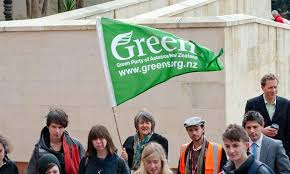
Understanding New Zealand: Voting Greens

Long stereotyped as a fringe movement for harmless eccentrics, the New Zealand Green Party appears to be following the general upward trend for environmentalist parties in the West as the social democrats continue to fragment into special interest groups. The Greens in New Zealand are large and established enough to be a political force in their own right and ought not to be considered an adjunct to the Labour Party.

Despite a nominal adherence to the left wing of Parliament, the Greens have a number of striking differences with the Labour Party to whom they appear shackled.

The most notable is that the Greens are a party for comfortably wealthy people, but not the ones creaming it. This might surprise many who still consider the Greens to be a party for students and semi-employed Golden Bay hippies. The correlation between voting Green in 2014 and Personal Income is 0.31, which is not as strong as National’s 0.53 but is much closer to that than to Labour’s -0.51.

Voting for the Greens in 2014 may have had a negative correlation with Median Age, but it was not significant at -0.17. This belies the image of the Greens as a student’s party, especially if one compares to the correlations between Median Age and voting Cannabis Party in 2014 (-0.55) and voting Labour (-0.70). This suggests that the average Green voter is significantly older than the average Labour voter.

The average Green voter was the best educated of those of all the parties, with a correlation between voting Green in 2014 and having a Master’s degree of 0.64. The only party to come close to this is ACT with 0.57 – National is the closest major party, with a not significant 0.20.

Also, the average Green voter was about as likely as the average National voter to have no qualifications. The correlation between having no qualifications and voting Greens in 2014 was -0.49, for National -0.43, for Labour 0.34 and for New Zealand First 0.79.

One factor that correlates highly with support for the Greens is not being religious. Not being religious and voting Green in 2014 had a correlation of 0.56, which was much higher than for any other major party (National 0.10, New Zealand First 0.12, Labour -0.50). Only the Cannabis Party was close: voting for them in 2014 had a correlation of 0.34 with being religious.

Unsurprisingly, Green voters are very unlikely to be Christians. Voting Green in 2014 and being Christian had a correlation of -0.57. This was at variance with all other parties except Internet MANA (-0.40) and Cannabis Party (-0.41). None of the other major parties are so antichristian. Being Christian and voting National had a correlation of 0.29, with voting Labour it was 0.10 and with voting New Zealand First it was -0.11.

Perhaps the oddest correlation is the one between voting Green in 2014 and having spiritualism as a religion. This is a fairly significant 0.52. This was shared with the Cannabis Party, who had a correlation with being a spiritualist of 0.36, and is a notable point of difference with the ACT Party, with who the correlation with being a spiritualist was -0.43.

Perhaps these points can be explained by the fact that cannabis use tends to turn people strongly away from the exoteric side of religion and strongly towards the esoteric side, an interest they will share with the spiritualists.

Although the Greens are mostly a white person’s party, there is just barely a signification correlation between being of European descent and voting Green in 2014 – this is 0.24. There was also a barely significant correlation in the other direction (-0.27) between being of Pacific Islander descent and voting Green in 2014. For being of Maori descent it was a not significant -0.09, and for being of Asian descent it was perfectly uncorrelated.

So the Greens are an odd mix – like Labour when it comes to taxes, like National when it comes to personal income, like the ACT party when it comes to education and like the Cannabis Party when it comes to religion. The only party they are really opposed to seems to be New Zealand First. Probably the bulk of their voters come from people who are educated in the hard sciences in particular and the humanities to a lesser extent.

*

This article is an excerpt from Understanding New Zealand, by Dan McGlashan, published by VJM Publishing in the winter of 2017.

Is It Time For Gay and Lesbian New Zealanders to Lose Their Victim Status?

Apart from Rugby World Cup trophies, the one thing that New Zealanders fight for with the most intensity is victim status. Being a victim in our society is to wield the power of laying guilt trips on people, which often brings with it a free media platform to convince people to stop their behaviour and adopt others more to the guilt-tripper’s liking.

Once you have achieved the status of victim no-one can disagree with you without feeling ashamed because if they disagree with you they automatically become part of the oppressor class, who all New Zealanders have been conditioned since kindergarten to reflexively despise.

This social pressuring has an extremely powerful influence on the thoughts and feelings of the individual, but the problem with this cozy arrangement is this.

The reason why gay and lesbian New Zealanders have, as of right now, an impregnable position at the very summit of Mount Victim is that being gay and lesbian is not highly correlated with significant measures of social deprivation in the country today.

The average homosexual is actually fairly wealthy on account of being both better educated than average and being less likely to have children, a phenomenon known as the pink dollar.

There’s no denying being gay and lesbian once was highly associated with measures of social deprivation and disenfranchisement. This is inevitable when you can literally get locked in a cage for being who you are. The contention of this column, however, is that this battle has long been won.

Homosexuality became illegal in 1840 in New Zealand and legal again in 1986 – now thirty years ago – so the people that enforced the legal prohibition on it are all long ago dead and buried.

In the 2011 General Election, seven gay or lesbian MPs were elected to Parliament, which is almost six percent of the total – over twice the actual proportion of gay and lesbian New Zealanders (and this is ignoring the known homosexual MPs who are just not public about it).

If your marginalised group is represented in Parliament at 250%+ of its proportion among general society, so much so that when a law is passed in your favour the entire Parliament will band together and sing a song of regret that they didn’t do it sooner, are you really that marginalised?

The irony of the eternal battle for victimhood is this: once your victim status is recognised by your society at large, you are automatically no longer a victim, because you are instantly doing much better than all the oppressed people whose victim status is not recognised.

The reverse of this is also an irony: in order to get into a position where you can do anything about being a victim, you have to get into a position where you are no longer a victim.

This is why the physically and mentally infirm will always be at the bottom of society – simply because they are in the weakest position to advocate for themselves. It is exceptionally rare to meet a sick person wearing a suit and who is articulate as Grant Robertson.

So perhaps it’s time for another marginalised group of New Zealanders to get some attention?

If you are one of New Zealand’s 400,000 medicinal cannabis users, getting completely ignored by all parties is galling when you can turn the television on and hear Jacinda Ardern passionately arguing for legalising gay adoption – an issue which affects perhaps 50 people a year.

Every day you are ignored is another slap in the face, another insult. But no-one will bring up your plight in Parliament, ever, and merely to point out that it’s time for you to displace some of the wealthy and powerful people raking it in at the victim table is seen as effrontery (no doubt many people will read the headline of this article and become outraged without reading the body).

That’s a real victim of societal prejudice.

The Real Gateway Phenomenon Is The Government Telling Lies About Drugs

One of the reasons for keeping cannabis illegal is known as the Gateway Drug Effect (or Gateway Drug Story, for the cynical). The logic goes like this: people who try cannabis will like it and, in doing so, come to reason that drugs are awesome, and will then inevitably try heroin and die.

Apparently this happens with such tragic predictability that the phenomenon has taken the name the Gateway Effect – namely, that cannabis serves as a gateway to the wider world of drugs.

This reasoning, wrong as it may be, is almost logical. There is a Gateway Drug Effect, only – the gateway drug is alcohol. There is also a gateway effect related to cannabis, but it’s not what the Government claims it is.

The real gateway effect usually kicks in the morning after one has tried cannabis for the first time. Invariably one has already tried alcohol and discovered what a hangover is. Waking up after having smoking weed for the first time the night before is often accompanied by a sense of relief, as one might have been expecting an alcohol-style hangover only to find the cannabis one is very different.

So that next morning, and that next day, it sinks in that you have been lied to the whole time about cannabis. That evening, you start wondering what else the Government has lied to you about.

And then you’re on a journey down the rabbit hole.

That rabbit hole can take the neophyte psychonaut to some paranoid places. This is natural when one realises that the police officers who came to your high school to tell you that cannabis causes violence and mental illness were lying. They came to you as if they were pillars of the community, and they lied to your face about a medicine that you might have found beneficial.

Did they know they were lying? Probably some of them did and some of them didn’t. The ones that didn’t know were lied to by someone else – but who are these people?

It soon comes to appear that the lying comes from the very top – from the political class itself.

This lying and forcing other people to lie has the effect of devastating the social fabric.

If I go to see a doctor about pills I’ve ordered off the Internet, I don’t know if I can trust them or not. I already know that doctors will quite happily repeat lies told to them by authority figures, whether those figures are in government or the pharmaceutical industry.

A doctor will look you right in the eyes and tell you that cannabis causes depression if their paycheck is provided by a pharmaceutical company who sells an antidepressant that makes more money than cannabis could.

Does it have to be this way?

Teenagers are going through a rite of passage nowadays that is very common. It involves smoking your first joint and realising that you’ve been lied to, and then following the same reasoning described in this article. This rite of passage (Eleusinian Mysteries aside) is a modern thing – people in the recent past were generally more than happy to march into a meat grinder if an authority figure said it was to their benefit.

The astute reader might have observed the paradoxical benefit here – this exact cynicism about the government is what makes it harder for English-speaking people to follow dictators.

Still, there’s surely a better way to shock people awake then by putting an unlucky minority of them in prison and leaving their friends and family to rue the butcher’s bill.

The Government’s strategy of lying about cannabis to the detriment of the people it governs, and then refusing to stop telling lies even when it’s obvious to almost everyone that they are lying, has devastated confidence in authority figures for an entire generation of Westerners.

If You Want to Think of the Children, Then Legalise Cannabis

When I was working a cannabis law reform booth at a hippie festival in Nelson about eight years ago, I had an unpleasant encounter with a local hysteric. She approached us like she would have approached two fellows who were advocating to legalise child molestation and launched into a rant about the “twelves” who would inevitably get hold of cannabis if it was legal.

Before either of us could respond, she was dragged off by her embarrassed husband. If we had had the chance, we would have responded with an argument out of the Cannabis Activist’s Handbook: that a repeal of cannabis prohibition would actually make it harder for teenagers to get hold of cannabis.

Now there is evidence that this counterargument was correct. The stupid thing is that, if one puts the hysteria aside for ten seconds, it’s quite obvious that legal cannabis is safer for teenagers than New Zealand’s current black market model.

It was found that in Colorado, where cannabis was legalised in 2012, legal cannabis stores generally don’t sell weed to minors. In a study similar to the Liquor Board stings in New Zealand, 19 out of 20 Colorado cannabis retailers refused to sell cannabis to a person who looked under 21 and who could not produce ID.

As can be imagined, a 19 out of 20 rejection rate is much better than what it would have been had the 20 stooges gone to tinnie houses instead.

Even though American teenagers are consuming less alcohol and tobacco than previously, rates of cannabis use among teenagers remains constant. Why?

It’s probably because, as centuries of relentless cultural brainwashing has ever less of an effect thanks to the Internet spreading truth about forbidden subjects, people naturally come to realise that they enjoy smoking cannabis more than getting drunk and smoking cancer sticks.

A short history lesson: the Greatest and Silent Generations survived the Great Depression and World War Two and incurred severe psychological trauma in doing so. This trauma was passed down to the Baby Boomers, many of who were fed into the meat grinder of Vietnam. Generation X, who followed, mostly escaped direct trauma but there are many who suffered secondary trauma as a consequence of being raised by mentally damaged Boomers. Now there are the Millennials, who are mostly okay.

It is not a coincidence that, as the generations get younger, they seem to naturally prefer smoking cannabis over using alcohol and tobacco.

This is probably because the less traumatised a person is, the less they desire the brutal sledgehammer effect on consciousness that alcohol has, and the less they desire the serenity-at-all-costs mentality that accompanies a tobacco habit. Alcohol is a brutal drug for a brutal age, and legal tobacco might prove to be an anachronism from a time when considerations like human life weighed far lighter than profit.

The desire to alter consciousness, however, also occurs frequently in people who have not been severely traumatised – and these people appear to prefer cannabis.

Cannabis tends to have the effect of making the user more, not less, sensitive. This means that people tend to avoid using it unless they are around people they like in a setting they find comfortable or in a mindstate where some cognitive enhancement, not destruction, is desired.

There is no good reason to limit the freedom of young people to alter consciousness to using alcohol and tobacco.

It may have made sense in an era when the life expectancy of humans was so low that few had the fortune to live long enough to die of alcohol or tobacco-related illnesses, but in the current age denying young people the use of recreational cannabis has the cruel effect of pushing them towards an early death from cancer or heart disease.