How the Ruling Class Stays in Power

If a person is slapped awake for even the briefest of moments they might come to look around and ask why a parasitic class of politicians wields power of life and death over them despite a total lack of historical evidence that they are wise enough for the responsibility or even intelligent enough to comprehend that it exists.

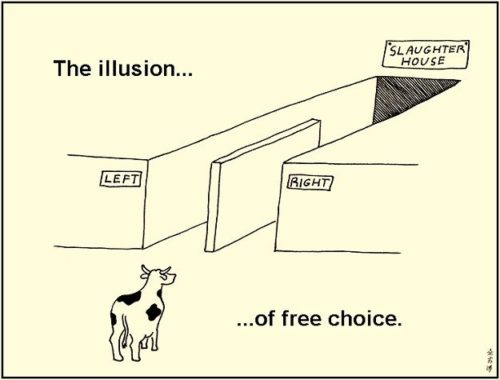
The truth is that the ruling classes maintain their position in every time and place in the same simple way, and have done so ever since the first chimpanzee established a dominance hierarchy in the primeval jungle: by taking rights away from the people they rule, and then giving some of them back in exchange for submission.

This essay will describe the method of enslavement known as “democracy” – a method that has reached acute levels of sophistication in the modern West.

As described above, the essential pattern is bipartite: first, take rights away from the people; second, promise to give some of those rights back to the people in exchange for their submission.

What’s crucial to understand is that the relationship described here is that of the rulers towards the ruled. Which flavour of political party the rulers use to swindle the rights of the ruled away from them is not relevant, as all political parties are tools of the ruling class.

Any political party is capable of taking rights away and giving rights back, because in a democratic system the masses have submitted to the rulers of that party. All that matters is that more rights are taken away than are given back.

This can be seen when the National Party takes away people’s rights to use medicinal cannabis, but gives them back some of their right to keep the money they have earned.

The Labour and Green Parties, by contrast, will promise to give you your rights to use medicinal cannabis back, but they will take away some of your right to keep the money you have earned.

And both parties will team up to give you back your rights to have sex with people of the same gender as you, but will team up to take away your rights to recreational use of tobacco and alcohol. At least today – it was the other way around 80 years ago and probably will be again in 80 years’ time.

The trick is that as long as both wings of the political machine take away more rights than what they give back, the machine itself can stay in power forever, because there will always be an unjust deficit of rights somewhere and therefore always grounds for a politician to come in and start promising things.

Helen Clark, for example, knew that she could not make any progress on cannabis law reform between 1999 and 2008, because then the Labour Party would not be able to gain votes by promising to look at reforming the medicinal cannabis laws in 2017.

Likewise, Andrew Little in 2017 knows that, if he is to be elected to power, he must make the smallest possible amount of progress on the issue.

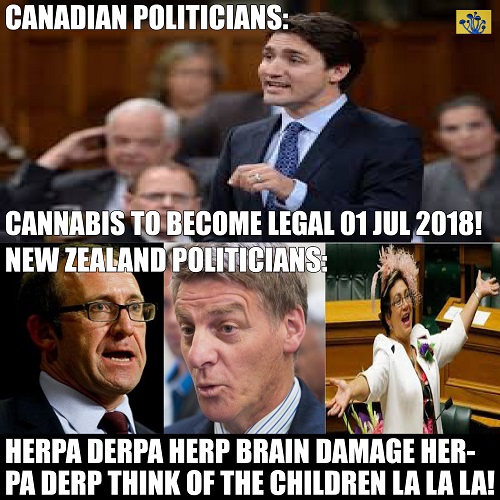
This is why he only makes vague mumblings about sorting out medicinal cannabis, but will not under any circumstances discuss the incredible success of the Colorado model, and how adopting it in NZ would save us $400,000,000 per year.

That is something that has to be left to Jacinda Ardern’s Seventh Labour Government in 2035 or so. If the Labour Party gave too many rights back to the people too quickly, they would lose the leverage that they are currently exploiting to stay in power.

Unfortunately, New Zealanders (like voters everywhere) reward this kind of carry-on by continuing to vote for whichever of its number the ruling class puts forward to rule them that electoral cycle.

After all, it doesn’t matter which party a politician claims to represent – as long as they are from the ruling class, nothing will change.

It can confidently be predicted that many New Zealanders will vote for the Green Party this year for the sake of relief from cannabis prohibition, and that little thought will be given to the people who will lose rights under a Labour-Greens Government – namely, taxpayers.

And it can be confidently predicted that the National Party will rely on the outrage of taxpayers to get back into power in 2026.

Likewise, it can be predicted that any rights that Kiwis can claw back from the ruling class regarding the use of cannabis will be outweighed by the loss of rights to access alcohol, tobacco, and other recreational alternatives.

As before; so after – the Hermetic axioms apply to time as well as space.
Cannabis Cowardice is Punishing Andrew Little in the Preferred PM Stakes

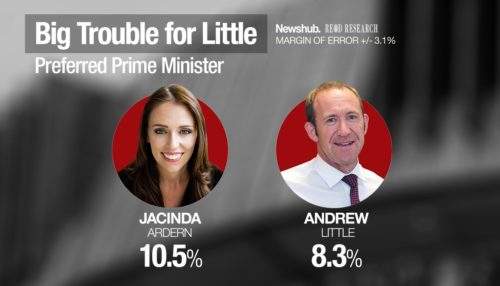
Andrew Little has been the Labour Party leader since 2014, and has struggled so far to gain much traction with prospective Labour voters. A recent poll brought some very bad news for him – namely that he has now fallen behind his deputy Jacinda Ardern in the preferred Prime Minister stakes.

No doubt the Labour Leader will have a team of pollsters working overtime ringing people up to ask why they’re not interested. However, they won’t ask the large numbers of Kiwis who are disenfranchised from the political and economic systems – and this is supposed to be Labour’s constituency and is the key to their recent failure.

These disenfranchised people are mostly the young, the invalid’s beneficiaries and Maori. These three groups will all tell you that they are crying out for a change to New Zealand’s cannabis laws.

The young are crying out for a recreational alternative to alcohol. All young people have had the unpleasant experience of watching people in their parents’ generation destroy themselves with alcohol, while noting that people who preferred cannabis generally had a much better time of things.

Invalid’s beneficiaries are crying out for medicinal relief for their suffering. Huge numbers of invalid’s beneficiaries in New Zealand have found that cannabis is a better medicine for alleviating the suffering that comes with their condition than the pharmaceutical alternatives.

They will point that since medicinal cannabis is now legal in 28 states of the USA there’s no continuing to deny that it is a medicine.

Maori are probably the group worst brutalised by cannabis prohibition, for a number of reasons. The foremost is the lack of genetic resistance to alcoholism that has seen so many Maori come to prefer cannabis as a recreational alternative to cannabis.

Not only Maori – there are many, many New Zealanders whose close family history has a detailed history of either alcoholism or violence related to drinking. All of these people are desperate for a recreational alternative to booze.

Andrew Little’s refusal to even consider a 21st century approach to the cannabis laws is causing him to bleed support among all of the Labour Party’s major demographics – all of which are crying out for some kind of cannabis law reform.

On the cannabis issue, Little appears to hover somewhere between cowardice and supporting a National party-style prohibition. This hits hard against exactly those sort of people who like to vote Labour.

As has been described in an excerpt to Dan McGlashan’s upcoming book Understanding New Zealand, the sort of person who votes Labour is the same sort of person who is likely to be adversely affected by the country’s cannabis laws.

The correlation between median age and voting for the Aotearoa Legalise Cannabis Party in 2014 was -0.55, which tells us that the bulk of ALCP voters were young. The correlation between median age and voting for the Labour Party was -0.70, so that tells us that Labour and the ALCP are competing for the same voters to a large extent.

The correlation between being on the invalid’s benefit and voting for the ALCP in 2014 was a very strong 0.76. This is because many, if not most, people on an invalid’s benefit would be greatly helped by any change to the law that made cannabis more readily available.

Finally, the correlation between being Maori and voting for the ALCP in 2014 was a whopping 0.89. This is not at all surprising considering that Maori suffer by far the worst of the abuse from cannabis prohibition. This is enough to suggest that a mature, intelligent cannabis law reform policy would attract masses of Maori voters.

All three of these groups also have very strong correlations with not voting at all in 2014 – because of the total failure of any of the mainstream political options to represent their needs.

What this tells us is that there are legions of disaffected, disenfranchised New Zealanders who will not support the Labour Party as long as it has a leader who is too timid to support a definitive change to the country’s cannabis laws.

Going by the large numbers of young, sick and Maori non-voters who are desperate for a change, we can predict that the Labour Party will lose the General Election this year unless it adopts an intelligent, modern, compassionate cannabis law reform policy.

The Consequences of Making All Fun Illegal in Nelson

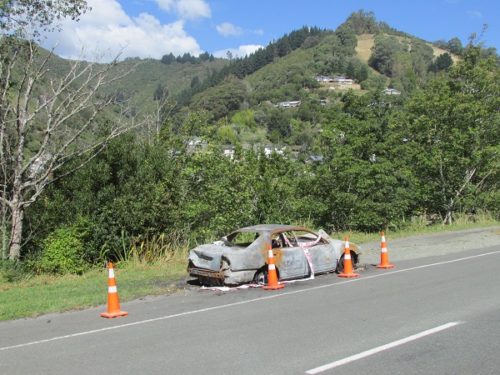
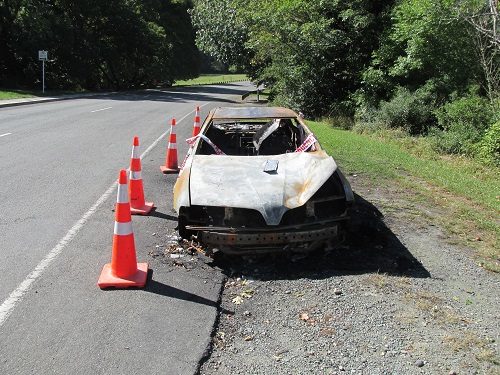
This burnt-out stolen car has sat on the side of Maitai Valley Road for over a week. Actions that lead to the consequences shown above are often the result of boredom

In the words of Doug Stanhope: “Boredom is a disease. Drugs cure it.” This might be a throw-away line from a famously irreverent standup comedian, but it points to a truth that our society lacks the sophistication to debate: boredom causes legitimate human suffering, and this costs money and even lives.

Some psychologists are aware of the consequences of boredom. It’s now believed that boredom literally causes the brain to degenerate, as it requires a certain minimum amount of excitory stimulation to maintain the strength of existing neuron connections.

This is why it seems to actually hurt. The mental pain associated with boredom is the pain of your brain dying from a lack of stimulation, in the same way that a newborn infant neglected by its mother may die of hospitalism from a lack of oxytocin.

It’s not likely that anyone in Nelson will go as far as shooting someone out of sheer boredom, as happened to the unfortunate Chris Lane in Oklahoma. But the more boring this city becomes, the further we move towards forcing people to become violent in order to combat the pain that comes from so many fun things being illegal.

Boredom is a real thing that makes people misbehave. It has been observed in British prisons that boredom leads to misbehaviour.

When there are too many recreational outlets closed off by puritan laws, people naturally come to ignore them and may purposefully break any law just to relieve the boredom

The reason for this ought to be clear by now, especially if the reader knew any juvenile delinquents while growing up. Because boredom is painful, people suffer from it, and as a result of the suffering they become willing to destroy in order to alleviate it.

Almost everyone has done something recklessly stupid at some point because it felt good on account of that it relieved boredom.

Unfortunately, the people making the laws in New Zealand are whores, not psychologists. They have whored themselves out to the pharmaceutical, tobacco and alcohol industries, and these industries have commanded the politicians to make recreational alternatives to their products illegal for the sake of wiping out their competitors.

Neither is the Nelson City Council any better. They have proven themselves utterly incapable of taking care of a single homeless protester outside the Farmers building, so the expectation that they could comprehend an end to the War on Drugs is far too much to ask for.

Nelson, like all provincial New Zealand towns, is not an easy place to live in when a person is aged between 18 and 30 or thereabouts. If you’re a young person and consequently have a high point of homeostasis for excitement, there are not many really good options.

Cannabis is illegal, the drinking culture is violent and disgusting, the hookup culture is vile and depressing, and the control freaks have even taken away the simple pleasure of having a cigarette to relax by making it too expensive to be enjoyable.

Well, this is the price. This is how we end up with burnt-out cars sitting on the side of Maitai Valley Road.

As this column has previously argued, there ought to be cannabis cafes on Bridge Street. Giving the young people of Nelson greater recreational options than booze and television would result in less boredom, which would result in fewer burnt-out cars.

This would necessarily require a change to New Zealand’s cannabis laws, which would have ancillary benefits, not least putting a stop to the current wastage of $400,000,000 of tax money every year.

Perhaps some of the estimated $120,000,000 of Police funding that would be saved from cannabis legalisation could then be used to clean up the mess on the side of Maitai Valley Road, as it has been sitting there for over a week.