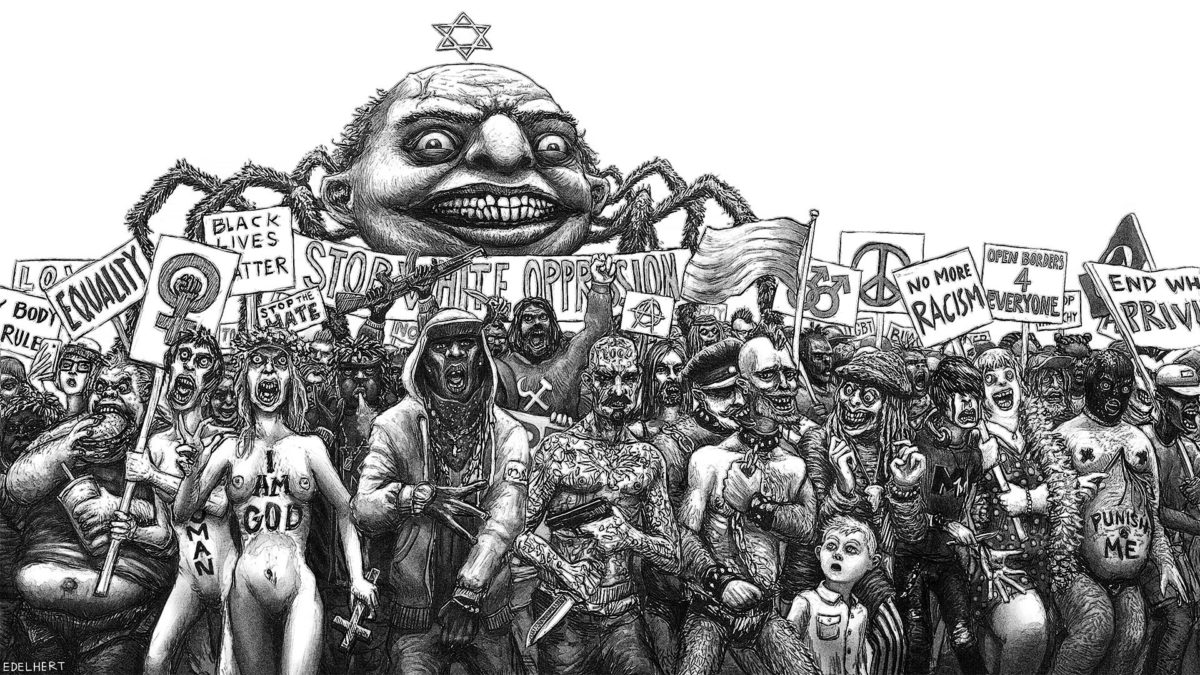
Mental Illness is a Political Concept, Not a Medical One

Many people live under the glib assumption that mental illness is a subject that the experts have got a good handle on. These experts, through the wisdom gleaned from decades of studying human behaviour in a myriad of contexts, have made a clear distinction between mentally ill and mentally healthy behaviours and thoughts, and can apply this accurately in a clinical setting. We are told that this distinction is objective and scientific, but the reality is that who is crazy and who isn’t depends more on fashion – and who is in power – than on science.

Take the example of homosexuality. Sexual attraction to people of the same gender was considered a mental illness as recently as the second edition of the Diagnostic and Statistical Manual of Mental Disorders. By this, it was meant that same-sex attraction was a mental defect that could be diagnosed and, if need be, treated. Some would say that we’ve evolved past such a mentality, and this author would not disagree, but with a caveat: we could easily make homosexuality illegal again.

All it would take would be a strong cultural shift towards a family-oriented kind of folk conservatism, and for it once again to be fashionable to be against homosexuals, and the herd could easily come to take it for granted once again that homosexuality should be illegal. If a popular celebrity made arguments against homosexuality on national television, the masses would soon be turned against it. Some arguments against homosexuality are perennial, and will inevitably become fashionable again, like the appeal to naturalism.

The appeal to naturalism is a common argument against homosexuality. It contends that, because both a male and a female are necessary for an act of sexual intercourse to have any chance of resulting in reproduction, only this arrangement of sexes is natural. Two people of the same sex engaging in sexual intercourse cannot produce a child and is therefore unnatural, and this is therefore immoral, in the same way that having sex with animals or the pre-pubescent cannot produce children and is therefore immoral.

One could fairly argue that there are a number of fallacies in this line of reasoning, but that’s not the point. The point is that, as long as the appeal to naturalism holds some sway among people, there is a chance that it could become fashionable again such that the masses came to accept it as obvious. If one looks at the world, and at the history of it, it’s apparent that homosexuality, like feminism and the use of certain drugs, is a fashion that waxes and wanes according to historical cycles.

The same thing is true of other conditions now considered to be mental illnesses. The case of schizophrenia is another example of where politics trumps medicine. No-one knows what schizophrenia and psychosis really are: psychosis is said to be the loss of touch with reality, but there is no universal, objective way of knowing what reality is. What is commonly accepted as reality is something that varies greatly from place to place and from time to time, even among people who are all committed to the scientific method.

No-one really understands why some people are crazy, but if a person doesn’t work, they need a doctor to declare them mentally unhealthy if they want to go on welfare. Sounds straightforward, but if an incoming conservative government wants to trim the number of people on welfare for psychiatric reasons by 10%, then the psychiatrists will select the 10% of their current patients that they feel have the best chance of making it and declare them to be mentally healthy. That they are the same as before doesn’t matter – the important thing is that the politics have changed.

For political reasons, all responsibility and blame for a person suffering a mental illness has to be shifted back onto either genetics or the person themselves. The environment is seldom to blame, but if it ever is, it is the fault of the parents and the home environment, never the fault of the rulers and the social environment. Depression is never caused by society being depressing. Anxiety is never caused by society being anxiogenic. What causes mental illness is bad genes, doing drugs or some kind of quasi-mystical spiritual failure, but never the misarrangement of society.

Some will say that mental illness demonstrates a failure to adapt to society. Fair enough, but the problem with this is that society is grossly unhealthy. For many tens of millions of people, the pressure of trying to fit into a society as fucked up as this one has pushed them beyond the limits of their psychological endurance. Their major problem is that society does not, and never will, recognise the part that it has played in making people mentally ill, because this would be a political error. This obstinance only serves to drive more people insane.

At the end of the day, it’s politicians that that people take orders from, and not research psychologists, and so doctors who have to deal with mental illness have to use the framework laid down for them by politicians. These politicians have not been able to resist the temptation to play around with the definitions of mental illness for the sake of achieving their political goals. Unfortunately, this meddling has become so severe that the concept of mental illness is now more political than it is medical.

*

If you enjoyed reading this essay, you can get a compilation of the Best VJMP Essays and Articles of 2017 from Amazon for Kindle or Amazon for CreateSpace (for international readers), or TradeMe (for Kiwis).


What Is ‘Globohomo’?

Internet dwellers will have found themselves more and more frequently encountering the world ‘globohomo’. It’s always used derisively, usually by members of the alt-right or alt-centre. The word appears to consist of two things, but the combination is another thing in its own right, much like how chloride and sodium combine to create table salt. This essay discusses the concept of ‘globohomo’.

The first component is ‘globo’. This refers to global, because globohomo is a strategy deliberately carried out by globalists in particular. Globohomo is very much a world-wide phenomenon, in the sense that it seeks to expand its reach into every corner of the planet. It intends to destroy all local cultures, whether they be national, provincial, city, town, village or family. These local cultures must be destroyed so that people have no resistance to the propaganda of the globalists.

This globalist component is very much pro-capitalist, and very much anti-working class. The globalist element is the same element, comprised mostly of international bankers and the like, that has been responsible for the destruction of the Western working class in pursuit of cheap labour and fat profits over the past 30 years. What they desire is the destruction of all national cultures, so as to pave the way for a world of McDonald’s-eating, Coke-drinking, televison-watching mass consumers.

The second component is ‘homo’. What this refers to is the fact that the people pushing the globohomo ideology are almost never people with healthy families, and they are always promoting behaviours that are not compatible with the function of healthy families. Inevitably there is some kind of sexual dysfunction among the people who cheer for globohomo. It isn’t simply a matter of homosexuality, but also a curious reluctance to have children, despite occupying a leadership position that will have consequences for all children for decades to come.

An essential part of the ‘homo’ element is that people are induced to either not have families, or to hate the families that they do have. The point of this is to further destroy the family unit for the sake of facilitating the indoctrination of the people with new ideologies. This is why transfaggotry is so heavily promoted: those pushing globohomo know that a young man who decides he is a woman will earn the disgust of his parents and grandparents, and will thereby cripple his family.

In combination, these qualities give us ‘globohomo’. What this amounts to is a globalised degeneracy pushed by the corporate media and intended to glorify materialism and mindless consumption. This is primarily achieved by destroying all natural social bonds and replacing them with a desire for either materialist gain or raw sensual pleasure. It is reminiscent of the ideology pushed by the ruling class of Aldous Huxley’s Brave New World, who have enslaved the population by way of totally satisfying their base, animalistic cravings.

One of the most telling signs of globohomo are actions taken in support of increasing the refugee quota. Bringing in more refugees is the globohomo dream: not only does it increase the supply of cheap labour, but it also destroys the natural bonds of solidarity that are held by the people in the target locale. This makes it harder for those people to organise for the sake of resisting further globalist capitalist predation.

Globohomo is an explicitly anti-spiritual movement, which is why it’s held in contempt by the alt-right and the alt-centre. It combines two grossly anti-spiritual mentalities: the tawdry orgasm-hunting of the sex-obsessed, and the endless greed and consumer fetishism of modern Anglo-American capitalism. These two patterns give us a third mentality which is terrified of death and the world beyond, more comfortable drinking itself into submission than exploring hyperspace.

The current trend that has made it extremely fashionable to identify as some kind of trans person is perhaps the most obvious current example of globohomo in action. Because of corporate media pressure, millions of young people have been led into a state where they have started to think that they might “really” be the opposite gender to what they were born as. Typical of globohomo, this emphasises obsession with superficial qualities and genitals in lieu of spiritual investigation and consciousness.

Part of globohomo is being given rights to do things that you don’t even want to do and never would – like marry another man – but losing your rights to do things that every normal person wants to do and used to be considered normal – like raise a family on one income. The corporate media works hard to create the impression that things are better than ever before (because the scourge of homophobia is finally overcome) but the truth is that life is getting much worse by all meaningful measures.

In summary, globohomo can be thought of as a manufactured culture that expands into cultural space like a cancer, destroying all genuine diversity and replacing it with a corporate Disneyland, for the sake of maximising profits and control, both of which are held by an international class with loyalties to no land and to no people. Its prevalence is one of the main reasons why people all over the West feel like their actual quality of life is decreasing, despite our obvious material and technological progress.

*

If you enjoyed reading this essay, you can get a compilation of the Best VJMP Essays and Articles of 2017 from Amazon for Kindle or Amazon for CreateSpace (for international readers), or TradeMe (for Kiwis).

The Case For Cannabis: People Have A Right to Freedom

All of us take for granted that we are a free people, that we are not slaves and so have the right to autonomy and self-determination. The problem with this line of thinking is that is doesn’t survive scrutiny, especially once one asks why we’re not allowed to grow or to use cannabis. This article argues that cannabis ought to be legal for the reason that we are supposed to be a free people.

History shows that the ruling class and the masses are always in conflict over what freedoms that masses are allowed to exercise. Alexei Sayle in The Young Ones satirised the cruelty of the medival ruling class by having a peasant sentenced to death for “whistling on a Tuesday”. Although facing the court system for whistling on the wrong day might sound arbitrary, the fact is that it’s no more so than cannabis prohibition.

A person does not have to be a libertarian to agree that it is the individual that ultimately has the right to decide what goes into their body. If that person’s body is their own private property, then it is that person who decides what goes into it and what doesn’t. If that person’s body is not their own private property, then whose property is it? If the answer is not their own, then they are a slave.

It doesn’t matter if the answer is “the nation” or “the community” because the individual has no way of knowing if the people who claim to be making decisions on behalf of these entities actually are. The vast majority of people can agree that conscription is immoral because it is effectively the Government stating that they own your body, even if you object. If the Government owning your body is immoral in that instance, it is so in other instances.

The argument for freedom is essentially an argument against slavery. What we now call chattel slavery is when the will of a person is entirely subjected to and subjugated by the will of another. If you are a slave, then that other person decides what goes into your body and what does not. This state of subjugation is considered so inhumanly cruel that it is now illegal anywhere that has pretensions to be civilised.

We are forced to ask ourselves, however: is not the prohibition of cannabis, such that if a person presumes to be free enough to grow a cannabis plant in a bucket of dirt then they go to prison for years, in the same category of brutal and unjustified control of another person as chattel slavery?

If we can all agree that freedom entails the right to grow and consume medicinal plants, particularly when neither activity causes harm to anyone, then on what grounds does the Government believe that it has the right to restrict this freedom?

Freedom means freedom. Freedom doesn’t mean “You’re free to do what you like except for things on this list of arbitrary and inhumane restrictions, because if you do anything on this list you go in a cage”.

From the perspective of a cannabis enthusiast, the law prohibiting cannabis is immensely frustrating. It is immensely frustrating to desire cannabis but to not be able to use it, because some idiots in Parliament decided that they had the right to decide what goes into your body and not you. This frustration leads to a deep sense of humiliation – sometimes it seems like the main reason for cannabis prohibition is just to rub our faces in it.

Without freedom, depression, low self-esteem and despair follow naturally. It’s only natural to lose the will to live when politicians are the ones that decide what goes into your body, because this is a form of authoritarianism, which doesn’t work for everyone. The natural place for authoritarian conduct is between master and slave, or between farmer and livestock – it’s not natural for humans to conduct relations between each other on such a level, and the more educated and sophisticated a people are, the less well it works.

There might have been a place for authoritarianism in drug policy a century ago, back when the vast majority of people were illiterate and incapable of rationally forming their own opinions. In such a primitive state, people could not have been expected to handle the complexity of the cannabis issue, and therefore could not have been expected to think rationally about it.

In 2018, people can simply go on the Internet to find as much information about cannabis as they like. We’re able to research the medicinal effects of cannabis, and we’re able to research the consequences of legalising cannabis in other places. Every one of us has access to a hundred times more information about cannabis than even Government ministers had as little as ten years ago. We all know that legal restrictions in this area are unreasonable.

Ultimately, cannabis should be legal for people to use because people have the right to be free. There is no higher authority than the individual when it comes to deciding what can and what cannot go into the body of that individual. This means that the law prohibiting this ought to be repealed on the grounds that it is immoral and an unreasonable restriction of our natural right to freedom.

*

This article is an excerpt from The Case For Cannabis Law Reform, compiled by Vince McLeod and due for release by VJM Publishing in the summer of 2018/19.

Alchemical Gold, Gold Magic and Gold Magicians

In alchemism, the Elementary Masculine Perspective divides reality into four elements of increasing value: clay, iron, silver and gold. Previous articles looked at alchemical iron and alchemical silver, what they represent, and what sort of person embodies them. This article looks at the fourth of the four masculine elements: the radiant and enigmatic substance known as gold.

The primary masculine division is into precious and base. The secondary masculine division is the further division of the base, as well as the further division of the precious into silver (colourless precious) and gold (colourful precious), with the latter more precious than the former.

That gold is shiny and colourful means that it represents the highest frequency of all, namely that of God, that which makes all things possible. The chemical symbol ‘Au’ comes from the Roman word aurum, which shares a root with the modern word aura. It was believed that the substance possessed an aura such that it was holy, or from God.

Elementary alchemy has it that the division between yin and yang can be represented as the division between clay and iron, with the first passive and soft and the second active and unyielding. Silver relates to a balance of iron and clay that is more correct for the current situation than either extreme, and represents how according with the World of Forms is more valuable than simply being an animal.

Gold is a second order of balance, between and beyond all of silver and clay and iron. What this means is that gold is unafraid to act as pure iron or pure clay, should the situation demand it. This makes it different to silver, which attributes value to the middle ground between the feminine extreme of clay and the masculine extreme of iron, and which is reluctant to act as either.

Silver is prone to a particular form of the balance fallacy called the Conceit of Silver. Essentially this means that silver always believes that it’s of the highest value (i.e. that it is of gold). Gold is willing to place itself below silver – and that is precisely why it is more valuable than silver. Gold is without ego.

Gold represents a kindness that none of the other elements are capable of. Silver is too conceited, iron too harsh and clay too soft. This kindness is something extremely valuable, because without it this world is something of a hell. It is why Aleister Crowley was impelled to write “Love is the law, Love under Will.”

Kindness given of the free will of the giver, and not to secure some future advantage, is real gold, and invaluable. Without it, nothing else in this world can have any real value, for gold gives meaning to things.

Being the most malleable of all metals, gold is softer than both silver and iron. This relates to the fact that it is also the most expansive. One gram of physical gold can be beaten out into a sheet a square metre in size; by similar means, a tiny amount of alchemical gold is enough to make a tremendous number of things possible. Therefore, gold is pliable enough to achieve things that silver cannot (much less iron or clay).

Gold relates to the widest, broadest, most fundamental and most deeply hidden knowledge. It is the esoteric to the exoteric of silver. Knowledge of gold is knowledge of the metaphysical fundamentals, what Plato called the World of Forms. Silver is knowledge of the material world; gold is knowledge of the immaterial. Silver is knowledge of the current state of affairs; gold is knowledge of the eternal.

Metaphorically, gold refers to that of the greatest value. No element is more valuable than gold: therefore, gold is perfection. Gold also relates to God, which is to say that it cannot be described, on account of being more fundamental than language. It is consciousness to the intellect of silver, the muscles of iron and the viscera of clay.

Gold magic relates to a person’s frequency of consciousness. If a person can overcome suffering and come out the other side neither pacified nor cruel, then it can be said that they are in possession of spiritual gold. A human being that has never suffered will be something like the silver. One who has suffered and become cruel as a result is like the iron, and one that has suffered and become meek is like the clay. To remain kind even when one has suffered is like the gold.

Psychological and spiritual healing fall under the rubric of gold magic. Successful gold magic will induce a depressed person to be more happy, an anxious person to be calm, and a despairing person to find meaning. Silver cannot do any of those things because its nature is cold and austere. Silver cannot impress with warmth of kindness. Gold causes those suffering in its presence to feel that everything is going to be okay.

This an esoteric quality possessed by gold magicians. You could never trust a person who said that they were a gold magician, and any gold magician would know this, and therefore they would never say it. Anybody claiming to be a gold magician could be confidently said to actually be a silver magician, because a real gold magician wouldn’t go around bragging about how wonderful they were – they would be content that their behavioural example was such that they would be sufficiently rewarded.

The presence of alchemical gold is felt on such a fundamental level that it causes its possessor to radiate warmth. Unlike silver, which can be measured in IQ tests and university achievements, gold cannot be measured. This is a feature of its divine origin. It can only be sensed – and some people sense its presence where others do not, which is another reason why it defies description.

*

If you enjoyed reading this essay, you can get a compilation of the Best VJMP Essays and Articles of 2017 from Amazon for Kindle or Amazon for CreateSpace (for international readers), or TradeMe (for Kiwis).