The ninth chapter of Edward Bernays’s Propaganda is called ‘Propaganda in Social Service’.
By “Social Service,” Bernays refers to what would today be known as the welfare system. He states that the welfare system requires constant propagandising, on account of that its continued existence is contingent on the will of the wealthy. Here he states the maxim that “Civilization is limited by inertia.”
One striking feature of today’s world, Bernays contends, is the democratisation of propaganda opportunities. Back in the day, change was effected by autocratic rulers who decreed it, but today any person is able at least to try changing public opinion about something.
In this chapter Bernays again underlines the significance of appealing to the leaders of the various groups within society. If a variety of leaders of different social groups can be brought on board, it’s not too hard to get the people they influence on board too. With this achieved, it’s possible to use the approval of these leaders to further propagandise.
Bernays states here that “Social service… is identical with propaganda in many cases.” By this he means that all efforts to effect social change are propaganda efforts. The efforts of the welfare state to raise the wellbeing of people necessitates a propaganda effort. This is especially true when new scientific advances suggest certain changes (as they did in Bernays’s time in the case of prison reform).
He concludes this chapter with the statement that “Social progress is simply the progressive education and enlightenment of the public mind in regard to its immediate and distant social problems.” In this regard, the propagandist has an extremely important role. It’s perhaps telling, though, that Bernays doesn’t write about how the propagandist knows whether they’re enlightening or misleading people with their work.
The hierarchy of iron is characterised by big muscles; the hierarchy of silver is characterised by flash suits
A lot of discussion in social psychology revolves around the idea of the dominance hierarchy. This refers to the fact that humans, as a form of primate, have social dominance hierarchies like other primates (and other mammals). There are actually three separate forms of dominance hierarchy, depending on the nature of the situation, as this essay will examine.
The elementary dominance hierarchy corresponds to the realm of iron. This is the same as the dominance hierarchy that exists in a state of Nature.
In principle, there’s little more to the elementary dominance hierarchy than who can beat up who. The dominance hierarchy relating to iron is similar to the dominance hierarchy that exists in prison. Authority is determined by a capacity and a will to use violence. The top of this hierarchy is held by mighty warriors, warlords and kings.
All the posturing one sees about who could beat up who is establishing a dominance hierarchy in the realm of iron. There is a whole art to posturing in this manner, and males will start learning it while they are still boys. The point of it is to establish who is better at fighting, but without actually fighting. The man who is believed to be the best fighter is at the top of this hierarchy and, if you disagree, he will bash you.
The dominance hierarchy that corresponds to the realm of silver is the same as the social hierarchy.
This hierarchy doesn’t reflect fighting ability but rather social status. In a civilised setting, where peace reigns, the person who generally makes the most intelligent long-term decisions will be at the top of the dominance hierarchy. Fighting in terms of social status means that the loser gets ostracised (or incarcerated) instead of killed.
The dominance hierarchy of silver is the same as the hierarchy of all the people who have agreed to play by civilised rules. The uncivilised can contest the dominance hierarchy of iron by bashing and stabbing each other, but in doing so they will fall down the hierarchy of silver, because civilised men will not respect them.
In practice, the hierarchy of silver often represents the hierarchy of wealth. When it comes down to it, this hierarchy is an extension of the hierarchy of iron because silver gives you the opportunity to hire men of iron to do your bidding. Wealth can buy loyalty, even if only temporarily. It can also buy land, weapons and propaganda.
However, social status can be afforded to people on the basis of their knowledge alone, which is why the hierarchy of silver can, on occasion, promote a knowledgeable man above a wealthy one. This is most obviously the case in the university system, where extremely knowledgeable people are afforded a high status.
The third form of dominance hierarchy is much more subtle, and consequently it corresponds to the realm of gold.
The spiritual hierarchy reflects those who are most closely attuned to the Will of God. Because every person has their own idea of what the Will of God is, it’s rare that people openly agree as to who is at the top of the spiritual hierarchy. Therefore, this hierarchy is subtle, sometimes even occluded.
At the top of the spiritual hierarchy is the person with the greatest knowledge of God. In most cases, this will not only be a person who believes in God, but will also be a person who maintains a practice that keeps them in connection with God. This means that they have explicitly repudiated the other two dominance hierarchies and no longer contest them.
These three hierarchies interplay with each other in many ways.
The hierarchies of iron and silver clash all the time in civilised society. The hierarchy of iron is almost always topped by a male aged between 20 and 40, because it’s in these years that men possess maximum physical strength. The person at the top of the hierarchy of silver, by contrast, will have achieved their position after decades of building social and financial capital, and so will be much older.
This means that the person at the top of the hierarchy of iron is almost never the same as the person at the top of the hierarchy of silver. This is all but inevitable if the population is larger than 50 or so. With two different people at the top of two different dominance hierarchies, conflict between them is possible. This is why some ancient tribes used to split leadership into a war chief (man of iron) and a peace chief (man of silver).
Likewise, the person at the top of the hierarchy of gold will not be the decision-maker all the time. This person will only be in charge as long as others put their egos down and seek wise counsel instead of trying to force their will on others. As long as people choose to fight, then they will fall behind the leadership of either the best physical fighter or the best social fighter, and neither will follow the man of gold.
Because of the Conceit of Silver, people of silver will regularly fancy themselves to be people of gold. This leads many people of silver to adopt the trappings of the people of gold and to start mimicking them. Therefore, one can never be sure that anyone claiming to be a believer in God really is one. This means that the hierarchy of gold cannot be measured.
The hierarchies of silver and gold naturally clash with each other, as those driven by egoic desires for self-aggrandisement clash with those driven to minimise the suffering of all sentient beings. The men of silver are generally happy to cause suffering to other sentient beings if it grants them more power, but in doing so they inevitably provoke the ire of the men of gold.
These three dominance hierarchies can be observed in virtually all human groups. The interplay between physical strength, social strength and moral strength all but ensures that ultimate decision-making power is never held in the same hands for long.
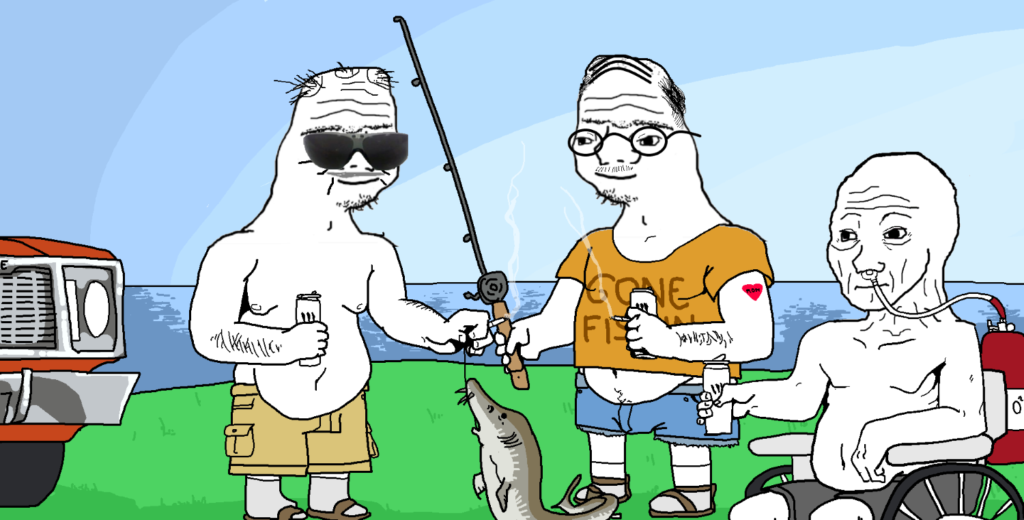
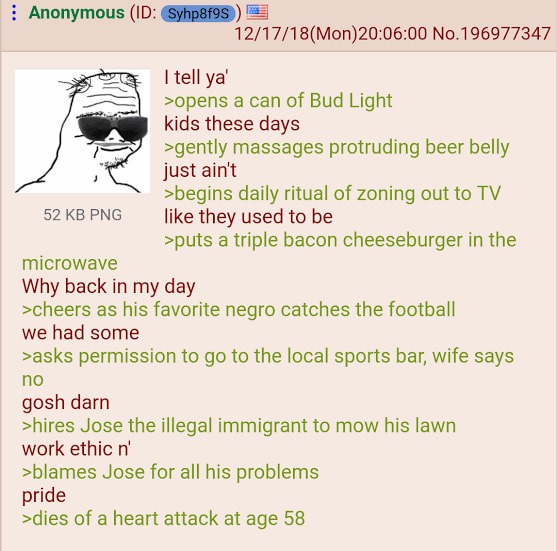
A man on the wrong side of male menopause bears a slack, satisfied grin, a can of Monster energy drink in his hand. Despite a beer belly and signs of pattern baldness, all is well in this man’s world. This is the Boomer, and this essay explains his significance in the Clown World Pantheon.
The term Boomer comes from Baby Boomer. This is a reference to the generation of people who were born immediately after World War II. Because the end of that war resulted in a temporary sharp increase in birth rates, it led to a “Baby Boom” of new children who all had unique generational features in common.
In theory, this means that a Boomer is someone born between 1945 and 1963 or so. In other words, people aged between their mid-50s to their mid-70s. This age group comprises the vast majority of high-ranking political and business decision-makers right now. The vast bulk of the world’s power, wealth and control now lies in the hands of this generation.
The Boomer meme satirises the values and attitudes that are characteristic of Boomers.
Boomers were known from the beginning to be a particularly narcissistic cohort. This was mostly a function of the great deprivations that their parents had endured during World War II and the Great Depression. The parents of the Boomers had resolved to not allow their children to suffer the same traumas they had. So they showered everything on them.
Then, as the Boomers reached young adulthood, the popular culture catered to them on account of their spending power. Music, books and movies were all crafted to appeal to Boomer values. After that, when they reached middle adulthood, the political establishment catered to them on account of their voting power. Party policy was then crafted to appeal to Boomer values.
This has led to a generation of people who genuinely believe that the whole planet revolves around them. They know nothing else than getting their own way, and they feel entitled to demand that this state of affairs should continue. They are so accustomed to luxury that they insist that the whole world work to keep them in it, even if they have to destroy everything about their countries that the following generations could have inherited.
This is the Boomer.
The central idea behind the Boomer meme is that the entire world has been set up for the benefit of this generation and that they, like spoiled children, assume that this is the way it should be and demand that it stays that way (even if following generations have to suffer).
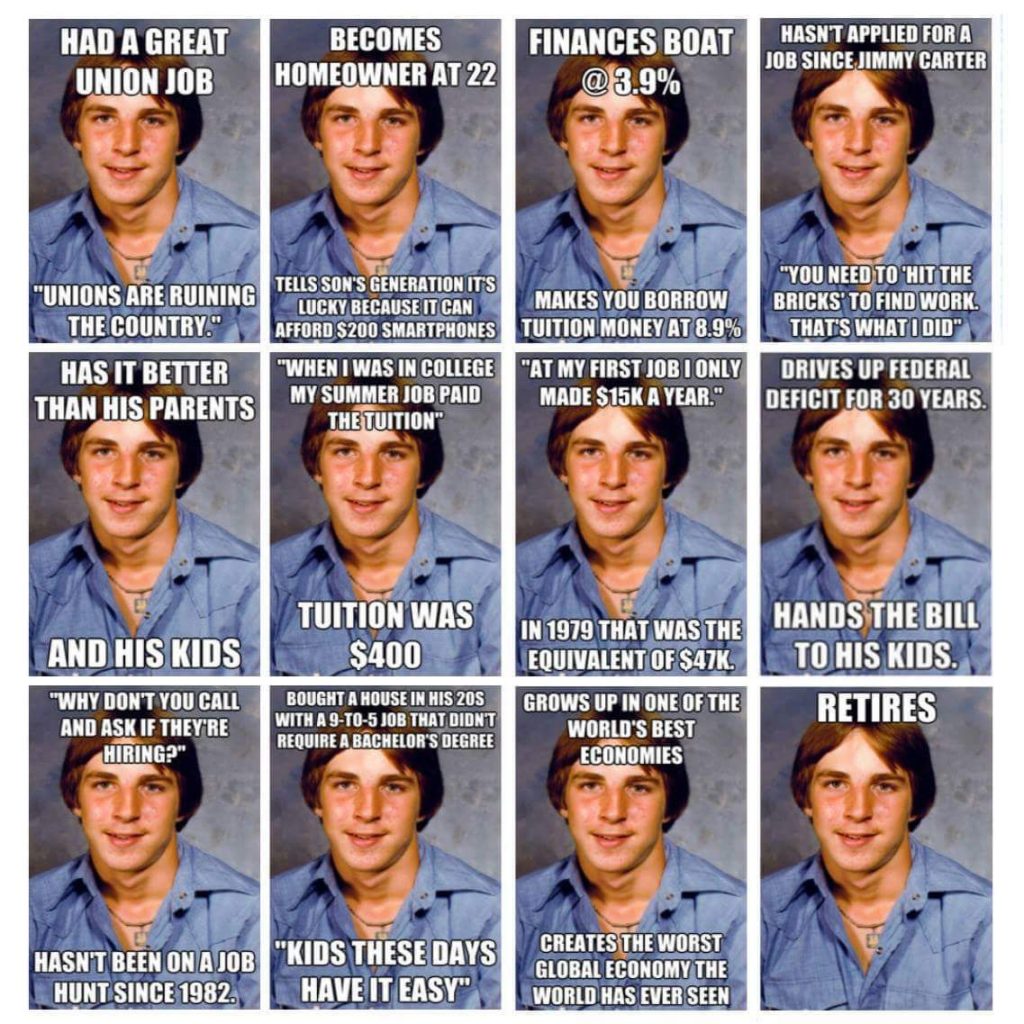
The meme captures the frustration of those following generations, who are suffering under housing and employment markets that are leaving them with no realistic chance of ever being able to own a home, and therefore much less chance of ever raising a family of their own. Amplifying the frustration is the knowledge that young people are labouring long hours not for their own benefit, but to pay for the luxurious retirements of the Boomers.
The Boomer image is a Wojak variant. It’s really just the standard Wojak with a generation of age added on. This makes the Boomer meme a caricature of age, and not of anything else. The idea of the Boomer meme is that almost everyone in that generation thinks much the same way – smug, satisfied, and naturally unwilling to countenance any change to a system that puts their wishes at the very centre.
The meme also captures the frustrations with the Boomers themselves. The generations following the Boomers have discovered that their elders don’t give a fuck, at all, about how hard things are for young people now. It’s now widely understood that the generations following the Boomers have it harder than the Boomers themselves did, marking the first time in centuries that one generation had it harder than the preceding generation.
This is not merely a popular belief: studies have shown that life is objectively much harder now. A study by VJM Publishing showed that young people today have less than half of the house-buying power that their parents’ generation enjoyed. Even worse, the mass importation of cheap labour has destroyed any negotiating leverage those young people may have had.
The Boomers own everything, and they run the world in their interests exclusively.
The phrase “OK Boomer,” epitomises the frustration caused by this state of affairs. It’s the reaction of an exasperated young person to years and years of listening to old people bleat about how hard they worked and how they’re entitled to this or that because of how much they supposedly “paid into the system”.
It’s the younger generations’ response to decades of trying to talk about things like housing availability, the failure of neoliberalism, cannabis law reform and climate change, only to encounter millions of goat-stubborn old bastards who wouldn’t listen if the future of the world depended on it.
It’s regularly said in response to “When I was your age,” because this phrase inevitably precedes a lecture about how the young person just needs to knuckle down and work hard. Boomers, as a rule, completely fail to understand that the nature of work and of society have both changed from when they were young and that many things are much, much harder now in many major ways.
The young adults of today know that there is simply no way to get this information through the thick skulls of the average Boomer. No communication is possible with people that self-centered, ignorant and arrogant. Therefore, all that can be done is to say “OK Boomer,” as one would dismiss any other senile old fool who ought to be put out to pasture, and wait for the chance to lever their fingers from the rings of power.
The Boomer occupies a central role in the Clown World Pantheon, as he is effectively Wojak’s Dad. This means that it’s the Boomer’s personal failings that have set the scene for Wojak to become the way he is. The Boomer figure is the archetype of irresponsibility and selfish indifference to the long-term wellbeing of society. All this serves to make the Boomer cut a Zeus-like figure in Clown World.
*
This article is an excerpt from Clown World Chronicles, a book about the insanity of life in the post-Industrial West. This is being compiled by Vince McLeod for an expected release in the middle of 2020.
A simply-drawn MS Paint image of an expressionless man is one of the commonest memes seen today. Some know him as Feels Guy, but to most Internet denizens he is called Wojak. As this essay will show, Wojak and his many incarnations are a core part of the Clown World pantheon.
To many who see him for the first time, there is nothing special at all about Wojak. He is simply a generic-looking white face with a blank expression. Neither is he drawn with any great finesse – he is merely an MS Paint depection of a young adult male. This, however, is his great power. Wojak represents the common human spirit that is shared by all of us.
Wojak bears the brunt of the cruelties of Clown World. This is shown in his manifestation as Feels Man. As Feels Man, Wojak is the face that expresses the disappointment and crushing sadness that follows coming to terms with the reality of living in a Clown World. He is the expression of all kinds of sadness, disappointment and despair.
A common portrayal of Wojak is from behind as he stares out across an ocean towards a setting Sun. This meme speaks to the sense that one’s naivety has come to an end. As the Sun sets and leaves Wojak on the beach, so too do our conceptions of an ideal world disappear, leaving us in Clown World with all its insanity.
Another common portrayal of Wojak is as the Doomer (this concept is elaborated upon in another chapter). The Doomer is a man who has been worn down to near breaking point by the insanity of Clown World. He cannot see anything getting better – doom lurks just beyond every horizon. He is strung out, with bags under his eyes, stubble under his chin and a cigarette butt in his mouth.
Yet another is the Coomer (also elaborated upon elsewhere). The Coomer is a man who has become hopelessly addicted to pornography, to the point where he lives for nothing else. This incarnation of Wojak represents the potential sex addict inside each of us, and serves as a warning.
So Wojak, much like Pepe, represents another kind of everyman. Perhaps the essential difference is that Pepe is the masculine form, whereas Wojak is the feminine form. Whereas Pepe feels disgruntlement leading to rage, Wojak feels sorrow leading to despair.
Fundamentally, though, Wojak’s place in the Clown World pantheon is as a representative of the youthful idealism that is lost when a person realises that they live in Clown World. It’s natural to grow up thinking that one lives in a world of reason, where science and evidence weigh heavily. The realisation that only power matters and that logic is meaningless comes as a spiritual shock to many.
For those who have been through it, however (and most have), this spiritual shock is highly relatable. This relatability is the reason for the success of the Wojak meme and its descendants – the ubiquitous nature of Wojak means that he can serve as a kind of template upon which other memes are based.
NPC Wojak is a variant of the original that satirises the unthinking nature of the average pleb. NPC Wojak is similar to the original, only with a grey face and simplified features. The commonest meme to feature the NPC Wojak is a multipanel comic where he is presented with some inane political fact and becomes enraged – a satirisation of how the average NPC out there has no consciousness and simply responds to stimuli like any invertebrate would.
Brainlet Wojak is another common variant. This one involves the regular Wojak but with a variety of cranial deformities so that his brain is clearly much smaller than that of a normal person. The implication, of course, being that the idea associated with the Brainlet Wojak image is a stupid one.
There is also a female version of Wojak, identical to the male original but with long, coppery hair. This version is most commonly seen incarnated as Tradfem Wojak, wearing a flowery blue dress. In this incarnation she also represents a lost promise, in this case the promise of a loyal wife who was interested in raising a family – something that Clown World has made impossible.
Wojak and the various forms that he appears in could be described as an ur-meme and its memetic offspring. Wojak represents the grim, inescapable awareness that the world is really much, much worse that what it promised to be. His feels are our feels; his loss of innocence is ours too. Wojak represents the everyday citizen of Clown World: lost, confused, dismayed.
*
This article is an excerpt from Clown World Chronicles, a book being compiled by Vince McLeod for an expected release in the middle of 2020.
If you would like to support our work in other ways, please consider subscribing to our SubscribeStar fund.