Psychologist Erik Erikson is best known for his theory on psychosocial development, which outlines the various stages of development and highlights their key characteristics and associated conflicts. However, another area that Erikson extensively researched was early childhood trauma and its effects on healthy psychological development.
Early childhood trauma refers to any adverse event or experience that a child experiences before the age of six. This can include various forms of abuse, neglect, loss of a loved one, violence and other experiences that can negatively impact a child’s healthy psychological development. Erikson was keen to address the effects of such trauma on child development, noting how they can affect an individual’s psychological makeup well into adulthood.
One of the key areas of early childhood development that Erikson focused on was the development of trust versus mistrust. According to Erikson, children pass through this stage within the first 18 months of their life, and its central conflict is between trust and mistrust. In this stage, children require consistent care and affection from their primary caregivers to develop a sense of trust in the world around them. Parents and caretakers play a crucial role in shaping the child’s perception of the world through their daily interactions and responses to the child’s needs. If these needs are not met due to early childhood trauma, mistrust may develop, leading to further psychological problems later on in life.
Erikson also emphasized the importance of a child’s autonomy during the second stage of psychosocial development, which occurs between the ages of two to three years. This stage is marked by toddlers’ assertion of their autonomy as they seek to assert control over their immediate environment. Children who experience early childhood trauma may find it challenging to develop a sense of self-trust and autonomy, leading to lower self-esteem, anxiety and feelings of inadequacy that can be long-lasting.
Early childhood trauma can also have profound effects on a child’s social and emotional development, affecting their ability to form secure relationships and attach healthily to others. Erikson posited that children pass through the stage of intimacy versus isolation during young adulthood, where they seek to develop genuine connectedness with others. However, individuals who lack a sense of trust and self-autonomy may find it difficult to establish such connections, leading to social isolation and feelings of disconnect.
Erikson was also concerned about the effects of early childhood trauma on academic achievement, given its critical role in shaping later-life outcomes. He argued that children exposed to traumatic experiences may develop cognitive and behavioural difficulties that can hinder their academic progress. Such difficulties can have long-lasting effects on their future career prospects, social mobility and overall well-being.
One of the most severe consequences of early childhood trauma is the risk of developing mental health issues such as anxiety or depression. This is because such experiences can leave a lasting impression on a child’s psyche, leading to unresolved emotional conflicts and feelings of vulnerability. The effects of childhood trauma can manifest in adulthood, leading to the development of low self-esteem, trust issues, difficulty forming relationships, and a host of other psychological difficulties.
Erikson was keen to emphasise the role of caregivers and parents in providing support and guidance to children exposed to early childhood trauma. Through supportive care, counseling and therapy, individuals can better work through such traumas and minimise their impact on their psychological development.
In conclusion, Erikson extensively researched the effects of early childhood trauma on healthy psychological development, noting how it can negatively impact a child’s perception of the world and their place in it. From issues of trust versus mistrust, autonomy, academic achievement, and social-emotional development, early childhood experiences profoundly shape later life outcomes.
Caregivers and parents play a crucial role in providing support and guidance to children experiencing traumatic events, which can minimise the impact of such events on their psychological well-being. Erikson’s work reminds us of the importance of a supportive and nurturing environment for children to develop healthy psychological development and highlights the long-lasting consequences of early childhood trauma.
This article is about how to engage pain appearing at a physical or emotional level. Fortunately, the process is much the same. I will maintain a focus on the inside view of pain, and what we can do about it. I would ask that the reader at least temporarily suspend their beliefs and views about anything theoretical regarding what pain is or where it comes from. It can be easy to rationalise or intellectualise our suffering, and in so doing, we can miss the opportunity to simply meet it on its own terms.
I have had a lot of experience with pain, mostly the emotional variety. I have never broken bones, but I have been through overwhelming grief and trauma. I have found this to be one of the most oppressive forms of pain. Since physical pain can often have a sense of being implacable once we see it is not moving anywhere, we can come to accept it to a certain degree.
Mental or emotional pain is different in that it can be very difficult to accept. We often feel very strongly that it simply shouldn’t be there, or that if we could only just think the right thought or occupy the right philosophical perspective then it could be cast out like a phantom, banished with a perfectly recited magic spell.
I have found that this kind of ongoing vacillation in non-physical suffering is precisely what keeps me tethered to it. It is not only the view that perhaps it should not be happening, that things ought to have developed differently in my life, but also the desperate hope that there may be some kind of salvation by way of a previously unconsidered solution.
We do everything we can think of to try to manage or subdue mental and emotional pain. One person’s meditation practice may be used in the same way that another person uses alcohol. In this case, are the means of escape necessarily better or worse, from an inner perspective? In frustration, we beg to be relieved or numbed in any way possible. I have watched myself go through these cycles of torment many thousands of times, frequently tempting me to at least consider taking the most extreme of measures.
However, I continue to have faith in the value – not of pain, not even of endurance or stoicism – but of our innate capacity to simply wakefully meet what is actually here. I don’t just mean here with me, but also the ‘here’ which you are assigned to experience indefinitely. I would contend that nothing is as important as where you are, here and now. This moment offers every tool for meeting that which it contains. Allow me to unpack this a little further.
We have a bevy of helpful perspectives, and many of them may be quite true, such as ‘pain is temporary’, or ‘we are more than just this form or our experiences’. Relatively true though these things may be, we must examine what the immediate value of such a position is relative to our immediate experience of pain.
Are we employing our confidence in the truth these things point to in order to make what appears here and now seem more bearable, for hopes of a brighter future?
As a seasoned sufferer, I have discovered that the most meaningful invitation in all of this is the invitation to simply stop and stand back. This includes weighing up whether you are a victim, whether there is justice in your suffering, and whether anything will ever get better or worse. I would like people to really take a look for themselves at how all of the psychological methods we have at our disposal for negotiating with this pain are actually ingeniously devised to draw our attention away from experiencing what is present to us emotionally here and now.
This can be a sobering discovery. I have watched myself and others suffer for a very long time, with an intensely keen interest in how and why we experience such pain. I had not learned a single thing of value until I stopped running from this pain it and met it where it sat within me, on its own terms. Easier said than done, to be sure, but here is what I have learned about the process this far.
Every instance of pain has an inside and an outside, and at least a potential narrative attached to it. If it doesn’t have one, the mind is extremely quick in manufacturing one. So, we have a story attached, often an angry story, or maybe a melancholic ‘woe is me’ tale. I don’t want to talk about whether the story is true, but what I do want to address is the simple fact that the application of the story is significant. This application is dysfunctional whether the story being told has a basis in fact or not – it is false in its foundational assumption.
The effect of this is to upgrade pain to what we call suffering. This is sustained pain in its unexamined and therefore potentiated form. The story allows it to breath like a fire, drawing in more oxygen making itself larger and more powerful.
All life must involve some degree of pain, but we have a massive influence over the degree to which pain becomes suffering. If you allow the pain to filter through your mind, it seems as if your entire field, your ‘am-ness’, your Self, is flooded with pain. Everything in the value of being in this moment is then hidden from view, occluded like a total lunar eclipse.
So, you do not allow it to filter through the mind. Instead, you occupy the witness state.
The story isn’t always easy to drop. What I would recommend you focus upon, again, based on my own experience, is not trying to drop the story. This effort can result in very little headway, and tends to also accompany frustration and self-punitive thoughts. Rather, direct your effort of attention to understanding the story.
By understanding, I also mean seeing through the story. To understand it means to step back and see where your pain fits in. Illusion is always transparent from some angle; it is usually just a case of rotating the object of our attention enough to get a clear view of its insubstantial nature. Why is this human pain there, what are the conditions of it? Do other people also have it? For what reasons? What was misunderstood?
So, I put it that it is critical to understand, not to renounce or revoke. You will not progress by renouncing or avoiding your feelings, no matter how upset you are, and no matter how justified or unjustified you think those feelings are. We are so used to meeting things we don’t want in the world with push-back – what happens inside us has a totally different dynamic that you will begin to see after a while if you spend enough time in there. Resistance will trap you, but acceptance and understanding will free you.
I will give an example of how a story can be sustained by ignorance and then challenged through inquiry. Remember that this story, being a narrative as accompanying the pain, while not necessarily causing the entirety of the pain, is what nonetheless promotes and sustains it, thereby elevating the pain to the status of suffering.
Here is an important inquiry rule which i have found indispensable. If there is suffering within you, then there is always something false that has been invested with your belief. In my thousands of hours of self-inquiry, this rule has proven true. I invite you to test this for yourself. The discovery, if you happen upon it, will possibly spark an inner revolution, but this cannot have value as a second-hand insight, you really need to see it for yourself in order for it to yield any effect. This gives you an important method for distinguishing pain from suffering and truth from falsehood.
I will provide some examples.
Say you value a relationship, and that relationship ends for whatever reason. There will in most instances be some form of pain, to a greater or lesser degree. Suffering may take root in a pronounced way when stories about this break-up begin to play in repeat. Common examples of the kinds of thoughts you may find yourself investing and believing in: I was not good enough to love. I was not worthy. No one will ever love me. I am a failure. I am not worthy of love from anyone else. I am ugly.
These can go on as far as the imagination will allow.
This tendency to problematise our pain must be present very early on. I remember being a child and doing this myself from as soon as I was capable of thought. I remember having arguments with my parents and wanting the pain to escalate into bittersweet suffering. Although it was completely uncalled for and totally unnecessary, I would take simple situations of not being permitted to do something, and then berating my mother with accusations such as “You wish you had an abortion”, “You wish you never had me”, and “You wish you gave me away for adoption”.
It is relatively easy to see as an adult how immature and baseless these reactive forms of lashing out are. It is a far more demanding task to see how the very same energies behind those immature reactions have insinuated themselves into our long-term thoughts and behaviours. The same energy feeds various manifestations of spite, resentment and acts of microaggression. In my adult life, I found that same energy translated into throttling my emotional availability to people based on whether I was in a good mood, or whether they were acceptable to me based on their looks, their behaviour, attitude towards me or what they could do for me. This is no way to live.
I didn’t know it at the time of childhood, because it was shrouded in darkness, but what I was really doing in this exercise was worshipping pain in order to allow it to become suffering, like someone thirsty for destruction throwing petrol onto a fire. It was of course completely unnecessary, because if I had known the fundamentals of experiencing human energy, I could have simply dealt with the pain of having my wants and desires thwarted without complicating the process and creating further turmoil for my family.
Where it becomes suffering, at least psychologically, I have discovered that it always relates to what is illusory, that which is false. What is false can always be subjected to the scrutiny of self-inquiry. In my childhood, I didn’t need to go to war with my ignorance and my false belief. If anything, I needed to see through the falsity of my claims, to make the falsehood transparent before my psyche. That would have resulted in understanding, and therefore relief of suffering.
I had no discipline at this stage of life, of course, but even so, occasionally there would be merciful spontaneous insights that resulted in the occasional relief of suffering. The availability of the promise of wisdom was never far away, even when all seemed encompassed in a pall of darkness.
These lessons of childhood are repeated for us in many similar ways in our adult lives with all of our relationships. I expected to grow into an adult one day and magically become a functional human being, but this isn’t how it works, as anyone with an interior life will have discovered for themselves. It usually takes a will, directed attention and a desire to understand our encounters that leads to wisdom.
It is possible to face the same situations over and over and react in precisely the same dysfunctional way indefinitely. This would lead to misery, because the failure to embrace understanding and wisdom is therefore, by the same movement, the welcoming of illusion and falsehood and therefore suffering.
As a child, in my situation, ideally, I could have applied a simple measure of self-inquiry in the following manner: why is it so important that I always get what I think I want? Does that rest on some universal truth, or is it something about my mind that is making demands of the world? Who else should be in pain because I do not get what I want? These are always relevant questions.
If we look again at the situation in which a person may have experienced grief from a relationship break up, the very same sobering questions can lead to understanding, even if it is only seeing how were stuck in the same patterns that repeat over and over. Remember, it is always falsehood that leads us to believe anything that causes us undue psychological torment. You will see this is if you look close enough. Bringing the power of this inquiry to bear is then like a healing balm to our pain.
For example, instead of berating myself for how dysfunctional or ugly or unworthy I am that may have led me to being abandoned by a partner, I could ask the following questions honestly of myself: under what conditions would I leave a partner? Does that mean that this other person is never capable of change? Does it mean that just because I have my own reasons for leaving them that they are inherently unlovable, unworthy, or permanently incapable of change? What is the part of me that needs to be loved or approved of by another in order to feel loved and worthy? If I really messed things up and I am indeed personally responsible, is there any universal law that forbids me from not only learning from my mistakes, but forgiving myself for the pain I caused myself and others? Was my love for that person the one thing that gave them value, or is there something else of value in them? So what about me?
There are many other forms of inquiry possible, but these are simply a few that strike at the heart of how and why suffering may be experienced, and introducing a sense of calm, honest objectivity to what can very often be emotionally reactive, volatile and subjective. This is impossible without your will. As we know, you can lead a horse to water, but you cannot make him drink. The wisest teachers in all of history can do nothing for a person who does not have the will to look for themselves.
When you are experiencing pain, as we all do, it is important to remember that we do not need to banish the pain. We do not need to get rid of our feelings, however painful they happen to be in the moment. What does benefit us is the wisdom inquiry brings. The expectation that our spiritual practice will banish our pain I have found to not be a reasonable or mature expectation. Oddly enough, we don’t even need to arrive at answers most of the time. Often simply asking the pertinent questions can be enough to bring a sober sense of wakefulness to a pattern of reactivity or entrenched self-involvement.
*
Simon P Murphy is a Nelson-based esotericist and philosopher, and author of His Master’s Wretched Organ, an astonishing and surreal collection of weird fiction stories.
Christianity, being one of the world’s largest and most widespread religions, has also played a significant role in causing Religious Trauma Syndrome. The ways in which Christianity can cause Religious Trauma Syndrome are vast and vary widely depending on the denomination and intensity of the beliefs in question.
One of the ways in which Christianity causes Religious Trauma Syndrome is through the belief in original sin, the idea that all humans are born with sin because of Adam and Eve’s disobedience in the Garden of Eden. Children are taught from a young age that they are inherently sinful and that needs to be ‘saved’ through faith in Jesus Christ.
This teaching creates an intense amount of guilt and shame within the individual, as they feel that they have done something wrong even when they have not committed any particular act. Believing that humans are inherently flawed can lead to self-loathing and negative self-talk, which can have long-lasting effects on an individual’s mental health.
Another way in which Christianity may lead to Religious Trauma Syndrome is through the concept of hell. Many Christians believe in a very literal hell, a place of eternal punishment for those who live a life of sin or do not believe in Jesus Christ. The idea of a literal hell can cause immense anxiety and fear in an individual, especially when coupled with the belief in original sin.
The fear of going to hell, not only for themselves but also for their loved ones, can cause significant psychological damage and can result in individuals living their lives in constant fear and worry about death and the afterlife.
Furthermore, Christian teachings around sex and sexuality can often cause immense harm to individuals who subscribe to them. Many denominations teach that sex is reserved for marriage, and anything outside of that context is considered sinful.
In addition, many denominations hold strict gender roles and homophobia, teaching that individuals should adhere to binary gender roles, and that same-sex relationships are morally wrong. The shaming and ostracising of individuals who explore sexual possibilities can cause deep emotional and psychological trauma, leading to feelings of self-hatred, worthlessness, and isolation.
Finally, the concept of spiritual warfare is another aspect of Christianity that can cause Religious Trauma Syndrome. Many Christians believe in a literal devil that actively seeks to deceive and ensnare individuals into sin. Actions that can be deemed as following the devil’s path range from anything from watching certain movies to exploring other religions.
Believing that spiritual warfare exists can lead to a constant state of fear and anxiety, with people struggling to feel safe in the world around them. Individuals can become paranoid about every situation in which they find themselves, never sure if they are following the right path.
In conclusion, Religious Trauma Syndrome is a real and important phenomenon that can have long-lasting effects on an individual’s mental health. Christianity, and the ways in which it is often taught, can play a significant role in causing Religious Trauma Syndrome in individuals who have had these beliefs forced on them.
Today we look at the aptly named Disinformation Project’s latest hit piece. The Disinformation Project, which can be accurately considered Establishment media, serves the same purpose as the other Establishment media: to set the bounds of acceptable discussion, and to smear the enemies of the ruling class. To that end, they run hit pieces on those enemies.
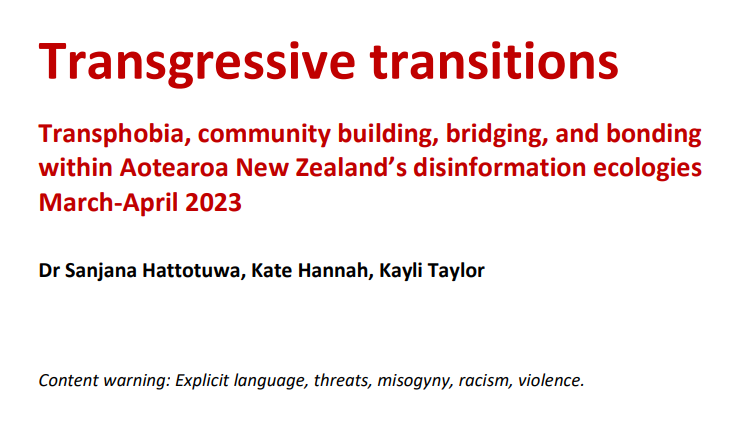
This time, the target was the “disinformation ecology” surrounding Posie Parker’s recent visit to Auckland. This analysis will explain how The Disinformation Project, spearheaded by admitted Marxist Kate Hannah, uses such terms to smear the reputations of those who dare criticise the Labour Government.
This report begins with the cringe-inducingly self-righteous declaration that The Disinformation Project has a legitimate interest in “observing, collating, categorising, and analysing open source publicly available data related to Covid-19 mis- and disinformation.” It’s like having a Ministry of Truth, but limited to the question of Covid-19.
Apparently, those who dissented from the Government’s Covid-19 narrative have now incorporated “more features of international far-right talking points – immigration, reproductive rights, LGBTQIA+ (and particularly trans rights), globalisation, nativism, loss of hegemony – alongside other, localised conspiratorial frames encompassing 1080 drops to co-governance.”
“Conspiratorialism” is a particular concern of theirs, for reasons not given. It’s just a way of smearing anyone who distrusts the Government as an unreasonably paranoid person. Andrew Little is fond of using the term “conspiracy theorist” to sully the reputation of anyone who thinks the Sixth Labour Government is lying about anything, and The Disinformation Project seems to have taken his lead.
In reality, anyone who doesn’t believe that any conspiracies are happening is stupid. Almost every historical event is preceded by multiple conspiracies. The settlement of New Zealand involved one conspiracy after another. Every war is conspiracy and counter-conspiracy until one side wins. The smarter someone is, the more conspiratorial they will be.
‘Transgressive transitions’ cites the theory of American social scientist Robert Putnam, but its authors don’t appear to be familiar with Putnam’s work as a whole. Putnam’s most cited work is titled ‘E Pluribus Unum‘, in which he established that “immigration and ethnic diversity tend to reduce social solidarity and social capital”. This was one of the first studies to demonstrate a statistically significant negative correlation between ethnic diversity and social trust.
Unfortunately for The Disinformation Project, the contention that ethnic diversity reduces social capital has been backed up by a meta-analysis of the science since Putnam’s article was written. So they find themselves mischaracterising concerns about immigration as an “international far-right talking point”, when such concerns are, in fact, backed up by mainstream science.
The Disinformation Project themselves spread disinformation – about nationalists, among others.
This report is notable for its obsessive belief in a “disinformation community”, which amounts to the same thing as their collective ideological enemies. These disinformation communities are primarily online spaces where people question the mainstream narrative. As Orwell put it: wrongthinkers.
Already by page 4 the authoritarian sentiments of the report’s authors are evident, as they rant about “dangerous speech”. Anti-free speech rhetoric is common among the authoritarian left – it was, after all, leftists who got Clown World Chronicles banned from TradeMe. The authoritarian left in New Zealand, as in the Soviet Union, correctly perceives free speech as a major threat to their attempts at narrative control.
Also by page 4 the authors manage to make clowns of themselves, linking anti-Covid sentiment to anti-Maori sentiment. Apparently they were not aware that some 30-40% of the Parliament Lawn protesters at any one time were Maori. Neither were they aware that Maori mothers, understandably concerned about the effects of an improperly tested vaccine on their children, have been one of the core dissident groups from the beginning.
Grandly, The Disinformation Project declares that it “now studies a diverse and dynamic disinformation ecosystem preoccupied with multiple and shifting ideological concerns” – i.e. the Deplorables, the bottom feeders, the Nazis. Anyone who questions the Government is now part of a disinformation ecosystem. The Disinformation Project – in their minds – are heroes fighting these trends on behalf of social cohesion.
The anti-white sentiments of the globalist leftist authors of this report are revealed when they make a determined effort to defend Marama Davidson for her racially abusive outburst to CounterSpin Media during the Posie Parker protests. They link to a propaganda piece from Establishment Left mouthpiece Radio New Zealand which defends Davidson and smears CounterSpin as “far-right”.
The authoritarian sentiments of the report’s authors are further revealed with their rant about Elon Musk that takes up most of page 7. This rant concludes with an accusation that Musk is guilty of “amplification of racism, and other harms” by engaging with accounts that promote, among other things, “disinformation”.
On page 8, this report claims that its observations are backed up by research from the Center for Countering Digital Hate. However, it has been noted elsewhere that the Center for Countering Digital Hate is a British Labour Party mouthpiece, with several of its high-ranking administrators also taking roles in the British Labour Party.
On page 9 the report’s authors further underline their authoritarian credentials by complaining that TeleGram is “unregulated”. Apparently the free speech approach of TeleGram has resulted in “a significant and immediate increase in the use of dangerous speech”. To the authoritarian left, it’s dangerous when people who are unregulated by the government presume to speak.
A multinational effort is being made to pressure TeleGram into banning political dissidents. Since 2021, some German politicians have demanded that TeleGram be banned if they do not submit to government censorship regarding permissible content matter. British political figures also spoke out against the platform. The anti-TeleGram rhetoric in The Disinformation Project’s report is just other example of this globalist anti-free speech trend.
The report then spends several pages crying about neo-Nazis. Again, we are left wondering if they are still talking about the same people as in the Parliament Lawn protests. The 30-40% Maori contingent were presumably not neo-Nazis, and neither were all the old hippie women who comprised at least another 25% of the protesters. So who are all these neo-Nazis? It’s never made clear. It’s just suggested that anyone anti-Establishment is a Nazi.
From there, the report spends a few pages complaining about dehumanising language – but there are few tropes more dehumanising that the one claiming that nationalism is inherently a philosophy of exclusion, and that anyone speaking for nationalism must be in favour of gas chambers full of Jews. This trope, typically pushed by the globalist authoritarian left, has had the effect of demonising and dehumanising all nationalists, as if to prefer one’s own kind was the preserve of bloodthirsty beasts.
Speaking of language, the language used in this report is usually of the bloated and pompous kind used by academics with little real-world experience. An example is the phrase “instrumentalization of stickers” where “use of stickers” would have conveyed the same information more efficiently.
It’s not obvious what purpose is served by complaining about sticker packs on TeleGram, as this report does at length. One suspects that The Disinformation Project is following the lead of America’s Anti-Defamation League, which catalogues every aspect of the online expression of people they hate and then links it somehow to far-right-wing extremism.
This is known elsewhere as the Censorship Industrial Complex. A similar concept to globohomo, the Censorship Industrial Complex refers to the alliance of Marxists and corporate whores who work together to silence true dissidents or freethinkers. The Disinformation Project is part of this complex, and their work (including this report) involves gaining support for the cancellation of their enemies.
Speaking the truth is now dangerous speech if it doesn’t suit The Agenda.
The report then spends several pages crying about GIFs and other memes, and how the spread of such memes can “formulate a norm-setting exercise”. Apparently there is such a thing called the “‘for the lulz’ tactic” and this is nefariously used to advance extremist ends. In the New New Zealand, a sense of humour is grounds for suspicion of wrongthink.
The Disinformation Project monitors 126 FaceBook pages “associated with disinformation narrative production and promotion”. These are contrasted with 84 mainstream media pages, which presumably never produce or promote falsehoods. This shameless cheerleading for the mainstream media further reveals The Disinformation Project’s pro-Establishment bias.
Apparently the Posie Parker visit and protests caused a remarkable uptick in the volume of “hate speech” directed against minorities and other vulnerable groups in New Zealand cyberspace. Hence The Disinformation’s Project’s concern. Christian lobbyists appear to have been particularly incensed at the time of the Parker visit.
The report goes on to state that questioning the validity of trans people is tantamount to “genocidality”. This further reveals authoritarian intent – ‘do what I tell you, else you’re a Nazi’.
On page 26, the authors start complaining about freethinkers on InstaGram. They discovered that “mis- and disinformation accounts studied on Instagram received higher engagement than accounts from mainstream media”, which is another way of saying that alternative media is more honest than the mainstream, and that this honesty drives the higher engagement.
Apparently there is a connection between the Parliament Lawn protesters and the pro-Parker protesters. This is cause for another neologism – “disinformation superspreaders”. This is a new term for high-ranking members of the alternative media who the Establishment would like to silence. The true connection between the Parliament Lawn protest and the Parker protest was that, in both cases, the Government lied about what was really going on. Hence, people flooded to the alternative media on both occasions.
To understand this is to understand the purpose of The Disinformation Project and even the mainstream media itself: to silence dissenters.
On page 29, the authors lament that “disinformation ecologies” are winning the battle for the public’s trust. At no point do they consider the obvious explanation for this: that the alternative media tells fewer lies. Moreover, much of the distrust of the mainstream media comes from their unwillingness to cover certain issues – issues that the alternative media has no problem covering.
Propaganda techniques that can be seen every day in the establishment media, such as “rage-baiting, performative outrage, emotional contagions, inflammatory presentations, aggrieved frames, and dangerous speech” are now “disinformation narrative techniques”, and we are asked to believe that only the alternative media performs them. To suggest that the establishment media does the same thing is to wrongthink.
The authors note on page 34 that the alternative media is not subject to the same decline of trust as the mainstream media. This is because the mainstream media does just as much rage-baiting, performative outrage and inflammatory presentation as the alternative media, if not more. People are no longer as gullible as in the 1950s, and have realised that media authorities are not moral authorities.
With a lack of irony befitting of the NKVD, the report goes on to complain of the “significant and growing implications for democracy and social cohesion” of people no longer trusting the mainstream media. What the authors of this report want is restrictions on the alternative media. But there wouldn’t even be an alternative media if the mainstream one didn’t tell lies and omit truths to suit the interests of their globalist owners.
The report repeats a delusion that is common among the New Zealand Left: that anti-Government, anti-authority or anti-the current thing sentiments are imported from America. They aren’t, and they don’t need to be. We’ve been part of the same global system as America for over 200 years. Anti-trans sentiments are growing because pro-trans sentiments are being pushed on people by globalists who intend to demoralise their subject populations.
On page 34, the report makes an obvious point: “It is possible that disinformation news, media, and information ecologies benefit from declining interest in mainstream journalism”. This is certainly true, but only if you replace “disinformation news, media and information ecologies” with ‘the alternative media’. If the mainstream anything goes bad – not just media – people will look for alternatives. The blame does not fall on the alternatives for providing a better product.
In the Conclusion section, this report rehashes Hillary Clinton’s long-debunked conspiracy theory that Russian propagandists are shaping the anti-Establishment sentiment in the West. Hilariously, it also warns of a “collective narcissism” among New Zealand’s alternative media, as if the camera-obsessed Hannah and Hattotuwa were any better.
The rest of the conclusion is spent in breathless hysteria trying to link all the anti-Establishment ideologies into one uber-conspiracy. Apparently “explicitly far-right content” has embedded itself in New Zealand cyberspace, and we have to stop it because it’s a threat to national security, as well as being a threat to social cohesion.
Ultimately, what The Disinformation Project is trying to do with this report is to build support for the banning or heavy restriction of all alternative narratives. To that end they demonise the alternative media, equating them with Nazis or other hated groups, in order to justify cancelling them. It’s shameless propagandising and disinformation-spreading, but that’s how the political establishment wages war against its domestic enemies today.