Apologising For Anti-Gay Oppression Means Nothing If The Government Still Oppresses

Thirty years after the New Zealand Government stopped violating the rights of Kiwi homosexuals, New Zealand politicians have finally worked up the courage to crawl out of their holes and apologise – but are they sincere?

The House of Representatives today took the extraordinary measure of apologising to Kiwis with historical criminal convictions for engaging in homosexual activity. The move was broadly welcomed, the general attitude suggesting that putting someone in a cage for an act that harmed no-one was, in hindsight, wrong.

Let’s be honest. What the New Zealand Government did to gay people wasn’t just wrong – it was a human rights abuse.

The reason why it qualifies as a human rights abuse is that humans have the inherent, inviolable right to do whatever they like as long as it doesn’t harm anyone else.

Engaging in consensual homosexual activity did not harm anyone else, therefore it wasn’t a crime. Therefore, putting gay people in cages for doing it was a human rights abuse.

After some decades of pressure from reasonable people, the New Zealand Parliament appears to have finally accepted this logic and apologised.

But the truly obscene thing about this whole affair isn’t men sticking their cocks up each other’s arses.

The truly obscene thing is how our current crop of gutless politicians, safely separated by thirty years of history, happily stick the boot into their forebears of a previous generation, while paying no mind to the fact that they are still oppressing cannabis users with the same total absence of justification as they once oppressed homosexuals.

So how can we take the Government’s apology for violating the human rights of homosexuals seriously when it continues to do exactly the same thing to cannabis users?

Marama Davidson, who never misses an opportunity to shamelessly grandstand, spoke in Parliament today about the deaths caused by the anti-homosexual prejudice engendered by the law criminalising homosexual activity.

But regarding the fact that prejudice and discrimination against medicinal cannabis users is still taking lives today, she (like everyone in Parliament apart from Julie Anne Genter) remains completely silent.

The cowards in Parliament won’t be making apologetic speeches about the damage caused by cannabis prohibition for another thirty years, not until most of the current lot are dead.

Grant Robertson stood up in Parliament today and said, on the subject of homosexuality being illegal, that “the arrests, the imprisonments and the fear of that happening did not just ruin lives and destroy potential – it killed people. Hundreds, possibly thousands of lives have been lost because men could not bear the shame, the stigma, and the hurt caused by this Parliament.”

Exactly the same words could be said about cannabis prohibition – but our politicians lack the courage to say them.

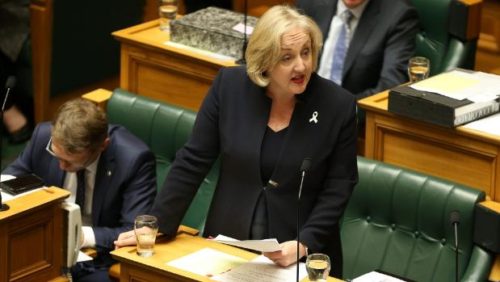
Justice Minister Amy Adams said “this apology is a symbolic but important act that we hope will help address the harm and right this historic wrong.”

If the New Zealand House of Representatives is serious about being apologetic for violating the human rights of Kiwi homosexuals, why are they continuing to violate the human rights of Kiwi medicinal cannabis users?

The prejudice against cannabis users – one that is enforced by the New Zealand Parliament to this very day – has taken ten times as many lives as the law against homosexuality and continues to take them.

Until the current Parliament takes the general issue of human rights seriously – not just rights for favoured, fashionable minorities – this apology can be dismissed as an exhibition of crocodile tears.

Understanding New Zealand

The paperback version of the New Zealand Edition of Understanding New Zealand is available from the VJM Publishing TradeMe store for $29.90

The paperback version of the International Edition of Understanding New Zealand is available from Amazon for USD19.99.

The Kindle version of the International Edition of Understanding New Zealand is available from Amazon for AUD11.99.

*

Dan McGlashan’s Understanding New Zealand has now (07 DEC 17) been released as a paperback 2nd Edition to take into account the results of the 2017 General Election.

This brilliant and unprecedented demographic analysis of the full breadth of the people of Aotearoa has been updated to tell you what groups of people voted for which parties in the 2017 General Election, exactly which demographics supported those parties and how strongly.

It will also tell you about the direction and size of trends in voting patterns from 2014.

Compiling the data from the Electorate Profiles index on the New Zealand Parliament website into a correlation matrix, Understanding New Zealand discusses the various interrelations between age, income, sex, education, occupation, industry, ethnicity, religion, tenure of dwelling, how the North Island compares to the South and even tobacco smoking habits.

Over 11,000 correlations were examined in the writing of this book, allowing McGlashan to bring enlightenment to any Kiwi with an interest in sociology, psychology, anthropology or politics.

New Swear Words For A New Digital Age

“I got in trouble for saying the F-word,” goes the common lament of schoolboys across the Anglosphere. Just about everyone understands the quoted sentence – but few realise that it has two different meanings.

For most of the modern history of the English-speaking people “the F-word” meant ‘fuck’. Swear words are usually taboo because of their association with a sacred subject, so it’s not surprising that a culture subjected to the sexual repression of Abrahamism would make a swear word out of the sexual act.

However, we’re no longer in a sexually repressed age. Far from it – arguably no other cultural tradition has ever found within itself the range of sexual expression and alternative identities as the modern West.

In fact, if anything we have swung the other way (no pun intended). Now it’s seen as deeply immoral and aggressive to criticise anyone for any sexual expression, even those undertaken in front of children in broad daylight.

And so, the F-word isn’t ‘fuck’ any more. The F-word is now ‘faggot’.

If you don’t believe this, just try using either word on social media and see what sort of response you get.

People use ‘fuck’ all the time on FaceBook and nothing bad ever happens to them. No-one reports it, no-one cares, and no-one appears to be seriously suggesting that it breaches what community standards FaceBook has.

However, people calling each other ‘faggots’ is strictly discouraged by means of bans – even though the word was barely considered a profanity 15 years ago.

Even better, observe a young person when something undesired happens to them, like stubbing a toe: chances are that they will cry out ‘faggot!’ rather than any variant of ‘fuck’.

They are also much more likely to tease their friends by calling them faggots than by calling them fuckwits or fuckheads. This is now also true of ‘nigger’ and various epithets for Jews, such as ‘kike’ etc.

So any young person trying to be edgy isn’t going to bother saying the old F-word. That’s so passe that even our grandmothers use it without blushing.

The swear words of this century will reflect this century’s social mores – casual sex is in, setting boundaries is out.